Posts Tagged ‘Prayer’

A Heart of Stone

Heart of Stone

Political discourse in America today has become vitriolic — constant lying, name-calling, bickering, accusations and spewing pent up anger. Indeed it has gotten so bad that even the president has joined the fray.  Social media outlets like Twitter, Instagram and Facebook only serve to exacerbate the situation, as they have become bully pulpits for angry politicians and journalists.  It’s gotten to the point where I dread looking at social media or reading/listening to the news, as there is a paucity of objective discussion and reporting everywhere. Personal civility and decorum in America is rapidly declining, particularly in the political realm.  

           Gracious words are a honeycomb, sweet to the soul and healing to the bones.                                           –Proverbs 16:24*

 Words are like bullets—once they’re let fly there’s no taking them back. The Epistle of James calls the tongue “a restless evil, full of deadly poison” (James 3:8).  By using this  strong comparison, James emphasizes that Christians must be mindful of the colossal power of what proceeds from their mouths.  The epistle goes on to note the inconsistency of praising God with one breath and cursing people made in God’s image with the next (vv. 9–10). Words can demean and destroy.

When you have learned to walk in the light of the Lord, bitterness and contention are impossible.”  —Oswald Chambers

This leads me to ask the question, “How radically would America change if suddenly all the politicians who profess to be Christians started behaving like Christ followers, becoming beacons of light in the dark political landscape?”

In January 2017, the New York Times reported that 91 percent of the new Congress identified as Christian.1 The Times went on to say that this figure was only slightly less than the 95 percent reported in 1961. Allmost all US presidents, including President Trump, have been Christians according to Pew Research.2

Christianity isn’t a label or tag; it’s a life, guided by the Holy Spirit, where an individual endeavors to be Christ-like in thoughts, words and deeds.  Inevitably, all Christians transgress and fall short of the glory of God along the way, but striving towards the ultimate goal of Christ-likeness remains a constant.

Restoration and transformation are two recurring themes in the Book of Ezekiel. Restoration is displayed in God saving the people of Israel from bad shepherds, giving them societal safety, reuniting tribes, and God’s children being restored to a right relationship with Him.  God’s ultimate restoration of his people is exemplified by Jesus’ crucifixion and resurrection. 

On the other hand, Ezekiel describes transformation as a personal, spiritual experience. To the ancient Hebrews, the heart was the locus of a person’s being, their mental processes, emotions and personal will. The Miriam Webster Dictionary defines hard-hearted as, “having or showing no kindness or sympathy for other people.”  In the passage from Ezekiel 36 below, evidence of spiritual transformation in God’s children is the softening of their hearts. 

I will give you a new heart and put a new spirit in you; I will remove from you your heart of stone and give you a heart of flesh. And I will put my Spirit in you and move you to follow my decrees and be careful to keep my laws.  —Ezekiel 36:26-27

One of those laws referred to in the Ezekiel passage is, “Love the Lord your God with all your heart and with all your soul and with all your strength. (Deuteronomy 6:5). Jesus quotes this verse in Mark 30:5, after being asked, “What is the greatest commandment?” In the next verse, Mark 30:6, Jesus adds to this, “Love your neighbor as yourself. There is no commandment greater than these.”   

This brings me back to politics.  Christians who also happen to be politicians don’t get a free pass when it comes to loving their neighbors.  Christian politicians contributing to the Capitol Hill vitriol need to take a long look in the mirror and ask themselves whether their actions glorify God. Are they being patient, humble, pure and obedient to God?

In Colossians 3:8, Paul tells us to put away anger, wrath, and malice; instead, he says in verse 12, we must, “…put on tender mercies, kindness, humility, meekness, longsuffering.”  This is the model Christ gave his followers through many examples in his own life; it’s the model all Christians should strive to adhere to in their actions towards believers and nonbelievers alike.

Christian politicians should display a Christ-like heart—Ezekiel’s “heart of flesh.”  Christians behaving like Christ can bring real healing transformation. Around 312 A.D, during the reign of Emperor Constantine, Rome recognized Christianity as a legal religion.   This remarkable feat, going from persecuted underground church to a legal religion, recognized by the Empire, was accomplished not by violent revolution, but through years of adhering to the tenets of the faith while suffering terrible persecution.

It was not political or military power that ultimately convinced Rome to accept Christianity, but the perseverance and faithfulness to Christ’s teachings by the early Christians. The tender mercies, kindness, humility, meekness, and longsuffering displayed by Christians prevailed over Roman cruelty and oppression. American politicians could achieve a lot by following their example.

 Most merciful God, we confess that we have sinned against you in thought, word, and deed, by what we have done, and by what we have left undone. We have not loved you with our whole heart; we have not loved our neighbors as ourselves. We are truly sorry and we humbly repent. For the sake of your Son Jesus Christ, have mercy on us and forgive us; that we may delight in your will, and walk in your ways, to the glory of your Name. Amen.  —from an Anglican Prayer of Confession

 1 https://www.nytimes.com/2017/01/03/us/politics/congress-religion-christians.html

2 https://www.pewresearch.org/fact-tank/2017/01/20/almost-all-presidents-have-been-christians/

* All Bible quotes are taken from the NIV Bible.

 

#SiouxFallsStrong: after the disaster

Tornado - SiouxFallsStrong

Tornado aftermath in Sioux Falls, SD (9/11/2019)

For most Americans 9/11 is an unforgettable date—the anniversary of the horrific terrorist attacks on the Twin Towers of New York’s World Trade Center, and the Pentagon. The residents of Sioux Falls, SD, have a new date to remember—9/10. Just after 11pm on 9/10/2019 a tornado warning was issued by the National Weather Service. Shortly thereafter three tornados touched down in Sioux Falls. They caused extensive destruction of structures, power lines, and trees. Instead of waking up on 9/11 and remembering the terrorist attacks, Sioux Falls awoke to the aftermath of a natural disaster of epic proportions.

For my family it was a good lesson.  After our cell phones began beeping the weather warning, we were too slow taking shelter, choosing instead to gawk at the spectacular storm outside through a patio sliding door. We finally came to our senses when the air rushing around the frames of our very airtight Anderson windows started making a screeching noise and it felt like the glass of the patio door buckled.

Thanks be to God, we only lost a large section of a big birch tree, but were spared damage to our home, despite one of the tornadoes touching down about 200 yards away as the crow flies.  There were also non-tornadic straight-line winds comparable to a Category 2 hurricane recorded. According to meteorologist Jeff Haby (www.theweatherprediction.com), “Straight-line wind is wind that comes out of a thunderstorm. If these winds meet or exceed 58 miles per hours then the storm is classified as severe by the National Weather Service. These winds are produced by the downward momentum in the downdraft region of a thunderstorm.” 

For in the day of trouble he will keep me safe in his dwelling; he will hide me in the shelter of his sacred tent and set me high upon a rock.  –Palm 27:5 (NIV).

The straight-line winds alone were bad enough to cause extensive damage. The tornados were like salt in Sioux Falls’ wounds. It was only by the grace of God that there was no loss of life.  Just a few blocks from our home several small children had to be dug out of the rubble after the roof and walls of their bedroom collapsed on top of them. Miraculously, they were unharmed. An employee of a heavily-damaged pancake restaurant rode out a tornado by hunkering down inside a walk-in freezer. There are dozens of similar survival stories.  

In our neighborhood alone, there were hundreds of trees and large tree limbs down, widespread roof damage, and numerous homes so severely damaged that many of them are likely to be condemned and demolished.  I saw several sturdy steel poles supporting basketball backboards that were bent at right angles by the ferocious winds.

A couple of miles to our east a hospital suffered extensive tornado damage.  Just a couple of miles to the northwest a section of a 41st street business district had an Advanced Auto Parts store totally destroyed, several other businesses severely damaged, and hundreds of structures suffered lesser damage.  

Disasters bring out the best and the worst in people. There was some scattered looting in the aftermath of the storm. A family in our neighborhood removed some valuables from the rubble of their home and locked them in their car—someone promptly broke into the car and helped themselves.  There were also stories of phony building contractors convincing several owners of damaged homes to pay advanced deposits for repairs, only to disappear with the money.

The Lord is good, a refuge in times of trouble. He cares for those who trust in Him,  –Nahum 1:7 (NIV)

While there were some bad actors in the storm’s aftermath, the disaster response was mostly a reminder that despite the bad news we’re bombarded with by the media every day, there are still many kind and loving people in this world. Volunteers armed with pickup trucks, trailers, chainsaws and other essential tools seemed to show up from nowhere and jumped right into the cleanup fray—sympathetic strangers helping the less fortunate.  

While my son-in-law and I were cutting up the downed birch tree in the front yard a nice lady named Deb saw us working.  She stopped her car, got out and offered to help.  We accepted of course and Deb helped turn a four-hour job into two hours. Similar examples occurred across the Sioux Falls area.

By September 12, the response was more organized, with scores of volunteers being directed to individuals in need of help by the local 2-1-1 Helpline. Many Sioux Falls churches provided squads of volunteer to help with the cleanup.  My wife Linda and I participated in a group from own church, Church of the Resurrection Anglican church (www.resurrectionsf.com).

For our initial assignment we were given an incorrect address and ended up helping out at another home that wasn’t on the Helpline list, but definitely needed help. We worked there to clean up yard debris and help cut up a fallen maple tree.  We worked alongside several members of the University of Sioux Falls men’s track team.

Tornado Volunteers

Church of the Resurrection Volunteers

The Church of the Resurrection finished that first house and moved to the location where we were originally intended to help. We made short work of that yard and then helped clear the next door neighbor’s yard.  A local resident with a pickup truck and trailer stopped by and let us load all the tree debris in his trailer.  He hauled the debris to one of several wood chipping sites set up by the city of Sioux Falls. The city’s overall response was fantastic! 

While we were working on these yards a roving patrol from God’s army—the Salvation Army—stopped by and gave us free snacks and cold drinks.  The Gatorade I received was a welcome relief on a warm summer afternoon. I’d seen the Salvation Army at work before, back in 1992 as an Army officer with the 10th Mountain Division doing disaster relief in the wake of Hurricane Andrew in south Florida.  I can’t say enough about the wonderful work they performed then and today.

In the aftermath of this natural disaster #SiouxFallsStrong was born. While this hashtag might seem trite to some readers, it means a lot to many Sioux Falls residents.  Just search for it on Twitter or Facebook to gain some insight to my community’s disaster response!  The true face of Sioux Falls—a thing of beauty—was clearly on display in the aftermath of the three tornados and storms of 9/10/2019. What a blessing it is to live in such a community!

Please lift up Sioux Falls in prayer.  While much has been accomplished in the almost two weeks since the tornados struck, much remains to be done.  The recovery efforts will continue for many weeks to come. Thanks be to God for those who continue to support this monumental effort.

An Unshakeable Kingdom

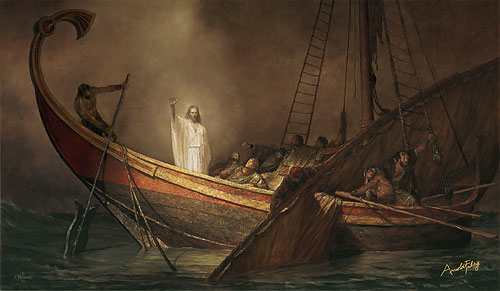
Peace be Still by Arnold Friberg

“Peace, be still,” by Arnold Friberg

The tragic mass shootings in El Paso and Dayton have many Americans on edge, as they struggle to understand what is causing it all. Sadly, such tragedies have become common in our country. The public and government responses to these shootings are predictable: the left calls for stricter gun control laws, while the right emphasizes the Constitutional right to bear arms and attributes the shootings to mental health problems. Unfortunately, most Americans fail to recognize the root cause of the problem. Why is this?  Perhaps it’s because we live in a country where, for many, the idea of good and evil has become an archaic concept, something associated with ancient religious superstitions.   

The Rev. Canon Phil Ashley of the American Anglican Council explained it like this. We face a culture that is “…increasingly shaped by the forces of aggressive secularism, moral relativism, religious pluralism, individual autonomy and a utopian hope in secular authority.” As more and more Americans push God out of their lives, social, cultural and spiritual chaos is filling the vacuum. When a country or society pushes God out, it opens the door for the enemy to come in. 1 Peter 5:8 says, Satan “…prowls around like a roaring lion looking for someone to devour.” Those lacking a solid spiritual foundation very easily become his prey. Yes, evil is real.

Chaos often breeds isolation, which for some people means empty lives nearly devoid of human contact. Isolated and confused, they might seek meaning in their lives through narcissism—an egoistic admiration of one’s self, which is a form of idolatry. Narcissism is easily fed through social media, where one can simply manufacture a false persona in an effort to gain approval from others.

Over prolonged periods, isolated individuals can  become enveloped by darkness.  Some may seek meaning or self-purpose through infamy—mass shooters are not soon forgotten.  Mass shootings are only one symptom of the problem however. It manifests itself in many other ways, including drug and alcohol addiction, pornography addiction, child abuse, human trafficking, suicide and countless others.

To begin to fix the problems in America, we don’t need more laws or more gun rights.  We need a spiritual revival of our Judeo-Christian roots. Dr. Jack Graham, the pastor of the Prestonwood Baptist Church in Plano, TX explains it like this, “All of us are involved in some kind of a spiritual battle—a warfare that’s going on increasing.  A battle that is getting hotter and hotter right now and predictably so.  In fact, the Bible tells us that in the final hours of human history that perilous times will come.  Difficult dangerous times will come.” Dangerous times are not exclusive to American Christians.  Persecution of Christians because of their faith is running rampant around the globe.

Of the shootings in El Paso and Dayton, the Rev. Franklin Graham wrote, “The Word of God tells us to ‘mourn with those who mourn,’ and that is what our nation is doing. We grieve the tragic and devastating loss of life in El Paso and Dayton this weekend. The number of victims of the mass shootings is much higher than the headlines reveal, because each mother, each father, each sister and brother, each wife and husband, is also a victim—a victim of the heinous and senseless evil unleashed by two murderous gunmen. Their loved ones have been stolen from them.” And “”As we mourn with these families and communities, let’s continue to sincerely lift them up in prayer before the Lord.” Despite what some politicians have said, prayer is a proper response to mass shootings.

Fortunately, Christians needn’t despair at what they see happening around them. They can be confident that God is in control of their lives, even when the world appears to be coming apart all around them. Throughout the scriptures Jesus remains as solid as a rock. We see this vividly portrayed in Mark chapter 4, when Jesus and His disciples are on a boat in the midst of a terrible storm. Jesus is asleep on a cushion when his frightened disciples wake Him, fearing they are about to perish. Jesus rises and speaks the words the simple words, “Peace, be still.”  Immediately, the wind ceases to blow and the water grows calm. His disciples then marvel that even the wind and the sea obey Him.    

The same Jesus who calmed the storm is in control of our lives today. Hebrews 12:28-29 says we live in an unshakeable kingdom. “Therefore, since we are receiving a kingdom that cannot be shaken, let us be thankful, and so worship God acceptably with reverence and awe, for our God is a consuming fire.”  

Christians have nothing to fear in the midst of today’s chaos.  As the late Rev. Dr. Billy Graham said, “I’ve read the last page of the Bible. It’s all going to turn out all right.” Christians need only do their best to imitate the life of Christ. God will take care of the rest.

The Seven Penitential Psalms


Saint Peter in Penitence by El Greco

St. Peter in Penitence, El Greco, (ca. 1580)

We are currently celebrating the church season of Lent, a 40-day period before Easter when Christians reflect upon the passion and sacrifice of Jesus Christ, who was crucified and died as atonement for our sins, setting believers free from sin and death. Easter celebrates Christ’s resurrection from the dead and the promise of eternal life for His believers.  Penitence, a solemn contemplation of one’s sins and request for God’s forgiveness, is foundational to Lent.

One Lenten discipline that I recommend is the prayerful reading of the Seven Penitential Psalms—Psalms 6, 32, 38, 51, 102, 130 and 143. These psalms (prayers) are generally attributed to David.  Psalm 51 is probably the most widely read of the seven. In Anglican and Catholic traditions, it is often recited by congregations on Ash Wednesday and at other times during the Lenten season.

Christian tradition suggests several possible reasons behind the writing of these psalms. Probably the most widely accepted explanation is they were King David’s prayers of repentance for his sins against Uriah and Uriah’s beautiful wife Bathsheba. David’s sinful lust for Bathsheba drove him to conspire to have Uriah killed in battle. With Uriah out of the way, David took Bathsheba for his wife.  She conceived and bore a baby son, but the child died shortly after birth.  Recalling the words of condemnation delivered to him by the prophet Nathan regarding David’s sin with Bathsheba (2 Samuel 12: 4-7), David believed the baby’s death was God’s punishment for his transgressions. Nathan said to David:

“Now a traveler came to the rich man, but the rich man refrained from taking one of his own sheep or cattle to prepare a meal for the traveler who had come to him. Instead, he took the ewe lamb that belonged to the poor man and prepared it for the one who had come to him.”David burned with anger against the man and said to Nathan, “As surely as the Lord lives, the man who did this must die! He must pay for that lamb four times over, because he did such a thing and had no pity.”  Then Nathan said to David, “You are the man! (NIV)

Another Christian tradition associate’s the Seven Penitential Psalms with the Seven Deadly Sins. We first encounter the Seven Deadly Sins in the writings of Pope Gregory I around the year 600.  The sins are pride, greed, lust, wrath, gluttony, envy, and sloth.

The writings of  French Roman Catholic theologian Cardinal Pierre d’Ailly (1351-1420) associates certain spiritual virtues with the Seven Penitential Psalms: Psalm 6, fear of punishment; Psalm32, sorrow and confession for sin; Psalm 38, hope;  Psalm 51, love of purity and mercy; Psalm102, longing for heaven, Psalm 130, distrust of one’s own strength and hope for mercy; and Psalm 143: joy.

During this year’s season of Lent, I’ve committed to prayerfully reading the Seven Penitential Psalms daily as part of my morning devotion.  It has been a deep spiritual experience, one that I plan to make part of my future Lenten discipline.  I encourage readers to give this a try.  You can find the Seven Penitential Psalms online at the following URL:

http://www.usccb.org/prayer-and-worship/liturgical-year/lent/seven-penitential-psalms-songs-of-suffering-servant.cfm

Lent: a Season of Penitence and Prayer

Lenten Journey 3

As an Anglican, I follow a Church liturgical calendar, celebrating each of its many seasons.  Very soon the season of Lent will be upon us.  Lent this year is the period of 40 days from Ash Wednesday (March 6th) to Easter Sunday, commemorating Christ’s 40 days of fasting and temptation in the wilderness, His final journey to Jerusalem, where He was crucified, and His last hours with His disciples before His crucifixion. For believers, it is a period of penitence and alms giving. On Ash Wednesday, many Christians have their foreheads marked with ashes in the sign of the cross.  The ashes are often collected from burning the palm fronds used in the celebration of Psalm Sunday.

The Catholic and Anglican traditions regarding Lent are very similar.  In the Anglican tradition, which I practice, Lent is sometimes called the Paschal season (relating to Passover or Easter). It is a preparation time intimately connected to the most important Festival of the Church year, Easter, which marks Christ’s resurrection from the dead and His victor over sin and death. In celebration of the so-called Easter Triduum, Christians commemorates the passion (suffering), death, and resurrection of Jesus and thus the origin of the all Christian belief and the source of our faith and salvation. So, as Jesus spent 40 days fasting and praying in the desert, Anglicans prepare for 40 days for the encounter with Him in the Easter celebration. Traditionally, the Easter season begins with Ash Wednesday and ends on Holy (or Maundy) Thursday, a day we recall Jesus washing the feet of his disciples and having his last meal with them before his crucifixion.  Maundy Thursday reminds believers of their hunger for God by refraining from food and intensifying one’s prayer life and charitable giving. 

In the Orthodox tradition, Lent is an invitation to learn the salvation story  by studying the death and the resurrection of Christ. It is an exercise in which believers partake of suffering and resurrection of the Lord. The cross and resurrection are daily realities: we die every day in all trials of life with Christ, but we experience our resurrection every day when we unite with him in faith and prayer. It is important in the Orthodox tradition to recognize that the cross is symbolic of the resurrection, not death. Fasting during Lent is an exercise of self-restraint, by which believers overcome their physical passions and win true freedom. It helps us to the internalization, especially when we pray. The believers should fast and avoid meat. They should intensify their prayer life and dig deeper into the scriptures than usual.  On Wednesdays and Fridays during Lent, many Orthodox churches celebrate an evening service called “liturgy of the pre-sanctified gifts”. During these services, no elements are sanctified for the Holy Eucharist.  Instead, the bread and wine sanctified on the precious Sunday are used.  On these days, many Orthodox believers fast until evening.

Protestant denominations observe Lent in a wide variety of ways. Sadly, many traditional Protestant denominations barely observe Lent or the Church Calendar at all.  However, for some, fasting during Lent is a time for reflecting on the essentials of Christianity. The original purpose is to prepare one’s self internally for the coming of Easter. Many Protestants avoid certain things during Lent in a quest to learn the true necessities in life. They may deprive themselves of dependency-related risks such as alcohol, chocolate and other sweets, and even the consumption of social media. The Lenten season is a good time to reorder one’s life—restacking priorities.  

For those readers who have no set way of observing Lent, I urge you to consider adopting a Lenten tradition.  One simple way to begin is to read a daily Lenten devotion.  There are many available on the web, but my favorite is published by Lutheran Hour Ministries.  Beginning March 6 you will be able to find the devotions at this link:  https://www.lhm.org/lent/.

“…special (church) holidays give rise to various liturgical calendars that suggest we should mark our days not only with the cycles of the moon and seasons, but also with occasions to tell our children the stories of our faith community’s past so that this past will have a future, and so that our ancient way and its practices will be rediscovered and renewed every year.” 
         ― Brian D. McLaren,  Finding our Way Again: The Return of Ancient Practices


A Balanced Life

Wheel of Life

The wheel of life graphic above is a tool I used a lot in my past life as a Management Consultant. The purpose of the wheel is to illustrate that people need to balance their activities/involvement in the six life areas depicted in the outer ring of the wheel. If any of these areas is neglected or over-indulged, the wheel (and ergo one’s life) becomes out of balance, which can result in a multitude of personal problems.

Looking at the wheel, some might be inclined to argue that it’s impossible to put too much emphasis on one’s spiritual life. However, renowned Scottish Theologian Oswald Chambers would disagree.  Chambers said:

 Days set apart for quiet can be a trap, detracting from the need to have daily quiet time with God. That is why we must “pitch our tents” where we will always have quiet times with Him, however noisy our times with the world may be. There are not three levels of spiritual life— worship, waiting, and work. Yet some of us seem to jump like spiritual frogs from worship to waiting, and from waiting to work. God’s idea is that the three should go together as one. They were always together in the life of our Lord and in perfect harmony. It is a discipline that must be developed; it will not happen overnight. Oswald Chambers, My Utmost for His Highest

Chambers would agree that days set apart for quiet time, such as for church retreats, spiritual renewal weekends, and even weekly worship services are all good. However, he would caution against letting these become one’s focus for spiritual rejuvenation. These days that are set apart are special times on the “mountain top” when we can see the transfigured Christ in all of his glory. They’re highly spiritual experiences that one hates to see end. 

On the other hand,   Chambers strongly advocates for daily quiet time when one enters God’s “throne room” and learns to commune with God not on the mountain top, but while walking through the demon infested valley below.  Daily quiet time with God is obedience to John 15:4-5 (NIV), which says:

Remain in me, as I also remain in you. No branch can bear fruit by itself; it must remain in the vine. Neither can you bear fruit unless you remain in me. I am the vine; you are the branches. If you remain in me and I in you, you will bear much fruit; apart from me you can do nothing.

The website Vibrant Christian Living recommends three secrets to a daily quite time habit:

#1: Do your quiet time first thing in the morning.  With all the distractions in our lives, this can be difficult, but it will pay big dividends.

#2: Start small and let your quiet times with God Grow.  Quite time is a spiritual discipline that can grow in depth as we become more mature in Christ.

#3: Make your quiet time with God about a life rhythm, not a religious schedule. Focus on how to make quiet time a regular part of your ever changing life. Sometimes you’ll fail, but God is quick to forgive when we ask him.

Worship the Lord with gladness; come before Him with joyful songs.
Know that the Lord is God. It is He who made us, and we are His;
we are His people, the sheep of His pasture.

Enter His gates with thanksgiving and His courts with praise;
give thanks to Him and praise His name.

Psalm 100:2-4 (NIV)

Too much to pray for!

Prayer

Renowned Scottish theologian Oswald Chambers said, ‘Prayer does not equip us for greater works— prayer is the greater work. Yet we think of prayer as some commonsense exercise of our higher powers that simply prepares us for God’s work. In the teachings of Jesus Christ, prayer is the working of the miracle of redemption in me, which produces the miracle of redemption in others, through the power of God.’

The older I grow, the more it seems like I have more to pray for than I can handle.  Is this is a common dilemma for Christians as they grow older?  I’d like to hear from readers who share the same or a similar problem.  

My prayer list is getting too long to manage.  It includes numerous categories including family (spouse, children, grandchildren, siblings, cousins, aunts, uncles, in-laws and extended family members); friends; colleagues at work; clergy; those persecuted for their Christian faith; my church; my former churches; local leaders; state leaders; national leaders; military service members; and even the abused and missing children on the evening TV network news.  Where should I begin praying on a prayer like this?

 I’ve tried ‘checklist’ praying–simply going down the list and asking God’s blessing for each category, but that feels very hollow. I’ve tried lifting up specific prayers for everyone and everything on the list, but my ability to concentrate usually fails after five or 10 minutes into the prayers.  I’ve segmented my prayers to pray for one category at a time on my prayer list.

When Jesus’ disciples asked him to teach them to pray, he gave them (and us) the ‘Lord’s Prayer’. It’s a beautiful model for praying, but should not be the only prayer we pray; one of the purposes of prayer is simply for us to be with God and to listen and experience the glory of his presence. Our Lord’s prayer goes like this:

Our Father who are in heaven (recognition of God’s supreme authority in all creation),

Hallowed be thy name (affirmation of God’s perfect nature),

Thy kingdom come, Thy will be done on Earth as it is in heaven (a petition for God to restore the perfect order on Earth that he has intended since creation),

Give us this day our daily bread (recognition that God sustains us),

And forgive us our trespasses (a plea for God’s forgiveness through Jesus Christ),

As we forgive those who trespass against us (an acknowledgement that we have all sinned and fall short of the glory of God and a reminder to forgive others),

And lead us not into temptation (a plea to God to spare us from testing, as Job, Jesus and so many Christian martyrs have been tested),

But deliver us from evil (protect us from Satanic forces),

For Thine is the kingdom, and the power, and glory forever, amen (a final acknowledgement of God’s supreme authority in all creation).

The Lord’s Prayer is a beautiful way to begin or end any prayer! 

St. Paul’s epistle to the Romans (8:26-27) tells us, ‘…We do not know what we ought to pray for, but the Spirit himself intercedes for us through wordless groans. And he who searches our hearts knows the mind of the Spirit, because the Spirit intercedes for God’s people in accordance with the will of God (NIV).’  I try to apply this wisdom when I’m feeling overwhelmed.  Sometimes my daily prayer is simply, “Holy Spirit, please pray for me and my family.”  I also pray this prayer for individuals, when I feel troubled about/for them, but I don’t know how to pray for them.

One thing I’ve learned is not to pray too much for myself.  When I do pray for myself, it usually entails asking God for forgiveness.  Psalm 51 and the Lord’s Prayer are my ‘go to’ prayers when I pray for myself. They are more than sufficient!

So how should we pray?  I would love to hear your comments and ideas on prayer. Please consider leaving a comment. 

To Be a Christian without prayer is no more possible than to be alive without breathing.    —Martin Luther

Hurry up and slow down!

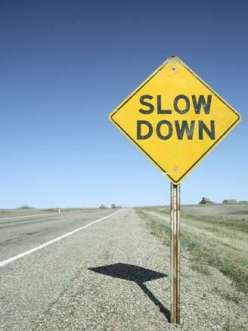
Slow Down

Be still, and know that I am God.  —Psalm 46:10a (ESV)

We live in a world of high-speed escape artists.  Everywhere one looks, people are rushing to and fro to get the next thing on their long list done. When they grow weary, many turn to adrenalin-pumping extremes to “relax.” There is extreme biking, extreme running (Parkour), building- and rock-climbing without safety equipment (free-climbing), half-pipe skiing and snowboarding, and base jumping, which is free fall parachuting from cliffs or high structures.

We watch extreme television entertainment, like American Ninja Warrior and Mixed Martial Arts (MMA) fighting.  If sports is not your thing, there are extreme game shows with names like Wipeout, where contestants crash and burn on crazy obstacle courses, and Fear Factor where contestants, among other feats, eat large volumes of worms and bugs.

Many escape reality through physical addictions, turning to drugs, alcohol or sex to remove them from reality. Others simply unplug from their daily grind, spending long periods of the day disconnected from the world. Video games are one way of escaping reality. The most extreme “unplugging” involves new virtual reality technology.  With this technology, one can don a pair of goggles and be instantly transported to a new 3-D “world.”  Anything goes on these virtual playgrounds, including extreme sports, extreme violence and extreme sexual fantasies.

For some, cell phone addiction provides a different kind of virtual reality.  Have you spoken with someone who constantly looks down at their phone? It’s like they don’t have time for you. It’s annoying, not to mention downright rude.  Or perhaps you’ve observed a family seated in a restaurant waiting for their orders to arrive—everyone is heads down playing with their phone instead of interacting with other family members.  In 2014, Charit Taneja wrote in “The Psychology of Excessive Cellular Phone Use” that:

Cell phones enable behavioral problems and disorders, particularly in adolescents. This fact has become more and more evident in communications media, inspiring new pathologies, such as “Nomophobia” (No-Mobile-Phobia), “FOMO” (Fear Of Missing Out) – the fear of being without a cell phone, disconnected or off the Internet, “Textaphrenia” and “Ringxiety” – the false sensation of having received a text message or call that leads to constantly checking the device, and “Textiety” – the anxiety of receiving and responding immediately to text messages. 

Some people escape auditory reality. In the fitness center where I exercise, about half of the people wear headphones or ear buds while using an exercise bike, treadmill, elliptical machine, stair-stepper or other exercise device. I assume most listen to music, hoping it will carry away them to another, less painful place as they push their bodies to the physical limit.  While such auditory isolation might reduce the agony of a heavy workout, it hinders socializing with others and can even be dangerous. At certain times of the year here in South Dakota it’s a good idea to keep one’s ears peeled for the sound of a tornado warning siren.   

A frantic pace combined with isolation can lead to perilous situations. Anyone who lives in a big city has seen drivers who dangerously weave in and out of traffic, desperately trying to get ahead a couple of car lengths while putting their own and other people’s safety at risk. Many of these drivers have so much on their “to do” lists that feel a need to constantly rush. Others live in their own private worlds where it’s all about satisfying their own needs, with no regard for the needs and safety of those around them.

 Far too often, erratic driving results in road rage.  According to analysis by performed by Trace, an independent, nonprofit news organization dedicated to expanding coverage of guns in the United States, instances of road rage where someone in a car brandished a gun or fired a gun at another driver or passenger more than doubled over the a three-year period, increasing from 247 in 2014 to a high of 620 in 2016.

The high-speed, escape mentality is tearing away the very fabric of our society. We’re becoming a bunch of one-armed jugglers with our eyes and ears covered. It’s easy to get caught up in the race and lose sight of what really matters in life.  Christians aren’t immune to this.  It’s easy to become distracted and let the day slip by without a thought of God.  I think Islam gets it right on one point—stopping to pray five times per day.  Christians would do well to adopt a similar practice. 1 Thessalonians: 5 encourages us to “pray without ceasing.” (ESV)

Psalm 46:10a (ESV) says, “Be still and know that I am God.” God wants us to slow down and focus on him in the midst of our daily hustle.  It’s during times of stillness that we can, if just for a moment, look God in the face and begin to gain a deeper understanding of Him. In Mark 4:39, Jesus is with his disciples in a small boat when a great storm occurs.  The terrified disciples appeal to Jesus to do something to save them.  He utters the simple command, “Peace! Be still.” Immediately the weather becomes calm.

This beautiful story is about much more than Jesus calming the weather.  It is about Jesus giving up a sense of Peace in Him that helps us through the storms that occur in our daily lives. In 1 Kings: 19 (ESV), God speaks to Elijah in “a low whisper.” My advice to you—slow down, be still, unplug, hear God’s whisper, and discover His peace. 

 “Rejoice in the Lord always; again I will say, rejoice. Let your reasonableness be known to everyone. The Lord is at hand; do not be anxious about anything, but in everything by prayer and supplication with thanksgiving let your requests be made known to God. And the peace of God, which surpasses all understanding, will guard your hearts and your minds in Christ Jesus.” —Philippians 4:4-7 (ESV)


Give Thanks to God

Thanksgiving Turkey.jpg

May love and laughter light your days, and warm your heart and home.

May good and faithful friends be yours, wherever you may roam.

May peace and plenty bless your world with joy that long endures.

May all life’s passing seasons bring the best to you and yours!

                                                                             An Irish Blessing

Father Desmond O’Donnell, a Roman Catholic Priest in Northern Ireland, recently told the Belfast Telegraph newspaper that Christians should abandon the word “Christmas,” noting that the name has been “hijacked by Santa and reindeer” and commercialized to the point that it is virtually meaningless.  “We’ve lost Christmas, just like we lost Easter, and should abandon the word completely,” O’Donnell said.  

Just go to a mall today and see what he means.  You’ll find Christmas on display everywhere, even though we’ve yet to celebrate Thanksgiving. Check your mailbox today and you’re apt to find a pile of Christmas sale catalogs and flyers.  The Christmas theme is clear—buy, buy, buy!

Sadly, we can say the same thing about losing Thanksgiving.   What was originally a day set aside for Americans to thank God for our many blessings is now often referred to as “Turkey Day,” a time to overeat, over indulge in alcohol, and watch football on television. Indeed, a number of Thanksgiving Day football matches across the country are referred to as the “Turkey Bowl.” Thanksgiving has become irreversibly connected with Black Friday, the day Christmas buyers literally battle one another in malls and big box stores to get super bargain prices on anything and everything.  Some stores have even resorted to open at midnight on Thanksgiving to maximize the Black Friday “spend fest.”    

For many Americans, it might appear that there isn’t too much to be thankful for.  We see reports of multiple mass shootings; police officers are gunned down in our streets; there are dozens of reports of sexual misconduct by politicians and Hollywood celebrities; natural disasters hammer the land; and we have a government run by two feckless political parties that seemingly can’t even agree on when to hold the next meeting.  Sometimes it seems as if our whole system, our entire way of life, could be swept away in an instant (and it can, but that’s the Book of Revelation, which I won’t go into today).

So what does America have to be thankful for?  The answer is truly simple, although not necessarily obvious.  What a pity more Americans don’t travel abroad to Third World countries and countries with oppressive regimes like Afghanistan, Iran, and North Korea.  In such places it takes very little time to recognize how truly blessed we are.  I was blessed that my military career allowed me to see so much of the world. It changed me forever.

America isn’t perfect, but it is great enough that many people around the globe dream of coming here.  If you take time to thank God this coming Thursday, thank Him for these simple blessings:

  • We can go to the faucet and fill a glass with clear, clean water. In Somalia I watched people drink water drawn straight from the muddy Jubba River, where it was not uncommon to see the carcass of a hippopotamus or other large animal floating down the river. Diarrheic disease kills Somalis and other Third World citizens by the score.
  • Our country is relatively free of deadly infectious diseases like plague, cholera, and malaria that devastate many other countries.
  • We light our homes with the flip of a switch. Following the long civil war in the Former Yugoslavia, I was deployed to Sarajevo, Bosnia-Herzegovina. Most of the city was without electricity when I arrived, and much of it was still without when I returned home 13 months later.
  • We are well-fed compared with much of the world. Even many people living below the poverty level in America are better fed than people in some Third World countries.
  • One can travel freely in America. Oppressive regimes around the world control movement of the population. They use checkpoints with armed officials to prevent unrestricted movement about the country.
  • Americans can speak freely without fear of reprisal by the government. Sure, sometimes there are bad consequences for speaking freely, such as libel suites, but we aren’t silenced by the government.
  • While there is a problem with homelessness in America, most of us have a roof over our heads nevertheless. In Kuwait, Iraq, Somalia and Bosnia I saw thousands of people who had been violently forced from their homes or had their homes destroyed by war.
  • We have the freedom to worship God in the way we choose. While many Christians grumble about losing religious freedom (and some rightfully so), we enjoy more religious liberty than most of the world.

Truly America has its problems, but our country is blessed in many ways.  Despite its faults, it is still a place where many oppressed people dream of coming to.  Take time to pause and thank God for blessing America. May he continue to do so in the coming year!

‘Tis the gift to be simple, ’tis the gift to be free

‘Tis the gift to come down where we ought to be,

And when we find ourselves in the place just right,

‘Twill be in the valley of love and delight.*

*Lyrics from “Simple Gifts,” a traditional Quaker Tune

What do you believe?

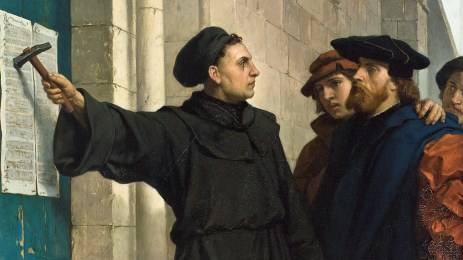
Martin Luther by Ferdinand Pauwels

Martin Luther by Ferdinand Pauwels

Tomorrow much of the world will commemorate the 500th anniversary of the 95 Theses, when a brave Roman Catholic monk named Martin Luther nailed a revolutionary document to the church door in Wittenburg, Germany (see http://www.luther.de/en/95thesen.html).   The document, consisting of 95 parts, denounced his church’s practice of selling “indulgences” to absolve sin, which ran contrary to Luther’s Bible-based belief that that salvation could be attained through faith and by God’s grace alone.  I call him brave, because Luther’s act put him at risk of excommunication and possibly even death.

When called before the Catholic Council (Reichstag) in the city of Worms and ordered to renounce the document, Luther refused, saying  the famous words, “Hier stehe ich. Ich kann kein anders.” (Here I stand.  I cannot do otherwise).   Rather than renouncing his 95 Theses,  Luther eventually renounced his monastic vows and married a former nun. His act of faith rocked the Catholic church and ultimately spawned what today is known as the Protestant Reformation.

What would you do if your Christian faith were challenged?  What if someone asked you about your Christian beliefs?  How would you reply? I’d like to think I’d be as brave as Luther, but in reality I probably wouldn’t. How many people are willing to risk everything for Christ? Recently, we’ve heard stories of Christians in Iraq and Syria identifying themselves to ISIS terrorists and being executed, rather than hide their Christian faith. How would you respond?

Have you ever really thought about what your Christian faith means to you?  Sure, you might recite the Apostle’s Creed or Nicene Creed at church every week, but did you ever really stop to think what those words mean?   I’m an Anglican.  My denomination, the Anglican Church in North America (ACNA), subscribes to three creeds:  the Nicene, Apostle’s, and Athanasian.  Unless you’re a relatively new Christian, you’re probably familiar with the first two, which are worded very similarly.  The Athanasian Creed is a bit harder to digest, as it  clearly discuss the three persons comprising the Holy Trinity, one of the most controversial tenets of the Christian faith.  It is accepted by many Western churches and often read at Trinity Sunday worship services in lieu of the Apostle’s or Nicene Creed.

I challenge you to set aside some quiet time and seriously consider the question, “What do I believe?” I can assure you that of the three great world religions, Christianity, Judaism, and Islam, the average Christians is the least well-equipped to answer this question.  Islam and Judaism emphasize reading and memorizing scriptures much more than does Christianity.

Here are a few things to consider if you accept the challenge.

  • The Holy Trinity (Matthew 28:19) – Do the words of the Bible or the Athanasian Creed’s take on the Trinity cause you to question your own beliefs?
  • Your Body (1 Corinthians 6:19-20) – Do you treat your body as if it is the Temple of the Holy Spirit? (Think about what you put into it).
  • Divorce (Matthew 19) – Do you accept Jesus teaching on divorce? He opposes it.
  • Abortion (Psalm 139:13-16; Jeremiah 1:5) – What are your beliefs about the early stages of life?
  • Gay Marriage (Romans 1) – What are your beliefs on gay marriage?
  • Love the Lord your God with all your heart (Mark 12:28-34) – Do you love God above everything else, or is something (addiction, idolatry) getting in the way?
  • Love your neighbor as yourself (Mark 12:28-34) – Are you at peace with your neighbor?
  • Sin (Romans 7:14-25) – What is sin? Are you a sinner?                   

This is a tough challenge—not something you can think through in a few minutes. Matthew 9 tells the story of a man who is imploring Jesus to heal his young son, who has an unclean spirit (demon) plaguing him.  Jesus says to the man (ESV), “If you can’! All things are possible for one who believes.”  Immediately the father of the child cried out and said, “I believe; help my unbelief!” I submit that most Christians who take the challenge will find themselves crying, “Help my unbelief!”

 “Today, many churches are taking God’s laws and saying, ‘These no longer are in effect.’ In Luther’s time the Church said, ‘You need to buy indulgences to be forgiven of your sin.’ Today, more than one church says, ‘Sin? What is sin?’” 

                                                                  Ken Klaus, Pastor Emeritus, The Lutheran Hour 

Back to Scripture: The Protestant Reformation and the Five Solas   https://www.christianheadlines.com/slideshows/back-to-scripture-the-protestant-reformation-and-the-five-solas.html