Posts Tagged ‘faith’

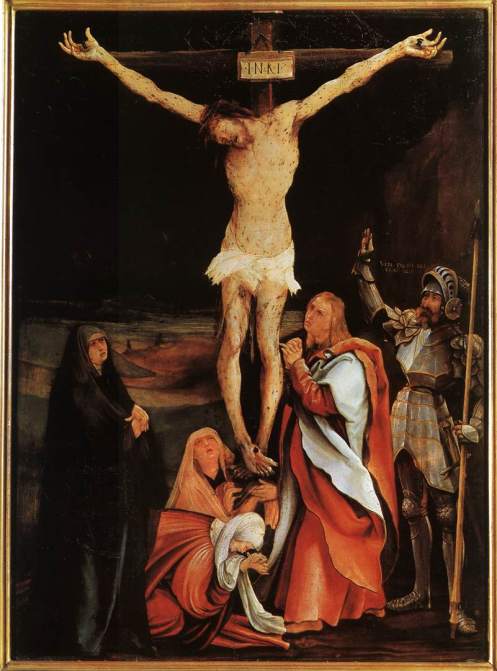
Now thank we all our God*

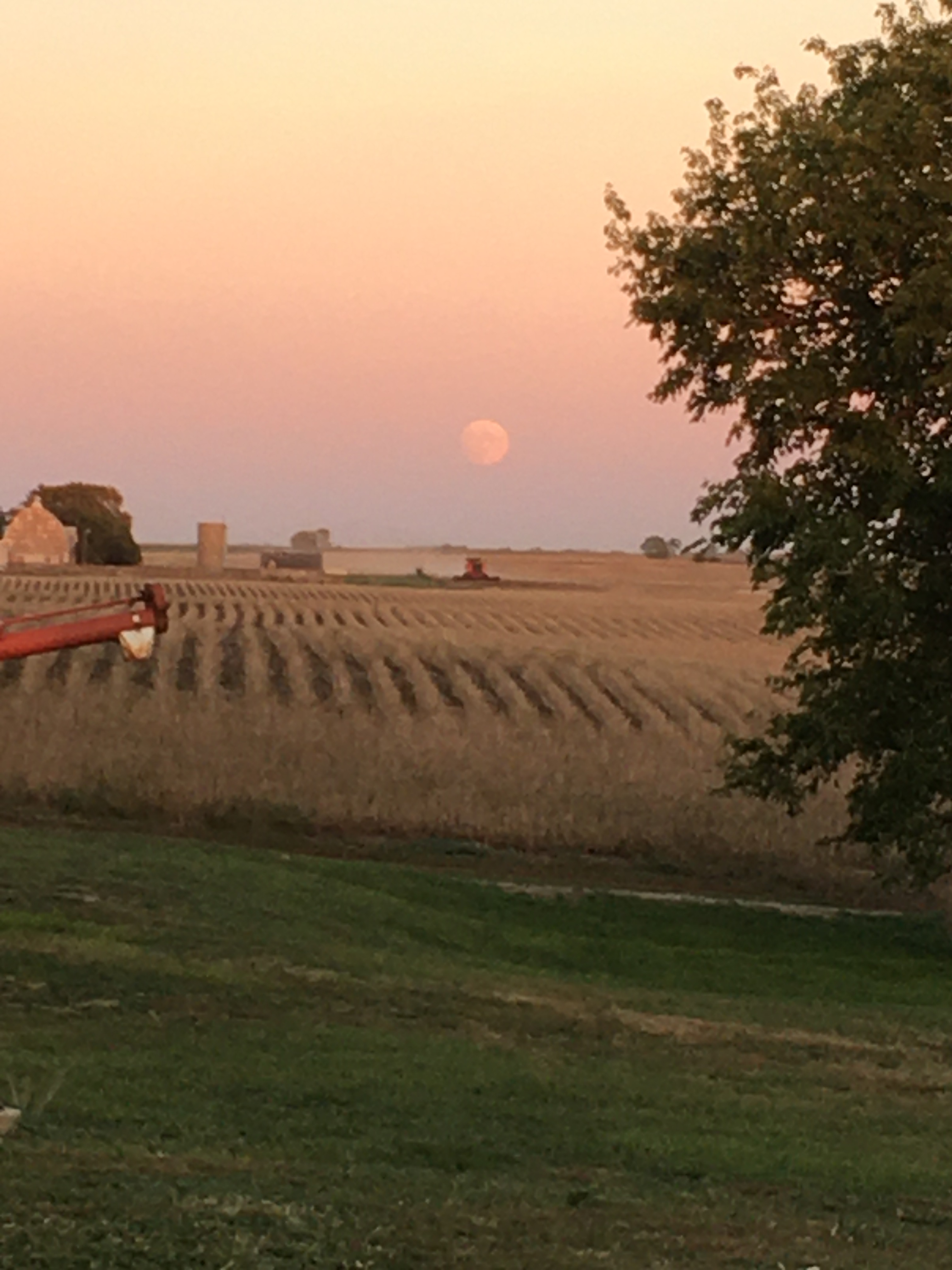
Harvest moon near Sioux Falls, South Dakota

Thanksgiving Day 2023 – Pause for a moment today and thank God for all His blessings!

1. Now thank we all our God
with heart and hands and voices,
who wondrous things has done,
in whom God’s world rejoices,
who from our mother’s arms
has blessed us on our way
with countless gifts of love,
and still is ours today.

2. Oh may this bounteous God
through all our life be near us,
with ever joyful hearts
and blessed peace to cheer us,
and keep us all with grace,
and guide us when perplexed,
and free us from all ills
in this world and the next.

3. All praise and thanks to God
who reigns in highest heaven,
the Father and the Son
and Spirit now be given,
the one eternal God,
whom heaven and earth adore,
for thus it was, is now
and shall be evermore.

*Nun danket alle Gott (Now thank we all our God), BWV 192 is a church cantata composed by Johann Sebastian Bach in 1730. https://www.youtube.com/watch?v=quYd7qJzsAE

Heavenly homes

“You can’t take it with you” is an adage often used in discussions surrounding money and death. Similarly, if you’ve been a church going Christian for a while, you might have heard a preacher say something akin to, “You never seen a hearse pulling a U-Haul trailer.” Well, perhaps the person in the photo never got the word, but the spirit of the idea remains valid. Naked we were born and naked we will stand before God’s judgement seat after we depart this world.

I recently heard a sermon where the preacher suggested that maybe there is something we can take with us when we die—souls. By this, he meant that in heaven we will see the one’s we’ve led to faith in Jesus Christ. I believe the preacher got it right. In death, we can take something with us after all.

Dear friends, since God so loved us, we also ought to love one another. 1 John 4:11

God has surrounded each of us with people we ought to love and want to take to heaven with us—family, loved ones, friends and other acquaintances. This got me thinking about how can we make our homes a little more heaven-like for our children.

I accepted Christ as my Savior when I was eight years old. For the next 10 years I did my best to follow Him as I was able. Then came college, where I drifted away from the church. I married just before graduating and continued my journey “in the wilderness” with my then non-Christian wife. 

My period of wandering away from Christ ended abruptly some seven years after it started.  It happened on the occasion of the birth of my wife’s and my first child. The first time I gazed at this tiny new human that God had gifted us was a wakeup call from the Holy Spirit. I literally heard, “she’s your responsibility.” I took this as a commission to raise our new daughter in a Christ-centered home. Like the Prodigal Son, I had come to my senses. My new insistence on raising the child in a Christian home came as a shock to my wife, but thanks be to God she slowly became a believer herself, as did our daughter.

Now I understand our greatest responsibility as Christian parents is to raise children who are Christ followers. How to go about that differs from family to family.  As Christian author and radio host Susie Larson has written, “Refuse the temptation to form your children into your own image.  They are the handiwork of God. He will show you how to love them, lead them and pray for them.” My advice would be that you should make decisions for your children based on Godly principles. You need search no farther than the Holy Bible to find sound child rearing instruction.

For many Christian homes, the concept of Sunday as the Sabbath has fallen by the wayside.  Sundays have become days for children’s sports league competitions, watching NFL football games, doing household chores, and almost anything but worshiping our Creator. The fast-paced life found in many modern-day households is a challenge to living Christ-centered lives. Observing the Sabbath establishes the perfection conditions for enjoying the Christ-centered, fellowship that God desires for each of our families.

Be forewarned! Deciding to create a “heavenly” home environment, one that is Christ-focused, won’t come without a price. It’s almost certain to create conflict. This can be extremely challenging, as those we love the most are often the ones who hurt us the worst. Fortunately, God has given us the perfect example of forgiveness in Jesus Christ. God so loves us that he forgave all of our sins through the death and glorious resurrection of his beloved Son. The pathway to building heavenly homes begins and ends with the Son.

Start children off on the way they should go, and even when they are old, they will not turn from it. –Proverbs 22:6

*All Bible quotes are NIV

Finding work is hard work

Prayer does not fit us for the greater works; prayer is the greater work. –Oswald Chambers

I once was employed under contract as a workforce developer for the Commonwealth of Pennsylvania. During the course of serving in this role I performed as a case manager for several hundred men and women who had lost their jobs. For the most part, my clients were blue collar workers from manufacturing industries in the Greater Pittsburgh area. If there’s one lesson I learned from this experience, it is that the only thing a worker complains more about than his or job is complaining about not having a job to go to each day.

For the past 12 years I’ve helped job seekers as a volunteer job coach. Many of those I assist are Christians.  I encourage believers to put God at the center of their job search. Christians job seekers can approach the process with the same principles that guide their faith and values. The following discusses some tips and guidance I give them.

Prayer: Begin by seeking God’s guidance through prayer. Ask for wisdom, discernment, and clarity in your job search. Pray for guidance on what kind of work aligns with your skills, interests, and values.

A prayer – Heavenly Father, you know my needs before I speak them. I come to You humbly seeking guidance and mercy in my job search. Provide suitable opportunities and lead me through a journey aligned with Your will. Grant me strength, wisdom, and favor as I seek employment.

When you are unemployed: I encourage unemployed job seekers to make the job search process their full-time job. Try to work at it at least six hours per day, five days per week. Make church, prayer and scripture reading part of your routine. Set aside time for family, fitness, recreation, and rest.   

Reflection: Reflect on your skills, interests, and values. Consider what type of work aligns with your talents and passions. This self-assessment can help you identify job opportunities that resonate with your God-given abilities.

Networking: Build and leverage your network of friends, family, and fellow believers. Networking can often lead to job opportunities and provide valuable insights into companies and industries. Attend church events and gatherings to connect with others who might have job leads or advice. Search the Internet for job networking groups near you.

A prayer – Heavenly Father, Guide and bless me as I network for my job search. May the connections I make be in accordance with Your will for my life. Help me to build meaningful relationships leading to opportunities.

Resume and cover letter: Build a well-written resume and cover letter that highlight your skills and experience. Be honest and accurate about yourself.

Online job search: Use online job search platforms to find job openings. Websites like LinkedIn, Indeed, and others can help you identify job opportunities matching your qualifications.

Employer values: Research potential employers to ensure their corporate values and culture align with your beliefs and principles. Investigate their mission statement, corporate social responsibility, and work environment.

Christian Ethics Check: Ensure that the job you’re pursuing doesn’t involve unethical practices or conflicts with your Christian beliefs. For example, consider the ethical implications of the products or services the company provides.

Interview preparation: Prepare for job interviews by practicing common interview questions and formulating answers that reflect your values and experiences. Be honest and transparent during the interview process.

A prayer – God of all wisdom, you have promised to give wisdom to anyone who asks. As I approach my interview, please give me wisdom in my speech. Guide my thoughts and direct my steps. When I experience uncertainty and confusion, may I lean on your limitless wisdom. May your Holy Spirit be at work in me like a lamp to my feet and shield to my mind. Help me to think clearly and calmly. Help me to speak with confidence and clarity. Help me to glorify you in this interview.

Work-life balance: Prioritize work-life balance. Overworking can be detrimental to your spiritual and personal lives. Seek employers who offer flexibility and understand the importance of maintaining a healthy work-life balance.

Patience and Trust: Job searches are marathons, not sprints. Trust in God’s plan for your life and exercise patience in the job search process. Sometimes, it may take time to find the right opportunity that aligns with your values and skills.

Seek advice: Consult with mentors, pastors, or other trusted individuals in your Christian circles for guidance and support during your job search. They can provide valuable insights and spiritual advice.

Remember that the job search process can be challenging, and it’s important to remain faithful to your principles and values throughout. Seek opportunities that allow you to be a positive influence in your workplace and community, and always strive to honor God in your work.

A prayer – Heavenly Father, help me to remain diligent in my job search because I know it is only with Your guidance that I can truly succeed.  Thank You, Holy Father, because I have faith that you are leading me toward the perfect employment opportunity.

*AI was used to search for the prayers used in this piece.

What do you believe?

King David stretches out his hands in Prayer

Late in the spring of 2022 I had highly invasive surgery that laid me low for about 90 days.  It was miserable. Fast forward to the present and I’m currently recovering from another surgical procedure that left me feeling, weak, bruised and even despairing. In both instances, I found it comforting to meditate on the word of God. In my weakened state from the most recent surgery, I found time to meditate on what being a Christian means to me and how I could best explain it to an unbeliever. There are dozens of examples of similar attempts on the Internet, so please allow me to add to the discussion. If nothing else, I hope some readers might be motivated by my awkward musings and take a moment to dwell upon their own Christian beliefs.   

There are several key Christian principles and values that hold great significance and guide the faith and actions of a believer, or Christ follower as I like to call myself. While interpretations and emphasis vary between various individuals and denominations, the following are some fundamental aspects of Christianity that matter to me and seem to be widely accepted amongst fellow believers.

Faith in Jesus Christ – Central to being a Christian is having faith in Jesus Christ as the Son of God and the Savior of the world (Ephesians 2:8). All believers are encouraged to confess their sins to Jesus, ask his forgiveness, and receive the free gift of salvation. The Scriptures encourage us to have a personal relationship with Jesus and to endeavor to follow His teachings (Galatians 2:20).

The Bible as the Word of God – I believe the Bible is the inspired Word of God, written by the hands of men who were guided by God’s Holy Spirit (2 Timothy 3:16). It serves as a guide for faith and practice. Studying and applying its teachings is a vital aspect of life as a Christ follower.

Prayer – Prayer is the means of communication between believers and God. Christians are encouraged to pray regularly for guidance, thanksgiving, supplication, and fellowship with God. Prayer is the pathway to God’s peace (Philippians 4:6-7). We are also taught by the Scriptures to say prayers of intercession for others. Both believers and unbelievers, both friends and enemies (Matthew 5:44). 

Love and Compassion – Following Jesus’ command to love one another (John 13:34-35), Christians are called to show love and compassion to their neighbors, both fellow believers and others. This includes acts of kindness, charity, and forgiveness. These acts are not a means of earning salvation.  Rather, they are an outward expression of thanksgiving for the gift of salvation I have received from God through the death of God’s Son Jesus, that purchased the forgiveness of my sins.

Worship and Fellowship – Regular worship services, communal prayer, and fellowship with other believers are important for spiritual growth and building a sense of community. As the living body of Christ, the church requires many different parts to make it function efficiently (1 Corinthians 12:12-27).  There’s a role in the church for everyone.

Repentance and Forgiveness – Christians are taught to acknowledge and repent of their sins, seeking forgiveness through the grace of God. Forgiving others is also emphasized as a key aspect of Christian life (Matthew 18:21-22).

The Great Commission – Following Jesus’ command to “go and make disciples of all nations” (Matthew 28:19-20), I and many other Christians consider evangelism and spreading the Gospel as a central mission. This is one reason I write this blog.

Stewardship – Believers are encouraged to be responsible stewards (Matthew 25:14-30). This includes not only stewardship of our finances, but stewardship of God’s creation.

Mysteries – There are many mysteries in Christianity that remind us faith is not about having all the answers. Among these are the virgin birth of Jesus; whether Christ is physically present in the Holy Communion; and the doctrine of the Holy Trinity. These mysteries invite believers to explore the unknown and cultivate a deeper trust in God. They stretch the limits of human reason and promote a realization that there are aspects of God’s nature and plan that exceed our understanding. These will be explained to us in heaven one day.  Paul sums it up in 1 Corinthians 13:12 like this, “For now we see only a reflection as in a mirror; then we shall see face to face. Now I know in part; then I shall know fully, even as I am fully known.” I challenge fellow Christians to explore these mysteries and consider how you would attempt to explain them to a non-believer.

Thanks for taking the time to read this.  I hope it encourages you to explore your own faith.

*All Bible quotes are NIV.

Separation Anxiety

Canine separation anxiety is a complex psychological disorder affecting many dogs and their owners. When left alone, the otherwise wonderful pets affected by the disorder experience overwhelming distress, displaying a wide range of associated harmful behaviors. These range from incessant barking and destructive chewing to house soiling, total home wrecking and attempts to escape. Dogs are social creatures that thrive on the human companionship, which can make the absence of their owners highly disturbing.

My wife and I live in a multigenerational household comprised of grandparents, parents, children, and grandkids. It’s not uncommon for our daughter, son-in-law, and grandsons to be away for a weekend or longer vacation. When this occurs the family dog Mars, a large Labrador, is visibly moved. Mainly, he lies motionless on the floor or bed, and lets out big lonely sighs. My wife and I say that he “misses his humans.” While Mars doesn’t display destructive behaviors, family separation clearly makes him lonely for those he loves.

Loneliness is a key element of separation anxiety. It is not simply the absence of company, but rather a deep sense of isolation that can envelop practically anyone. It’s possible to feel lonely even while surrounded by a host of others. As a career Army officer, I endured multiple long deployments to Africa, the Middle East and the Balkans.  In addition to the deployments, there were many other extended periods of family separation when I was required to attend training, exercises, and formal schools. In each instance, I suffered bouts of loneliness caused by being separated from those whom I love most, my wife and children. I sometimes became increasingly anxious as anticipated periods of separation approached.

The Apostle Paul looked forward to death, but not because he was depressed.  He simply wished to again be in the physical presence of his first love, Jesus. In the first chapter of his letter to the Philippians (v. 21-24*) he wrote, “For to me, to live is Christ and to die is gain. If I am to go on living in the body, this will mean fruitful labor for me. Yet what shall I choose? I do not know! I am torn between the two: I desire to depart and be with Christ, which is better by far; but it is more necessary for you that I remain in the body.”   

In Mark chapter 14 the disciples eat the Passover meal with Jesus and then go to the garden of Gethsemane. In Gethsemane, Jesus went off by Himself to pray. As fully man and fully God, He knew exactly what was in store for Him—torture, crucifixion, and death. Just a few days prior to this Jesus had told his disciples plainly, “We are going up to Jerusalem, and the Son of Man will be delivered over to the chief priests and the teachers of the law. They will condemn him to death and will hand him over to the Gentiles to be mocked and flogged and crucified. On the third day he will be raised to life!” (Matthew 20:18-19)

Despite this foreknowledge, Jesus’ prayer in Gethsemane shows He was not distressed over any of the coming physical violence. He was in agony knowing that when the sins of the world were laid on Him, God the Father would turn away. Jesus dreaded the coming separation from God!  We are reminded of this later when we hear His impassioned cry from the cross, “My God, my God, why have you forsaken me?” (Matthew 27:46)

After the crucifixion, Jesus’ disciples suffered with separation anxiety. John 20:10 describes them hiding in fear of the Jewish leaders. No doubt they feared the Romans too!  After all, they’d been hanging out with this “criminal” who was perceived by some as a threat to Roman authority. Their teacher and master had, by all practical appearances, made a bunch of empty promises and then left them alone. But it was not so.  Behind the locked doors where they hid, the resurrected Jesus appears to His disciples in the flesh (John 20:19-20).

During his ministry, Jesus devoted a lot of time and effort to preparing His disciples for the day when He would be physically absent from them. He reassures them in John 14:15-18, saying “If you love me, keep my commands. And I will ask the Father, and he will give you another advocate to help you and be with you forever—the Spirit of truth. The world cannot accept him, because it neither sees him nor knows him. But you know him, for he lives with you and will be in you. I will not leave you as orphans, I will come to you.” Jesus final reassuring words to his disciples in Matthew 28:20b are, “and surely I am with you always, to the very end of the age.”

Isaiah 26:9 – “My soul yearns for you in the night; in the morning my spirit longs for you. When your judgments come upon the earth, the people of the world learn righteousness.

Psalm 42:1-2 – “As the deer pants for streams of water, so my soul pants for you, my God. My soul thirsts for God, for the living God. When can I go and meet with God?”

Psalm 143:6 – “I spread out my hands to you; I thirst for you like a parched land.”

Psalm 73:24 – “Whom have I in heaven but you? And earth has nothing I desire besides you.”

Thank God for leaving the Spirit of Truth with all believers. We need only to listen for His still, small voice to find Him. Thank God that He loves all of us so much that our foolish fears and anxieties don’t upset Him. Thank God He’s so patient with me, and that He is patient with all of us, even when we are impatient with Him. He loves us unconditionally, so much that he stretched out His arms on the cross to suffer and die for all of us. He will not send us anywhere He is not going; and when it comes to death, He’s been there and done that already. No matter how anxious, frightened, and lonely we may become, the Holy Spirit will keep us in His grip until the day Jesus bring us safely home. We are never alone.

*All Bible quotations are NIV

The Steadfast Disciples

Samaritan woman and the living well

Women serving in church clergy has been a hot topic in the news of late. This is driven by the Southern Baptist Convention’s decision last month to uphold the expulsion of two member churches with female pastors—paving the way to speculation that many more could follow. The churches were Saddleback Church in southern California, and Fern Creek Baptist Church in Louisville, KY. The former is a megachurch, reportedly the largest church in California, that is widely known for its popular cofounder, pastor Rick Warren.  Warren authored the bestselling book The Purpose Driven Life.  Fern Creek Baptist Church has been led by Rev. Linda Barnes Popham for 30 years.

Galatians 3:27-28  …for all of you who were baptized into Christ have clothed yourselves with Christ. There is neither Jew nor Gentile, neither slave nor free, nor is there male and female, for you are all one in Christ Jesus. (NIV)

My aim in writing this piece is not to argue for or against women in the clergy.  I will, however, note that women have historically been an important part of the Christian church from its beginning and they remain so today. 

The Gospels and book of Acts identify many women who were actively involved in the Lord’s ministry.   At the time of Jesus earthly ministry, the Jews regarded a disciple as one who followed the teachings and lifestyle of a particular Jewish rabbi (teacher). Listed below are some notable women followers of Christ.  I believe all can accurately be described as Christ’s disciples.

  • Mary Magdalene, or Mary of Magdala as she is sometimes called, is one of the most prominent female disciples of Jesus. She is mentioned as being present during Jesus’ crucifixion, burial, and resurrection. She is the first person to witness the risen Jesus and was commanded by Him to tell Jesus’ apostles, His innermost circle of disciples, about Jesus’ resurrection (John 20:1-18). Mary Magdalene is mentioned in all four Gospels (Matthew 27:56, 61; 28:1; Mark 15:40, 47; 16:1-11; Luke 8:2; 24:10; John 19:25; 20:1-18).
  • Mary, the mother of Jesus: Although not specifically referred to as a disciple, Jesus’ mother, played a significant role in His life and ministry. She is present at various moments in the Gospels, including the wedding at Cana (John 2:1-12) and at the crucifixion (John 19:25-27).
  • Samaritan woman by the well – (John 4:1-42). As told in the Gospel of John, Jesus, on a journey through Samaria, stops at a well where he meets a Samaritan woman drawing water. Despite cultural and religious differences, He has a conversation with her, violating Jewish social norms, and revealing His total knowledge of her life. He offers her living water, a metaphor for salvation and eternal life. She recognized Jesus as the Messiah and might even be described as an early evangelist. John 4:30 says, “Many of the Samaritans from that town believed in him because of the woman’s testimony.”
  • Joanna: Joanna is mentioned in Luke 8:1-3 as a woman who accompanied Jesus and the 12 Apostles, providing financial support for their ministry. She is described as the wife of Chuza, Herod’s household manager.
  • Susanna: Susanna is mentioned along with Joanna in Luke 8:1-3 as one of the women who supported Jesus and the disciples in their ministry. However, little else is known about her.
  • Salome: Salome is mentioned in Mark 15:40 as one of the women who witnessed Jesus’ crucifixion. She is also mentioned as being present during Jesus’ burial and is among the women who discovered the empty tomb (Mark 16:1).
  • Martha and Mary: Martha and Mary are sisters mentioned in Luke 10:38-42 and John 11:1-44. They, along with their brother Lazarus whom Jesus raised from the dead, were close friends of Jesus; He frequented their home in Bethany. Martha is depicted as a diligent worker busy with serving others, while Mary is seen as a devoted listener to Jesus’ teachings.
  • Tabitha (also known by her Greek name Dorcas):  Tabitha lived in the town of Joppa by the sea. She is described as a faithful disciple of Jesus who went around doing good and helping the poor.   The Apostle Peter raised Tabitha from the dead after she suddenly fell ill and died (Acts 9: 36-42).

These are just a few examples of women who can rightly be called disciples of Jesus. Their roles varied, but they were actively involved in Jesus’ ministry and played important roles in helping spread the Gospel.

Looking at the roles played by the women above led me reflect on and give thanks for several key women in my family who significantly shaped my personal Christian formation. I was born in the Appalachian Mountains of southeastern Kentucky. My father and most of my uncles were World War II veterans. For the most part, mountain men worked while women stayed home to raise kids and manage the household. It was a maternally-centered culture. All the ladies below played instrumental roles in raising me.

Granny Myrtle: my maternal grandmother was born in 1900 in southwestern Virginia, near the town of Rose Hill. She had an 8th grade education which was typical for the time and place she was born. A Southern Baptist, Granny was a Bible scholar and memorized hundreds of Bible passages. She read me Bible stories at bedtime and taught me to pray. She cared for me in her home during school summer recess. She loved to witness for Christ and helped lead many people to accept Jesus as their personal savior, including me.

Mother Phyllis: my mother was born in Wallins Creek, Kentucky, a small town deep in the Appalachian Mountains. Her family lived in a large beautiful log home by a creek. She and my father Jack divorced when I was six years old. Following the divorce, mom worked as a nurse’s aide and put herself through night classes at the University of Louisville, eventually earning certification as a medical technician and landing a good job in the Veterans Administration medical system. She taught me the importance of worshipping regularly and ensured that I attended Sunday school, worship services on Sunday mornings and evenings, prayer meetings on Wednesday evenings, and Vacation Bible School in the summer. She lived a life of selfless sacrifice, ensuring our basic needs for food, clothing and shelter were always met, no matter how hard she had to work.   

Aunt Sarah: my mother’s sister Aunt Sarah was always there for me, along with her husband, Uncle Carl. Their home was a second home to me and a place of refuge at times when my working mother wasn’t available to solve my “crisis du jour.” Aunt Sarah had three miscarriages and was never able to have children of her own, but she mothered me continually.  She took me to church and told me Bible stories. She gifted me a plane ride on my 8th birthday—it was my first. Aunt Sarah suffered from multiple sclerosis for over 60 years, but I never heard her complain about it. She taught me love of family.

Aunt Betty: my mother’s sister, Aunt Betty lived in a small town in northern Alabama together with Uncle John and my cousins John III, David, and Philip. Philip and I were only a year apart in age. We fished, swam, biked, and played games together. Over a period of about six years, I visited every summer, staying 2-4 weeks. Having me there during school summer recess was a great help to my divorced, working mother. Aunt Betty was a stern but loving disciplinarian who ran a tight ship. She made sure the family went to church on Sundays. She taught us cousins to make our beds, dust our rooms, clean our shoes, clear dishes from the dinner table. Moreover, she taught us self-discipline, something that was invaluable during my military career.  

Wife Linda: Linda and I met in college in Munich, Germany, exactly 50 years ago next month. I was just shy of my 18th birthday.   We’ve been together ever since. She never ceases to amaze me. Throughout my 24-year military career, she was my strong right arm and remains so today. Linda is a powerful example of faith and peace in the midst of spiritual storms. She is a fountain of generosity and has a servant’s heart. She is blessed with an abundance of common sense and the gift of discernment. I thank God for bringing us together. (Proverbs 31:10-31)

All these women had several traits in common, including a love of God, a daily walk with Jesus, and an unconditional, steadfast love for me. By the grace of God, the man I am today is due, in large part, to the love, teaching, and care I received from these steadfast disciples of Christ. I couldn’t have made it this far without them.

“…nor is there male or female, for you are all one in Christ Jesus.”

Note: I used ChatGPT AI to research some of the Bible passages mentioned in this piece. I typically use BibleGateway. The AI was much faster, but I can’t vouch for its accuracy.

A breath of life

Anyone who has spent some time in a deep swimming pool probably knows the feeling of diving a little too deep and then having to hold their breath while struggling towards the water’s surface, lungs aching for oxygen. The urge to breathe in such a situation is nearly irresistible. Breathing is such a natural part of life that most healthy people do it unconsciously.  Breath and breathing hold a special place in the Bible.

2 Timothy 3:16 says, “All Scripture is God-breathed and is useful for teaching, rebuking, correcting and training in righteousness,” i.e., Scripture comes straight from the mouth of God!

In Genesis 2:7, God’s breath equates to life, “Then the Lord God formed a man from the dust of the ground and breathed into his nostrils the breath of life, and the man became a living being.”

We see this again in Ezekiel 37:9, the story of the Valley of Dry Bones. We read, “Then he said to me (Ezekiel), ‘Prophesy to the breath; prophesy, son of man, and say to it, ‘This is what the Sovereign Lord says: Come, breath, from the four winds and breathe into these slain, that they may live.’”

In Luke 23:46, the absence of God’s breath equates to death. We read, “Jesus called out with a loud voice, ‘Father, into your hands I commit my spirit.’ When he had said this, he breathed his last.” Many places in the scriptures tell us someone “breathed his last” and died.

John 20:21-22, in a passage we call the Great Commission, equates the Holy Spirit to Jesus’ breath. It reads, “Again Jesus said, ‘Peace be with you! As the Father has sent me, I am sending you.’ And with that he breathed on them and said, ‘Receive the Holy Spirit.’”

 There’s no denying that there is power in the breath of God!

Breath Prayer

I have a friend who recently took a new job in counseling. A lot of his work is done via phone calls. Yesterday he told me, “I finally have a full case load and so I’m frequently very busy… but relearning to breathe and talk to the Lord as I’m dialing a call.”  My friend is on to something. Wittingly or unwittingly, he has learned the value of breath prayer. I only learned this lesson recently.

Nancy S. Wiens wrote this about breath prayer:

Within the Orthodox tradition, Breath Prayer appears perhaps as early as the 3rd century. Known as the “Jesus Prayer” or “Prayer of the Heart,” it draws from Mark 10:47, where a blind man, Bartimaeus, calls Jesus to heal him. A common form is, “Jesus Christ, Son of God, have mercy on me.” By placing a few words on the inhale and a few on the exhale, it unites the prayer with the body. (Breath Prayer: An Ancient Spiritual Practice Connected with Science. As found at biologos.org)

Breath prayer focuses on speaking, aloud or silently in one’s heart, a short phrase or prayer while coordinating it with one’s breathing. It can be useful in reducing anxiety, cultivating mindfulness, centering, and forming a deeper connection with God.

To engage in breath prayer, one typically chooses a brief phrase or prayer that is personally significant to them. It can be a simple affirmation, a biblical verse, or a sacred word or name. For example, in Christianity, a common breath prayer is “Lord Jesus Christ, have mercy on me.” Below is a beginner’s list of breath prayers. I highly recommend you give them a try.

As we breathe without ceasing, so should we pray!

*Peace. Be still. – from Mark 4:39

Speak Lord. I am listening. – from 1 Samuel 3:9

You are the Potter. I am the Clay. – from Isaiah 64:8

You, Lord are my shield. And the lifter of my head. – from Psalm 3:3

I am anxious for nothing. I give thanks and make my needs known to you. – from Philippians 4:6

You satisfy me with good things. And I am renewed. – from Psalm 103:1-5

I serve with the strength God provides. To God be the glory. – from 1 Peter 4:11

My flesh and heart may fail. But God is my strength forever. – from Psalm 73:26

You are doing a new thing. Let me perceive it! – from Isaiah 43:19

Keeping my eyes on what is unseen // I do not lose heart. – from 2 Corinthians 4:16-18

Lord, shine your face on me. Lord, give me peace. – from Numbers 6:25-28

When I am afraid // I put my trust in you. – from Psalm 56:3

My heart trusts in God alone. I have no fear of bad news. – from Psalm 112:7-8

* I hope that some of my readers will find this list useful. Thanks to Rachel Mayew for providing it in her “Holistic Faith” blog. 

A psalm for facing adversity

David Praying – Hungarian Gradual 1500-1520

Along the wilderness journey we call life, one will inevitably face periods of adversity. They can begin in a multitude of ways. Some of the most common causes are the death of a loved one, a bad medical diagnosis, the breakup of a love relationship, losing a job, or a personal financial crisis just to name a few. In extreme cases, severe adversity can make one wonder whether their life is worth living anymore.

My life has been overflowing with adversity recently, including the deaths of a beloved uncle and a beloved brother-in-law in rapid succession, and my own health concerns. Prayer and meditation on God’s word can be a great source of comfort when facing adversity. The Lord Jesus has given his followers a model for prayer in what today we generally refer to as “the Lord’s Prayer.” The most familiar form of His prayer is found in chapter 11 of Luke’s Gospel.

It is Jesus model for daily prayer and focuses on approaching life with faith in God, one day at a time. I suspect that Jesus prayed a similar prayer daily.  I have found Psalm 143 to be a wonderful companion to the Lord’s Prayer, particularly when believers are navigating periods of adversity. This psalm is attributed to David and is one of the Seven Penitential Prayers found in the Book of Psalms. Below I share some thoughts on how this psalm speaks to me.

Psalm 143 (a form used in the Scottish Episcopal Church)

1 Lord, hear my prayer, and in your faithfulness heed my supplications;
answer me in your righteousness
.  

This is an opening petition acknowledging that God listens to my prayers and takes them to heart. Our God is a good listener and is never too busy to pay attention when one of His children prays. He seriously considers each prayer I lift up to Him, and he answers each according to His holy will.

2 Enter not into judgement with your servant, for in your sight shall no one living be justified. Verse 2 asks God not to judge me by my actions, as all have sinned against Him and fallen short of the total obedience He requires. I can rest assured that I don’t have to earn the right to pray to God. Christ has already paid the price of admission for a space where I may kneel before the throne of God the Father and offer my heartfelt prayers. Jesus is my advocate before the Father and the Holy Spirit prays for me when I lack the proper words to make my own petitions.   

3 For my enemy has sought my life; he has crushed me to the ground; he has made me live in dark places like those who are long dead. 4 My spirit faints within me; my heart within me is desolate.

These verses remind me of 1 Peter 5, which describes Satan as a roaring lion that is on the prowl looking for someone to devour. For me it paints a dark picture of the adversity I am facing, as if I were hiding in a tomb, filled with a spirit of fear and hopelessness, abandoned by God.  Jesus must have felt like this hanging on the cross, asking why God had forsaken him.

5 I remember the time past; I muse upon all your deeds; I consider the works of your hands.
Verse 5 steps back and from the darkness and depression of the two preceding verses as the Psalmist recalls how God has led him through adversity and saved him. As I read this verse, I recall the many times in my life God has rescued me from adversity.

6 I spread out my hands to you; my soul gasps to you like a thirsty land.7 O Lord, make haste to answer me; my spirit fails me; do not hide your face from me or I shall be like those who go down to the Pit.

Like a small child reaching for the outstretched hands of a loving parent, I trust in my God for comfort and sustenance. My spirit thirsts for God like the desert thirsts for water. I ask God to respond quickly, as I feel like I’m standing on the brink of disaster.

8 Let me hear of your loving-kindness in the morning, for I put my trust in you; show me the road that I must walk, for I lift up my soul to you.

As I begin a new day, I ask God to reassure me of his loving presence.  I trust in God to sustain me throughout the day.

9 Deliver me from my enemies, O Lord, for I flee to you for refuge.

I ask God to foil the plans of my enemies, both spiritual and physical ones.  Seeking refuge from my enemies, I turn to God’s word and prayer for comfort.

10 Teach me to do what pleases you, for you are my God; let your good Spirit lead me on level ground.

I ask the Holy Spirit to lead me along a safe path where I may understand God’s will for my life and learn how to do His will. I pray that the Holy Spirit will move the mountains of adversity that are in my way.

11 Revive me, O Lord, for your name’s sake; for your righteousness’ sake, bring me out of trouble.

My spirit grows weary and I need God to renew and refresh me. In accordance with His holy will, I ask him to rescue me from all adversity that troubles me.

12 Of your goodness, destroy my enemies and bring all my foes to naught, for truly I am your servant.

This closing verse echoes verse 9, reiterating my need for God’s protection from my enemies.  I am reminded that as God’s servant, I am owned and protected in His holy service.  

So do not fear, for I am with you;
    do not be dismayed, for I am your God.
I will strengthen you and help you;
    I will uphold you with my righteous right hand.

—Isaiah 41:10

The God of second chances

This is the word that came to Jeremiah from the Lord: “Go down to the potter’s house, and there I will give you my message.” So I went down to the potter’s house, and I saw him working at the wheel. But the pot he was shaping from the clay was marred in his hands; so the potter formed it into another pot, shaping it as seemed best to him.  Then the word of the Lord came to me.  He said, “Can I not do with you, Israel, as this potter does?” declares the Lord. “Like clay in the hand of the potter, so are you in my hand, Israel. If at any time I announce that a nation or kingdom is to be uprooted, torn down and destroyed, and if that nation I warned repents of its evil, then I will relent and not inflict on it the disaster I had planned. –Jeremiah 18:1-8

If you have ever watched an artisan blowing glass you will probably agree that it is an amazing skill. If you walk around a glass blowing studio, you are likely to see a lot of beautiful finished examples of the artisan’s craft. You are also likely to see are a lot of broken glass fragments from failed attempts to craft a work of art.  Glass blowing is very unforgiving and correcting a mistake often proves impossible.

Making clay pottery, on the other hand, is very forgiving.  When a skillful potter makes an error, it can often be corrected without abandoning the piece and having to start over. Even when a piece is a total flop the fresh clay can be rolled into a ball and used to start a new piece. Like the potter reshaping a new piece of pottery from a failed one, so is the loving Savior I serve.  Jesus is truly a God of the second chance. The bible abounds with examples of people given second chances. Here are just a few from the New Testament.

A woman caught in the act of adultery

John chapter 8 tells of a Jewish woman was caught in the act of adultery.  Her accusers—teachers of the law and Pharisees—brought her to Jesus, asserting that the law of Moses dictated she should be stoned for her transgressions. Hoping to trap Jesus with his own words, they asked him what they should do with her. Jesus remains silent for a long time, stooping down and writing in the dirt.  He finally responds, “Let any one of you who is without sin be the first to throw a stone at her.” Slowly her accusers departed one by one until there was none remaining. Neither did Jesus accuse her.  Instead, he commanded her, “Go now and leave your life of sin.”

Jesus raises the son of a widow from the dead

In Luke chapter 7, beginning at verse 11, we find Jesus traveling through a city called Na’in. Along the way, Jesus observed a funeral procession carry a funeral bier bearing the body of a man who was the only son of a widow.  In Jewish society of the day, the man’s death would almost certainly have sentenced his mother to a life of poverty of worse.  Having compassion for her, Jesus stopped the procession, touched the bier, and commanded the dead man to rise, upon which the man sat up and began to speak. The people in the crowd were astonished and said, “A great prophet has arisen among us!” and “God has visited his people!”

The demon possessed man

Luke 8:25 begins the story of a demon possessed man. Upon arriving in the country of the Ger′asenes, which is opposite Galilee, Jesus encountered the man, who was naked.  We are told he lived among the tombs and was possessed by many demons. When Jesus approached the man, the demons recognized the Son of God and cast the man to the ground while begging Jesus not to destroy them. Jesus cast out the demons drove them into a herd of swine; the herd subsequently rushed down a steep slope and fell into a lake (Sea of Galilee), where they drowned. Afterwards, the formerly possessed man, now clothed and in his right mind, wanted to follow Jesus in his journey.  Jesus forbade him, telling him, “Return to your home, and declare how much God has done for you.” We are told, “he went away, proclaiming throughout the whole city how much Jesus had done for him.”     

A 12-year-old girl raised from the dead

Luke 8:40 begins the story of a man named Jairus, who is described as a ruler of the Synagogue.   Jairus came to Jesus, falling at his feet, and begged him to go and heal his young daughter, who was very ill and near death. Before they can reach Jairus’ house, a messenger comes with news that the girl has died.  Despite the news, Jesus continued to Jairus’ house.  When he was led to the place where the dead girl lay, Jesus took her by the hand and commanded, “Child arise.” Immediately her spirit returned to her and she stood up.

A thief on the cross next to Jesus’ cross

Luke 23:32 begins the story of two criminals who were crucified at the same time Jesus was—one on His left and one on His right. One criminal railed against Jesus, while the other confessed his sins and pleaded, “Jesus, remember me when you come into your kingdom.” Jesus replied to him, “Truly, I say to you, today you will be with me in Paradise.”

The Prodigal Son

Luke chapter 15, beginning with verse 11, tells the familiar story of the “Prodigal Son.” The young man in the story displayed the utmost disrespect for his father, demanding that his father give him his portion of the old man’s estate while the father was still living.  The father acquiesced and gave his son his inheritance.  The prodigal consequently went away to a far land, where he squandered his wealth. So complete was his fall that he eventually ended up barely surviving by working a job feeding pigs.  He longed to return home. One day, having reached the bottom of the abyss of poverty, he came to his senses and decided to return home and beg his father to let him live there, not as a son, but as a hired servant. Verse 20 describes how his father, who is a figurative character representing God, seeing the returning son from a long way off, ran to meet him, embraced him, and kissed him. The son said, “Father, I have sinned against heaven and before you; I am no longer worthy to be called your son.” But the father said to his servants, “Bring quickly the best robe, and put it on him; and put a ring on his hand, and shoes on his feet; and bring the fatted calf and kill it, and let us eat and make merry; for this my son was dead, and is alive again; he was lost, and is found.”     

Repentance

Why does God give us second chances?  Because it is His nature to forgive and it is our nature to continually sin. King David exploited Bathsheba sexually.  He arranged circumstances so that her husband Uriah would be killed in battle. He betrayed the trust of the people of Israel. Despite the three offended parties, in Psalm 51:4, David confessed that he had sinned against God and God alone.

Luke 15 contains three parables describing how heaven rejoices when a sinner repents and (re)turns to God. 2 Peter 3:9 says, The Lord is not slow about his promise as some count slowness, but is forbearing toward you, not wishing that any should perish, but that all should reach repentance. Mark 1:14-15 says, “Now after John was arrested, Jesus came into Galilee, preaching the gospel of God, and saying, ‘The time is fulfilled, and the kingdom of God is at hand; repent, and believe in the gospel’.” Repentance, while not a prerequisite for receiving a second chance from God, is essential to living a Christ-like life and receiving the gift of salvation through Jesus Christ.

God is the God of the second chance—and the hundredth chance, and the thousandth chance! No matter how rebellious and sinful we’ve been, He always stands ready to forgive us and welcome us home if we truly repent and commit our lives to Jesus Christ. –Billy Graham

*All Bible references are NIV

Easter 2023: He is risen!

Christ is Risen: The world below lies desolate.

Christ is Risen: The spirits of evil are fallen.

Christ is Risen: The angels of God are rejoicing.

Christ is Risen: The tombs of the dead are empty.

Christ is Risen indeed from the dead, the first of the sleepers, Glory and power are his forever and ever.

— St. Hippolytus of Rome

Read Matthew 28.