Posts Tagged ‘Christian’

The tough work of prayer

Prayer is like a battle. The enemy is constantly placing barriers in your way to keep you from reaching your final objective.

Life is a series of continual distractions that make it difficult to find time to commune with God. Even if one manages to slip away to a quiet place for a few minutes, odds are they will find themselves distracted by thoughts about what lies ahead in their day or week. I’ve heard so many people complain, “My days are so busy I just can’t find time to pray.”  In reality, if you have a busy day ahead you can’t afford not to pray. Paul’s epistle to the Church at Philippi says:

Do not be anxious about anything, but in every situation, by prayer and petition, with thanksgiving, present your requests to God. And the peace of God, which transcends all understanding, will guard your hearts and your minds in Christ Jesus. –Philippians 4:6-7

This is tough advice!  Who, after all, is not anxious about something, especially in the midst of the COVID-19 pandemic?  And how difficult is it to present your prayers to God with thanksgiving in every situation? “Dear God, I thank you for allowing me to crash my car into that tree yesterday.”  Prayer is tough work indeed.

The nation has just gone through a painful, extraordinarily divisive presidential election process. The political rhetoric is still turned up to near the boiling point. Political disagreements have resulted in many friendships ending and have even caused divorces. Sometime it feels like the entire world has gone mad amidst the name calling, threats, riots, burning and looting. Many politicians will tell you that they have the answers to all our problems, but they don’t. Only God can fix this mess!

I lift up my eyes to the mountains—where does my help come from? My help comes from the Lord, the Maker of heaven and earth.  —Psalm 121:1-2

More than any time in recent history, America’s Christians need to join together in praying for our nation and those whom have been elected to serve. So, what about that politician from the “other” party?  Should you pray for him or her?  “God, please help this idiot to see how wrong he is.”  Well, not exactly.  You can certainly pray that the Holy Spirit would convict the individual politician to make decisions that honor God, especially politicians who profess to be Christ followers.   

If you have a beef with a particular politician—get over it.  I don’t mean this in the traditional fashion that contemporary culture says “get over it.”  I mean that, as Christians, we are obliged to forgive those who have trespassed against us, just as we pray to God to forgive us our own sins.      

“In Jesus, we experience freedom not only from sin and its hold on us but also from guilt, shame, worry, Satan’s lies, superstitions, false teaching, and eternal death. No longer hostages, we have freedom to show love to enemies, walk in kindness, live with hope, and love our neighbors. As we follow the Holy Spirit’s leading, we can forgive as we’ve been forgiven” —Patricia Raybon, Our Daily Bread

Now here’s where it really gets difficult.  Not only are we told to “forgive as we’ve been forgiven,” but in Matthew 5, Jesus tells us to love our enemies:

You have heard that it was said, ‘Love your neighbor and hate your enemy.’ But I tell you, love your enemies and pray for those who persecute you, that you may be children of your Father in heaven. He causes his sun to rise on the evil and the good, and sends rain on the righteous and the unrighteous. —Matthew 5:43-45

Is there a politician or other leader whose behavior absolutely disgusts you?  If so, think of that person, then pray for him or her. Really!  Pray that God will soften their heart.  It they profess to be a Christian, ask God to fill them with the Holy Spirit.

Since 2001, The Presidential Prayer Team has been the source thousands of Americans have turned to for encouragement and inspiration to pray for America’s leaders. It is a non-partisan organization.  I encourage you click the “About Us” link below to visit their website and sign up for the daily prayer alerts.

A Prayer for Good Leaders

Father God, good leaders, come from you. Lord, this nation needs leaders with discerning hearts and wise minds. I beseech you today asking you today to give us wise leaders that will lead this nation in the right direction. Remove wrong people that are corrupt and living against your word from influential positions. Let our leaders be people who honor your holy name for it is only from you that they will get true wisdom. It is in the mighty name of Jesus that we believe and pray, Amen. —Anonymous

What do you believe?

“What are we to make of Christ?” There is no question of what we can make of Him; it is entirely a question of what He intends to make of us. You must accept or reject the story.

—C.S. Lewis

I’m a member of a parish of the Anglican Church in North America (ACNA).  Each week during Sunday worship we recite the words of the Nicene Creed, a widely accepted collective statement of faith in the triune God. I’ve been reciting the creed for so many years that now it is memorized and literally flows effortlessly out of my mouth each Sunday.

I enjoy communal prayers, but with this form of prayer comes a risk—the words become so familiar they can lose personal meaning. The renowned Scottish theologian Oswald Chambers said, “When we become advocates of a creed, something dies; we do not believe God, we only believe our belief about Him.”

This begs the question, “What does it mean to believe something?” I’ve provided two definitions above.  I prefer the second one. This leads to another question, “What is the difference in believing something and believing in something.”  Surely Satan believes in God, as he has seen God face to face.

  “You believe that there is one God. Good! Even the demons believe that—and shudder.” James 2:19 (NIV)

With all this in mind, I’d like to challenge each reader who calls him- or herself a Christian to examine your beliefs in the coming year. Do you believe God? If so, what exactly do you believe and what is the source of your beliefs? Let me preface the remaining discussion by confessing that I have many more questions on this subject than answers.   

A Gallup poll conducted in May 2017 indicated that a record few Americans (24%) believe the Bible is the literal word of God (Gallup poll). A 2020 Barna Group survey published by the American Bible Society indicated that “Mainline Protestant denominations had the largest proportion of unchurched adherents (50%) with one in every two members being unchurched, followed by 46% of Catholics, 37% of Evangelicals, and 36% of Historically Black Protestants.” (Barna Group Survey).  

Where do you stand on this?  If you believe the Bible is the inspired word of God, do you read it frequently? If you answered “no,” why not? How well versed are you in the scriptures?  If the Bible isn’t the source of your Christian beliefs, what is?  If you profess to be a Christian and don’t regularly attend church, why don’t you?

The bottom line of my thought process can be summed up like this: “If you can’t articulate what you believe, how can you live what you believe?”  In the coming year, I challenge each reader to answer the following questions for themselves. Take time to research the scriptures and other authoritative sources as you formulate your answers.  Try to discuss “why” or “why not” in each of your answers.

  1. Do you “believe” God or do you “believe in” God?
  2. Do you believe the Bible is the inspired word of God or just a book of wisdom?
  3. Proverbs 9:10 says, “The fear of the Lord is the beginning of wisdom.” What does it mean to fear the Lord?
  4. Do you believe the creation story in Genesis 1 is literal or figurative?
  5. Is Jesus the son of God or simply a great moral teacher?
  6. Do you believe in the virgin birth?
  7. What is sin and what is salvation?
  8. Do you believe Jesus died for your sins?
  9. Did Jesus really rise from the dead?
  10. Is Jesus the only pathway to God, as He said, or are there other paths?

Many people claim we’re presently living in a “post-Christian” era today, where Western cultures are increasingly embracing secularism and turning their backs on their original Judeo-Christian roots. More and more, we see Christians accused of being racists, bigots, homophobes, transphobes and a host of other slurs because of their beliefs. This is occurring both before the law, in the media, and in the court of public opinion. When your faith is eventually questioned by a non-Christian, as it inevitably will be, will you be prepared to articulate what you believe or will you silently submit to their accusations?

I sought the Lord, and he answered me; he delivered me from all my fears.

Those who look to him are radiant; their faces are never covered with shame.

This poor man called, and the Lord heard him; he saved him out of all his troubles.

The angel of the Lord encamps around those who fear him, and he delivers them.

Taste and see that the Lord is good; blessed is the one who takes refuge in him.

—Psalm 34:4-8 (NIV)

Until I come, devote yourself to the public reading of Scripture, to preaching and to teaching. Do not neglect your gift, which was given you through prophecy when the body of elders laid their hands on you. Be diligent in these matters; give yourself wholly to them, so that everyone may see your progress. Watch your life and doctrine closely. Persevere in them, because if you do, you will save both yourself and your hearers. —1 Timothy 4:13-16 (NIV)

Feed My Sheep

The Good Shepherd (C.1650-60) by Philippe de Champaigne

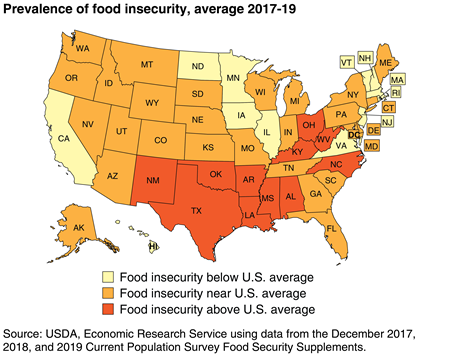
My recent work with a struggling young man in my community has provided me a stark reminder of the reality of hunger in America. The US Department of Agriculture (USDA) defines food security as “having access, at all times, to enough food for an active, healthy life for all household members.”  According to USDA figures, 10.5 percent of American households in 2019 lacked proper food security. While the government’s 2020 food security figures are not yet available, indications are that this year’s numbers will be much higher.  The primary reason for this is the sharp increase in national unemployment due to the COVID-19 pandemic. As the map below shows, the food insecurity problem is widespread.

As a state workforce developer in Pennsylvania, I worked with hundreds of clients who had recently lost their jobs.  Food security was often a major concern of these displaced workers. Many had small children at home, making their situations even more dire.  More recently, as a volunteer job coach working with the elderly, I discovered that food security is a major concern for many of my clients. My typical client is age 70 or older, dependent upon a Social Security check of less than a thousand dollars a month as their primary income, and frequently has to decide between purchasing expensive prescription drugs or food, as they lack sufficient income to pay for both with what remains after paying the rent or mortgage.  

While the mission of Christ’s church is to spread the Gospel, it’s difficult to convey the Good News to someone with a growling, empty stomach. Jesus clearly recognized this. By feeding the five thousand in the miracle of the loaves described in John 6, Jesus provided for the physical needs of the crowd.  The very next day, he called Himself the “Bread of Life.” (John 6:35). Clearly, one needs food in the belly in order to be more open to partaking of the Bread of Life.  The level of involvement in feeding the needy varies significantly from church to church.  Many get involved in collecting and distributing holiday food baskets for the needy.  While this is a wonderful thing, such baskets only cover a few days of the annual 365 that people need to eat. Much more is needed.   

Food banks and pantries exist across the country to help support food security. Typically, a food bank supports a region (such as a county), while local food pantries serve small towns or communities within larger towns/cities. According to the non-profit organization Feeding America, a food bank is a non-profit that safely stores thousands to millions of pounds of food for bulk distribution to local food programs, like food pantries. Food banks come in all different sizes. In contrast, food pantries receive food shipments from food banks and run food distribution programs where hungry families can receive food directly. Pantries feed hundreds of people per week! Because every community is different, there are many different types of pantries. It is common for a food pantry to operate from inside a community school or church. Some areas even have mobile food pantries to serve seniors with limited mobility or rural communities with little transportation.  Some pantries require the clients to demonstrate financial need, while others serve anyone who shows up. Some communities also have food kitchens, where the needy can eat a hot, nutritious meal.

Churches and individuals can help their local food banks, pantries and kitchens in a number of ways by donating money and by volunteering their time. Check directly with your local organizations to ascertain the best way to help each. A general rule of thumb is that monetary donations are preferable to food, as it enables the organization to spend where the need is greatest. Another general rule is that volunteers are always needed; this is particularly so during the COVID-19 pandemic.  Many food banks, pantries and kitchens have adopted special precautions for COVID-19.  Those who might wish to volunteer should check with their local organization(s) to determine if they are comfortable volunteering in light of the precautions that have been adopted. In any case, I encourage you to reach out as you can to support food security in America. As James 2:15-16 tells us, “Suppose a brother or a sister is without clothes and daily food. If one of you says to them, “Go in peace; keep warm and well fed,” but does nothing about their physical needs, what good is it?

Jesus feeds the five thousand, John 6:1-13 (NIV).  Some time after this, Jesus crossed to the far shore of the Sea of Galilee (that is, the Sea of Tiberias), and a great crowd of people followed him because they saw the signs he had performed by healing the sick.  Then Jesus went up on a mountainside and sat down with his disciples. The Jewish Passover Festival was near.  When Jesus looked up and saw a great crowd coming toward him, he said to Philip, “Where shall we buy bread for these people to eat?” He asked this only to test him, for he already had in mind what he was going to do.

Philip answered him, “It would take more than half a year’s wages to buy enough bread for each one to have a bite!” Another of his disciples, Andrew, Simon Peter’s brother, spoke up, “Here is a boy with five small barley loaves and two small fish, but how far will they go among so many?”

Jesus said, “Have the people sit down.” There was plenty of grass in that place, and they sat down (about five thousand men were there). Jesus then took the loaves, gave thanks, and distributed to those who were seated as much as they wanted. He did the same with the fish.

When they had all had enough to eat, he said to his disciples, “Gather the pieces that are left over. Let nothing be wasted.” So, they gathered them and filled twelve baskets with the pieces of the five barley loaves left over by those who had eaten.

Managing Change

Changes“There are far better things ahead than any we leave behind.” –C.S. Lewis


(Note: All Bible quotes are NIV.)

Most people naturally resist change. Some scientists have theorized this is caused by an innate survival response programmed into human beings at the genetic level. Businesses desiring to grow and remain competitive are often forced to change or face failure.   Change Management is a business discipline used to bring about organizational change while minimizing the impact on the affected individuals (employees, suppliers,  customers etc.).  Dr. Rosabeth Moss Kanter is a professor at the Harvard Business School.  She has written about the 10 common reasons people resist business change. They are:

  1. Loss of Control – Change interferes with autonomy and can make people feel that they’ve lost control over their territory.
  2. Excess Uncertainty – If change feels like walking off a cliff blindfolded, then people will reject it.
  3. Surprise, Surprise – Decisions imposed on people suddenly, with no time to get used to the idea or prepare for the consequences, are generally resisted.
  4. Everything Seems Different – Change is meant to bring something different, but how different? We are creatures of habit.
  5. Loss of Face (dignity) – By definition, change is a departure from the past.
  6. Concerns About Competence – Can I do it? Change is resisted when it makes people feel stupid.
  7. More Work – Here is a universal challenge. Change is indeed more work.
  8. Ripple Effects – Like tossing a pebble into a pond, change creates ripples, reaching distant spots in ever-widening circles.
  9. Past Resentment – The ghosts of the past are always lying in wait to haunt us. As long as everything is steady state, they remain out of sight.
  10. Real Threats – Now we get to true pain and politics. Change is resisted because it can hurt.

Fortunately, the business world has amassed a substantial body of knowledge describing effective methods for managing organizational change. Change Management consulting is a lucrative field of business and can be very effective in ushering in change.   

The seasons of our lives are full of changes as well. People resist life changes for many of the same reasons they resist business change. Human lives are in a constant state of flux. Ecclesiastes 3:1-8 describes this quite poetically:

There is a time for everything,

and a season for every activity under the heavens:

a time to be born and a time to die,

a time to plant and a time to uproot,

a time to kill and a time to heal,

a time to tear down and a time to build,

a time to weep and a time to laugh,

a time to mourn and a time to dance,

a time to scatter stones and a time to gather them,

a time to embrace and a time to refrain from embracing,

a time to search and a time to give up,

a time to keep and a time to throw away,

a time to tear and a time to mend,

a time to be silent and a time to speak,

a time to love and a time to hate,

 a time for war and a time for peace.  

Life changes come in two overarching categories. The first encompasses personal lifestyle changes one might need to make, like losing weight, exercising more, eating healthier, quitting tobacco, eliminating or reducing alcohol consumption, getting more sleep, spending more time with family, reducing social media time and the like. These changes often never come about because they usually involve great individual effort, sacrifice and self-discipline. When one accomplishes such a change, it can be one of the most exhilarating experiences in their life.

The second category of life changes consists of unplanned/unexpected events that life seems to drop on one’s head. Each morning one awakes never knowing what the day might bring—a serious accident, grim medical diagnosis, stroke, heart attack or other life changing event might occur. This category also includes external influences such as political upheaval and societal changes. Unfortunately, the body of knowledge for managing this sort of change is very broad, continually evolving and is riddled with disagreements between the so-called “experts.”  Several fields of study offer solutions for managing the changes of life. These include psychology, psychiatry, sociology and their related disciplines.  

Fortunately, for believers there is a body of knowledge for managing life changes that is totally reliable, one-hundred percent accurate, and immutable. Of course, I’m referring to the Bible. Biblical truth never changes because God never changes. Jesus Christ is a solid rock, an unalterable holy alter upon which we may lay all our hopes and fears.

Every good and perfect gift is from above, coming down from the Father of the heavenly lights, who does not change like shifting shadows.  James 1:17

God is not human, that he should lie, not a human being, that he should change his mind.  Does he speak and then not act?  Does he promise and not fulfill?  Numbers 23:19

Jesus Christ is the same yesterday and today and forever.  Hebrews 13:8

Believers have no reason to fear changes in their circumstances.  Scripture assures of this:

Have I not commanded you? Be strong and courageous. Do not be afraid; do not be discouraged, for the Lord your God will be with you wherever you go. Joshua 1:9

The Lord himself goes before you and will be with you; He will never leave you nor forsake you. Do not be afraid; do not be discouraged.  Deuteronomy 31:8   

Trust in the Lord with all your heart and lean not on your own understanding; in all your ways submit to him, and he will make your paths straight.  Proverbs 3:5-6

The Lord is my rock, my fortress and my deliverer; my God is my rock, in whom I take refuge, my shield and the horn of my salvation, my stronghold. Psalm 18:2

Peace I leave with you; my peace I give you. I do not give to you as the world gives. Do not let your hearts be troubled and do not be afraid. John 14:27

Do not be anxious about anything, but in every situation, by prayer and petition, with thanksgiving, present your requests to God. And the peace of God, which transcends all understanding, will guard your hearts and your minds in Christ Jesus. Philippians 4:6-7

As children of God, believers have no reason be afraid of life changes. Oswald Chambers said it like this, “If your faith is in experiences, anything that happens is likely to upset that faith. But nothing can ever change God or the reality of redemption. Base your faith on that, and you are as eternally secure as God Himself. Once you have a personal relationship with Jesus Christ, you will never be moved again.” 

Blessed is the one who trusts in the Lord, who does not look to the proud, to those who turn aside to false gods.  Psalm 40:4

Prayer: the Greater Work

Prayer

Prayer does not equip us for greater works— prayer is the greater work. Yet we think of prayer as some commonsense exercise of our higher powers that simply prepares us for God’s work. In the teachings of Jesus Christ, prayer is the working of the miracle of redemption in me, which produces the miracle of redemption in others, through the power of God. The way fruit remains firm is through prayer, but remember that it is prayer based on the agony of Christ in redemption, not on my own agony. We must go to God as His child, because only a child gets his prayers answered; a “wise” man does not.  –Oswald Chambers

As if this time of pandemic isn’t bad enough, one can hardly look at the news without seeing a “peaceful” protest turned violent in another one of our cities. The Rev. Canon Phil Ashley of the American Anglican Council has explained the situation like this. We face a culture that is “…increasingly shaped by the forces of aggressive secularism, moral relativism, religious pluralism, individual autonomy and a Utopian hope in secular authority.” As more and more Americans push God out of their lives, social, cultural and spiritual chaos is filling the vacuum. When a country or society pushes God out, it opens the door for the enemy to come in.

It’s easy to despair in situations such as this, but hopelessness is not a state of mind Christians should possess.  The same Jesus who calmed the storm by saying “Peace, be still” on the Sea of Galilee is in control of our lives today. Hebrews 12:28-29 says we live in an unshakable kingdom: “Therefore, since we are receiving a kingdom that cannot be shaken, let us be thankful, and so worship God acceptably with reverence and awe, for our God is a consuming fire.” 

Christians have nothing to fear in the midst of today’s chaos.  Our kingdom is unshakable. As the late Rev. Dr. Billy Graham said, “I’ve read the last page of the Bible. It’s all going to turn out all right.” It doesn’t matter whether you believe “Black Lives Matter,” or “Blue Lives Matter,” or “All Lives Matter.” These are all summed up in two words, “Jesus Matters.” Politicians will tell you that we need this or that, but all we need is Jesus. Now is the time for Christians to focus on the greater work and pray to almighty God for the revival of our nation, while we share our faith with those we encounter who have lost all hope.  

A Prayer for the Nation

Lord God, we have not been faithful people in these recent times. As a result, our peaceful and quiet nation has turned into a chaotic one. So many bad things are happening all around because we have given the enemy a footing over our lives and nation. O heavenly Father, turn our hearts towards you. Help us to live peaceful and quiet lives. Let our leaders advocate for peace and love instead of chaos. May the words that come from their mouths be words that edify the nation. May we find peace within our borders. In Jesus’ name, I believe and pray, Amen.

The blessings of quarantine (and being out of control)

Quarantine

Just as every dark cloud has a silver lining, so too does a COVID-19 quarantine have its own hidden blessings.  Without question, the greatest blessing I’ve received so far in a self-imposed quarantine is the daily reminder that I’m not in control of my situation.  The Army trained me as a planner—to plan every detail and for every imaginable contingency.  But who could have anticipated this?  Remembering that I’m no longer in control helps me focus on almighty God, the source of all goodness and blessings in our lives.  

The gift of time is a common topic for many people these days.  I’ve heard numerous folks commenting on this—more time to read a book; to clean up clutter in garages, storerooms, and drawers; cook healthy meals; exercise; write letters and cards; sleep; and pray.

I’ve also heard a lot of discussion about more time spent together with loved ones—having sit down dinners with the family; helping the kids with their school lessons; taking family walks; popping popcorn and having a movie night; playing board games around a table; playing outdoor games in the backyard; having long phone calls with family and friends; and simply walking the dog.

I’ve been reminded how fortunate we Americans are that, even in the midst of this major crisis, our supply chains and critical infrastructures continue to function, providing for our basic needs like groceries, pharmaceuticals, telecommunications, electricity, water, and fuel. During my military career I witnessed firsthand in the Hurricane Andrew aftermath, Somalia, and Bosnia how quickly social order deteriorates when supply chains and critical infrastructures are disrupted and a population must depend upon the government, military and relief agencies for their basic needs.

I’ve also been reminded of the many wonderful people it takes to keep our daily lives running smoothly. I live in a household with three generations.  It’s been wonderful watching my daughter teach her middle school science students online while she sits on a bar stool at the island in the kitchen.  It’s been delightful watching our grand kids busily doing their school lessons on iPads while sitting around the dining room table. It’s been amazing watching my tireless wife keeping the grand kids focused, helping them with their lessons, and refereeing their occasional bouts.

I’ve also been reminded how many people are placing their own lives on the line to ensure we beat this pandemic.  Let us lift up our voices in prayer for all of them:

O Holy Spirit, we thank you for the advancements that have led to improving the health of so many. We beg you to inspire new breakthroughs in overcoming the coronavirus and all serious flu viruses. Protect, we pray, health care professionals from the illnesses they are treating, and make them instruments of your healing. Protect, we pray, emergency medical workers on the front line of the Coronavirus battle.  Protect, we pray, police, firefighters and other first responders engaged in this battle. Protect, we pray, the men and women of the armed forces who are daily receiving orders to join this battle. Pray for those who fly the planes, drive the trains, the trucks and work in the grocery stores to keep us fed and keep critical supplies moving. Dear God, as you led Moses, Joshua and David in battles against the Israel’s enemies, guide our leaders and all of us today as we fight this unseen enemy. Amen.

As we prepare to observe the most Holy Christian day of Easter and celebrate the resurrection of Jesus Christ from the dead, I pray that God will bless, protect, comfort and strengthen you all.  Lift up your voices in prayer to the Most Holy Redeemer.

Prayer to the Most Holy Redeemer

 (Anima Christi)

Soul of Christ, sanctify me.

Body of Christ, save me.

Blood of Christ, embolden me.

Water from the side of Christ, wash me.

Passion of Christ, strengthen me.

O good Jesus, hear me.

Within thy wounds hide me.

Never permit me to be parted from you.

From the evil Enemy defend me.

In the hour of my death call me.

and bid me come to thee,

that with your saints I may praise thee

for age upon age. Amen.

May the Lord God strengthen your faith as we pass through these troubled waters. I offer you this prayer in closing.

A Celtic Prayer of Faith

We arise each day through a mighty strength:

God’s power to guide us,

God’s might to uphold us,

God’s eyes to watch over us,

God’s ear to hear us,

God’s word to give us speech,

God’s hand to guard us,

God’s way to lie before us,

God’s shield to shelter us,

God’s host to secure us.

—St. Brigid of Gael, (c.451–525)

These trying times

King David stretches out his hands in prayerKing David stretches out his hands in prayer,  Hungarian Gradual 1500-20


“These are the times that try men’s souls.”  American patriot, poet, philosopher, and political activist Thomas Paine penned these words in December 1776, referring to the difficulties associated with America’s Revolutionary War.  Paine’s words couldn’t ring truer today. These are tough times. The global Coronavirus (COVID-19) pandemic has caused rapid, fundamental changes in the lives of Americans and millions of people around the world. The pandemic effects are cascading and could affect us for a generation.

Christians have special responsibilities during times like these.  My recommendations for all who profess Christ as their Savior are as follows:

Trust in God: Viruses are a natural part of this world. Remaining informed, preparing and not panicking are vital when facing contagion, just like we plan for natural disasters like hurricanes and blizzards. No matter how dire the situation might appear, the Lord remains our refuge and strength, “an ever-present help in trouble” (Psalm 46:1). When Christians put their trust in God, it bears witness to the power of Jesus Christ to all those around us.

Pray Without Ceasing: Be aware of God’s presence and have an ongoing conversation with Him throughout the day. Pray for the sick, those who are frightened, and those who are alone. Pray for public health officials, for doctors and nurses, researchers, caregivers, emergency management personnel and police. Pray for our elected leaders, especially those who will be making important decisions that will impact many lives. Pray for those who have lost their jobs and whose continued employment is at risk.  Pray for those who have lost their child care.  Pray for those who have had their school year disrupted.

A Prayer for Protection

Since you, O God, are with us,
nothing that has happened, nothing still to come,
can rob us of our hope in Christ.
Sustain us, we beg you,
during this time of uncertainty.
Bless all the emergency and medical personnel
who are caring for the sick and working to contain the outbreak.
Grant swift recovery to those who are affected
and comfort to their families and loved ones.
Encourage those who are afraid.
Bind us now, more than ever,
to you and to each other,
so that we may triumph
by the power of him who loves us,
our Lord Jesus Christ, your Son,
who lives and reigns with you in the unity of the Holy Spirit,
one God for ever and ever.

Social Distancing, not Social Disconnection: Caring for the sick and dying is a fundamental calling of Christians. Early Christians were noted for caring for the sick and dying, sometime risking their lives. John 15:13 says, “Greater love has no one than this, that someone lay down his life for his friends. Even if a pandemic prevents Christians from gathering as congregations to worship, they can still support one another in caregiving. This can be in the form of prayer, verbal encouragement in person or by phone, and coming alongside others to provide help. Each individual’s personal situation will dictate the level of risk he or she is willing to accept.

Be Informed, not Misinformed: Today we live in the Information Age.  Unlike previous times, where people may have suffered from a paucity of information, today people are bombarded by information from thousands of sources on a 24/7 basis. Many of these sources are not accurate or reliable. It is more important than ever to get your information from reliable sources.  Here are some good sources.   


Crises come and crises go.

When they’ll happen you never know!

But rest assured that God is there,

to keep you in his loving care.

This will pass!

Therefore, I tell you, do not be anxious about your life, what you will eat or what you will drink, nor about your body, what you will put on. Is not life more than food, and the body more than clothing? Look at the birds of the air: they neither sow nor reap nor gather into barns, and yet your heavenly Father feeds them. Are you not of more value than they? And which of you by being anxious can add a single hour to his span of life? –Matthew 6:25–27


Distracted Living

Zombie ApocalypseHas the Zombie apocalypse begun!

We’ve all heard tragic stories about distracted driving, where someone texting on a cell phone lost control of their car and caused a great tragedy. When driving, it’s absolutely crucial to keep one’s eye on the road ahead.  The advent of the internet and subsequently cell phones has created millions of distracted people.  You’ve probably seen some of them sitting at a family dinner in a restaurant—all heads down, focused on their phones and no family interaction at all.  How very sad!

According to a January 2020 article in The Guardian, a study conducted in 2014 indicated that mobile phone users receive an average of 63.5 alerts every day, most viewed within minutes whether the phone is on silenced or not. A 2016 study by Deloitte corporation found that people checked their phones an average 47 times a day, often in response to alerts. Many people are bombarded by cell phone beeps, blips and buzzes nearly every waking moment.  These distractions can even continue through the night for those who sleep with cell phones by their beds.

Unfortunately, many Christians today suffer from another form of distraction—distracted living. Distracted living is a byproduct of other distractions and cares of this world, for example partying, obsessive fitness, substance abuse, emails, texting, internet browsing, social media, television, movies, sports, and many others that that steal our time daily.

The Bible story of Mary and Martha is a perfect example of distracted living (Luke 10:38-42).  Mary and Martha were the sisters of Lazarus, whom Jesus raised from the dead. They were all beloved friends of Jesus. On one particular occasion, Jesus visited their home in Bethany. There were others present as well. Mary chose to sit at Jesus’ feet and listen to him teach, while her sister Martha busied herself serving their guests. Martha became irritated with Mary and asked Jesus to send Mary to help her. Jesus responded with a mild rebuke, saying, “Martha, Martha, you are worried and troubled about many things. But one thing is needed, and Mary has chosen that good part, which will not be taken away from her.” Mary was laser focused on Jesus, while Martha was living a distracted life.

People with distracted lives may become easily agitated, they often feel overwhelmed, and they frequently neglect the essential “four-F’s” of things that really matter in this life—faith, family, friends and freedom.  Christians shouldn’t allow any of these areas to suffer neglect, but they must be especially cautious about neglecting their faith. Renowned Scottish theologian Oswald Chambers said, “Starvation of the mind, caused by neglect, is one of the chief sources of exhaustion and weakness in a servant’s life.” Evidence of faith neglect often includes finding reasons to skip church, not finding the time to read and study scripture, not praying, feeling rushed while praying, and even sometimes falling asleep while praying.

Christian churches around the globe will soon begin commemorating the holy season of Lent, which begins on Ash Wednesday (2/26/2020) and runs through sunset on Holy Saturday, the day before Easter.  I blogged about this very special church season in February last year  (https://divinesimplicity.wordpress.com/2019/02/26/lent-a-season-of-penitence-and-prayer/).   

For Christians, Lent is traditionally a season of fasting, penitence and prayer. It’s a wonderful time for Christians to practice disciplines to help them reconnect with their faith.  One of my Lenten disciplines is to prayerfully read the Seven Penitential Psalms the first thing each morning during Lent. I also find a good Lenten devotional and read a morning devotion daily. A wonderful version of the Seven Penitential Psalms can be found at this link: http://www.edgeofenclosure.org/intro7penitentialpsalms.html.  Lutheran Hour Ministries provides a new series of daily Lenten devotions each year.  Beginning on February 26, they can be found at this link: https://www.lhm.org/dailydevotions/default.asp.  I encourage you to take part in a Lenten discipline this year and, if you’re leading a distracted life, begin turning your attention back to God.

The Joy of the Holy Spirit

christmas-2017

This is the month, and this the happy morn, Wherein the Son of Heav’n’s eternal King, Of wedded Maid, and Virgin Mother born, Our great redemption from above did bring; For so the holy sages once did sing, That he our deadly forfeit should release, And with his Father work us a perpetual peace. —John Milton, from his poem ‘On the Morning of Christ’s Nativity’

The word Joy is a much-overused in secular communications around Christmas time.  One sees the word frequently on secular Christmas tree ornaments, gift wrapping paper, greeting cards and the like. Joy is an extremely important word for Christians; it appears frequently in the Bible, in both the Old and New Testaments. Galatians 5:22 tells us that joy is a fruit of the Holy Spirit, along with love, peace, forbearance, kindness, goodness, faithfulness, gentleness and self-control (NIV).

According to one Jesuit explanation of this, a fruit of the Holy Spirit is “an observable behavior in people who have allowed the grace of the Holy Spirit to be effective in them.”  With this interpretation, two things become clear.  First, the fruits of the Holy Spirit do not appear automatically once a person accepts Christ as his or her Savior.  To reap the fruits, we must surrender our right to ourselves and allow the Holy Spirit to work in us.  Secondly, Christian joy is not the same as happiness.  Christian joy can be experienced in the midst of pain and sadness. In fact, James 1:2-3 (NIV) tells us, “Consider it pure joy, my brothers and sisters, whenever you face trials of many kinds, because you know that the testing of your faith produces perseverance.”

In Philippians 4:4, the Apostle Paul tells us to “rejoice in the Lord always.” He penned this epistle from prison.   Some people confuse joy with happiness.  They are not the same.  Christian joy comes from within, while happiness stems from external sources.  I’m happy when my wife bakes her famous apple pie.  I’m joyful in the knowledge that Christ is my Savior. I can savor Christian joy even in difficult times, just like Paul writing words of encouragement from prison.

I recently visited a friend who is quickly approaching death. He’s the godfather of my children and a friend of over 35 years. While it was sad knowing I probably won’t see him again in this life, it was also joyful to know that he is secure in his salvation through Jesus Christ and we will see each other again in God’s eternal kingdom.  

But the angel said to them, ‘Do not be afraid. I bring you good news that will cause great joy for all the people. Today in the town of David a Savior has been born to you; he is the Messiah, the Lord. —Luke 2: 10-11

My prayer for you is that you will allow the joy of the Holy Spirit to work in your life. May your heart be filled with the joy and peace of Jesus Christ during this Christmas Season and in the coming New Year!

What can I give Him, poor as I am? If I were a shepherd, I would bring a lamb; If I were a Wise Man, I would do my part; Yet what I can I give Him: give my heart. —Christina Rossetti from her poem ‘In the bleak midwinter’


Is your God this big?

HubbelHubble Space Telescope Image

The heavens declare the glory of God;
    the skies proclaim the work of his hands.  —Psalms 19:1*

During my 24-year U.S. Army career I deployed to the Middle East and the horn of Africa for extended stays.  Much of my time there was spent in very remote areas of Saudi Arabia, Kuwait, Iraq and Somalia.  While I can’t say I enjoyed my time in these places, the deployments were great learning experiences that I wouldn’t trade for anything. 

One thing that I did enjoy, however, was the nighttime sky in the desert west of Kuwait City and in the plush south Jubba River valley of Somalia.  With no man-made light to interfere with my vision, I could look upward and literally see billions of stars.  God has created an unfathomable universe that defies human description. As the Psalmist says, truly the heavens declare the glory of God. 

My God can alter this vast universe in the blink of an eye. Is your God this big?

In the beginning you laid the foundations of the earth,
    and the heavens are the work of your hands.
They will perish, but you remain; they will all wear out like a garment.
Like clothing you will change them and they will be changed.
But you remain the same
 and your years will never end.  —Psalm 102:25-27

The King James Bible of 1611 paints an image of God reflecting the social order of Jacobean England—a king sitting on a throne, surrounded by throngs of courtiers. Many Christians have grown up with this image of God. God truly is our king; however, he is much, much more. English clergyman and Bible scholar J.B. Phillips is probably best known for his epic book, “Your God is Too Small.” Published in 1952, he might have just as easily called it, “Your Mind is Too Small.”  Phillips encourages us to set aside the limits human reason places on God and instead embrace Him as the omnipotent, omnipresent creator of the universe. Rather than having God conform to a man-made image of Him, which Phillips calls “God in a box,” Phillips challenges us to open our minds and embrace God’s reality—the creator of the universe, who is unconstrained by our concepts of time, speed, distance and space.

When I consider the work of your fingers, the moon and stars which you have set in place, what is mankind that you are mindful of them, human beings that you care for them?—Psalm 8:3-4

Perhaps what’s most amazing about my God is that the creator of the limitless universe is also the God who cares for you and for me as individuals.  As our father and creator, God knows our thoughts, our fears, our weaknesses and our individual needs. He wants to care for us.

See what great love the Father has lavished on us, that we should be called children of God! And that is what we are! —1 John 3:1

The glory of God can shine through us as individuals when we are in a right relationship with Him, but because of mankind’s fallen state, we cannot even look God in the face (Exodus 33:20). Therefore, our creator sent us a savior, His only begotten son Jesus Christ, who willingly set aside his heavenly glory and took on human form, being born of a virgin, for the express purpose of dying on the cross for your sins and mine. By his death and resurrection, we can be restored to a right relationship as children of God.

But the cross wasn’t the end, it was the beginning.  Through His glorious resurrection from the dead, Christ banished death and opened the gateway to eternal life for all who put their faith in Him as savior. There is nothing we can do by ourselves to be restored to a right relationship with God; it is a gift that must be accepted. Jesus Christ offers forgiveness and eternal life freely to those who confess their sins and trust in Him. Do you want to trust Jesus?  Click the link to find out how. 

https://www.youtube.com/watch?v=P8qWlN7c3lQ

If we confess our sins, he is faithful and just and will forgive us our sins and purify us from all unrighteousness. —1 John 1:9.     

*All Bible quotes are taken from the New International Version.