Imagine, for a moment, that God really is who he says he is: the God of your days and your nights, of your future and your past; the God of all. What an impertinence worry is! Set aside your worries, and let your attitude be one of eager adventure. –Oswald Chambers, My Utmost for His Highest, Jan. 2
I don’t mention it very often, but I’m a big blues guitar fan. Most of the blues guitarists I like would make any top 100 best list. They include, in no particular order, Eric Clapton, Muddy Waters, John Lee Hooker, Robert Cray, Bo Diddley, Stevie Ray Vaughn, B.B. King and Joe Bonamassa. I would add the oft underrated Jon Mayer to this distinguished list. If you won’t take my word for it, Eric Clapton said Mayer, “doesn’t even know how good he is” and has called him a “master” guitarist.
While he is not lauded as a poet or lyricist, many of Mayers’ songs have wonderful lyrics. One of my favorites is “Stop This Train. The lyrics are a reflection on Mayer’s stressful, fast-moving life and his struggle to deal with the inevitability of aging.
Mayer’s father Richard is Jewish. The younger Mayer has publicly spoken of his personal identification with Judaism. I like to think the lyrics to this song reflect some of this religious identification. Here’s my take on the lyrics. I’ve printed them below.
No, I’m not color blind I know the world is black and white I try to keep an open mind But I just can’t sleep on this, tonight
Stop this train I want to get off and go home again I can’t take the speed it’s moving in I know I can’t But, honestly, won’t someone stop this train?
Don’t know how else to say it I don’t want to see my parents go One generation’s length away From fighting life out on my own
Stop this train I want to get off and go home again I can’t take the speed it’s moving in I know I can’t But, honestly, won’t someone stop this train?
So scared of getting older I’m only good at being young So I play the numbers game To find a way to say that life has just begun
Had a talk with my old man Said, “Help me understand” He said, “Turn sixty-eight You’ll renegotiate”
“Don’t stop this train Don’t for a minute change the place you’re in And don’t think I couldn’t ever understand I tried my hand John, honestly, we’ll never stop this train”
Once in a while, when it’s good It’ll feel like it should When you’re all still around And you’re still safe and sound And you don’t miss a thing ‘Till you cry when you’re driving away in the dark Singing, stop this train I want to get off and go home again I can’t take the speed it’s moving in I know, I can’t ‘Cause now I see I’ll never stop this train.
The lyrics captures a feeling that many who read this will know too well—a longing to slow down, escape the rush, and to return to a simpler time. But as Christ followers we’re reminded that while we can’t stop the train of time, we can trust Him who created the foundation upon which the train tracks are laid.
Trust in the Lord with all your heart, and lean not on your own understanding; in all your ways acknowledge Him, and He will make your paths straight. —Proverbs 3:5-6
The Inevitability of Aging
Mayer’s lyrics speaks directly to the aches of growing older, the dread of losing those we love, and the longing for inner peace and stability in a world that constantly changes. These are common human emotions. The Bible speaks directly to them. Psalm 90:10 reminds us of life’s brevity; Ecclesiastes 3:20 reminds us that we were all made from dust and to dust we will return; while Psalm 23:4 assures us of God’s presence even in the dark valley, including the darkest “Valley of Death.”
The words “Stop this train, I want to get off and go home again,” is a cry for peace of mind, comfort, familiarity, and stability. As Christians, we know that home isn’t a place we left; it’s a destination ahead in eternity with God. Hebrews 13:14 tells us we’re seeking a city yet to come and Revelation 21:4 promises a future free of pain, tears or death.
Mayer’s father makes a cameo appearance in the lyrics. His wise advice to son John is, “Don’t stop this train.” The father’s advice echoes Paul’s call to embrace each of Life’s season with faith. Paul learned to be content in every situation (Philippians 4:11), and we’re invited to do the same, trusting that God is with us through every twisting, turning, climbing, and descending moment.
I hope these lyrics remind you not of what you’ve lost, but of the hope you have in Christ. This train of life we’re riding may not stop—but we’ll’ never ride alone. Lord, teach us to embrace each season of life with faith, knowing that You are with us and that every believer’s future is secure in You.
To everything there is a season, and a time to every purpose under the heaven. —Ecclesiastes 3:1
The journey we’re each called to make is from the dead-end of putting faith in ourselves, or in some other finite creature, to the expanding horizon of trusting our Creator, following His lead, loving like He loves. And the vehicle, the means of conveyance, the way to get there, is the Word, Jesus, God’s Word who set up His tent, His tabernacle, in our midst. —Rev. Dr. Michael Zeigler, Speaker for The Lutheran Hour
The Apostle Paul frequently emphasized the importance of declaring Jesus as “Lord” and believing in His resurrection from the dead for salvation. This declaration might sound fairly straightforward at first, but upon closer examination it raises deep theological and spiritual questions regarding the early Church as it existed in the Roman Empire. In his letter to the Romans, Paul says plainly, “If you declare with your mouth, ‘Jesus is Lord,’ and believe in your heart that God raised him from the dead, you will be saved” (Romans 10:9*). So, what does Paul teach us about declaring Jesus as one’s personal Lord?
Context
The early Christian church grew up in a Roman-dominated world that was highly influenced by Greek literature, philosophy, art, and other lesser facets of Greek culture. The term “lord” (Greek: kyrios) was generally used to denote authority and ownership. It was a title often bestowed upon emperors, kings, gods, and other figures of ultimate authority. Those who watched Game of Thrones might recall hearing someone commanded to “bend the knee,” i.e. bow before another, often under a threat of death, and swear to faithfully serve them.
By urging believers to declare Jesus as “Lord,” Paul was challenging Roman culture and Rome’s political good order. This declaration was a direct affront to a large number of Romans who professed Caesar as the ultimate “lord.” Paul’s assertion that Jesus is Lord was a declaration of His ultimate authority, above all earthly rulers and powers.
In this context, Paul’s message becomes a threat of insurrection. To declare Jesus as “Lord” was to “bend the knee” to Him above all other authority. It demands a complete makeover of one’s life and priorities, aligning them with Jesus’ teachings and the example of how He lived. For early Christians, declaring Jesus “Lord” was much more than a public profession of faith. It was a dangerous political declaration that invited Roman persecution and risked ostracism in public, religious, and political sectors.
Pronouncing Jesus as “Lord” encompasses several key aspects of Christian beliefs. Foremost, it acknowledges Jesus’ divinity. In Philippians 2:9-11, Paul describes how God exalted Jesus and bestowed upon Him “the name that is above every name,” such that “at the name of Jesus every knee should bow… and every tongue acknowledge that Jesus Christ is Lord, to the glory of God the Father.” This passage highlights the divine authority and honor accorded to Jesus, reinforcing His central role in God’s plan of salvation that has existed from God’s foundation of the world.
Pronouncing Jesus “Lord” affirms His sovereignty over every facet of one’s life. It implies a surrender to Jesus’ will and guidance, trusting in His lordship to guide and transform one’s life. This declaration is inseparably linked to the believer’s acknowledgment of Jesus’ resurrection from the dead. Paul points to the resurrection as definitive proof of Jesus’ divine power and authority. The resurrection is a transformative truth in that it enables believers to live in accordance with Jesus’ teachings.
Personal Transformation
On an individual level, declaring Jesus as “Lord” signifies a deep internal transformation. It requires a conscious decision to turn away from sin and self-centeredness and embrace a life of discipleship. Christian discipleship is marked by love, humility, and service. Paul describes this transformation in terms of a “new creation” in 2 Corinthians 5:17 and “putting on the new self” in Ephesians 4:24. These highlight the radical change in personal priorities and purpose that occur when one becomes abandoned to Jesus.
Declaring Jesus “Lord” is the central point of unity and shared identity among believers, who are often referred to as “brothers and sisters in Christ.” With Jesus as “Lord” Christians are joined together in a common faith and mission. This communal aspect is evident in Paul’s frequent use of the metaphor of the body of Christ, where each believer is a member with unique gifts and roles, all contributing to the health and growth of the whole (1 Corinthians 12:12-27). The lordship of Jesus rises above cultural, social, racial, and ethnic divisions, creating a diverse yet highly cohesive community of faith. Praise the Lord!
Doxology
“For I am convinced that neither death nor life, neither angels nor demons, neither the present nor the future, nor any powers, neither height nor depth, nor anything else in all creation, will be able to separate us from the love of God that is in Christ Jesus our Lord.”—Romans 8:38-39
* All Bible quotations are NIV unless otherwise noted.
Copilot AI was used to assist with historical research for this article.
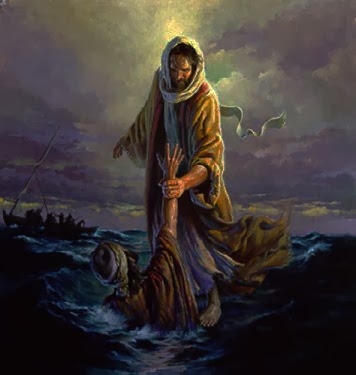
“Come,” he said. Then Peter got down out of the boat, walked on the water and came toward Jesus. But when he saw the wind, he was afraid and, beginning to sink, cried out, “Lord, save me!”Immediately Jesus reached out his hand and caught him. “You of little faith,” he said, “why did you doubt?” Matthew 14:29-31
I’m scheduled for major surgery in a few days. The procedure will necessitate a long convalescence period. While I’ve had several surgeries during my life, this marks the first time that I’ll be under general anesthesia. I’m not looking forward to it. To be truthful, my dread of this surgery has tested my faith. Yep, I’m a little bit scared.
For many years I have enjoyed the writings of Scottish theologian Oswald Chambers. I first discovered him through his famous daily devotional, “My Utmost for His Highest.” You might have noticed that I frequently quote Chambers in this blog. One of my favorite pieces of his wisdom is:
The great word of Jesus to His disciples is Abandon. When God has brought us into the relationship of disciples, we have to venture on His word; trust entirely to Him and watch that when He brings us to the venture, we take it.
The Apostle Paul is a great example of living a life abandoned to God. In Acts 20:22-24, Paul tells the elders of the Church at Ephesus, “And now, compelled by the Spirit, I am going to Jerusalem, not knowing what will happen to me there. I only know that in every city the Holy Spirit warns me that prison and hardships are facing me. However, I consider my life worth nothing to me; my only aim is to finish the race and complete the task the Lord Jesus has given me—the task of testifying to the good news of God’s grace.”
Throughout history, many people have chosen to abandon a sinking ship when the situation became so bad that an act of desperation appeared to be their only way out. Being abandoned to God is like jumping off a sinking ship and finding Jesus there, walking on the water and offering his hand to pull you above the dangerous waves as he whispers, “You of little faith, why did you doubt?”
A life of abandon is content with God, not with circumstances. That’s how I want to live. I close asking for your prayers as I undergo surgery on April 29. Until the next time!
I am the Lord your God who takes hold of your right hand and says to you, Do not fear; I will help you. —Isaiah 41:13 (ESV)
Note: I periodically turn to previous blog entries for content that is relevant today. This entry is based upon an article I wrote in 2015.
Many people today are scared. Constant fear is slowly become part of the human condition. It’s running rampant right here in America. The majority of Americans now believe that their children’s lives will be harder than their own. They worry about unemployment and the economy. Many fear illegal immigrants. Others are afraid to gather in public places for fear of violence. Why wouldn’t people be afraid? Many media outlets and politicians survive by instilling fear in the public.
On a cosmic scale we hear about giant solar flares that could destroy technology, pushing humankind back into the Stone Age. A large meteor or asteroid collisions could destroy the Earth.
In the natural world, super volcanoes threaten to cause destruction on a planetary scale. Earthquakes like the recent one in Haiti and tsunamis in diverse places threaten thousands of lives. Many fear that global warming will cause killer storms, droughts, melting polar ice, coastal flooding and forest fires.
On the human plane, we have just just witnessed the rapid collapse of the US-backed government in Afghanistan and the ensuing chaos and death. Many fear the threat of terrorism in the homeland as a result of Afghanistan’s demise. Others fear home grown terrorists. Yet others worry about flesh eating bacteria, brain eating amoebas, the CORONA-virus Delta variant, and a growing list of drug resistant bacteria and viruses. Some hunker down in their homes, worried about wearing masks, riots, violence by/against the police, and mass murders making public places unsafe. Some fear that computer hackers will steal their identities and wealth. Others fear hackers will disrupt our critical national infrastructure, as we recently saw with the hack on the Colonial pipeline. There are wars and rumors of wars. Religious persecution is increasing around the globe. It can all be paralyzing.
Do not fear.
There are two types of fear mentioned in the Bible. The first is fear of the Lord. This fear is not associated with being frightened. It is a reverential awe of God and is to be encouraged. According to Psalm 111, fear of the Lord is the “beginning of wisdom” and leads to rest and peace.
The second type of fear is detrimental. In the first chapter of 2 Timothy it is described as a “spirit of fear.” A person can be completely overcome by a spirit of fear, virtually frozen and unable to function. Such fear weighs a person down physically, emotionally and mentally.
Unfortunately, many Christians have succumbed to a spirit of fear. Some fear those of other religions and are reluctant to reach out to them in Christian love. Some fear those who are different from them culturally or racially. Some of us are hesitant to invite those in need into their lives for fear they might lose something or it might cost something. Some are afraid to leave the comfort of their homes and familiar surroundings in order to reach out to the needy. Others are hesitant to give of their wealth for fear they might later find themselves in need. A few are afraid of just about everything.
Christian fears often boils down to a fear of losing something—possessions, comfort, safety, security. In Philippians chapter 3, verses 7-8 (ESV), St. Paul describes how he has let go of the things of this world in order to focus on what is truly important: ” But whatever gain I had, I counted as loss for the sake of Christ. Indeed, I count everything as loss because of the surpassing worth of knowing Christ Jesus my Lord.”
It is impossible to grasp the outstretched hand of Christ as long as we tightly cling to things of this world. David tells us in Psalm 34 verses 4-7 (ESV):
“I sought the Lord, and he answered me and delivered me from all my fears. Those who look to him are radiant, and their faces shall never be ashamed. This poor man cried, and the Lord heard him and saved him out of all his troubles. The angel of the Lord encamps around those who fear him, and delivers them.”
Take the fears before you today and give them to the Lord. You may paralyzed by a fearful nature, facing a health crisis, unemployment, divorce, a call to missionary service, or other difficult challenges. The best first step in any situation is to cast aside your fears—let go and let God!
Finally, be strong in the Lord and in the strength of his might. Put on the whole armor of God, that you may be able to stand against the schemes of the devil. For we do not wrestle against flesh and blood, but against the rulers, against the authorities, against the cosmic powers over this present darkness, against the spiritual forces of evil in the heavenly places. —Ephesians 6: 10-12 (ESV)
“The remarkable thing about God is that when you fear God, you fear nothing else, whereas if you do not fear God, you fear everything else.” —Oswald Chambers
In his popular play All’s Well that Ends Well, William Shakespeare said, “Love all, trust a few, do wrong to none.” This quote could introduce a number of discussions, but today I want to focus on trust. The Miriam Webster Dictionary has several definitions of trust. For this discussion, I’ll focus on the first, which is “assured reliance on the character, ability, strength, or truth of someone or something.”
Think about this question for a minute and then try to answer. Who can you trust? I’ll bet you didn’t come up with a long list of people. The fact is that most of the people reading this blog aren’t very trusting. According to polls of American voters, trust in the U.S. Congress is running at near all-time lows, as is trust in many state and local governments.
Much of this distrust is fueled by the pending insolvency of many so-called “trust funds,” like the Social Security “lock box,” which apparently isn’t locked tight enough to keep the Congress from raiding it and depleting the funds. Then there are numerous similar lock boxes at the state and local levels established to fund the retirements of teachers, firefighters and police. It seems that politicians have raided many of these as well, causing some states and municipalities to renege on their retirement promises to employees.
Trust in amorous relationships is on the rocks. Social media is awash in “cheater” stories and videos. Videos about catching cheaters in the act have become a popular form of entertainment. Websites with advice on how to cheat on your significant other without getting caught abound.
You certainly can’t trust a lot information on the Internet. Internet sexual predators take on false identities to try to lure children into sexual encounters. Internet news sites (and news outlets in general) are awash in so-called “fake news.” Comparing the story lines of Fox News (right-leaning) and CNN (left-leaning), for instance, gives two very different views of reality.
You can’t trust advertising, especially when it comes to products like weight loss supplements, miracle cures, and get rich quick schemes. Environmental news is questionable—global warming advocates and so-called global warming deniers are locked in seemingly mortal combat. Do you have a financial adviser or auto mechanic you fully trust? Do you have complete faith in your physician or dentist? Do you trust the attendants in the nursing home that’s caring for your parent? Do you trust the weather forecaster on your TV? Do you even trust the clergyman in the pulpit?
So amidst all this distrust in the world, who can you trust? The great entertainer Lawrence Welk, who was better known for Polkas than proverbs, might have said it best when he advised, “Never trust anyone completely but God. Love people, but put your full trust only in God.” Scripture is full of similar advice (references are taken from the NIV):
Proverbs 3:5-6, Trust in the Lord with all your heart and lean not on your own understanding; in all your ways submit to him, and he will make your paths straight.
Micah 7:5-6, Do not trust a neighbor; put no confidence in a friend. Even with the woman who lies in your embrace guard the words of your lips. For a son dishonors his father, a daughter rises up against her mother, a daughter-in-law against her mother-in-law—a man’s enemies are the members of his own household.
1 Peter 2:6, For in Scripture it says: “See, I lay a stone in Zion, a chosen and precious cornerstone, and the one who trusts in him will never be put to shame.”
There are many other examples of scripture that speak to trust. The best advice I can provide is to trust in God alone. Your friends and loved ones will inevitably let you down, but God will never fail you. You can trust me on this!




 Divine Simplicity
Recent Comments