Archive for the ‘simplicity’ Category

The joy of the Lord

The Joy of the Lord

If you’re a user of Facebook or YouTube, you’ve probably seen videos of military service members who have been on deployments reuniting with family members.  These are moments of pure joy and happiness.  They seem to say, “everything is going to be OK now.” This type of joy is a wonderful mountaintop experience, but it is fleeting.  It’s simply not possible to sustain such temporal joy, but there is another type of joy that’s eternal.  

Joy is the simplest form of gratitude.  Karl Barth

Did you ever meet somebody you just knew was a Christian without being told?  There are some people whose face and disposition simply can’t hide the joy of Christ that dwells inside them. Often, this kind of person will invite you to visit their church. Christians want to share their joy with others. They are thankful for the joy that dwells within.  In Galatians 5:22, the Apostle Paul calls joy a fruit of the Holy Spirit. In 2 Corinthians 2:3, Paul describes how he wants to share his joy with the people of the young church in Corinth.

Describing Christian joy to a non-believer can be difficult. When I was a young captain serving in the Army, I had a battalion commander who assigned me a special project.  I listened to his instructions, but they weren’t clear to me.  I asked specifically what sort of product he expected me to give him when I had completed the project. His surprising response was, “I’m not sure, but I’ll know it when I see it.” Christian joy is like that, you’ll never fully understand it until you’ve experienced it.

Joy may include happiness, but happiness is not a precondition for Christian joy.  The Apostle Peter describes joy as gladness not based on circumstances (1Peter 1:8-9). Paul says in 2 Corinthians 7:4, “In all our affliction, I am overflowing with joy.”  Clearly, Christian joy does not depend on being happy.  It is founded in the assurance that:

  • Jesus has paid for all your sins, past, present, and future.
  • You have been freed from the power of sin and can choose to obey.
  • You live under God’s grace and mercy.
  • You are an adopted child of God.
  • You have eternal life.
  • God knows you by name and hears your prayers.
  • You are part of God’s church family and joined by the Holy Spirit to fellow Christians.

In Romans 15:13 Paul says, “May the God of hope fill you with all joy and peace as you trust in him, so that you may overflow with hope by the power of the Holy Spirit. Joy and peace are yours for the taking if you will put your trust in God today.

Doxology: To him who is able to keep you from stumbling and to present you before his glorious presence without fault and with great joy— to the only God our Savior be glory, majesty, power and authority, through Jesus Christ our Lord, before all ages, now and forevermore! Amen.  –Jude 1:24-25

Enduring Truths for Recent Graduates

Eight years ago I wrote an article  for my newspaper column with some advice for recent grads.  It has become one of the most popular pieces I ever wrote. I’ve received hundreds of emails thanking me for writing it.  Therefore, I decided to  republish it annually around graduation time.  I hope some of you might find it useful.  You can view the original article in the Tribune-Democrat news at this link: http://goo.gl/LtN72

For those who are graduating high school this year and beginning the long transition into adulthood, I’d like to offer you a gift. Here are five enduring truths I have learned. They will help you through life’s journey.

Choices

“If you decide to just go with the flow, you’ll end up where the flow goes, which is usually downhill, often leading to a big pile of sludge and a life of unhappiness. You’ll end up doing what everyone else is doing.” ― Sean Covey, The 7 Habits of Highly Effective Teens

 Life will deal you an endless string of choices along the way.  Some will be trivial, like deciding what to wear today.  Others will be weighty and their outcomes will affect you forever.  Weighty decisions should always be preceded by much thought and soul searching.  This includes decisions about who you date or marry, what you put into your body, bringing children into the world, what you do for a living, how much debt you incur and who you associate with.

All of these decisions will have a lasting effect on your life. Therefore, make them slowly and deliberately. Often you’ll discover that the right choice is not the easiest one.  A habit of making poor choices will, as the Sean Covey quote suggests, drag your life downhill.

I was recently contacted by a young man who had just received a bad conduct discharge from the Navy.  He asked me how the discharge would impact his future employability.  His mistake was choosing to drive a car while intoxicated and hitting a pedestrian. Fortunately, the victim wasn’t seriously injured. Had it been otherwise, the young sailor would probably be in prison.  It was my sad responsibility to inform him that with some employers the discharge would be a black mark for life. Choices matter!

Learning

“Experience is a hard teacher because she gives the test first, the lesson afterwards.”    ―Vernon Saunders Law, former professional baseball pitcher and Cy Young Award winner

Some of you will go on to college or technical school.  Others will enter the workforce.  Even if your formal education is over, don’t quit learning. Make learning a lifelong adventure.  I did my undergraduate work at the University of Kentucky.  The school offers a fellowship program for individuals aged 65 and older to attend classes tuition free. Every year numerous senior citizens walk the stage to receive degrees ranging from Associate of Arts to Doctor of Philosophy.  It’s never too late to learn.

Even if you don’t choose to continue formal learning, make it point to learn from life. Observe others; note their successes and failures; then learn from their experiences.  More importantly, learn from your own mistakes.

Some of the greatest lessons I’ve learned, particularly those while serving in uniform, were the result of having made a terrible mistake.  This sort of lesson sticks, like the first time you grab the handle of a hot iron skillet with your bare hand.  The key to learning from mistakes is owning them.  Admit your mistakes and then move on, having learned something from the experience.  Don’t let, “It wasn’t my fault,” be part of your vocabulary.

Work

“A dream doesn’t become reality through magic; it takes sweat, determination and hard work.”  ―Colin Powell, retired U.S. Army four-star general and former U.S. Secretary of State

Work isn’t always fun. If it were, they’d call it play.  Work can be downright unpleasant, but it’s an essential element of life! Along the way you’re going to have jobs you won’t like. Note what you don’t like and make it a point to improve yourself, so you’ll never again have to work at such a job.

Accepting a job means submitting to the authority of those placed over you.  Learn to work within this system.   You’ll inevitably have bosses you don’t like.  Learn to respect the position, if not the individual.

Fairness

“Life is not fair; get used to it.” ―Bill Gates, founder and former CEO, Microsoft Corporation

You will hear much discussion about fairness in this life. It’s all hot air.  Life isn’t fair.  Some good people die young, while some bad people live a long life.   Disease sometimes strikes arbitrarily, for no apparent reason.  Some people prosper while others suffer failure. A death or accident can change your life forever.

There is randomness to life that can’t be avoided.  Don’t expect kindness to be returned with kindness.  Don’t expect generosity to be returned with generosity.  The best choice is to be fair and kind to others and learn to accept what they return to you.

A wise man named Harry Browne ran for president of the United States on the Libertarian Party ticket. On Christmas day in 1966, Browne wrote his young daughter a letter aptly titled, “A Gift for My Daughter.”  I encourage every graduating senior to read it and digest it. In the letter, he explains to his daughter that, “Nobody owes you anything.”  Understanding what Browne meant can truly bless you. You can find it at: https://tenthamendmentcenter.com/2009/12/22/a-gift-for-my-daughter/ 

Faith

“A faith is a necessity to a man. Woe to him who believes in nothing.”  ―Victor Hugo

I once had a senior Army officer tell me he preferred to work with men who possessed spiritual values, regardless of their religion.  He explained that having faith in a power higher than one’s self was an indicator of how one will perform under pressure; in this instance, the pressure meant combat.

Too many people place their faith in all the wrong places.  It might be in wealth, celebrity, good looks, talent, or even government.  Whatever the case, misplaced faith leads to disappointment after disappointment.

To avoid these disappointments, put your faith in God alone.  You, your loved ones and your friends will all inevitably let you down, but God will never fail you.

A perpetual communion with God

Do you love God?  Do you know God’s son, Jesus Christ?  Do you spend time with him daily? Revelation 22:4-5 shows us a picture of the saints in heaven enjoying a “perpetual communion” with God, “They will see his face, and his name will be on their foreheads. And night will be no more. They will need no light of lamp or sun, for the Lord God will be their light, and they will reign for ever and ever.”  While this passage in Revelation paints a picture of the future, the perpetual communion it describes is available to Christ followers today. But how do we get there?

In the hustle and bustle of today’s busy, fast-moving life it can be easy to pass an entire day without having even a single thought of God. At least this is true for me and I suspect many others will recognize it as true.  So how does one achieve perpetual communion with God today?  Here’s a clue.  One of the things I admire about Muslims is their commitment to the daily prayers. Practicing Muslims pause to pray five times a day. The pause for prayer is a chance to center one’s self and refocus on their god.  The prayers go like this:  

  • First: This prayer starts off the day with the recognition of God; it takes place before sunrise.
  • Second: After the day’s work has begun, one breaks shortly after noon to again remember God and seek His guidance.
  • Third: In the late afternoon, the faithful take a few minutes to remember God and the greater meaning of their lives.
  • Fourth: Just after the sun goes down, one remembers God again as the day begins to come to a close.
  • Fifth: Before retiring for the night, the Muslim faithful pause to remember God’s presence, guidance, mercy, and forgiveness.

Whether or not you’re a Muslim, such a daily prayer schedule that keeps one focused on God is a wonderful idea. Abraham was the father of both Islam and Judaism.  In Genesis 17, God appeared to Abraham and “spoke with him,” announcing the Covenant of Circumcision. Genesis chapter 5 list Adam’s descendants down to Noah. Speaking of one descendant who was named Enoch, verse 24 says, “Enoch walked with God, and he was not for God took him.”  

The meaning of this cryptic passage has been heavily debated by Bible scholars. Did Enoch physically walk with God?  Was he taken up to heaven without dying?  The New Testament holds a clue. Hebrews 11:5 says, “By faith Enoch was taken up so that he should not see death, and he was not found, because God had taken him. Now before he was taken, he was commended as having pleased God.” 

It appears that both Abraham and Enoch literally met God—stood in His presence while they lived on this Earth—pretty special to say the least.  Even so, they could not have seen him face to face. Moses too had a literal meeting with God. God spoke to him in Exodus 33:20, saying, “…you cannot see my face, for man shall not see me and live.”  Exodus 33:23 goes on to recount how God physically passed by Moses, showing him his back.

Like Adam and Eve before them, Abraham, Enoch and Moses were blessed to have physically communed with God.  I can’t help but think how easy it would be for me to live in perpetual communion with God if I could physically meet him. God doesn’t make it that easy, however.  As Jesus tells the Apostle Thomas in John 20:29, “Have you believed because you have seen me? Blessed are those who have not seen and yet have believed.”

What moves someone to believe without seeing. From Jesus’ own words spoken to “doubting Thomas,” we can extrapolate that developing a perpetual communion with God requires faith. The renowned Scottish theologian Oswald Chambers said, “The mystery of God is not in what is going to be, it is now…Realize that the Lord is here now, and the freedom you receive is immediate.”  Communion with God leads to liberation—being set free from the cares and worries of the day. How can one achieve this liberation? As Chambers suggests, we must first recognize that God is here now! 

How is such a close communion developed?  Unlike justification, which Luther explained is achieved “through faith alone” (sole fide), developing a perpetual communion with God requires more than faith.  It requires hard work. This work takes two forms: studying the Scriptures and praying without ceasing, as Paul describes in 1 Thessalonians 5:16-18. We cannot truly come to know and understand God without committing ourselves to studying the scriptures, for they are the revealed word of God. Prayer is also essential.  Psalm 143 suggests we should begin each day with prayer: “Let me hear of your loving-kindness in the morning, for I put my trust in you.”

With respect to praying, one often overlooked aspect of prayer is extremely important to developing a perpetual communion with God—praying requires listening!  We need to take time to be silent and listen for the voice of God. God is with us.  His name is Emmanuel. Start getting to know Him today and begin the hard work of developing a perpetual communion with Him.  

Amazingly, the Creator and Ruler of the universe wants to spend time with you so that you can know Him better. It’s as if He is saying, “I want you all to Myself for a little while.” Take Him up on the invitation to get away to a quiet place and learn about Him.  –Dr. Charles Stanley

Dust in the wind: a Lenten reflection

“Remember that you are dust and to dust you shall return.”

As I began writing this post it was the first Sunday in the church season of Lent, a 40-day period of prayer, fasting, and almsgiving that begins on Ash Wednesday and ends at sundown on Holy Thursday. Lent is a time of preparation to celebrate Christ’s resurrection on Easter day. The blessing priests pronounce at the Ash Wednesday service is a solemn reminder of our mortality—the priest draws the sign of the cross with ashes on one’s forehead while saying, “Remember that you are dust and to dust you shall return.”

On the surface, this seems like an odd sort of blessing—a reminder that you’re going to die someday.  Death is an inevitable part of life, but it’s a contradiction because it wasn’t part of God’s plan for us. The Lenten ashes on one’s forehead reminds us that we are dead in our sinfulness and that our only hope is God’s saving grace, a gift offered freely through Christ’s death and resurrection.   

Christ’s sacrifice on the cross, where he bore the sins of the world, revealed God’s limitless love for each of us. Death has a way of revealing love. Over the past 100 days I’ve lost three dear friends and Army pals. For me, their deaths are also a reminder of my own mortality. I miss them all and will miss them always.  It’s easy to take someone for granted while they’re alive, but their death provides a stark reminder of how much they meant in one’s life. Though I miss them all, I take comfort in the knowledge that they were all Christ followers and they will see the Lord face to face on Resurrection Day.  

Lent is a somber season. The focus on penance, fasting, and one’s mortality is like living Christ’s final journey to Jerusalem and His crucifixion. The beauty of the crucifixion is that it isn’t the end of the story. It is the chapter in Jesus’ life leading to the season of Easter and the celebration of His glorious resurrection, which brings a gift of eternal life to those who accept him as Savior.  Lent is my favorite church season.

“(Lent) is a period of spiritual ‘combat’ which we must experience alongside Jesus, not with pride and presumption, but using the arms of faith: prayer, listening to the word of God and penance. In this way we will be able to celebrate Easter in truth, ready to renew the promises of our Baptism.”  -Pope Benedict XVI

If you come from a church tradition that doesn’t celebrate Lent, I encourage you to learn more about it. There are many free resources available online from the Anglican Church in North America (ACNA). Please visit the “Gift of Lent” link below. 

Lent
by Christina Georgina Rossetti

It is good to be last not first,
Pending the present distress;
It is good to hunger and thirst,
So it be for righteousness.
It is good to spend and be spent,
It is good to watch and to pray:
Life and Death make a goodly Lent,
So it leads us to Easter Day.

The tough work of prayer

Prayer is like a battle. The enemy is constantly placing barriers in your way to keep you from reaching your final objective.

Life is a series of continual distractions that make it difficult to find time to commune with God. Even if one manages to slip away to a quiet place for a few minutes, odds are they will find themselves distracted by thoughts about what lies ahead in their day or week. I’ve heard so many people complain, “My days are so busy I just can’t find time to pray.”  In reality, if you have a busy day ahead you can’t afford not to pray. Paul’s epistle to the Church at Philippi says:

Do not be anxious about anything, but in every situation, by prayer and petition, with thanksgiving, present your requests to God. And the peace of God, which transcends all understanding, will guard your hearts and your minds in Christ Jesus. –Philippians 4:6-7

This is tough advice!  Who, after all, is not anxious about something, especially in the midst of the COVID-19 pandemic?  And how difficult is it to present your prayers to God with thanksgiving in every situation? “Dear God, I thank you for allowing me to crash my car into that tree yesterday.”  Prayer is tough work indeed.

The nation has just gone through a painful, extraordinarily divisive presidential election process. The political rhetoric is still turned up to near the boiling point. Political disagreements have resulted in many friendships ending and have even caused divorces. Sometime it feels like the entire world has gone mad amidst the name calling, threats, riots, burning and looting. Many politicians will tell you that they have the answers to all our problems, but they don’t. Only God can fix this mess!

I lift up my eyes to the mountains—where does my help come from? My help comes from the Lord, the Maker of heaven and earth.  —Psalm 121:1-2

More than any time in recent history, America’s Christians need to join together in praying for our nation and those whom have been elected to serve. So, what about that politician from the “other” party?  Should you pray for him or her?  “God, please help this idiot to see how wrong he is.”  Well, not exactly.  You can certainly pray that the Holy Spirit would convict the individual politician to make decisions that honor God, especially politicians who profess to be Christ followers.   

If you have a beef with a particular politician—get over it.  I don’t mean this in the traditional fashion that contemporary culture says “get over it.”  I mean that, as Christians, we are obliged to forgive those who have trespassed against us, just as we pray to God to forgive us our own sins.      

“In Jesus, we experience freedom not only from sin and its hold on us but also from guilt, shame, worry, Satan’s lies, superstitions, false teaching, and eternal death. No longer hostages, we have freedom to show love to enemies, walk in kindness, live with hope, and love our neighbors. As we follow the Holy Spirit’s leading, we can forgive as we’ve been forgiven” —Patricia Raybon, Our Daily Bread

Now here’s where it really gets difficult.  Not only are we told to “forgive as we’ve been forgiven,” but in Matthew 5, Jesus tells us to love our enemies:

You have heard that it was said, ‘Love your neighbor and hate your enemy.’ But I tell you, love your enemies and pray for those who persecute you, that you may be children of your Father in heaven. He causes his sun to rise on the evil and the good, and sends rain on the righteous and the unrighteous. —Matthew 5:43-45

Is there a politician or other leader whose behavior absolutely disgusts you?  If so, think of that person, then pray for him or her. Really!  Pray that God will soften their heart.  It they profess to be a Christian, ask God to fill them with the Holy Spirit.

Since 2001, The Presidential Prayer Team has been the source thousands of Americans have turned to for encouragement and inspiration to pray for America’s leaders. It is a non-partisan organization.  I encourage you click the “About Us” link below to visit their website and sign up for the daily prayer alerts.

A Prayer for Good Leaders

Father God, good leaders, come from you. Lord, this nation needs leaders with discerning hearts and wise minds. I beseech you today asking you today to give us wise leaders that will lead this nation in the right direction. Remove wrong people that are corrupt and living against your word from influential positions. Let our leaders be people who honor your holy name for it is only from you that they will get true wisdom. It is in the mighty name of Jesus that we believe and pray, Amen. —Anonymous

What do you believe?

“What are we to make of Christ?” There is no question of what we can make of Him; it is entirely a question of what He intends to make of us. You must accept or reject the story.

—C.S. Lewis

I’m a member of a parish of the Anglican Church in North America (ACNA).  Each week during Sunday worship we recite the words of the Nicene Creed, a widely accepted collective statement of faith in the triune God. I’ve been reciting the creed for so many years that now it is memorized and literally flows effortlessly out of my mouth each Sunday.

I enjoy communal prayers, but with this form of prayer comes a risk—the words become so familiar they can lose personal meaning. The renowned Scottish theologian Oswald Chambers said, “When we become advocates of a creed, something dies; we do not believe God, we only believe our belief about Him.”

This begs the question, “What does it mean to believe something?” I’ve provided two definitions above.  I prefer the second one. This leads to another question, “What is the difference in believing something and believing in something.”  Surely Satan believes in God, as he has seen God face to face.

  “You believe that there is one God. Good! Even the demons believe that—and shudder.” James 2:19 (NIV)

With all this in mind, I’d like to challenge each reader who calls him- or herself a Christian to examine your beliefs in the coming year. Do you believe God? If so, what exactly do you believe and what is the source of your beliefs? Let me preface the remaining discussion by confessing that I have many more questions on this subject than answers.   

A Gallup poll conducted in May 2017 indicated that a record few Americans (24%) believe the Bible is the literal word of God (Gallup poll). A 2020 Barna Group survey published by the American Bible Society indicated that “Mainline Protestant denominations had the largest proportion of unchurched adherents (50%) with one in every two members being unchurched, followed by 46% of Catholics, 37% of Evangelicals, and 36% of Historically Black Protestants.” (Barna Group Survey).  

Where do you stand on this?  If you believe the Bible is the inspired word of God, do you read it frequently? If you answered “no,” why not? How well versed are you in the scriptures?  If the Bible isn’t the source of your Christian beliefs, what is?  If you profess to be a Christian and don’t regularly attend church, why don’t you?

The bottom line of my thought process can be summed up like this: “If you can’t articulate what you believe, how can you live what you believe?”  In the coming year, I challenge each reader to answer the following questions for themselves. Take time to research the scriptures and other authoritative sources as you formulate your answers.  Try to discuss “why” or “why not” in each of your answers.

  1. Do you “believe” God or do you “believe in” God?
  2. Do you believe the Bible is the inspired word of God or just a book of wisdom?
  3. Proverbs 9:10 says, “The fear of the Lord is the beginning of wisdom.” What does it mean to fear the Lord?
  4. Do you believe the creation story in Genesis 1 is literal or figurative?
  5. Is Jesus the son of God or simply a great moral teacher?
  6. Do you believe in the virgin birth?
  7. What is sin and what is salvation?
  8. Do you believe Jesus died for your sins?
  9. Did Jesus really rise from the dead?
  10. Is Jesus the only pathway to God, as He said, or are there other paths?

Many people claim we’re presently living in a “post-Christian” era today, where Western cultures are increasingly embracing secularism and turning their backs on their original Judeo-Christian roots. More and more, we see Christians accused of being racists, bigots, homophobes, transphobes and a host of other slurs because of their beliefs. This is occurring both before the law, in the media, and in the court of public opinion. When your faith is eventually questioned by a non-Christian, as it inevitably will be, will you be prepared to articulate what you believe or will you silently submit to their accusations?

I sought the Lord, and he answered me; he delivered me from all my fears.

Those who look to him are radiant; their faces are never covered with shame.

This poor man called, and the Lord heard him; he saved him out of all his troubles.

The angel of the Lord encamps around those who fear him, and he delivers them.

Taste and see that the Lord is good; blessed is the one who takes refuge in him.

—Psalm 34:4-8 (NIV)

Until I come, devote yourself to the public reading of Scripture, to preaching and to teaching. Do not neglect your gift, which was given you through prophecy when the body of elders laid their hands on you. Be diligent in these matters; give yourself wholly to them, so that everyone may see your progress. Watch your life and doctrine closely. Persevere in them, because if you do, you will save both yourself and your hearers. —1 Timothy 4:13-16 (NIV)

Saying goodbye to a brother in arms

Until this year, Veterans Day had become a relatively mundane affair for me.  As a 24-year veteran of the US Army, I’ve had my share of “Thank you for your service,” free meals from a special menu at (name your restaurant), and 10% discounts “for one day only” at various stores.  However, after this year Veteran’s Day will never be the same, as it is henceforth the day I said goodbye to a brother in arms.

In 1981 my wife and I were assigned military quarters in a duplex on a hilltop overlooking Godman Army Airfield at Fort Knox, Kentucky. I was a young captain serving in the Field Artillery. The couple living on the other side of the unit was approaching the end of their tour of duty at Fort Knox. It wasn’t long before they were gone and a new family moved in.  Although we were unaware at the time, God’s hand was moving in our lives by giving us these new neighbors.

Bill and Susan were a unique couple.  Susan was a former Army officer and a member of the last generation of the Women’s Army Corps—the women’s element of the US Army. The WAC, as it was called, was disbanded in 1978, and all units were integrated with male units. Bill, or “Flip” as he was better known to many of his friends, was a figure larger than life. He was a soldier’s soldier—what every professional soldier aspires to be.  Commissioned as an Infantry officer, Flip was highly decorated in Vietnam, winning a Silver Star for valor in action against the enemy, two Purple Hearts in recognition of his status as a twice-wounded soldier, the Legion of Merit, and two Vietnam Crosses of Gallantry. He also earned the Ranger tab and a coveted Combat Infantryman Badge, or C.I.B., in recognition as his service as an Infantryman in combat. When I met him, Flip was an officer in the Army’s Aviation Branch, a helicopter pilot flying Bell UH-1 Iroquois helicopters, better known as “the Huey.” I was in awe!

Despite my being 10+ years younger and of lesser rank, Flip never let that stand between us.  He quickly became both a friend and mentor. Most importantly, he was a man of God.  Flip had a deep faith that he was not shy about sharing with others. He and Susan introduced my wife Linda and me to the Anglican form of liturgical worship, which eventually led to us becoming Anglicans ourselves. What a wonderful gift!  Bill and Susan would later become the godparents of our two daughters and, in turn, their two children would become like daughters to us.

My friend Flip died on August 21, 2020. During this time of pandemic, we were fortunate to participate in his online memorial service on Veterans Day.  Like too many Vietnam veterans, late in life Flip suffered numerous ailments connected with his military service.  The brave men and women who served in Vietnam are quickly declining in numbers today—many have reached their 70’s and 80’s and there are even a few in their 90’s. They deserve our thanks and admiration, as well as the Veterans Administration’s medical support and other services that a grateful nation owes them.

For those who might have served as Army officers at Ft. Knox, KY in the early 1980’s, you’ll understand when I tell you that Flip and I often shared time together at the Fiddler’s Green.  But unlike forlorn cavalrymen in the poem by the same name, who are eternally destined to quench their thirst at an old-time canteen, the passing of my friend is no cause for sorrow or melancholy.  It’s a time for celebrating a life lived for God, family and country.  As with the passing of every Christian brother in arms whom I’ve bid a similar farewell, I rest assured knowing that I’ll see Flip again on that day when Christ restores all things on Earth to the original order that God intended. His departure leaves us with an emptiness which only Flip could fill, but we take comfort in assurance of the glorious reunion to come. Until that day, rest in peace brother!

In Memoriam

Lieutenant Colonel (Ret) William John Filippini

August 26, 1944 – August 21, 2020

Fiddler’s Green

Feed My Sheep

The Good Shepherd (C.1650-60) by Philippe de Champaigne

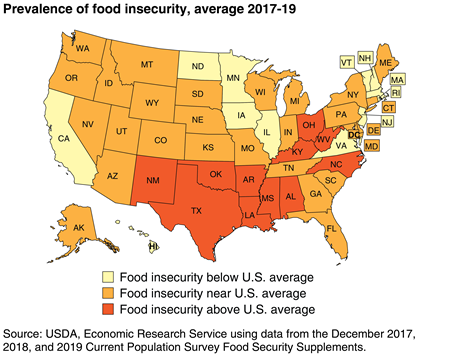
My recent work with a struggling young man in my community has provided me a stark reminder of the reality of hunger in America. The US Department of Agriculture (USDA) defines food security as “having access, at all times, to enough food for an active, healthy life for all household members.”  According to USDA figures, 10.5 percent of American households in 2019 lacked proper food security. While the government’s 2020 food security figures are not yet available, indications are that this year’s numbers will be much higher.  The primary reason for this is the sharp increase in national unemployment due to the COVID-19 pandemic. As the map below shows, the food insecurity problem is widespread.

As a state workforce developer in Pennsylvania, I worked with hundreds of clients who had recently lost their jobs.  Food security was often a major concern of these displaced workers. Many had small children at home, making their situations even more dire.  More recently, as a volunteer job coach working with the elderly, I discovered that food security is a major concern for many of my clients. My typical client is age 70 or older, dependent upon a Social Security check of less than a thousand dollars a month as their primary income, and frequently has to decide between purchasing expensive prescription drugs or food, as they lack sufficient income to pay for both with what remains after paying the rent or mortgage.  

While the mission of Christ’s church is to spread the Gospel, it’s difficult to convey the Good News to someone with a growling, empty stomach. Jesus clearly recognized this. By feeding the five thousand in the miracle of the loaves described in John 6, Jesus provided for the physical needs of the crowd.  The very next day, he called Himself the “Bread of Life.” (John 6:35). Clearly, one needs food in the belly in order to be more open to partaking of the Bread of Life.  The level of involvement in feeding the needy varies significantly from church to church.  Many get involved in collecting and distributing holiday food baskets for the needy.  While this is a wonderful thing, such baskets only cover a few days of the annual 365 that people need to eat. Much more is needed.   

Food banks and pantries exist across the country to help support food security. Typically, a food bank supports a region (such as a county), while local food pantries serve small towns or communities within larger towns/cities. According to the non-profit organization Feeding America, a food bank is a non-profit that safely stores thousands to millions of pounds of food for bulk distribution to local food programs, like food pantries. Food banks come in all different sizes. In contrast, food pantries receive food shipments from food banks and run food distribution programs where hungry families can receive food directly. Pantries feed hundreds of people per week! Because every community is different, there are many different types of pantries. It is common for a food pantry to operate from inside a community school or church. Some areas even have mobile food pantries to serve seniors with limited mobility or rural communities with little transportation.  Some pantries require the clients to demonstrate financial need, while others serve anyone who shows up. Some communities also have food kitchens, where the needy can eat a hot, nutritious meal.

Churches and individuals can help their local food banks, pantries and kitchens in a number of ways by donating money and by volunteering their time. Check directly with your local organizations to ascertain the best way to help each. A general rule of thumb is that monetary donations are preferable to food, as it enables the organization to spend where the need is greatest. Another general rule is that volunteers are always needed; this is particularly so during the COVID-19 pandemic.  Many food banks, pantries and kitchens have adopted special precautions for COVID-19.  Those who might wish to volunteer should check with their local organization(s) to determine if they are comfortable volunteering in light of the precautions that have been adopted. In any case, I encourage you to reach out as you can to support food security in America. As James 2:15-16 tells us, “Suppose a brother or a sister is without clothes and daily food. If one of you says to them, “Go in peace; keep warm and well fed,” but does nothing about their physical needs, what good is it?

Jesus feeds the five thousand, John 6:1-13 (NIV).  Some time after this, Jesus crossed to the far shore of the Sea of Galilee (that is, the Sea of Tiberias), and a great crowd of people followed him because they saw the signs he had performed by healing the sick.  Then Jesus went up on a mountainside and sat down with his disciples. The Jewish Passover Festival was near.  When Jesus looked up and saw a great crowd coming toward him, he said to Philip, “Where shall we buy bread for these people to eat?” He asked this only to test him, for he already had in mind what he was going to do.

Philip answered him, “It would take more than half a year’s wages to buy enough bread for each one to have a bite!” Another of his disciples, Andrew, Simon Peter’s brother, spoke up, “Here is a boy with five small barley loaves and two small fish, but how far will they go among so many?”

Jesus said, “Have the people sit down.” There was plenty of grass in that place, and they sat down (about five thousand men were there). Jesus then took the loaves, gave thanks, and distributed to those who were seated as much as they wanted. He did the same with the fish.

When they had all had enough to eat, he said to his disciples, “Gather the pieces that are left over. Let nothing be wasted.” So, they gathered them and filled twelve baskets with the pieces of the five barley loaves left over by those who had eaten.

Do not let your hearts be troubled

Jesus Watches Mary of Bethany Weeping at His Tomb

In John 14, Jesus’ disciples are troubled by the Lord’s words and behavior.  In John 13, Jesus washes His disciples’ feet and tells them that one who wishes to be a leader must be the servant of all.  He informs them that he is going away to a place where they cannot follow, foreshadowing his crucifixion, death and resurrection. Jesus tells them that one of the disciples will betray him. Finally, he tells Peter that he will deny Jesus three times. By this time, all the disciples are pretty shaken.  But next Jesus reassures and comforts them saying, “Do not let your hearts be troubled” (John 14:1) *.  He then goes on to explain that He is going away to prepare a place for them in heaven.

Such comforting words are needed today. The entire country is politically supercharged over the upcoming election.  Harsh words are spoken on both sizes of the aisle. Violent protests fill the streets of many major cities nightly. I continually hear people from the left, right, and middle expressing fears and worries over the future of America. This shouldn’t be a concern for Christians.

Here’s a news flash. The upcoming election has already been decided. The future of America has already been decided. Despite the hate and chaos, God’s divine plan is unfolding just as he wills it. The Father’s plan for Christ followers is the same as Jesus plan for His disciples.  He is preparing a place for Christians in Heaven. This plan was established before the Earth was created. It may seem to sometimes that God is moving slowly, but he isn’t.

But do not forget this one thing, dear friends: With the Lord a day is like a thousand years, and a thousand years are like a day. The Lord is not slow in keeping his promise, as some understand slowness. Instead he is patient with you, not wanting anyone to perish, but everyone to come to repentance. –2 Peter:8-9

Time is a perception that humans use to help wrap their minds around what occurs in life, but time is meaningless to God.  We see this clearly in Exodus 3:14, when God tells Moses that God’s name is “I am.”  We see this in Revelation 1:8, “I am the Alpha and the Omega,” says the Lord God, “who is, and who was, and who is to come, the Almighty.”  Mike Bennett, who writes for the Christian website Life, Hope and Truth, explains it like this:

The Bible tells us God “calls those things which do not exist as though they did” (Romans 4:17). In other words, God’s plans are so sure that it is as if they had already happened. So, when the One who became Jesus Christ volunteered to die for our sins from the foundation of the world (Revelation 13:8), it was as if He had already been slain. Jesus also described other things that were planned “from the foundation of the world,” and they are just as sure. “Then the King will say to those on His right hand, ‘Come, you blessed of My Father, inherit the kingdom prepared for you from the foundation of the world’” (Matthew 25:34).

“My spirit shakes with terror. How long God, how long? from Psalm 6

Rest assured that God is in control and nothing can change that. No matter what appears to be happening, God’s divine plan is unfolding just as He conceived it before creation. For many this is a difficult concept to grasp. Jesus is the key to God’s plan.  This is stated plainly in John 1:1-5, where John describes Jesus like this: “In the beginning was the Word, and the Word was with God, and the Word was God. He was with God in the beginning. Through him all things were made; without him nothing was made that has been made. In him was life, and that life was the light of all mankind. The light shines in the darkness, and the darkness has not overcome it.

If you are a Christian and find yourself fretting over the coming election or other events occurring in the nation, I encourage you to read (or reread) the Gospel of John.  I guarantee you will find great comfort in its words.  Even if you are not a Christ follower, I encourage you to read the Gospel of John and carefully consider its words, for it is a guide to eternity.

“Lord, to whom shall we go? You have the words of eternal life.” –John 6:68.

* All Bible passages are NIV.

Managing Change

Changes“There are far better things ahead than any we leave behind.” –C.S. Lewis


(Note: All Bible quotes are NIV.)

Most people naturally resist change. Some scientists have theorized this is caused by an innate survival response programmed into human beings at the genetic level. Businesses desiring to grow and remain competitive are often forced to change or face failure.   Change Management is a business discipline used to bring about organizational change while minimizing the impact on the affected individuals (employees, suppliers,  customers etc.).  Dr. Rosabeth Moss Kanter is a professor at the Harvard Business School.  She has written about the 10 common reasons people resist business change. They are:

  1. Loss of Control – Change interferes with autonomy and can make people feel that they’ve lost control over their territory.
  2. Excess Uncertainty – If change feels like walking off a cliff blindfolded, then people will reject it.
  3. Surprise, Surprise – Decisions imposed on people suddenly, with no time to get used to the idea or prepare for the consequences, are generally resisted.
  4. Everything Seems Different – Change is meant to bring something different, but how different? We are creatures of habit.
  5. Loss of Face (dignity) – By definition, change is a departure from the past.
  6. Concerns About Competence – Can I do it? Change is resisted when it makes people feel stupid.
  7. More Work – Here is a universal challenge. Change is indeed more work.
  8. Ripple Effects – Like tossing a pebble into a pond, change creates ripples, reaching distant spots in ever-widening circles.
  9. Past Resentment – The ghosts of the past are always lying in wait to haunt us. As long as everything is steady state, they remain out of sight.
  10. Real Threats – Now we get to true pain and politics. Change is resisted because it can hurt.

Fortunately, the business world has amassed a substantial body of knowledge describing effective methods for managing organizational change. Change Management consulting is a lucrative field of business and can be very effective in ushering in change.   

The seasons of our lives are full of changes as well. People resist life changes for many of the same reasons they resist business change. Human lives are in a constant state of flux. Ecclesiastes 3:1-8 describes this quite poetically:

There is a time for everything,

and a season for every activity under the heavens:

a time to be born and a time to die,

a time to plant and a time to uproot,

a time to kill and a time to heal,

a time to tear down and a time to build,

a time to weep and a time to laugh,

a time to mourn and a time to dance,

a time to scatter stones and a time to gather them,

a time to embrace and a time to refrain from embracing,

a time to search and a time to give up,

a time to keep and a time to throw away,

a time to tear and a time to mend,

a time to be silent and a time to speak,

a time to love and a time to hate,

 a time for war and a time for peace.  

Life changes come in two overarching categories. The first encompasses personal lifestyle changes one might need to make, like losing weight, exercising more, eating healthier, quitting tobacco, eliminating or reducing alcohol consumption, getting more sleep, spending more time with family, reducing social media time and the like. These changes often never come about because they usually involve great individual effort, sacrifice and self-discipline. When one accomplishes such a change, it can be one of the most exhilarating experiences in their life.

The second category of life changes consists of unplanned/unexpected events that life seems to drop on one’s head. Each morning one awakes never knowing what the day might bring—a serious accident, grim medical diagnosis, stroke, heart attack or other life changing event might occur. This category also includes external influences such as political upheaval and societal changes. Unfortunately, the body of knowledge for managing this sort of change is very broad, continually evolving and is riddled with disagreements between the so-called “experts.”  Several fields of study offer solutions for managing the changes of life. These include psychology, psychiatry, sociology and their related disciplines.  

Fortunately, for believers there is a body of knowledge for managing life changes that is totally reliable, one-hundred percent accurate, and immutable. Of course, I’m referring to the Bible. Biblical truth never changes because God never changes. Jesus Christ is a solid rock, an unalterable holy alter upon which we may lay all our hopes and fears.

Every good and perfect gift is from above, coming down from the Father of the heavenly lights, who does not change like shifting shadows.  James 1:17

God is not human, that he should lie, not a human being, that he should change his mind.  Does he speak and then not act?  Does he promise and not fulfill?  Numbers 23:19

Jesus Christ is the same yesterday and today and forever.  Hebrews 13:8

Believers have no reason to fear changes in their circumstances.  Scripture assures of this:

Have I not commanded you? Be strong and courageous. Do not be afraid; do not be discouraged, for the Lord your God will be with you wherever you go. Joshua 1:9

The Lord himself goes before you and will be with you; He will never leave you nor forsake you. Do not be afraid; do not be discouraged.  Deuteronomy 31:8   

Trust in the Lord with all your heart and lean not on your own understanding; in all your ways submit to him, and he will make your paths straight.  Proverbs 3:5-6

The Lord is my rock, my fortress and my deliverer; my God is my rock, in whom I take refuge, my shield and the horn of my salvation, my stronghold. Psalm 18:2

Peace I leave with you; my peace I give you. I do not give to you as the world gives. Do not let your hearts be troubled and do not be afraid. John 14:27

Do not be anxious about anything, but in every situation, by prayer and petition, with thanksgiving, present your requests to God. And the peace of God, which transcends all understanding, will guard your hearts and your minds in Christ Jesus. Philippians 4:6-7

As children of God, believers have no reason be afraid of life changes. Oswald Chambers said it like this, “If your faith is in experiences, anything that happens is likely to upset that faith. But nothing can ever change God or the reality of redemption. Base your faith on that, and you are as eternally secure as God Himself. Once you have a personal relationship with Jesus Christ, you will never be moved again.” 

Blessed is the one who trusts in the Lord, who does not look to the proud, to those who turn aside to false gods.  Psalm 40:4