Archive for the ‘Easter’ Category

Easter 2024 – He is risen

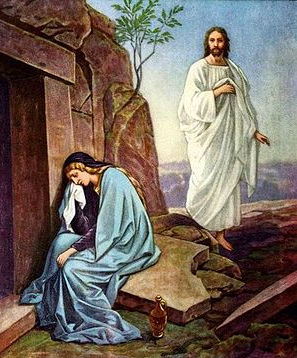
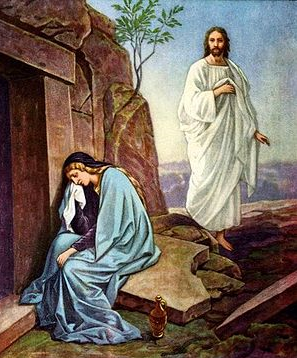
Jesus at His tomb with Mary Magdalene

Matthew 28 (ESV) – He Is Risen

Now after the Sabbath, as the first day of the week began to dawn, Mary Magdalene and the other Mary came to see the tomb. And behold, there was a great earthquake; for an angel of the Lord descended from heaven, and came and rolled back the stone from the door, and sat on it. His countenance was like lightning, and his clothing as white as snow. And the guards shook for fear of him, and became like dead men.

But the angel answered and said to the women, “Do not be afraid, for I know that you seek Jesus who was crucified. He is not here; for He is risen, as He said. Come, see the place where the Lord lay. And go quickly and tell His disciples that He is risen from the dead, and indeed He is going before you into Galilee; there you will see Him. Behold, I have told you.”

So they went out quickly from the tomb with fear and great joy, and ran to bring His disciples word.

The Women Worship the Risen Lord

And as they went to tell His disciples, behold, Jesus met them, saying, “Rejoice!” So they came and held Him by the feet and worshiped Him. 10

Forgiveness

I recently read a book that poses the question, “What about your life before you were a Christian has changed since you became a Christ follower.”  I can think of so many responses, but two stand out. First of all, as a Christian I have a profound sense of personal sin that wasn’t previously there. Note that I speak of “sin,” not “sins.”  My personal sins are a countless laundry list of bad, harmful things I have done during my life. Many people are repulsed by being called a sinner.  Yet sin (without an “s” on the end), is a condition we all live in. Martin Luther described it eloquently in a letter to Philip Melanchthon on August 1, 1521:

 “Be a sinner, and let your sins be strong, but let your trust in Christ be stronger, and rejoice in Christ who is the victor over sin, death, and the world.  We will commit sins while we are here, for this life is not a place where justice resides.  We, however, says Peter (2 Peter 3:13) are looking forward to a new heaven and a new earth where justice will reign.  It suffices that through God’s glory we have recognized the Lamb who takes away the sin of the world. No sin can separate us from Him, even if we were to kill or commit adultery thousands of times each day.  Do you think such an exalted Lamb paid merely a small price with a meager sacrifice for our sins?  Pray hard for you are quite a sinner.”

My second response to the question is that as a Christian I have a tremendous sense of gratitude that God has forgiven all my sins through Jesus Christ. Before becoming a Christian, I didn’t recognize my need for forgiveness. Now I understand that Jesus suffered, bled, and died on the cross as an atonement for not only my sins, but the sins of the entire world.  Hebrews 9:15 tells us that Christ’s blood inaugurated a new covenant. Through His sacrifice, He became the mediator between God and humanity. The old system of blood offerings through sacrificing animals could only cover sin temporarily, but Christ’s blood provides complete forgiveness. His death on the cross bridged the gap between the holy God and fallen humanity. Jesus the risen Lord is now seated at the right hand of the Father, where he intercedes on our behalf, our great High Priest.

The process of forgiveness begins with repentance. Acknowledging our sins, we turn to God, seeking His mercy. Acts 2:38 stresses baptism in the name of Jesus Christ for the remission of sins. More than a mere ritual; it symbolizes our identification with Christ’s death and resurrection. Through faith in Jesus as the risen Son of God, we receive forgiveness—the slate is wiped clean and our sins are remembered no more.

As the season of Lent winds down and Easter approaches, let us all consider Christ’s atonement for our sins. Through His death on the cross, Jesus atoned for the sins all mankind, satisfying God’s demand for justice, and accomplishing reconciliation for all who seek redemption through Him. The obedience and selfless sacrifice of Christ, who felt human emotions and pain just like you and me, serve as the foundation of our salvation. The shedding of Jesus’s blood on the cross symbolizes the ultimate atonement, restoring us to God’s favor and demonstrating the Father’s divine love and mercy. Jesus willingly gave His life for our sins, bridging the gap between humanity and God. His sacrifice on Calvary’s cross paid the price for our transgressions, conquered sin and death, and brought about the resurrection from the dead, not just for Jesus, but eventually for all of His followers.

God proved His love on the Cross. When Christ hung, and bled, and died, it was God saying to the world, ‘I love you.’ –Billy Graham

Lent: a Season of Penitence and Prayer

This piece was originally posted to my blog on February 26, 2019. The church season of Lent in 2024 runs from Ash Wednesday (February 14) to Easter Sunday (March 31).

Easter 2023: He is risen!

Christ is Risen: The world below lies desolate.

Christ is Risen: The spirits of evil are fallen.

Christ is Risen: The angels of God are rejoicing.

Christ is Risen: The tombs of the dead are empty.

Christ is Risen indeed from the dead, the first of the sleepers, Glory and power are his forever and ever.

— St. Hippolytus of Rome

Read Matthew 28.

Distracted Living

Zombie ApocalypseHas the Zombie apocalypse begun!

We’ve all heard tragic stories about distracted driving, where someone texting on a cell phone lost control of their car and caused a great tragedy. When driving, it’s absolutely crucial to keep one’s eye on the road ahead.  The advent of the internet and subsequently cell phones has created millions of distracted people.  You’ve probably seen some of them sitting at a family dinner in a restaurant—all heads down, focused on their phones and no family interaction at all.  How very sad!

According to a January 2020 article in The Guardian, a study conducted in 2014 indicated that mobile phone users receive an average of 63.5 alerts every day, most viewed within minutes whether the phone is on silenced or not. A 2016 study by Deloitte corporation found that people checked their phones an average 47 times a day, often in response to alerts. Many people are bombarded by cell phone beeps, blips and buzzes nearly every waking moment.  These distractions can even continue through the night for those who sleep with cell phones by their beds.

Unfortunately, many Christians today suffer from another form of distraction—distracted living. Distracted living is a byproduct of other distractions and cares of this world, for example partying, obsessive fitness, substance abuse, emails, texting, internet browsing, social media, television, movies, sports, and many others that that steal our time daily.

The Bible story of Mary and Martha is a perfect example of distracted living (Luke 10:38-42).  Mary and Martha were the sisters of Lazarus, whom Jesus raised from the dead. They were all beloved friends of Jesus. On one particular occasion, Jesus visited their home in Bethany. There were others present as well. Mary chose to sit at Jesus’ feet and listen to him teach, while her sister Martha busied herself serving their guests. Martha became irritated with Mary and asked Jesus to send Mary to help her. Jesus responded with a mild rebuke, saying, “Martha, Martha, you are worried and troubled about many things. But one thing is needed, and Mary has chosen that good part, which will not be taken away from her.” Mary was laser focused on Jesus, while Martha was living a distracted life.

People with distracted lives may become easily agitated, they often feel overwhelmed, and they frequently neglect the essential “four-F’s” of things that really matter in this life—faith, family, friends and freedom.  Christians shouldn’t allow any of these areas to suffer neglect, but they must be especially cautious about neglecting their faith. Renowned Scottish theologian Oswald Chambers said, “Starvation of the mind, caused by neglect, is one of the chief sources of exhaustion and weakness in a servant’s life.” Evidence of faith neglect often includes finding reasons to skip church, not finding the time to read and study scripture, not praying, feeling rushed while praying, and even sometimes falling asleep while praying.

Christian churches around the globe will soon begin commemorating the holy season of Lent, which begins on Ash Wednesday (2/26/2020) and runs through sunset on Holy Saturday, the day before Easter.  I blogged about this very special church season in February last year  (https://divinesimplicity.wordpress.com/2019/02/26/lent-a-season-of-penitence-and-prayer/).   

For Christians, Lent is traditionally a season of fasting, penitence and prayer. It’s a wonderful time for Christians to practice disciplines to help them reconnect with their faith.  One of my Lenten disciplines is to prayerfully read the Seven Penitential Psalms the first thing each morning during Lent. I also find a good Lenten devotional and read a morning devotion daily. A wonderful version of the Seven Penitential Psalms can be found at this link: http://www.edgeofenclosure.org/intro7penitentialpsalms.html.  Lutheran Hour Ministries provides a new series of daily Lenten devotions each year.  Beginning on February 26, they can be found at this link: https://www.lhm.org/dailydevotions/default.asp.  I encourage you to take part in a Lenten discipline this year and, if you’re leading a distracted life, begin turning your attention back to God.

Easter 2019

hand-drawn-he-has-risen-luke-24-6-text-on-white-vector-20468630

Holy Week

Triumphal Enter into Jerusalem - HosannaJesus entering Jerusalem

Traditionally, the week before Easter is called Holy Week. It starts on Palm Sunday. Holy week began today.  It is the last week of the penitential church Season of Lent. 

Palm Sunday
In the Bible, Holy Week begins with a religious festival. People have flocked to Jerusalem to celebrate Passover and see the controversial prophet Jesus. Many come to cheer him on as Jesus rides into Jerusalem. They wave palm Branches and shout “Hosanna,” which means “save us,” a Jewish call of lamentation that has since become a call of praise. Jesus enters Jerusalem riding on a Donkey.  Jesus’ triumphal entry fulfills an Old Testament prophecy and is seen as a sign of humility. Some who cheer him that day will inevitably cry “Crucify him” only a few days later, so the memory of Christ’s entrance into Jerusalem is a time of mixed joy and sadness.

Maundy Thursday
In the evening of this day Jesus met with his disciples for the last time before his death. Before the meal, he washes their feet, another sign of humility. During the meal, he prophesies that one of the disciples will betray him. On this evening, Christians are thinking of Christ’s establishment of the sacrament of Holy Communion. In many congregations, a worship service occurs in the evening, in which the congregants come together for a Eucharist meal, just as the first Christians celebrated it. Often after the communion, the altar is cleared, and left unadorned on Good Friday.

Good Friday
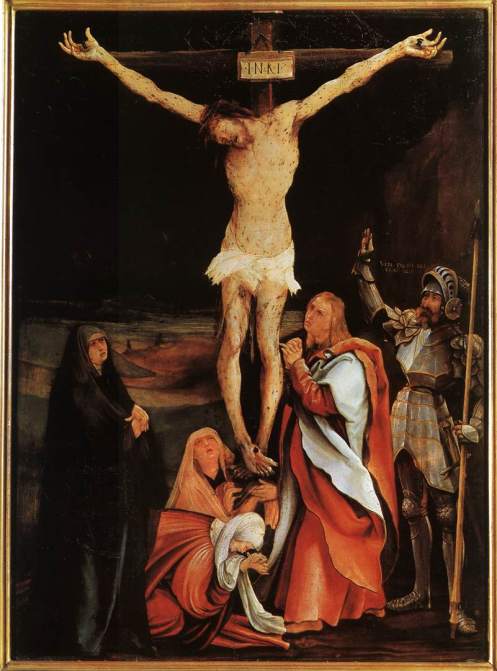
On Good Friday, Jesus was crucified. He was tortured and killed. His suffering is therefore at the heart of this day. But it also commemorates the suffering of mankind in general, because through Jesus, God has sided with the suffering. The day is quietly celebrated as Christians contemplate Jesus’ suffering and death. Together with Easter, Good Friday forms the centerpiece of the Christian message of good news: God is stronger than Death! On that day Jesus suffered all that a man can suffer to atone for the sins of mankind. Sin and Death did not have the last word. God raised Jesus as he will one day raise all believers who die in Christ.

Holy Saturday
On the evening of Good Friday, Jesus was taken down from the cross and buried. On Saturday, the Sabbath, that would not have been allowed. So Saturday is the full day that he was dead. In the creed, this means Jesus descended into Hell, or the realm of the dead. We aren’t sure what that is and what it is like there, but the message that Jesus was “resurrected on the third day” provides confidence that at the end of the age God will resurrect Christian believers.

Easter Night
The Bible doesn’t describe the physical resurrection of Jesus. On Easter morning, the women find the empty tomb and are told by an angel that Jesus was resurrected. That might have occurred at night, because in the Jewish Tradition the day begins with the night (“It was evening and it was morning, the first day”). Easter (Saturday) night belongs to Easter Sunday. The resurrection is celebrated on this “night,” mostly in the early hours of the morning, but in some places it is celebrated on Saturday evening. It is a celebration that, in its design, leads from darkness to light. At its climax many congregations light the new Pascal candle declaring “Hallelujah, Christ is risen; He is risen indeed.”

Easter Sunday
The women who discover Jesus empty tomb are the first to spread the Good News of Jesus’ resurrection. In the course of this and the next few days many people meet Jesus and witness the resurrected Son of God. In the early church congregations met regularly for a common Sacrament the day after the Sabbath to commemorate the resurrection. In the Christian context, Sunday was thus marked as the most important day of the week and as a day of rest.

An invitation:
Easter occurs on April 21st this year. For readers in the Sioux Falls area, you are invited to attend an Easter Sunrise service conducted by Church of the Resurrection (www.resurrectionsf.com). The service will begin at 7a.m. at the McKennan Park bandshell. Bring lawn chairs. The service will occur rain or shine.


Lent: a Season of Penitence and Prayer

Lenten Journey 3

As an Anglican, I follow a Church liturgical calendar, celebrating each of its many seasons.  Very soon the season of Lent will be upon us.  Lent this year is the period of 40 days from Ash Wednesday (March 6th) to Easter Sunday, commemorating Christ’s 40 days of fasting and temptation in the wilderness, His final journey to Jerusalem, where He was crucified, and His last hours with His disciples before His crucifixion. For believers, it is a period of penitence and alms giving. On Ash Wednesday, many Christians have their foreheads marked with ashes in the sign of the cross.  The ashes are often collected from burning the palm fronds used in the celebration of Psalm Sunday.

The Catholic and Anglican traditions regarding Lent are very similar.  In the Anglican tradition, which I practice, Lent is sometimes called the Paschal season (relating to Passover or Easter). It is a preparation time intimately connected to the most important Festival of the Church year, Easter, which marks Christ’s resurrection from the dead and His victor over sin and death. In celebration of the so-called Easter Triduum, Christians commemorates the passion (suffering), death, and resurrection of Jesus and thus the origin of the all Christian belief and the source of our faith and salvation. So, as Jesus spent 40 days fasting and praying in the desert, Anglicans prepare for 40 days for the encounter with Him in the Easter celebration. Traditionally, the Easter season begins with Ash Wednesday and ends on Holy (or Maundy) Thursday, a day we recall Jesus washing the feet of his disciples and having his last meal with them before his crucifixion.  Maundy Thursday reminds believers of their hunger for God by refraining from food and intensifying one’s prayer life and charitable giving. 

In the Orthodox tradition, Lent is an invitation to learn the salvation story  by studying the death and the resurrection of Christ. It is an exercise in which believers partake of suffering and resurrection of the Lord. The cross and resurrection are daily realities: we die every day in all trials of life with Christ, but we experience our resurrection every day when we unite with him in faith and prayer. It is important in the Orthodox tradition to recognize that the cross is symbolic of the resurrection, not death. Fasting during Lent is an exercise of self-restraint, by which believers overcome their physical passions and win true freedom. It helps us to the internalization, especially when we pray. The believers should fast and avoid meat. They should intensify their prayer life and dig deeper into the scriptures than usual.  On Wednesdays and Fridays during Lent, many Orthodox churches celebrate an evening service called “liturgy of the pre-sanctified gifts”. During these services, no elements are sanctified for the Holy Eucharist.  Instead, the bread and wine sanctified on the precious Sunday are used.  On these days, many Orthodox believers fast until evening.

Protestant denominations observe Lent in a wide variety of ways. Sadly, many traditional Protestant denominations barely observe Lent or the Church Calendar at all.  However, for some, fasting during Lent is a time for reflecting on the essentials of Christianity. The original purpose is to prepare one’s self internally for the coming of Easter. Many Protestants avoid certain things during Lent in a quest to learn the true necessities in life. They may deprive themselves of dependency-related risks such as alcohol, chocolate and other sweets, and even the consumption of social media. The Lenten season is a good time to reorder one’s life—restacking priorities.  

For those readers who have no set way of observing Lent, I urge you to consider adopting a Lenten tradition.  One simple way to begin is to read a daily Lenten devotion.  There are many available on the web, but my favorite is published by Lutheran Hour Ministries.  Beginning March 6 you will be able to find the devotions at this link:  https://www.lhm.org/lent/.

“…special (church) holidays give rise to various liturgical calendars that suggest we should mark our days not only with the cycles of the moon and seasons, but also with occasions to tell our children the stories of our faith community’s past so that this past will have a future, and so that our ancient way and its practices will be rediscovered and renewed every year.” 
         ― Brian D. McLaren,  Finding our Way Again: The Return of Ancient Practices


Bluegrass in my Blood

Pine Mountain Kentucky

Pine Mountain, Kentucky

I was born in the small town of Harlan, deep in the Appalachian Mountains of southeastern Kentucky. Southeastern Kentucky has close ties to parts of western West Virginia, southwestern Virginia; western North Carolina; and eastern Tennessee.  The entire region has a distinct culture that includes its own spoken dialect, cuisine and music. The mountains, culture and good people living there get in your blood and they’re impossible to forget, no matter how long or far one roams.  The regional music, widely known as Bluegrass, traces its roots back to Ireland, Scotland and England.

I find the music particularly enjoyable.  Bluegrass is notable for its combination of stringed instruments—specifically the banjo, mandolin and fiddle. Acoustic guitar and upright bass are common as well.  The music is also notable for many singers who care more about belting out the lyrics than staying in tune.  My affinity for Bluegrass music is something my wife tolerates, but doesn’t quite understand.  I’m particularly fond of the Bluegrass Gospel subgenre.  I grew up hearing it at home, at church and places all around our home.

Gospel Bluegrass tells the story of Jesus Christ as only mountain people can tell it.   If you’re not familiar with this music, it’s only fitting that I introduce you to it with a piece by Bill Monroe, who is commonly recognized as the “Father of Bluegrass.”  Since this is Holy Week, a good place to begin exploring is:

Were you there (when they crucified my Lord), performed by Bill Monroe.  It describes the feelings that many of the onlookers at Jesus’ crucifixion must have felt.

https://youtu.be/5EHP5Nj2BdE

Power in the Blood, performed by Dolly Parton.  It’s impossible to discuss Bluegrass music without the name of Dolly Parton coming up.  Dolly is a Tennessee girl whose voice is perfectly suited for the genre.  Her song of redemption discusses the power of Jesus’ blood to wash away our sins. “There’s power in the blood of the Lamb.”

https://youtu.be/B1CV-HtsMvc

I’m ready to go, performed by Ricky Skaggs and Kentucky Thunder. Ricky Skaggs, a Kentucky native, is a multi-talented musician with a Bluegrass legacy dating back to the days of Lester Flat and Earl Scruggs.  Skaggs’ group Kentucky Thunder has a powerful, fast-paced style.  The group’s rendition of I’m ready to go is about salvation through Jesus Christ.  I promise it’ll get stuck in our head. “Jesus came in and saved my soul from sin, Hallelujah I’m ready to go.”

 https://youtu.be/pjrJKnVmQwQ

The darkest hour is just before dawn, performed by Emmylou Harris. Alabama native Emmylou Harris has proven herself in a variety of genres, including folk, rock, country and Bluegrass.  She slows down the tempo with a Ralph Stanley salvation song. “Lay down your soul, let Jesus in.”

https://youtu.be/_r0FtxqR9Pc

One can’t listen to Gospel Bluegrass without hearing a song about eternal life in heaven that’s promised to Christ’s believers.  Here are two examples.  The Stanley brothers slow it down with their rendition of Angel Band.   Alison Kraus and Gillian Welch pick it up with I’ll Fly Away.

Angel Band, performed by the Stanley Brothers. “Bear me away on your white wings to my immortal home.”

https://www.youtube.com/watch?v=WIHFxIQfSxc

I’ll fly away, performed by Alison Krauss and Gillian Welch. “Some glad morning when this life is o’er, I’ll fly away, to a home on God’s celestial shore.”

https://youtu.be/sdRdqp4N3Jw?list=PL3BDAEBE555FB3CBF

Go Rest High on that Mountain, performed by Vince Gill, Ricky Skaggs, and Alison Krauss. No discussion of Gospel Bluegrass music is complete without Vince Gill’s epic Go Rest High on That Mountain, a song he penned in response to the death of country music singer Keith Whitley. Gill, an Oklahoma boy, is a talented songwriter, singer and guitarist whose work spans Bluegrass, country and rock.  His Bluegrass skills come out in this performance. “Go to heaven a shoutin’ love for the Father and the Son.”

https://youtu.be/NwFiWCUkk4M

So there you go—my guided tour through some of my favorite Bluegrass music that just happens to be Gospel.  If you’re having trouble deciding how to introduce someone to the Gospel message of Jesus Christ, just head to YouTube, Spotify or one of your favorite streaming services and play them some Gospel Bluegrass music.  “Hallelujah, I’m ready to go!”

Living by the Calendar

Calendar.jpg

The here-and-now is no mere filling of time, but a filling of time with God.         

I work in the tech industry on a virtual business team.  We have people located across the country from Virginia to Hawaii and many places in between.  The team is run by the calendar.  It’s difficult scheduling conference calls with a team spread across five time zones, so we have to schedule carefully and stick closely to the schedule.

Personally, I would be pretty lost without the Microsoft Outlook calendar on my laptop. Between my work, volunteering, doctor appointments, shuttling grand kids around, birthday reminders, weddings, funerals and the like I simply couldn’t keep track of where to be when without a calendar.

While most adults in the Western World are familiar with calendars, there is one calendar that’s terribly overlooked in many circles.  I’m speaking about the Christian liturgical calendar.  The liturgical year (or Church year) is a continuous cycle of Christian seasons that include various feast days that mark celebrations of the Church.  The liturgical year also has a set list of readings for every day of the year.  Observing the liturgical calendar is highly enriching, providing a continuous commemoration of key events in the life of Christ and the church.  Sadly, many Christian denominations hardly recognize the liturgical calendar at all. 

According to the website The Voice, “The Christian calendar is organized around two major centers of Sacred Time: Advent, Christmas, and Epiphany; and Lent, Holy Week, and Easter, concluding at Pentecost. The rest of the year following Pentecost is known as Ordinary Time, from the word “ordinal,” which simply means counted time (First Sunday after Pentecost, etc.)  (http://www.crivoice.org/chyear.html).

liturgical-calendar.jpg

Let’s take a short tour of the Church liturgical year.  It begins with Advent, which occurs in December.  Advent commemorates Israel’s wait for the birth of the Messiah, which was promised in prophecy.  For modern Christians, it is symbolic of our waiting for Christ to “come again in glory to judge the living and the dead,” as many Christians frequently recite in the words of the Nicene Creed.

Advent is followed by Christmas on December 25, and Epiphany in January.  Christmas is the celebration of the birth of Jesus Christ, Israel’s promised Messiah and God’s only begotten son–the savior of the world.   It is followed by Epiphany, which is translated “appearance.”  Epiphany commemorates the visit by the Magi (or three wise men) to baby Jesus, when they reveal that Jesus is the Messiah and bring him gifts of gold, frankincense and myrrh.  Gold represents the kingship of Jesus.  Frankincense, which is sweet incense, represents His earthly priesthood.  Myrrh, a sweet spice used in preparing bodies for burial, represents Jesus’ coming crucifixion and death on the cross for the forgiveness of the sins of the world. The later part of January and the month of February are ordinary time on the liturgical calendar.

Lent, Easter and Pentecost follow the ordinary time in February. Lent is the period of 40 days from Ash Wednesday to Easter Sunday, commemorating Christ’s final journey to Jerusalem, where he will be crucified. It is a period of penitence and alms giving for the church.  On Ash Wednesday, many Christians have their foreheads marked with ashes in the sign of the cross.  

Palm Sunday occurs the Sunday before Easter.  It commemorates Jesus’ Triumphal Entry into Jerusalem and his final journey to the cross. He rode into the city on a donkey while the crowds shouted “Hosanna,” which is translated “save us,” and they laid palm leaves in his path. Modern day Christians often celebrate Palm Sunday by waving palm leaves during a processional at the beginning of their church service.  Palm leaves from the Palm Sunday service are burned and the ashes collected to be used during Ash Wednesday of the following year.

At the end of Lent comes a period of three days called the Paschal Triduum, which begins on Maundy Thursday, proceeds through Good Friday, and ends with a liturgy on the evening of Easter Sunday.  These all fall inside Holy Week, the week ending with Easter.  

Maundy Thursday marks the night before Christ’s crucifixion, when he celebrates the Last Supper with his disciples, giving us the gift of the Holy Eucharist.  Good Friday commemorates the crucifixion of Christ for the forgiveness of our sins and his burial.  Easter celebrates Christ’s glorious resurrection and his victory over sin and death.  Christ taught his disciples for 40 days following the resurrection, then he miraculously allowed them to see his Ascension into heaven, which occurred before their eyes; meanwhile, angels promised the disciples that just as they saw him ascend into heaven, they will also him descend back to the Earth to reign in glory forever.

Following the Ascension comes Pentecost. Pentecost commemorates God’s gift of the Holy Spirit to his disciples and marks the beginning of the Church.  Following the season of Pentecost, the months of June through November are ordinary time on the liturgical calendar.  At the end of November, on the Sunday before Advent begins, we celebrate Christ the King Sunday, a day reminding Christians that they owe their first allegiance to Christ, not earthly powers or rulers.

So there you have it.  Observing the Church liturgical calendar is a beautiful way of celebrating Christ’s birth, crucifixion, resurrection and the establishment of Christ’s Church on Earth.  If your personal tradition doesn’t observe the liturgical calendar, consider adopting it to add a new level of richness to your worship.  In doing so you you’ll find inspiration and hope.