
Archive for the ‘discipline’ Category

Presidential Candidates Must Seek Wisdom

Trump - Clinton  credit NY Post

Donald Trump (L) and Hillary Clinton (R)

(Photo credit:  The New York Post)

The Democrats and Republicans have chosen their presidential candidates and, no surprise, Hillary Clinton and Donald Trump both profess they are Christians.

Clinton attended a town hall meeting in Knoxville, Tn. on January 25, 2016.  The New York Times quoted her saying, “I am a person of faith. I am a Christian. I am a Methodist. I have been raised Methodist.” 

The Religion News Service (RNS) quoted Donald Trump on June 25, 2016 saying he is a “Presbyterian and Protestant,” and a “Sunday church person.”  During an interview in June, Focus on the Family founder James Dobson, who knows Trump, called him a “born again Christian.” 

This is an open letter to both Hillary Clinton and Donald Trump.  Let me begin by suggesting the single most important rule for Christians who are public figures—especially politicians—is they need to behave like Christians. Former slave and abolitionist Frederick Douglass once said, “Between the Christianity of this land and the Christianity of Christ, I recognize the widest possible difference.” Douglass was speaking of the institution of slavery in America, but his words still ring true when it comes to American politics today.

Christianity gets a bad rap when people claiming to be Christians don’t act like it.  Mrs. Clinton and Mr. Trump, you have labeled yourselves Christians. The way you behave as candidates will reflect on all Christians.  Frankly, neither of you has behaved well thus far.  You’re both given to name-calling and mud-slinging that reflects poorly on your character and your faith.  Please stick to criticism of your opponent’s policies and dispense with character assassination.

Presidents and presidential candidates must seek wisdom.  As Christians, you needn’t look far; just open the Bible. Jesus told Pontius Pilate, “My kingdom is not of this earth.”  This is great wisdom. Even if elected president, as Christians you still have a higher authority.

1Kings, chapter 22 describes a time when the King of Israel had to decide whether or not to go to war with Syria. Jehoshaphat, the King of Judah, advised him, “Inquire first for the word of the Lord” before making a decision.  Sound advice you should take to heart!  Seek God’s guidance before seeking the guidance of man.  You should also note Matthew, chapter 5, “…let your light shine before others, so that they may see your good works and give glory to your Father who is in heaven.”

For Mr. Trump, sir, you seem to have a difficult time keeping your mouth shut.  You frequently blurt out opinions and ideas before thinking them fully through.  Then you have to “walk them back” as the media calls it, leaving yourself open to criticism of being a flip-flopper. 

One of my old Army battalion commanders liked to remind his officers, “Engage your brain before operating your mouth.”   Ecclesiastes, chapter 5 says it even better: “Be not rash with your mouth, nor let your heart be hasty to utter a word before God, for God is in heaven and you are on earth. Therefore let your words be few.  For a dream comes with much business, and a fool’s voice with many words.”   

Also, Mr. Trump, you anger quickly at comments from your opponents.  Proverbs, chapter 12 says, “The vexation of a fool is known at once, but the prudent ignores an insult.”  Proverbs, chapter 17 says, “Whoever restrains his words has knowledge, and he who has a cool spirit is a man of understanding.”  Don’t take your opponent’s words personally and become angry.  Instead, keep a cool head and explain clearly to the American people why you disagree with your opponent’s assertions. Otherwise you end up looking like a spoiled, rich brat.

This is for you Mrs. Clinton. You appear to have difficulty telling the truth.  This business about your unauthorized, personal email server when you were the U.S. Secretary of State has made you look very untrustworthy, as many national polls indicate. Your story has changed so many times that it I actually feel sorry for you when I see yet another version of your weak explanations. Ecclesiastes, chapter 5 says, Let not your mouth lead you into sin, and do not say before the messenger that it was a mistake.”  It’s time to admit you were wrong and ask the American public for forgiveness. We Americans tend to be very tolerant and forgiving to those who show genuine contrition.

Then there’s your problem with a string of seemingly shady deals for personal financial gain.  From receiving hundreds of thousands of dollars in speaking fees from Wall Street banks to receiving hundreds of millions of dollars pumped into the Clinton Foundation by individual investors and foreign entities seeking favors when you were the Secretary of State. By all appearances you value money over honesty and integrity.  Ecclesiastes, chapter 5 says, “He who loves money will not be satisfied with money, nor he who loves wealth with his income.” 1 Timothy, chapter 6 says, “…the love of money is a root of all kinds of evil.”  Steer clear of evil Mrs. Clinton.  

In closing, I offer both candidates a final word of advice from Ecclesiastes, chapter 12:  “Fear God and keep his commandments, for this is the whole duty of man.  For God will bring every deed into judgment, with every secret thing, whether good or evil.” As candidates and, if elected, as president you must answer to a higher authority.  You can do as you please for now, but your Christian faith promises there will be a day of reckoning. How will you rate?

Note:  All Bible quotes were taken from the English Standard Version (ESV).
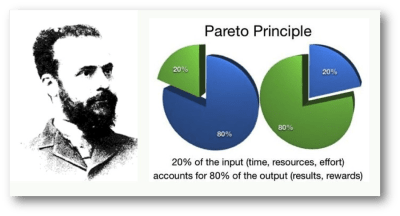
 

Simplifying Life: the Pareto Principle

Pareto Principle

When I was working as a management consultant, one of my favorite lessons to convey to clients was the Pareto Principle, which is also known as the 80-20 Rule.  The principle was named for the 19th century Italian economist Vilfredo Pareto, who observed that an 80-20 percent relationship applied to many practical aspects of life. For instance, about 80 percent of nonprofit donations come from 20 percent of the donor base.  About 80 percent of sales come from 20 percent of your client base. 

The application of the 80-20 Rule I most like is that about 80 percent of the work on a project is accomplished through 20 percent of the effort.  For example, if it takes five hours to detail a car, you can finish 80 percent of the job in about an hour.  The remaining 20 percent of the tasks will take four hours to complete.  The lesson learned is that if you can accept something less than perfection in a practical task like vacuuming your house or maintaining your lawn, you can save yourself a lot of time and significantly simplify your life.

The Rev. Dr. Alexander Whyte (1836-1921), was a popular Scottish theologian in his day.  His biographer, G.F. Barbour tells an interesting story about Whyte’s encounter with a particular female parishioner who told him, “Dr. Whyte, I just love being in your presence. You are so saintly.”  Whyte replied, “Madam, if you could look into my soul, what you would see would make you spit in my face.”

While the Pareto Principle has many practical applications in everyday life, Rev. White knew that when it comes to God, giving 20 percent of yourself is not enough.  Whyte understood what Jesus means in Matthew 10:37-39 when he says, “Whoever loves father or mother more than me is not worthy of me, and whoever loves son or daughter more than me is not worthy of me. And whoever does not take his cross and follow me is not worthy of me. Whoever finds his life will lose it, and whoever loses his life for my sake will find it.” (ESV) 

Jesus wants all of you—not 20, or 80, or even 99 percent of you.  He makes this clear when He tells his disciples “If anyone would come after me, let him deny himself and take up his cross and follow me.  For whoever would save his life will lose it, but whoever loses his life for my sake will find it. For what will it profit a man if he gains the whole world and forfeits his soul?” (Matthew 16:24-26, ESV)

It’s easy to give part of yourself to God.  You can attend church every Sunday, pray to Him every morning, and tithe 10 percent of your income. Outwardly you might appear saintly, as the Rev. Whyte appeared to his parishioner, but God sees inside us all.  Scottish Theologian Oswald Chambers said, “We are only what we are in the dark; all the rest is reputation. What God looks at is what we are in the dark—the imaginations of our minds, the thoughts of our heart, the habits of our bodies; these are the things that mark us in God’s sight.”  This is why, St. Paul tells us in Philippians 2:12 (ESV), “work out your own salvation with fear and trembling.”

God wants all of you. Therefore endeavor constantly to place Him first in every aspect of your life. And when you fail, as you inevitably will, seek His forgiveness.  As St. Paul encourages us in 2 Timothy 4:7, continue to fight the good fight.   


Let Not Your Hearts be Troubled

ISIS

“Let not your hearts be troubled. Believe in God; believe also in me. In my Father’s house are many rooms. If it were not so, would I have told you that I go to prepare a place for you?   And if I go and prepare a place for you, I will come again and will take you to myself, that where I am you may be also.”  —John 14:1-3 (ESV)

The daily news is filled with hate and violence. The Islamic State (ISIS) is conducting a systematic genocide of Christians and other minority religious groups in Syria and Iraq. Iran routinely threatens to destroy the state of Israel. North Korea recently threatened a preemptive nuclear strike against the United States for what its leader perceived as threats.

Here at home the anger in many Americans is palpable. Violence is increasingly occurring at political events as the presidential election approaches. Respect among diverse people and groups in our society is waning. Many American Christians feel persecuted. Sometimes it seems as if God is no longer welcome in our society.

With all of the bad news it’s easy to become disheartened if you lose sight of the big picture. However, Christians may take comfort in the assurance that GOD IS STILL IN CHARGE. He reigns supreme in this World. “The Lord has established his throne in the heavens, and his kingdom rules over all.” (Psalm 103:19)

The world may turn its back on Christ today, but a time of reckoning will come.  Hebrews 12 reminds us that God is “slow to anger,” but his wrath is a “consuming fire.” God commands a kingdom that “cannot be shaken.” Neither should we be shaken when we hear of all the troublesome things happening in the world today.

God’s perfect plan is being played out in our lives, even though it might not be clear to us today. Speaking of the future, St. Paul reminds us, “For now we see in a mirror dimly, but then face to face. Now I know in part; then I shall know fully, even as I have been fully known.” (1 Corinthians 13:12).

The heart trouble Jesus speaks of in John 14 is a spiritual problem for which He is the only cure. Let not your hearts be troubled!  When we take our eyes off of Christ, the heart troubles begin. Christians must stay focused and avoid getting caught up in the daily distractions. As St. Paul encourages us, fight the good fight, finish the race and keep the faith! (2 Timothy 4:7)  

Perseverance means more than endurance— more than simply holding on until the end.  A saint’s life is in the hands of God like a bow and arrow in the hands of an archer.  God is aiming at something the saint cannot see, but our Lord continues to stretch and strain, and every once in a while the saint says, “I can’t take any more.” Yet God pays no attention; He goes on stretching until His purpose is in sight, and then He lets the arrow fly. Entrust yourself to God’s hands.   –Oswald Chambers


Don’t Worry be Happy

Madonna and Child“Joy to the world, the Lord is come.”

A few years ago singer-songwriter Bobby McFerrin composed a great little song titled “Don’t worry be happy.” His lyrics advise us:

In every life we have some trouble
When you worry you make it double
Don’t worry, be happy!

Sounds like some sound advice doesn’t it? However, McFerrin might have better named his tune “Don’t worry be joyful.” Joy and happiness are often used interchangeably, but there is quite a difference in their meanings—especially for Christians.

Happiness is an emotion that arises from external factors, either objects, circumstances or other people. Many people chase after happiness, often taking incredible risks to capture this elusive prey.  From the beginning of time man has sought happiness through a variety of means—romance, travel, adventure, possessions, work, wealth, fame, power, good looks, drugs, sex and countless others—but all fall short.  As King Solomon tells us in Ecclesiastes, all these are “vanity.”

Chasing after happiness is like chasing a wave at the beach. You might get your hands around it for a moment, but it eventually slips through your fingers because happiness is fleeting.  Attaining lasting happiness is impossible in a fallen world, where decay, sickness and death visit everyone. Even Jesus is, as Isaiah tells us, a “man of sorrows.” Upon his shoulders God placed the burden of the sins of all mankind.

Joy, on the other hand, comes from within. One characteristic of Christian joy is a growing feeling of confidence in God’s promise that He will never forsake us. For mature Christians, finding joy is possible even during the unhappiest times because as our faith grows we come to understand that God will carry us through every time of tribulation. This is illustrated clearly by Paul and Silas, who we see praying and singing hymns to God in Acts 16, only a short time after they have been beaten and unjustly thrown in prison.

Along with Christian joy comes a sense of contentment. St. Paul describes this in Philippians 4:11-13:

Not that I am speaking of being in need, for I have learned in whatever situation I am to be content. I know how to be brought low, and I know how to abound. In any and every circumstance, I have learned the secret of facing plenty and hunger, abundance and need. I can do all things through him who strengthens me.” (ESV)

As Christians mature and learn to be content in the various situations they find themselves, their worries will begin to dissipate when they place them in God’s hands. The American poet and diplomat James Russell Lowell said, “Let us be of good cheer, remembering that the misfortunes hardest to bear are those which will never happen.”

Worry is a waste of time that would be more wisely spent devoted to prayer. The next time you find yourself worrying about something, get on your knees and lift those worries up in prayer. Don’t worry, be joyful!

“May the God of hope fill you with all joy and peace in believing, so that by the power of the Holy Spirit you may abound in hope. —Romans 15-13 (ESV)

Click-to-Listen: “Don’t Worry be Happy” by Bobby McFerrin.

Stretch Yourself

??????????

“It is perilously possible to make our conceptions of God like molten lead poured into a specially designed mould, and when it is cold and hard we fling it at the heads of the religious people who don’t agree with us.”  —Oswald Chambers

Alison J. Head and Michael B. Eisenberg are the co-principal investigators and co-directors of Project Information Literacy at the University of Washington Information School in Seattle. One of the areas they study is information overload and multi-tasking.

Since 2008 the pair has surveyed over 10,000 college students. One of their most significant findings is that, “Information is now as infinite as the universe, but finding the answers needed is harder than ever.”

In today’s complex, often confusing wilderness of digital information, it’s important that people periodically take time to slow down and think!  Scottish theologian Oswald Chambers said, “Always keep in contact with those books and those people that enlarge your horizon and make it possible for you to stretch yourself mentally.”

I have to agree with his advice. I’ve found that a good way to slow down is to turn off the laptop or smartphone.  Instead, try engaging in meaningful conversations and reading.

My most meaningful conversations usually occur with my wife Linda.  She is one of the smartest people I know. Her logic and ability to find clarity in the midst of confusion have always amazed me. If she were the only person I ever talked with, my life would never lack for interesting, meaningful dialogue.

As for books, it’s hard to know where to begin, but I’d like to suggest a few good ones for Christians hoping to stretch their minds a little.  My top five, in no particular order are:

My Utmost for His Highest, by Oswald Chambers

Oswald Chambers, who died in 1917 at age 43, is widely regarded as one of the most influential theologians of the 20th century. He wrote only three books in his lifetime, but there are many bearing his name.  They are the products of his devoted wife Gertrude, a professional stenographer who recorded all of Chambers’ sermons verbatim in shorthand.

My Utmost for His Highest is a book of daily devotions written by Mrs. Chambers. It draws from dozens of her husband’s sermons. First published in 1924, it is the most popular Christian devotional ever written.  The idea of total abandonment, i.e. completely surrendering one’s life to God, is at the center of its message. As the book’s title suggests, we must strive daily to do our utmost for God.

Chambers said, “We have the idea that we can dedicate our gifts to God. However, you cannot dedicate what is not yours. There is actually only one thing you can dedicate to God, and that is your right to yourself (see Romans 12:1). If you will give God your right to yourself, He will make a holy experiment out of you— and His experiments always succeed.”

The language of the original text is somewhat challenging for modern day readers due to its use of Scottish vernacular. Fortunately, there are versions available in modern English.  Personally, I find that working through the original version simply adds to the exercise of stretching my mind. When read as intended—one short devotion per day—this book will help you stretch yourself for an entire year.

Your God is too Small, by J.B. Phillips

J.B. Phillips was a canon of the Anglican Church.  He died in 1982.  His seminal work, Your God is Too Small, was published in 1952. According to Phillips, from childhood we are taught to package God in a tiny box conforming to our personal beliefs and preferences.  Look for all of the answers and you’ll find them by turning God into something simple and understandable. Phillips calls this “God in a box,” which is also the title of the book’s seventh chapter.

Oswald Chambers cautioned us against such shaping God in our own image, saying, “Our danger is to water down God’s word to suit ourselves. God never fits His word to suit me; He fits me to suit His word.” (Not Knowing Whither, 901 R).

David wrote in Psalm 8, “When I look at your heavens, the work of your fingers, the moon and the stars, which you have set in place, what is man that you are mindful of him, and the son of man that you care for him?”

Your God it too Small leads its readers through a series of intellectual exercises designed to expand their concept of the God who created the universe. If you find yourself marveling at God’s creation, unable to wrap your mind around it all, this book will help you see God in a totally different way.

The Screwtape Letters, by C.S. Lewis

Clive Staples Lewis (1898-1963) is one of the most popular and prolific Christian authors and apologists who ever lived. He penned over 30 books.  Today he is best known for his classic series The Chronicles of Narnia, which have been transformed into an extremely successful series of films.

Originally published in 1942, The Screwtape Letters is arguably the Lewis’s most unusual book.  It is written in the format of a series of letters from an uncle attempting to mentor his young nephew through an important task. This would be nothing unusual, were it not for the fact that Screwtape is a senior demon and servant of Satan.  The letters are written to his nephew Wormwood, a junior tempter.  Wormwood has been given the task of ensuring the damnation of a British businessman who is referred to only as “the patient.”  Screwtape provides his nephew a clear strategy on how to undermine the patient’s faith and lead him into sin.

Lewis’s book is a dissertation on the human condition—a deep analysis of man’s inner makeup, with all of its strengths, frailties, temptations and struggles. Screwtape, through his keen understanding of human behavior, explains to Wormwood the best methods for ensuring the patient’s ultimate demise. The book paints an in-depth picture of spiritual warfare and the ultimate triumph of God.  It is guaranteed to make you think about your own inner self.

Luther:  Man between God and the Devil, by Heiko A. Oberman 

Originally published in German in 1982, this book is considered by many German scholars to be the most comprehensive biography every written on Martin Luther (1483-1546).  Luther was the central figure of the Protestant Reformation and remains one of the most influential theologians in history.

Even without the discussion of Luther, Oberman’s book would be worth reading just for its political, cultural and religious discussion of the Reformation.  However, it offers much, much more. Unlike many Luther biographers before him, Oberman attempts to describe Luther’s thoughts and deeds as something much more than just a medieval German monk who rebelled against the authority of the Catholic Church.

Oberman contends that Luther was convinced of the reality of the devil and viewed his own life as a continuous struggle against evil. (Not unlike The Screwtape Letters).  Luther viewed the world as an enormous battleground where God clashes with Satan. Approaching him from this angle lends a whole new perspective to Luther’s theology. This book is guaranteed to stretch your mind!

Jesus Under Fire: Modern Scholarship Reinvents the Historical Jesus, edited by Michael J. Wilkins and J.P. Moreland

If you’re a middle-aged Christian like me you might recall hearing about a popular movement in the 80’s and 90’s centered on “the quest for the historical Jesus.” The movement, which still has some momentum today, was epitomized by the Jesus Seminar.  The Jesus Seminar was organized by the Weststar Institute in 1985.

According to the institute’s website, its purpose was to, “to renew the quest of the historical Jesus and to report the results of its research to the general public, rather than just to a handful of gospel specialists. Initially, the goal of the Seminar was to review each of the sayings and deeds attributed to Jesus in the gospels and determine which of them could be considered authentic.

The seminar began with a group of 30 Bible scholars, but eventually grew to around 200. Put simply, this movement was an attempt by Bible scholars, not necessarily Christian scholars, to refute the divinity of Jesus Christ by framing him in history as nothing more than a typical, popular Jewish teacher of his day.

Jesus Under Fire is a compilation of essays by eight prominent Christian apologists written to challenge the methodology and conclusions of the Jesus Seminar.  The book’s introduction describes the furor surrounding Jesus:

“Today some people say that Jesus never said most of what is recorded of him in the Bible.  Some pronounce further that Jesus never did most of what the Bible records he did.  They claim that Jesus of Nazareth was a far different figure than church history and the creeds have believed him to be.  Therefore, if we are to be intelligent people, even intelligent religious people, we must not simply accept what the Bible records Jesus claimed for himself and what the early church claimed him to be.  If we are to be truly modern in our religious quest, we must not simplistically hope that Jesus’ actions as they are recorded in the Bible are factual, or that they have any relevance for us today.  Jesus must be stripped of ancient myths that surround him as to what he said and did, so that the modern person can hear his true message.  Jesus must be brought down to earth from the status to which the early church elevated him, so that we can understand who he was as he walked under Palestinian skies and comprehend what, if any, religious relevance he has for us today.”

The chapter titles of Jesus Under Fire describe the authors’ response to the Jesus Seminar:

  • Where do we start studying Jesus?
  • Who is Jesus? An introduction to Jesus studies.
  • The words of Jesus in the Gospels: Live, Jive or Memorex?
  • What did Jesus do?
  • Did Jesus perform miracles?
  • Did Jesus rise from the dead?
  • Is Jesus the only way?
  • Jesus outside the New Testament: What is the Evidence?

This book is for serious mind stretchers only.  It is probably the most difficult book I have ever read…and reread.  I found each of the essays intellectually stimulating—the sort of stuff that makes me go back and reread each paragraph, underlining sentences as I go.  I spent about six months working my way through it the first time…and it was time well spent. I hope you will find it equally as enjoyable.

Give yourself a special gift this Christmas and start reading one of these wonderful books.  You won’t regret it.


Enduring Truths for Recent Grads

Graduate [2]

A couple of years ago I wrote an article  for my newspaper column with some advice for recent grads.  It has become one of the most popular pieces I ever wrote. I received dozens of emails thanking me for writing it.    I therefore decided to  re-publish it annually around graduation time.  I hope some of you find it useful.  You can view the original article at this link:  http://goo.gl/LtN72

For those who are graduating high school this year and beginning the long transition into adulthood, I’d like to offer you a gift. Here are five enduring truths I’ve learned. They will help you through life’s journey.

Choices

“If you decide to just go with the flow, you’ll end up where the flow goes, which is usually downhill, often leading to a big pile of sludge and a life of unhappiness. You’ll end up doing what everyone else is doing.” ― Sean Covey, The 7 Habits of Highly Effective Teens

 Life will deal you an endless string of choices along the way.  Some will be trivial, like deciding what to wear today.  Others will be weighty and their outcomes will affect you forever.  Weighty decisions should always be preceded by much thought and soul searching.  This includes decisions about who you date or marry, what you put into your body, bringing children into the world, what you do for a living, how much debt you incur and who you associate with.

All of these decisions will have a lasting effect on your life. Therefore, make them slowly and deliberately. Often you’ll discover that the right choice is not the easiest one.  A habit of making poor choices will, as the Sean Covey quote suggests, drag your life downhill.

I was recently contacted by a young man who had just received a bad conduct discharge from the Navy.  He asked me how the discharge would impact his future employability.  His mistake was choosing to drive a car while intoxicated and hitting a pedestrian. Fortunately, the victim wasn’t seriously injured. Had it been otherwise, the young sailor would probably be in prison.  It was my sad responsibility to inform him that with some employers the discharge would be a black mark for life. Choices matter!

 Learning

“Experience is a hard teacher because she gives the test first, the lesson afterwards.”    ―Vernon Saunders Law, former professional baseball pitcher and Cy Young Award winner

Some of you will go on to college or technical school.  Others will enter the workforce.  Even if your formal education is over, don’t quit learning. Make learning a lifelong adventure.  I did my undergraduate work at the University of Kentucky.  The school offers a fellowship program for individuals aged 65 and older to attend classes tuition free. Every year numerous senior citizens walk the stage to receive degrees ranging from Associate of Arts to Doctor of Philosophy.  It’s never too late to learn.

Even if you don’t choose to continue formal learning, make it point to learn from life. Observe others; note their successes and failures; then learn from their experiences.  More importantly, learn from your own mistakes.

Some of the greatest lessons I’ve learned, particularly those while serving in uniform, were the result of having made a terrible mistake.  This sort of lesson sticks, like the first time you grab the handle of a hot iron skillet with your bare hand.  The key to learning from mistakes is owning them.  Admit your mistakes and then move on, having learned something from the experience.  Don’t let, “It wasn’t my fault,” be part of your vocabulary.

 Work

“A dream doesn’t become reality through magic; it takes sweat, determination and hard work.”  ―Colin Powell, retired U.S. Army four-star general and former U.S. Secretary of State

Work isn’t always fun. If it were, they’d call it play.  Work can be downright unpleasant, but it’s an essential element of life! Along the way you’re going to have jobs you won’t like. Note what you don’t like and make it a point to improve yourself, so you’ll never again have to work at such a job.

Accepting a job means submitting to the authority of those placed over you.  Learn to work within this system.   You’ll inevitably have bosses you don’t like.  Learn to respect the position, if not the individual.

Fairness

“Life is not fair; get used to it.” ―Bill Gates, founder and former CEO, Microsoft Corporation

You will hear much discussion about fairness in this life. It’s all hot air.  Life isn’t fair.  Some good people die young, while some bad people live a long life.   Disease sometimes strikes arbitrarily, for no apparent reason.  Some people prosper while others suffer failure. A death or accident can change your life forever.

There is randomness to life that can’t be avoided.  Don’t expect kindness to be returned with kindness.  Don’t expect generosity to be returned with generosity.  The best choice is to be fair and kind to others and learn to accept what they return to you.

A wise man named Harry Browne ran for president of the United States on the Libertarian Party ticket. On Christmas day in 1966, Browne wrote his young daughter a letter aptly titled, “A Gift for My Daughter.”  I encourage every graduating senior to read it and digest it. In the letter, he explains to his daughter that, “Nobody owes you anything.”  Understanding what Browne meant can truly bless you. You can find it at:  www.harrybrowne.org/articles/GiftDaughter.htm.

Faith

“A faith is a necessity to a man. Woe to him who believes in nothing.”  ―Victor Hugo

I once had a senior Army officer tell me he preferred to work with men who possessed spiritual values, regardless of their religion.  He explained that having faith in a power higher than one’s self was an indicator of how one will perform under pressure; in this instance, the pressure meant combat.

Too many people place their faith in all the wrong places.  It might be in wealth, celebrity, good looks, talent, or even government.  Whatever the case, misplaced faith leads to disappointment after disappointment.

To avoid these disappointments, put your faith in God alone.  You, your loved ones and your friends will all inevitably let you down, but God will never fail you.

A New Year’s Resolution Worth Keeping

New Years Eve Time Square

“Exercise is labor without weariness.”  —Samuel Johnson

Exercise is an important part of my life that was ingrained during a 24-year career in the U.S. Army.  I enjoy a good workout and feel out of sorts when I go too long without exercising.  In January there are always a lot of new faces in my local fitness center—mostly folks who made a new year’s resolution to exercise and lose weight.

Moving into February the numbers dwindle and by March, few of the new faces are still around.  We humans are great at making promises to ourselves that we never keep.  This year I’ve made a resolution worth keeping and it’s not the usual “lose some weight.”   Instead, I’m going to slow down.

“Adopt the pace of nature.  Her secret is patience.”  —Ralph Waldo Emerson

An Army career often requires one to maintain a “hair on fire” pace for long periods of time.  Mine was no exception. After retiring from the service, I continued the fast pace in my civilian work.  I can recall my mom continually advising me to slow down, but I never made an attempt to comply until fairly recently.  A couple of years ago I came to a realization that there are better ways to spend one’s time than to dash about in a frenzy trying to get as much done as humanly possible.

Slowing down doesn’t mean getting lazy, however.   It’s more about tempering the urgency in life and finding balance.  If I succeed at this, there won’t be sufficient time to do everything I might be inclined to do.   Therefore, I aim to re-evaluate what’s important in my life and then do my best to focus on the things that matter, while sweeping aside the trivial.

“The whole point of getting things done is knowing what to leave undone.”   —Oswald Chambers

I’ve been thinking about some of the things I can sweep aside this year.  Television ranks high on the list.  As my wife often reminds me, I watch some fairly mindless shows with no redeeming social value. Shows like ”Man vs. Food” come to mind.  If you’re not familiar with it, check it out on the Travel Channel website.  It’s about a fellow who travels the country seeking “pig out” restaurants  (www.travelchannel.com/tv-shows/man-v-food).

The “Colbert Report” is also on my “fuggedaboutit” TV list.   I enjoy the show immensely, but it truly is mindless entertainment.  There are others, but I’ll spare you the laundry list.

“Time is what we want most, but what we use worst.”  —William Penn

As a management consultant, I periodically presented time management seminars.  They were very well received by every audience. Unfortunately, I constantly find myself violating the time management techniques I know to be effective.   I aim to be more disciplined with my time this year.

One of the best techniques I know to save time is by turning off the TV.  Limiting time on Facebook and other unproductive Internet sites is also advisable.  Avoiding web surfing and clicking links on the web pages one must visit will also save an enormous amount of time.

I’m also going to avoid checking emails and messages on my phone every few minutes.  At present, I’m an email version of Pavlov’s dog—grabbing my cell phone every time an email or text message alert beeps.  (For those struggling with time management, the Mindtools.com website has a simple, 10-step approach to help you get on track http://goo.gl/RsWrQ1.)

“I find television very educating. Every time somebody turns on the set, I go into the other room and read a book.”  —Groucho Marx

By reducing the time spent in front of the boob tube and on unproductive websites, I hope to make some time for reading.  I’m not talking about casual reading either.  Gibbon’s classic The Decline and Fall of the Roman Empire has been sitting on my bookshelf for about three years.  This year I plan to dust it off and dive in.  I’m also going to try to read or reread several books by C.S. Lewis.

“Prayer does not equip us for the greater work, it is the greater work.” —Oswald Chambers

At the top of my “to do” list for 2014, however, is spending more time in the scriptures and prayer. Prayer is work and I plan to work a lot in this new year.   Romans 12:12 advises us, “Rejoice in hope, be patient in tribulation, be constant in prayer” (ESV).  Now that’s a new year’s resolution worth keeping.

Divine Simplicity: Focus on the things that matter…sweep aside the things that don’t.


Our Waning Confidence

Faith

God is our refuge and strength, a very present help in trouble.  Therefore will we not fear, though the earth do change, and though the mountains be shaken into the heart of the seas;  Though the waters thereof roar and be troubled, though the mountains tremble with the swelling thereof.    —Psalm 46: 1-3 (ASV)   

 In June of this year Gallup conducted a poll on the public’s confidence in several major institutions in American society.  The U.S. military topped the list with a 76 percent confidence rating.  Not surprisingly, the U.S. Congress ranked at the bottom with only 10 percent.

There were troubling results suggesting that less than half of Americans have confidence in many of the institutions that helped form the bedrock of our society.  Big business came in at 22 percent.  Newspapers and television tied at 23 percent.  The criminal justice system was rated 28 percent. Public schools were rated 32 percent.  The U.S. Supreme court was rated 34 percent. The presidency received a rating of 46 percent.  The public’s confidence in churches and organized religion was only 48 percent.

There are plenty of reasons to lack confidence in these institutions.  Violence and even homicides in our schools are now commonplace.  It seems like hardly a month can pass anymore before you hear about another beating or killing in a school.

The recent federal government shutdown left World War II veterans blocked from visiting their memorial in Washington D.C., national parks closed, most government employees furloughed and many federal contractors idled.

A failure of the Electronic Benefit Transfer (food stamp) computer system recently caused panic across multiple states.  The registration website for the new federal health care system is a train wreck.

On top of all this, the U.S. economy stinks.  The national debt is at 17 trillion dollars—that’s 12 zeros.  Congress narrowly averted a default on the debt earlier this month, but could not reach a definitive solution.  They merely postponed the debt argument for a few months.   Failed economic policies spanning multiple presidential administrations have left millions of Americans unemployed or underemployed.

The church has taken a lot of hits in recent times.  Just last week Pope Francis chastised a German Bishop for his lavish lifestyle. Embezzlement of  funds by church employees is becoming commonplace.   It is no longer unusual to hear about a church leader caught up in a sexual crime or other form of corruption.

When times are good it’s easy for you and me to simply drift through life without a care, but when things turn bad all kinds of troubles arise.  Just trying to comprehend all of the problems plaguing American society today can cause fear, anger, paranoia, despair and depression for some.

In Matthew chapter 17, Jesus is transfigured on the mountaintop. His apostles Peter, James and John behold the full glory of God.  It’s no surprise that immediately afterwards they ask Jesus if they should pitch tents so they can remain on the mountain.  His apostles want to stay and continue to soak in the glorious experience.  Instead Jesus leads them back down the mountain to the valley and their regular lives.

Life’s greatest lessons are rarely learned on a mountaintop.  They’re learned in the daily drudgery and pain of life. Fortunately for Christians, regardless of how bad things might look today, we know how the story ultimately ends.  As Oswald Chambers described his life, “I am in the procession of a conqueror, and it doesn’t matter what the difficulties are, for I am always led in triumph.”

Saint Paul echoes the same message in Romans 8:38-39 (ASV), “I am persuaded, that neither death, nor life, nor angels, nor principalities, nor things present, nor things to come, nor powers, nor height, nor depth, nor any other creature, shall be able to separate us from the love of God, which is in Christ Jesus our Lord.”  He goes on to challenge us in Philippians 4:6 (ASV), “In nothing be anxious; but in everything by prayer and supplication with thanksgiving let your requests be made known unto God.”

When you’ve reached wit’s end, stop, take a deep breath, lift your eyes and look.   You’ll see God standing right there.  Regardless of your present circumstances, never forget that He is the author of the story in every Christian’s life.  God stands ready for us to lift the burdens from our backs and place them squarely on His.  Therefore, guided by the Holy Spirit, let your thoughts and deeds spring from faith, not fear.

Come unto me, all ye that labor and are heavy laden, and I will give you rest.  Take my yoke upon you, and learn of me; for I am meek and lowly in heart: and ye shall find rest unto your souls. For my yoke is easy, and my burden is light.  —Matthew 11:28-30 (ASV)

Discipline in Everything

Cupcakes

Developing discipline is neither easy nor pleasurable. Anyone who has tried to diet knows this! For most people, dieting is a struggle between the desires of the body and the needs of the spirit.

Like dieting, a good job search also requires strict discipline. The best approach is to develop a strategy and stick to it. Your strategy must be proactive. It should include networking, personal branding & marketing, lots of research and a double dose of patience and perseverance. Approach your job search like a fulltime job until you find employment. At the same time, use your period of unemployment as an opportunity to improve yourself: try to shed a few of those extra pounds; develop a fitness routine to improve your physical condition; work on acquiring some new job skills that will make you more marketable and current in your field; reach out to help others around you; and work on disciplining yourself spiritually.

Taking just a few minutes of quiet time each morning to pray, study the scriptures and reflect on the day ahead will add clarity and purpose to your day. Christians could learn a lesson from the followers of Islam. Muslims stop five times per day to pray–morning, noon, afternoon, sunset and evening. Periodically pausing for prayer throughout each day is guaranteed to help you cope with stress and worry, two challenges that you will encounter daily while unemployed.

Mark 1:35 (NKJV) tells us that, “Now in the morning, having risen a long while before daylight, He (Jesus) went out and departed to a solitary place; and there He prayed.” If this is the way the Lord began his mornings, how can we do otherwise? If you don’t currently start the day with some quiet time with God, I challenge you to give it a try during this season of Lent. A blessing awaits you.

Psalm 84, the blessedness of dwelling in the house of God
How lovely is Your tabernacle,
O LORD of hosts!
2 My soul longs, yes, even faints
For the courts of the LORD;
My heart and my flesh cry out for the living God.
3 Even the sparrow has found a home,
And the swallow a nest for herself,
Where she may lay her young—
Even Your altars, O LORD of hosts,
My King and my God.
4 Blessed are those who dwell in Your house;
They will still be praising You. Selah
5 Blessed is the man whose strength is in You,
Whose heart is set on pilgrimage.
6 As they pass through the Valley of Baca,
They make it a spring;
The rain also covers it with pools.
7 They go from strength to strength;
Each one appears before God in Zion.[b]
8 O LORD God of hosts, hear my prayer;
Give ear, O God of Jacob! Selah
9 O God, behold our shield,
And look upon the face of Your anointed.
10 For a day in Your courts is better than a thousand.
I would rather be a doorkeeper in the house of my God
Than dwell in the tents of wickedness.
11 For the LORD God is a sun and shield;
The LORD will give grace and glory;
No good thing will He withhold
From those who walk uprightly.
12 O LORD of hosts,
Blessed is the man who trusts in You! 

Today’s Lenten Prayer: a prayer for self-discipline
Lord, give me the wisdom to see
No good life comes without right discipline.
Give me the grace to impose it upon myself
Lest others do it for me.
Help me to discipline my tongue
That I may be clear rather than clever
Sincere instead of sarcastic
Help me to discipline my thinking and actions
To do what is right
And not what is easy
Let me get on with the job on hand
Doing the best I can
And leaving the rest to You. Amen.

Today’s Reading: Oswald Chambers – the Discipline of Spiritual Perseverance

The Discipline of Spiritual Perseverance