Archive for the ‘discipleship’ Category

Discipline and Discipleship

Discipline - Boot Camp summer 1975Army Boot Camp, July 1975

It was sunny and warm in Louisville, Ky. on June 28, 1975. That’s the day I boarded a bright yellow school bus at an Army recruiting station for a short journey to Fort Knox, where I was scheduled to undergo Army basic training or boot camp as it’s commonly called. Only a few weeks earlier I’d been a bright eyed college student receiving his associate degree in Munich, Germany.  My mother Phyllis and stepfather Ray were still in Germany—Ray was an Army officer and second in command of a tank brigade in Friedberg, about an hour north of Frankfurt.

I had departed Germany in early June to visit family in my home state Kentucky before attending boot camp.  The last stop was Louisville, at the home of my favorite aunt and uncle, Sarah and Carl.  At the end of that wonderful visit, it was Aunt Sarah who drove me to the induction station and hugged me goodbye as I began a nervous, one hour journey to Fort Knox.

After what seemed like hours, the bus turned into the main gate of Fort Knox. Entering the post felt very familiar, as I’d lived there during my freshman and sophomore years of high school while Ray was assigned to the Armor School. The familiarity helped quell my sense of dread that had been increasing steadily since we departed Louisville. The post was sprawling, hilly and hot. The eclectic mix of architecture ranged from a beautiful state-of-the-art hospital to drab three-story concrete barracks to the low slung, pale yellow wooden buildings dating back to World War II.

About ten minutes after entering the post, the bus turned down a side street and then swung into the parking lot of Delta Company, 13th Training Battalion, 4th Training Brigade, home of the ‘Delta Demons’. Peering out the window I could see two tough looking fellows wearing olive drab fatigues and the iconic Smoke Bear hats that identified them as drill sergeants. Their fatigues were starched stiff with creases that looked sharp enough to slice an apple. They fit like gloves. Their boots were polished to a mirror finish. Not a hair was out of place. All you needed was one look at these impressive gentlemen to know that they were pure badass!

The driver opened the bus door and we were greeted by a booming voice.  ‘Off the bus and line up.  Move it ladies’.  After a clumsy exit fumbling with our bags and bumping into each other, we managed to get into something resembling a line. The empty bus quickly pulled away, leaving us feeling isolated and helpless.  It was then that we were introduced to the two gentlemen who would fill the roles of father, mother, confessor and mentor for all of us in the coming weeks.

Staff Sergeant Hunter, the platoon sergeant, stood about five feet ten inches tall.  He was built like an NFL linebacker. Drill Sergeant Hunter was just tall enough that he could press the stiff brim of his Smoky Bear into the bridge of my nose as I stood at attention while receiving his instructions.  The assistant platoon sergeant, Sergeant Anderson, stood about five feet seven inches.  He was lean, wiry and just mean looking. They immediately commanded our attention.

These fine men, as I would learn they both were, taught us so much: military customs and courtesies; how to wear the uniform and properly groom ourselves; how to spit shine a boot; how to polish brass; how to make a bunk; how to roll our socks and underwear and store them in our lockers; how to make a barracks GI clean; how to get physically fit; how to do close order drill; how to march and sing ‘jodies’, those sometimes naughty songs marching troops sing to help them stay in step; how to fire and clean an M-16 rifle; how to fire M-60 and 50 caliber machineguns; how to fire a recoilless rifle; how to throw hand grenades; how to do fire and maneuver without shooting your buddy; how to take out a pillbox; how to use a field telephone and radio; how to give first aid; and how to doctor blisters on our feet.

But most of all, they taught us about how to be soldiers—about responsibility, self-discipline, and respect for country, Army, unit, comrades, family and ourselves.  At first we listened to them out of fear of punishment. One small misstep could lead to running laps around the compound holding your rifle above your head with two arms while yelling ‘I’m a s#!thead’ or the dreaded ‘Drop and give me fifty’, meaning pushups. Even worse, you could end up pulling ‘KP’ in the mess hall, peeling potatoes, dicing onions and mopping floors.   But there came a point in time when we listened out of a sense of respect for our drill sergeants and our fellow soldiers in the platoon.  In the end, a soldier’s sense of responsibility, respect and self-discipline becomes a normal way of life.

It’s easy to learn military discipline in Boot Camp, where you’re isolated, restrained, focused and under the watchful eye of a drill sergeant.  Sadly, developing discipline in one’s spiritual life isn’t so easy.  I often wonder why this is so.  I was the picture of discipline during my military career, yet my Christian discipline suffers. ‘Disciple’ is the root word of discipline.  A disciple is a student or follower who is trained by a teacher and subsequently spreads the teacher’s beliefs.  I had a lot of training and learning as a Christian, but have I ever really been a disciple?  I think not and I believe I’ve finally figured out why. 

In his book, The Spirit of the Disciplines: Understanding How God Changes Lives, the late Christian scholar Dr. Dallas Willard explains that self-transformation stems, in large part, from the practice of spiritual disciplines.  He cites many disciplines, which he divides into two broad categories of ‘abstinence’ and ‘engagement’.

Under abstinence Willard includes chastity, fasting, frugality, sacrifice, secrecy, silence and solitude. These deal with our physical bodies.  Engagement includes celebration, confession, fellowship, prayer, service, study, submission and worship. These deal with our spiritual lives.  The disciplines are the means to an end; just as we practice to learn a sport, we practice the disciplines to become more Christ-like.  Willard provides many scriptural references to the disciplines in the life of Jesus and the Apostles. The abstinence disciplines focus inward and help build self-discipline and restraint; they are about habits.  The engagement disciplines look outward, helping us become servants of Christ and others; they are about building Christian character.  

Using Willard’s criteria, a quick self-analysis reveals that while I’m strong in the engagement disciplines, I have a long way to go in the abstinence disciplines before I can become a true disciple of Christ.  I have a lot of work to do, but I’m going for it.  How do you measure up? Consider leaving a reply.



Hurry up and slow down!

Slow Down

Be still, and know that I am God.  —Psalm 46:10a (ESV)

We live in a world of high-speed escape artists.  Everywhere one looks, people are rushing to and fro to get the next thing on their long list done. When they grow weary, many turn to adrenalin-pumping extremes to “relax.” There is extreme biking, extreme running (Parkour), building- and rock-climbing without safety equipment (free-climbing), half-pipe skiing and snowboarding, and base jumping, which is free fall parachuting from cliffs or high structures.

We watch extreme television entertainment, like American Ninja Warrior and Mixed Martial Arts (MMA) fighting.  If sports is not your thing, there are extreme game shows with names like Wipeout, where contestants crash and burn on crazy obstacle courses, and Fear Factor where contestants, among other feats, eat large volumes of worms and bugs.

Many escape reality through physical addictions, turning to drugs, alcohol or sex to remove them from reality. Others simply unplug from their daily grind, spending long periods of the day disconnected from the world. Video games are one way of escaping reality. The most extreme “unplugging” involves new virtual reality technology.  With this technology, one can don a pair of goggles and be instantly transported to a new 3-D “world.”  Anything goes on these virtual playgrounds, including extreme sports, extreme violence and extreme sexual fantasies.

For some, cell phone addiction provides a different kind of virtual reality.  Have you spoken with someone who constantly looks down at their phone? It’s like they don’t have time for you. It’s annoying, not to mention downright rude.  Or perhaps you’ve observed a family seated in a restaurant waiting for their orders to arrive—everyone is heads down playing with their phone instead of interacting with other family members.  In 2014, Charit Taneja wrote in “The Psychology of Excessive Cellular Phone Use” that:

Cell phones enable behavioral problems and disorders, particularly in adolescents. This fact has become more and more evident in communications media, inspiring new pathologies, such as “Nomophobia” (No-Mobile-Phobia), “FOMO” (Fear Of Missing Out) – the fear of being without a cell phone, disconnected or off the Internet, “Textaphrenia” and “Ringxiety” – the false sensation of having received a text message or call that leads to constantly checking the device, and “Textiety” – the anxiety of receiving and responding immediately to text messages. 

Some people escape auditory reality. In the fitness center where I exercise, about half of the people wear headphones or ear buds while using an exercise bike, treadmill, elliptical machine, stair-stepper or other exercise device. I assume most listen to music, hoping it will carry away them to another, less painful place as they push their bodies to the physical limit.  While such auditory isolation might reduce the agony of a heavy workout, it hinders socializing with others and can even be dangerous. At certain times of the year here in South Dakota it’s a good idea to keep one’s ears peeled for the sound of a tornado warning siren.   

A frantic pace combined with isolation can lead to perilous situations. Anyone who lives in a big city has seen drivers who dangerously weave in and out of traffic, desperately trying to get ahead a couple of car lengths while putting their own and other people’s safety at risk. Many of these drivers have so much on their “to do” lists that feel a need to constantly rush. Others live in their own private worlds where it’s all about satisfying their own needs, with no regard for the needs and safety of those around them.

 Far too often, erratic driving results in road rage.  According to analysis by performed by Trace, an independent, nonprofit news organization dedicated to expanding coverage of guns in the United States, instances of road rage where someone in a car brandished a gun or fired a gun at another driver or passenger more than doubled over the a three-year period, increasing from 247 in 2014 to a high of 620 in 2016.

The high-speed, escape mentality is tearing away the very fabric of our society. We’re becoming a bunch of one-armed jugglers with our eyes and ears covered. It’s easy to get caught up in the race and lose sight of what really matters in life.  Christians aren’t immune to this.  It’s easy to become distracted and let the day slip by without a thought of God.  I think Islam gets it right on one point—stopping to pray five times per day.  Christians would do well to adopt a similar practice. 1 Thessalonians: 5 encourages us to “pray without ceasing.” (ESV)

Psalm 46:10a (ESV) says, “Be still and know that I am God.” God wants us to slow down and focus on him in the midst of our daily hustle.  It’s during times of stillness that we can, if just for a moment, look God in the face and begin to gain a deeper understanding of Him. In Mark 4:39, Jesus is with his disciples in a small boat when a great storm occurs.  The terrified disciples appeal to Jesus to do something to save them.  He utters the simple command, “Peace! Be still.” Immediately the weather becomes calm.

This beautiful story is about much more than Jesus calming the weather.  It is about Jesus giving up a sense of Peace in Him that helps us through the storms that occur in our daily lives. In 1 Kings: 19 (ESV), God speaks to Elijah in “a low whisper.” My advice to you—slow down, be still, unplug, hear God’s whisper, and discover His peace. 

 “Rejoice in the Lord always; again I will say, rejoice. Let your reasonableness be known to everyone. The Lord is at hand; do not be anxious about anything, but in everything by prayer and supplication with thanksgiving let your requests be made known to God. And the peace of God, which surpasses all understanding, will guard your hearts and your minds in Christ Jesus.” —Philippians 4:4-7 (ESV)


Live for the Minute

Gather Ye Rosebuds While Ye May, by John William Waterhouse

Gather ye rosebuds while ye may, old Time is still a-flying; and this same flower that smiles today, tomorrow will be dying.   Robert Herrick

Few would argue that making plans isn’t important.  As an Army officer, I spent over a decade participating in various planning teams.  It requires meticulous planning to move a mass of soldiers and their equipment from point A to point B, whether the end destination is a local training area or a battle somewhere in the Middle East. The old adage we lived by was, “Those who fail to plan, plan to fail!”

Hardly anyone would think of going on vacation without planning some sort of itinerary—where you’re going, when you’ll be there, overnight accommodation etc.  Many people use financial planners to help them plan for the future—monthly income, a dwelling, health care, long term care, assisted living, etc. We are a planning society.

All planning aside, however, there’s only one place you can accomplish anything—that’s in the here and now.  Too many people today are stuck in the realm of “if only.” If only I could (you fill in the blank), then I would be set.  Unfortunately, many Christians take this approach, striving to achieve some unattainable goal of holiness or obedience before they believe they can be of use to God. 

The truth is, God can use you where you are right now.  Many Christians strive to reach a future destination, while God’s main goal for them is in the here and now.  God is more about the process than our final destination.  He teaches us to be calm and courageous in whatever situation we find ourselves; and he teaches us to serve others.

St. Paul tells us in Philippians 2, to work out our own salvation in fear and trembling.  This “working out” is a process of sanctification that can last a lifetime–again, it is more about the process than the destination.   The future is uncertain—it is only in your present situation that you can serve others.  Don’t wait to take up the work of God.  There will never be a better time than now to pick up your cross and follow Jesus.

Never allow the thought, “I am of no use where I am,” because you certainly can be of no use where you are not. Wherever God has dumped you down in circumstances, pray to Him all the time.  Oswald Chambers


Simplifying Life: the Pareto Principle

Pareto Principle

When I was working as a management consultant, one of my favorite lessons to convey to clients was the Pareto Principle, which is also known as the 80-20 Rule.  The principle was named for the 19th century Italian economist Vilfredo Pareto, who observed that an 80-20 percent relationship applied to many practical aspects of life. For instance, about 80 percent of nonprofit donations come from 20 percent of the donor base.  About 80 percent of sales come from 20 percent of your client base. 

The application of the 80-20 Rule I most like is that about 80 percent of the work on a project is accomplished through 20 percent of the effort.  For example, if it takes five hours to detail a car, you can finish 80 percent of the job in about an hour.  The remaining 20 percent of the tasks will take four hours to complete.  The lesson learned is that if you can accept something less than perfection in a practical task like vacuuming your house or maintaining your lawn, you can save yourself a lot of time and significantly simplify your life.

The Rev. Dr. Alexander Whyte (1836-1921), was a popular Scottish theologian in his day.  His biographer, G.F. Barbour tells an interesting story about Whyte’s encounter with a particular female parishioner who told him, “Dr. Whyte, I just love being in your presence. You are so saintly.”  Whyte replied, “Madam, if you could look into my soul, what you would see would make you spit in my face.”

While the Pareto Principle has many practical applications in everyday life, Rev. White knew that when it comes to God, giving 20 percent of yourself is not enough.  Whyte understood what Jesus means in Matthew 10:37-39 when he says, “Whoever loves father or mother more than me is not worthy of me, and whoever loves son or daughter more than me is not worthy of me. And whoever does not take his cross and follow me is not worthy of me. Whoever finds his life will lose it, and whoever loses his life for my sake will find it.” (ESV) 

Jesus wants all of you—not 20, or 80, or even 99 percent of you.  He makes this clear when He tells his disciples “If anyone would come after me, let him deny himself and take up his cross and follow me.  For whoever would save his life will lose it, but whoever loses his life for my sake will find it. For what will it profit a man if he gains the whole world and forfeits his soul?” (Matthew 16:24-26, ESV)

It’s easy to give part of yourself to God.  You can attend church every Sunday, pray to Him every morning, and tithe 10 percent of your income. Outwardly you might appear saintly, as the Rev. Whyte appeared to his parishioner, but God sees inside us all.  Scottish Theologian Oswald Chambers said, “We are only what we are in the dark; all the rest is reputation. What God looks at is what we are in the dark—the imaginations of our minds, the thoughts of our heart, the habits of our bodies; these are the things that mark us in God’s sight.”  This is why, St. Paul tells us in Philippians 2:12 (ESV), “work out your own salvation with fear and trembling.”

God wants all of you. Therefore endeavor constantly to place Him first in every aspect of your life. And when you fail, as you inevitably will, seek His forgiveness.  As St. Paul encourages us in 2 Timothy 4:7, continue to fight the good fight.   


Unemployed? Seek the Lord in Your Day of Trouble.

Prayer

In the Day of Trouble I Seek the Lord

Today millions of Americans are facing the challenges of unemployment or under employment. These can lead to fear, frustration, depression and even physical illness. However, they also present opportunities for growth.

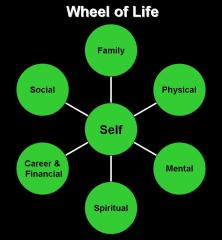
When you’ve lost your job or find yourself in a job that is not self-sustaining, a whole-person approach is needed as you strive to improve your situation. I like to use the “Wheel of Life” to help illustrate this. The circles on the outside of the wheel represent six areas of one’s life that contribute to the whole we refer to as “self.” Neglecting any of these puts the entire wheel out of balance, leaving one struggling and feeling out of sorts.

Wheel of Life

 Wheel of Life

Family and Social Life.  A period of unemployment or underemployment opens the door to opportunities in each the six areas on the wheel of life. It is a good time to spend extra time with family, renew old connections with friends and build your social network (which will improve your chances of finding self-sustaining employment).  Don’t forget to have some fun!

Physical Conditioning. It also provides an opportunity to improve your physical condition through proper exercise, sleep and nutrition. It is a wonderful chance to shed a few pounds and look your best for your next interview..

Career and Financial.  Dedicate some of your extra time towards education. You don’t necessarily need to pick up another degree or certification. Focus on learning something that will help make you more employable. Perhaps you can focus on improving your Microsoft Office software skills. There are free training courses galore on the Internet. If you need to improve your speaking skills, you could join the local Toastmasters chapter. The possibilities are endless.

Finances.  Being unemployed or underemployed is also the perfect time to work on improving your finances. Perhaps you’ve been talking about downsizing your household.  Start by selling off things you don’t really need.  Put together a new budget, trying to reduce frivolous spending. Try keeping close track of where your money actually goes. You might be surprised at how most of it gets spent.

Mental.  Take time to relax and stretch your mind.  Put down your phone, turn off the computer and TV, and pick up a challenging book that you’ve always wanted to read.  Spend some time with people who challenge your way of thinking. Visit an art gallery or museum that would not normally be of interest to you.

(Read Psalm 77: https://www.biblegateway.com/passage/?search=Psalm%2077&version=ESV)

Spiritual.  Lastly, Psalm 77 provides a simple, yet perfect framework for approaching the spiritual realm when you’re unemployed or under employed. When things aren’t going your way, it’s comforting to be reminded God has not and will not abandon you. The Psalmist finds comfort in reflecting on how God helped his people in the past. We should follow his example.

Pray fervently—then pray again. The Psalmist prayed throughout the entire night. He felt abandoned by God. He spoke what was on his mind. We can be totally honest and open with God, telling him about our feelings, our fears, our doubts and our desires. We can ask him any question. Because Jesus suffered every temptation we have faced and felt every emotion that we have felt, we are free to discuss our deepest thoughts and feelings with God. Through Jesus’ experiences, God the Father has firsthand experience with everything we might face in our lives (v.9-10)

“We tend to use prayer as a last resort, but God wants it to be our first line of defense. We pray when there’s nothing else we can do, but God wants us to pray before we do anything at all. Most of us would prefer, however, to spend our time doing something that will get immediate results. We don’t want to wait for God to resolve matters in His good time because His idea of ‘good time’ is seldom in sync with ours.” ― Oswald Chambers                                              

Recall how God has blessed you in the past. The Psalmist did not simply spill his heart out to God. He thought about everything the scriptures say regarding what God has done for his people in the past. God blesses those who have faith in him (v. 11).  Too often we dwell on what God hasn’t done for us rather than being thankful for the multitude of blessings he has provided.

Focus on the future. Think positively about your situation, hopes and desires. What is God teaching you? What is His will for your life? Make a list of Biblical promises you can identify about your future? (v. 13)

Reconsider your present circumstances. Ask God to strengthen your faith as you strive to cope with unemployment. Remind yourself that you can always trust  His promises (v. 14). Share your experience with others.

Let us then with confidence draw near to the throne of grace,  that we may receive mercy and find grace to help in time of need.   ―Hebrews 4:16


Did Jesus laugh?

Laughing Baby

I recently listened to a program on Christian talk radio debating whether or not Jesus ever laughed. After all, doesn’t the book of Isaiah tell us that Jesus was a “Man of Sorrows?” Does that imply that He was serious all the time he walked on the Earth?

Many non-believers view Christians as a solemn, dull bunch of people. Nothing could be farther from the truth. I grew up a Southern Baptist. A big part of Baptist culture, especially in the south where I lived, centers on shared meals—not just eating but reveling in the joy of sharing a big meal with a group of fellow believers. These gatherings tend to be loud, happy events full of smiles and laughter.

When I was growing up, Sunday afternoons after church frequently consisted of friends and family gathering at my grandparent’s house. Most of the ladies teamed up to prepare a grand southern feast while the rest of the folk conversed, shared family news and stories, discussed the weather and politics, told jokes and simply enjoyed being together. Of course there were many smiling faces and much laughter. It was a noisy, joyful place to be as a young child.

If we accept the Biblical accounts of Jesus life as a fully human child, we must at a minimum concede that He smiled, even though the Bible never mentions it. Following His conception Jesus grew in Mary’s womb, as any baby grows and He was born in a normal fashion. Anyone who has cared for a baby knows that babies smile. High resolution sonograms have shown that some even smile while in the womb.

We also know that “Jesus wept” (John 11:35). The shortest passage in the Bible is an account of Jesus becoming overwhelmed by emotion while standing before the tomb of his friend Lazarus, who had recently died.

Jesus also displayed anger. John 2:13-17, describes Him becoming outraged at the moneychangers and those selling animals in the courtyard of the temple. John describes how Jesus improvised a whip and went on a rampage, overturning the tables of the moneychangers and chasing away those selling the animals.

How could anyone with such normal human traits not laugh? Just look at some of those who Jesus chose as his first disciples. They included a bunch of roughneck fishermen, a conniving tax collector, a hot-headed Zealot and a manipulative liar—a motley crew if ever there was one! It must have made Jesus chuckle when he considered what the Jewish leaders must have thought about this unlikely team.

How He must have laughed when hearing some of his disciples debating which one would hold the most honored position in heaven. I can just see our Lord turning to them and saying, “Are you kidding me? I can’t believe how dense you guys are. Please start paying better attention.”

To put things in a modern perspective, imagine that Jesus had come today instead of two thousand years ago. If he had appeared in the area where I live near Pittsburgh, Pa., I imagine he would have chosen a few mill workers to be on his team of disciples. I can almost see Him walking into a neighborhood taproom, going up to the bar, and speaking to a couple of local fellows sitting there enjoying a few bottles of Iron City beer.  Follow me!

Unlikely disciples perhaps, but not so different from some of those he chose two millennia ago. It makes me smile just thinking about it. I pray that Jesus can find a little humor in the way I live today. I hope I can make him laugh now and then.

Click the link to listen to Thomas Rhett’s “Beer with Jesus.”

Don’t Worry be Happy

Madonna and Child“Joy to the world, the Lord is come.”

A few years ago singer-songwriter Bobby McFerrin composed a great little song titled “Don’t worry be happy.” His lyrics advise us:

In every life we have some trouble
When you worry you make it double
Don’t worry, be happy!

Sounds like some sound advice doesn’t it? However, McFerrin might have better named his tune “Don’t worry be joyful.” Joy and happiness are often used interchangeably, but there is quite a difference in their meanings—especially for Christians.

Happiness is an emotion that arises from external factors, either objects, circumstances or other people. Many people chase after happiness, often taking incredible risks to capture this elusive prey.  From the beginning of time man has sought happiness through a variety of means—romance, travel, adventure, possessions, work, wealth, fame, power, good looks, drugs, sex and countless others—but all fall short.  As King Solomon tells us in Ecclesiastes, all these are “vanity.”

Chasing after happiness is like chasing a wave at the beach. You might get your hands around it for a moment, but it eventually slips through your fingers because happiness is fleeting.  Attaining lasting happiness is impossible in a fallen world, where decay, sickness and death visit everyone. Even Jesus is, as Isaiah tells us, a “man of sorrows.” Upon his shoulders God placed the burden of the sins of all mankind.

Joy, on the other hand, comes from within. One characteristic of Christian joy is a growing feeling of confidence in God’s promise that He will never forsake us. For mature Christians, finding joy is possible even during the unhappiest times because as our faith grows we come to understand that God will carry us through every time of tribulation. This is illustrated clearly by Paul and Silas, who we see praying and singing hymns to God in Acts 16, only a short time after they have been beaten and unjustly thrown in prison.

Along with Christian joy comes a sense of contentment. St. Paul describes this in Philippians 4:11-13:

Not that I am speaking of being in need, for I have learned in whatever situation I am to be content. I know how to be brought low, and I know how to abound. In any and every circumstance, I have learned the secret of facing plenty and hunger, abundance and need. I can do all things through him who strengthens me.” (ESV)

As Christians mature and learn to be content in the various situations they find themselves, their worries will begin to dissipate when they place them in God’s hands. The American poet and diplomat James Russell Lowell said, “Let us be of good cheer, remembering that the misfortunes hardest to bear are those which will never happen.”

Worry is a waste of time that would be more wisely spent devoted to prayer. The next time you find yourself worrying about something, get on your knees and lift those worries up in prayer. Don’t worry, be joyful!

“May the God of hope fill you with all joy and peace in believing, so that by the power of the Holy Spirit you may abound in hope. —Romans 15-13 (ESV)

Click-to-Listen: “Don’t Worry be Happy” by Bobby McFerrin.

Stretch Yourself

??????????

“It is perilously possible to make our conceptions of God like molten lead poured into a specially designed mould, and when it is cold and hard we fling it at the heads of the religious people who don’t agree with us.”  —Oswald Chambers

Alison J. Head and Michael B. Eisenberg are the co-principal investigators and co-directors of Project Information Literacy at the University of Washington Information School in Seattle. One of the areas they study is information overload and multi-tasking.

Since 2008 the pair has surveyed over 10,000 college students. One of their most significant findings is that, “Information is now as infinite as the universe, but finding the answers needed is harder than ever.”

In today’s complex, often confusing wilderness of digital information, it’s important that people periodically take time to slow down and think!  Scottish theologian Oswald Chambers said, “Always keep in contact with those books and those people that enlarge your horizon and make it possible for you to stretch yourself mentally.”

I have to agree with his advice. I’ve found that a good way to slow down is to turn off the laptop or smartphone.  Instead, try engaging in meaningful conversations and reading.

My most meaningful conversations usually occur with my wife Linda.  She is one of the smartest people I know. Her logic and ability to find clarity in the midst of confusion have always amazed me. If she were the only person I ever talked with, my life would never lack for interesting, meaningful dialogue.

As for books, it’s hard to know where to begin, but I’d like to suggest a few good ones for Christians hoping to stretch their minds a little.  My top five, in no particular order are:

My Utmost for His Highest, by Oswald Chambers

Oswald Chambers, who died in 1917 at age 43, is widely regarded as one of the most influential theologians of the 20th century. He wrote only three books in his lifetime, but there are many bearing his name.  They are the products of his devoted wife Gertrude, a professional stenographer who recorded all of Chambers’ sermons verbatim in shorthand.

My Utmost for His Highest is a book of daily devotions written by Mrs. Chambers. It draws from dozens of her husband’s sermons. First published in 1924, it is the most popular Christian devotional ever written.  The idea of total abandonment, i.e. completely surrendering one’s life to God, is at the center of its message. As the book’s title suggests, we must strive daily to do our utmost for God.

Chambers said, “We have the idea that we can dedicate our gifts to God. However, you cannot dedicate what is not yours. There is actually only one thing you can dedicate to God, and that is your right to yourself (see Romans 12:1). If you will give God your right to yourself, He will make a holy experiment out of you— and His experiments always succeed.”

The language of the original text is somewhat challenging for modern day readers due to its use of Scottish vernacular. Fortunately, there are versions available in modern English.  Personally, I find that working through the original version simply adds to the exercise of stretching my mind. When read as intended—one short devotion per day—this book will help you stretch yourself for an entire year.

Your God is too Small, by J.B. Phillips

J.B. Phillips was a canon of the Anglican Church.  He died in 1982.  His seminal work, Your God is Too Small, was published in 1952. According to Phillips, from childhood we are taught to package God in a tiny box conforming to our personal beliefs and preferences.  Look for all of the answers and you’ll find them by turning God into something simple and understandable. Phillips calls this “God in a box,” which is also the title of the book’s seventh chapter.

Oswald Chambers cautioned us against such shaping God in our own image, saying, “Our danger is to water down God’s word to suit ourselves. God never fits His word to suit me; He fits me to suit His word.” (Not Knowing Whither, 901 R).

David wrote in Psalm 8, “When I look at your heavens, the work of your fingers, the moon and the stars, which you have set in place, what is man that you are mindful of him, and the son of man that you care for him?”

Your God it too Small leads its readers through a series of intellectual exercises designed to expand their concept of the God who created the universe. If you find yourself marveling at God’s creation, unable to wrap your mind around it all, this book will help you see God in a totally different way.

The Screwtape Letters, by C.S. Lewis

Clive Staples Lewis (1898-1963) is one of the most popular and prolific Christian authors and apologists who ever lived. He penned over 30 books.  Today he is best known for his classic series The Chronicles of Narnia, which have been transformed into an extremely successful series of films.

Originally published in 1942, The Screwtape Letters is arguably the Lewis’s most unusual book.  It is written in the format of a series of letters from an uncle attempting to mentor his young nephew through an important task. This would be nothing unusual, were it not for the fact that Screwtape is a senior demon and servant of Satan.  The letters are written to his nephew Wormwood, a junior tempter.  Wormwood has been given the task of ensuring the damnation of a British businessman who is referred to only as “the patient.”  Screwtape provides his nephew a clear strategy on how to undermine the patient’s faith and lead him into sin.

Lewis’s book is a dissertation on the human condition—a deep analysis of man’s inner makeup, with all of its strengths, frailties, temptations and struggles. Screwtape, through his keen understanding of human behavior, explains to Wormwood the best methods for ensuring the patient’s ultimate demise. The book paints an in-depth picture of spiritual warfare and the ultimate triumph of God.  It is guaranteed to make you think about your own inner self.

Luther:  Man between God and the Devil, by Heiko A. Oberman 

Originally published in German in 1982, this book is considered by many German scholars to be the most comprehensive biography every written on Martin Luther (1483-1546).  Luther was the central figure of the Protestant Reformation and remains one of the most influential theologians in history.

Even without the discussion of Luther, Oberman’s book would be worth reading just for its political, cultural and religious discussion of the Reformation.  However, it offers much, much more. Unlike many Luther biographers before him, Oberman attempts to describe Luther’s thoughts and deeds as something much more than just a medieval German monk who rebelled against the authority of the Catholic Church.

Oberman contends that Luther was convinced of the reality of the devil and viewed his own life as a continuous struggle against evil. (Not unlike The Screwtape Letters).  Luther viewed the world as an enormous battleground where God clashes with Satan. Approaching him from this angle lends a whole new perspective to Luther’s theology. This book is guaranteed to stretch your mind!

Jesus Under Fire: Modern Scholarship Reinvents the Historical Jesus, edited by Michael J. Wilkins and J.P. Moreland

If you’re a middle-aged Christian like me you might recall hearing about a popular movement in the 80’s and 90’s centered on “the quest for the historical Jesus.” The movement, which still has some momentum today, was epitomized by the Jesus Seminar.  The Jesus Seminar was organized by the Weststar Institute in 1985.

According to the institute’s website, its purpose was to, “to renew the quest of the historical Jesus and to report the results of its research to the general public, rather than just to a handful of gospel specialists. Initially, the goal of the Seminar was to review each of the sayings and deeds attributed to Jesus in the gospels and determine which of them could be considered authentic.

The seminar began with a group of 30 Bible scholars, but eventually grew to around 200. Put simply, this movement was an attempt by Bible scholars, not necessarily Christian scholars, to refute the divinity of Jesus Christ by framing him in history as nothing more than a typical, popular Jewish teacher of his day.

Jesus Under Fire is a compilation of essays by eight prominent Christian apologists written to challenge the methodology and conclusions of the Jesus Seminar.  The book’s introduction describes the furor surrounding Jesus:

“Today some people say that Jesus never said most of what is recorded of him in the Bible.  Some pronounce further that Jesus never did most of what the Bible records he did.  They claim that Jesus of Nazareth was a far different figure than church history and the creeds have believed him to be.  Therefore, if we are to be intelligent people, even intelligent religious people, we must not simply accept what the Bible records Jesus claimed for himself and what the early church claimed him to be.  If we are to be truly modern in our religious quest, we must not simplistically hope that Jesus’ actions as they are recorded in the Bible are factual, or that they have any relevance for us today.  Jesus must be stripped of ancient myths that surround him as to what he said and did, so that the modern person can hear his true message.  Jesus must be brought down to earth from the status to which the early church elevated him, so that we can understand who he was as he walked under Palestinian skies and comprehend what, if any, religious relevance he has for us today.”

The chapter titles of Jesus Under Fire describe the authors’ response to the Jesus Seminar:

  • Where do we start studying Jesus?
  • Who is Jesus? An introduction to Jesus studies.
  • The words of Jesus in the Gospels: Live, Jive or Memorex?
  • What did Jesus do?
  • Did Jesus perform miracles?
  • Did Jesus rise from the dead?
  • Is Jesus the only way?
  • Jesus outside the New Testament: What is the Evidence?

This book is for serious mind stretchers only.  It is probably the most difficult book I have ever read…and reread.  I found each of the essays intellectually stimulating—the sort of stuff that makes me go back and reread each paragraph, underlining sentences as I go.  I spent about six months working my way through it the first time…and it was time well spent. I hope you will find it equally as enjoyable.

Give yourself a special gift this Christmas and start reading one of these wonderful books.  You won’t regret it.


Simply Good News

Jesus on Cross

                                                            For I decided to know nothing among you,                                                                                                                  except Jesus Christ and him crucified.”                                                                                                                                        1 Corinthians 2:2 (ESV)

Life is becoming more and more complicated these days.  Wherever one turns he or she is met with new challenges.  Today’s new cars have more gadgets than did many airplanes just a few years ago. Simply watching television can require using several very different remote controls that must be used in a specific sequence to view the media one desires.  So-called smartphones often prove smarter than their users, leaving befuddled owners struggling to figure out how to use all of their phone’s capabilities.

Politics has also grown more complex. Many private interest groups today sponsor advertising in favor of one politician or another. It’s difficult to sort out the source and motivation behind each message and even harder to discern fact from fiction. Attack ads grow more vicious each year.

Even eating has become more challenging for those  concerned about health and fitness. Should you use butter or margarine?  Is coffee good for you or bad?  Is a little red wine really beneficial to your health? How much exercise does one really need?  Is it better to walk or jog? It’s hard to sort through it all.

Unfortunately, complexity has increased in religion as well.  Mainline Christian denominations are being divided by new doctrines and beliefs. Recently the National Cathedral, arguably the foremost Episcopal churches in the United States, hosted a Muslim prayer service.  And don’t even try to sort out what’s going on between Muslims, Jews and Christians in the Middle East! It’s enough to drive one mad.

Fortunately for Christians, St. Paul maintains a simple view of the Gospel. Listening to his words can help us cut through much of the confusion that exists today. In his first letter to the saints in Corinth he writes, “And I, when I came to you, brothers, I did not come proclaiming to you the testimony of God with lofty speech or wisdom. For I decided to know nothing among you except Jesus Christ and him crucified.”  (1 Corinthians 2:1-2, ESV)

Christ’s crucifixion for our sins and His resurrection from the dead are at the center of the Christian faith.  A highly educated and intelligent man, St. Paul professed a belief in Christ built on faith, not reason. He understood that reason could never lead to a full knowledge of God, because God is too big and too awesome for a simple human mind to fully comprehend. As the psalmist tells us:

O Lord, you have searched me and known me! You know when I sit down and when I rise up; you discern my thoughts from afar.  You search out my path and my lying down and are acquainted with all my ways.  Even before a word is on my tongue, beholding, O Lord, you know it altogether.  You hem me in, behind and before, and lay your hand upon me. Such knowledge is too wonderful for me; it is high; I cannot attain it.   —Psalm 39:1-6 (ESV)

Popular Christian pastor and author Ray Stedman wrote, “The main thing about being a Christian is to see that “the main thing remains the main thing.’ That is what Paul is saying (in 2 Corinthians 11:2). The ‘main thing’ is that at the heart and center of your life is the ‘simplicity that is in Christ,’ a simple thing. I have noticed over many years of observation that when religion becomes complicated, it is always a sign that it is drifting away from the realities and centralities of faith.”

The good news about Jesus that was preached by His apostles is quite simple: (all  citations taken from the ESV)

Jesus came to save all mankind.  1 Timothy 1:15 – The saying is trustworthy and deserving of full acceptance, that Christ Jesus came into the world to save sinners… —St. Paul

Jesus is mankind’s only pathway to God .  Acts 4: 11-12 – This Jesus is the stone that was rejected by you, the builders, which has become the cornerstone. And there is salvation in no one else, for there is no other name under heaven or given among men by which we must be saved.” —St. Peter

All people are born in a condition of sin, separated from God.  Romans 3:23 – “For all have sinned and fall short of the glory of God…” —St. Paul

There is nothing anyone can do on his own to earn God’s salvation.  Romans 3:10-12 – “None is righteous, no, not one; no one understands; no one seeks for God. All have turned aside; together they have become worthless; no one does good, not even one.”  —St. Paul

Christ came so save mankind from sin and death—separation from God. 1 Timothy 1:15 – “The saying is trustworthy and deserving of full acceptance, that Christ Jesus came into the world to save sinners, of whom I am the foremost.”  —St. Paul

Salvation is a gift freely given to those who put their faith in Christ.  Romans 10:9-10 – “…because, if you confess with your mouth that Jesus is Lord and believe in your heart that God raised him from the dead, you will be saved. For with the heart one believes and is justified, and with the mouth one confesses and is saved. —St. Paul

One needn’t be a Bible scholar to understand the Gospel.  The message is quite simple.  The gift of God’s salvation is free to those who, with faith and repentance, ask to receive it.

“Only through repentance and faith in Christ can anyone be saved. No religious activity will be sufficient, only true faith in Jesus Christ alone.  —Ravi Zacharias                                                                               


Living Without a Compass

Compass

Today we are engaged in a deadly global struggle for those who would intimidate, torture, and murder people for exercising the most basic freedoms. If we are to win this struggle and spread those freedoms, we must keep our own moral compass pointed in a true direction.      –Barack Obama

A few days ago I was on the phone with my good friend Joe, who lives in California. Joe and I have each spent a lot of time in the Middle East, so our conversations often drift into the current events there.  Naturally, we couldn’t have such a discussion without mentioning the Islamic State (ISIS), the radical group currently wrecking havoc in Syria and Iraq.

I was busy bloviating about the ISIS situation when Joe interrupted with a short but cogent comment summing up the entire problem. “This is typical of what eventually happens in every society that doesn’t have Christ.”

Wow!  I wish I’d thought of that.  Joe is right.  History is replete with examples of the same kind of godless butchery that is the ISIS trademark.  Not all of it was beheadings and ethnic cleansing, but it was ruthless and chaotic nonetheless. The cruelty of ISIS appears feeble when compared to the likes of the Roman Empire, Attila the Hun, Genghis Khan, Stalin, Hitler, Pol Pot and dare I say the People’s Republic of China, the country upon which the economy of the United States so depends.

While life in the United States has yet to descend into chaos, there is little doubt that the country is in a state of moral decline.  Create a vacuum and something will fill it.  Take God out of our families and homes, and chaos will eventually replace the divine spirit. The evidence is all around us. American society is rapidly becoming more secular; we are entering a post-Christian era.

For Christians, this could ultimately prove to be a blessing in the final analysis. Christianity has historically endured its greatest tests and proven strongest and most effective when operating from a position of weakness within society as a whole. Jesus was the perfect example of this.  The son of God allowed himself to be crucified, and in so doing took all of the sins of mankind upon himself.

His Apostles all fled in fear after Jesus’ crucifixion and remained in hiding until the resurrected Savior appeared to them in the flesh.  The assurance they gained from this and the manifestation of the Holy Spirit at Pentecost empowered them to spread the Gospel around the known world.  Their faith remained unbroken, even though most suffered a martyr’s death.

Like the resurrected Christ appearing to his Apostles 2,000 thousand years ago, today Christ still manifests Himself to His followers during both the best and worst of times. A good friend of mine who is a priest and former Army chaplain was fortunate enough to visit Russia back in the 1990’s to help re-establish the chaplain’s corps in the Russian army.

Like early Christians of the Roman Empire who had to meet secretly in catacombs beneath the cities, during the Soviet Union era many Russian Christians gathered in secret places to worship God.  After the collapse of communism they were eager to bring the church back “above ground.”  Today, the Russian Orthodox Church flourishes where only a few years ago it was suppressed.

Remarkably, Russia’s current leader and former KGB officer Vladimir Putin is being hailed by some as a defender of the Christian faith.  In December 2013, Putin declared in a speech, “Many Euro-Atlantic countries have moved away from their roots, including Christian values. Policies are being pursued that place on the same level a multi-child family and a same-sex partnership, a faith in God and a belief in Satan. This is the path to degradation.”  The world truly is turned upside down today!

I once had a senior Army officer tell me he preferred to work with men who possessed spiritual values, regardless of their religion.  He explained that having faith in a power higher than one’s self is an indicator of how one will perform under pressure; in this instance, the pressure he was referring to was the stress of combat. However, the truth of his statement applies to every facet of life. People and nations need a moral compass—something to keep them going in the right direction.  The best source of such guidance is a profound belief in God.

Nations rise and nations fall. Every nation has followed this progression from bondage to bondage. The nations of this century will be no different… As Christians we must recognize that nations will rise and fall just as individuals will be born and die. Our civilization will not last indefinitely, but will eventually pass off the scene. Only God’s Word endures forever. We should not put our trust in the things of this world for they are destined for destruction. Instead, we should put our faith in God and His word.    

                                                                                                            —Kirby Anderson, The Decline of a Nation*

*The complete text of Kirby Anderson’s “The Decline of a Nation” is available at this link:

http://www.leaderu.com/orgs/probe/docs/decline.html