Posts Tagged ‘truth’

Prayer: the Greater Work

Prayer

Prayer does not equip us for greater works— prayer is the greater work. Yet we think of prayer as some commonsense exercise of our higher powers that simply prepares us for God’s work. In the teachings of Jesus Christ, prayer is the working of the miracle of redemption in me, which produces the miracle of redemption in others, through the power of God. The way fruit remains firm is through prayer, but remember that it is prayer based on the agony of Christ in redemption, not on my own agony. We must go to God as His child, because only a child gets his prayers answered; a “wise” man does not.  –Oswald Chambers

As if this time of pandemic isn’t bad enough, one can hardly look at the news without seeing a “peaceful” protest turned violent in another one of our cities. The Rev. Canon Phil Ashley of the American Anglican Council has explained the situation like this. We face a culture that is “…increasingly shaped by the forces of aggressive secularism, moral relativism, religious pluralism, individual autonomy and a Utopian hope in secular authority.” As more and more Americans push God out of their lives, social, cultural and spiritual chaos is filling the vacuum. When a country or society pushes God out, it opens the door for the enemy to come in.

It’s easy to despair in situations such as this, but hopelessness is not a state of mind Christians should possess.  The same Jesus who calmed the storm by saying “Peace, be still” on the Sea of Galilee is in control of our lives today. Hebrews 12:28-29 says we live in an unshakable kingdom: “Therefore, since we are receiving a kingdom that cannot be shaken, let us be thankful, and so worship God acceptably with reverence and awe, for our God is a consuming fire.” 

Christians have nothing to fear in the midst of today’s chaos.  Our kingdom is unshakable. As the late Rev. Dr. Billy Graham said, “I’ve read the last page of the Bible. It’s all going to turn out all right.” It doesn’t matter whether you believe “Black Lives Matter,” or “Blue Lives Matter,” or “All Lives Matter.” These are all summed up in two words, “Jesus Matters.” Politicians will tell you that we need this or that, but all we need is Jesus. Now is the time for Christians to focus on the greater work and pray to almighty God for the revival of our nation, while we share our faith with those we encounter who have lost all hope.  

A Prayer for the Nation

Lord God, we have not been faithful people in these recent times. As a result, our peaceful and quiet nation has turned into a chaotic one. So many bad things are happening all around because we have given the enemy a footing over our lives and nation. O heavenly Father, turn our hearts towards you. Help us to live peaceful and quiet lives. Let our leaders advocate for peace and love instead of chaos. May the words that come from their mouths be words that edify the nation. May we find peace within our borders. In Jesus’ name, I believe and pray, Amen.

Distracted Living

Zombie ApocalypseHas the Zombie apocalypse begun!

We’ve all heard tragic stories about distracted driving, where someone texting on a cell phone lost control of their car and caused a great tragedy. When driving, it’s absolutely crucial to keep one’s eye on the road ahead.  The advent of the internet and subsequently cell phones has created millions of distracted people.  You’ve probably seen some of them sitting at a family dinner in a restaurant—all heads down, focused on their phones and no family interaction at all.  How very sad!

According to a January 2020 article in The Guardian, a study conducted in 2014 indicated that mobile phone users receive an average of 63.5 alerts every day, most viewed within minutes whether the phone is on silenced or not. A 2016 study by Deloitte corporation found that people checked their phones an average 47 times a day, often in response to alerts. Many people are bombarded by cell phone beeps, blips and buzzes nearly every waking moment.  These distractions can even continue through the night for those who sleep with cell phones by their beds.

Unfortunately, many Christians today suffer from another form of distraction—distracted living. Distracted living is a byproduct of other distractions and cares of this world, for example partying, obsessive fitness, substance abuse, emails, texting, internet browsing, social media, television, movies, sports, and many others that that steal our time daily.

The Bible story of Mary and Martha is a perfect example of distracted living (Luke 10:38-42).  Mary and Martha were the sisters of Lazarus, whom Jesus raised from the dead. They were all beloved friends of Jesus. On one particular occasion, Jesus visited their home in Bethany. There were others present as well. Mary chose to sit at Jesus’ feet and listen to him teach, while her sister Martha busied herself serving their guests. Martha became irritated with Mary and asked Jesus to send Mary to help her. Jesus responded with a mild rebuke, saying, “Martha, Martha, you are worried and troubled about many things. But one thing is needed, and Mary has chosen that good part, which will not be taken away from her.” Mary was laser focused on Jesus, while Martha was living a distracted life.

People with distracted lives may become easily agitated, they often feel overwhelmed, and they frequently neglect the essential “four-F’s” of things that really matter in this life—faith, family, friends and freedom.  Christians shouldn’t allow any of these areas to suffer neglect, but they must be especially cautious about neglecting their faith. Renowned Scottish theologian Oswald Chambers said, “Starvation of the mind, caused by neglect, is one of the chief sources of exhaustion and weakness in a servant’s life.” Evidence of faith neglect often includes finding reasons to skip church, not finding the time to read and study scripture, not praying, feeling rushed while praying, and even sometimes falling asleep while praying.

Christian churches around the globe will soon begin commemorating the holy season of Lent, which begins on Ash Wednesday (2/26/2020) and runs through sunset on Holy Saturday, the day before Easter.  I blogged about this very special church season in February last year  (https://divinesimplicity.wordpress.com/2019/02/26/lent-a-season-of-penitence-and-prayer/).   

For Christians, Lent is traditionally a season of fasting, penitence and prayer. It’s a wonderful time for Christians to practice disciplines to help them reconnect with their faith.  One of my Lenten disciplines is to prayerfully read the Seven Penitential Psalms the first thing each morning during Lent. I also find a good Lenten devotional and read a morning devotion daily. A wonderful version of the Seven Penitential Psalms can be found at this link: http://www.edgeofenclosure.org/intro7penitentialpsalms.html.  Lutheran Hour Ministries provides a new series of daily Lenten devotions each year.  Beginning on February 26, they can be found at this link: https://www.lhm.org/dailydevotions/default.asp.  I encourage you to take part in a Lenten discipline this year and, if you’re leading a distracted life, begin turning your attention back to God.

Getting Right With God

Get Right With God

“Get right with God” is a popular saying often seen on t-shirts, bumper stickers, church marquees, roadside billboards and the like.  Grammy award winner Lucinda Williams even recorded a song with this title. If you ask someone what getting right with God means, it’s highly likely that if they have an answer at all it will center around trying to be a “good person” or living a “good life.”  However, any moral answer to this question that fails to address the issue of sin is incomplete.

Paul described sin as the bondage of humanity, not just the bondage of the individual. Sin is more than a moral lapse, more than a failure of the moral action of individual human beings, but describes the problem of a destroyed relationship—in the cosmic realm, sin is not an act, but a condition of separation from God that is a result of man following his own will instead of God’s.  Sin, in this case, is a form of idolatry where we become our own God. As the Psalmist confesses to God in Psalm 51, “Against you, you only, have I sinned and done what is evil in your sight, so that you may be justified in your words and blameless in your judgement.”

For the mind that is set on the flesh is hostile to God, for it does not submit to God’s law; indeed, it cannot. Those who are in the flesh cannot please God.  –Romans 8:7-8

The Jewish Pharisees viewed sin in terms of moral misbehavior. Fearing a never-ending list of possible sins, Jewish leaders developed new laws containing prohibitions aimed at steering the people away from an immoral life. Jesus shook up the Jewish culture by continually going beyond moral laws and seeking relationships with people the Jewish leaders called sinners; instead of condemning such people, Jesus offered the communion of His healing and forgiveness. As He told the woman caught in the act of adultery in John chapter 8, “…go and from now on sin no more.” (John 8)

They criticized Jesus for his relationships with a tax collector, a prostitute, a Samaritan woman by a well, and a woman caught in the act of adultery just to name a few.  The reason for Jesus’ relationship seeking is because sin is centered on broken relationships—with neighbors, friends and family. More importantly, sin at the cosmic level is centered on mankind’s broken relationship with the Creator.  

Christ atoned for our personal sins by his death on the cross and glorious resurrection from the dead.  More importantly, however, He restored the right relation that God desired to have with us from the beginning. German writer Thomas Weißenborn in his book Das Geheimnis der Hoffnung: Einführung in den christlichen Glauben (The Secret of Hope: Introduction to the Christian Faith) said, “…if guilt and forgiveness are only understood personally, the cosmic aspect of the New Testament is lost.” One of Christ’s gifts, for those who confess their sins and accept Jesus as their Savior, is restoration into God’s eternal family; Christ offers each of us a chance to become a prodigal son or daughter (Luke 15). “By the giving up of His sinless life sacrificially, Christ annuls the power of sin to separate between God and the believer” (Propitiation – excerpt from Vines Dictionary of New Testament Words).  Only through Jesus Christ can we get right with God.

For I am sure that neither death nor life, nor angels nor rulers, nor things present nor things to come, nor powers, nor height nor depth, nor anything else in all creation, will be able to separate us from the love of God in Christ Jesus our Lord.                                               –Romans 8:38-39

Note: All Bible quotes are ESVUK.

A son is given: Christmas 2019

Annunciation-to-the-Shepherds-Berchem-Nicolaes-Pietersz-oil-painting-2-768x533

Annunciation to the Shepherds by Berchem Nicolaes Pietersz

And there were in the same country shepherds abiding in the field, keeping watch over their flock by night. And, lo, the angel of the Lord came upon them, and the glory of the Lord shone round about them: and they were sore afraid. And the angel said unto them, Fear not: for, behold, I bring you good tidings of great joy, which shall be to all people. For unto you is born this day in the city of David a Saviour, which is Christ the Lord. And this shall be a sign unto you; Ye shall find the babe wrapped in swaddling clothes, lying in a manger. And suddenly there was with the angel a multitude of the heavenly host praising God, and saying, Glory to God in the highest, and on earth peace, good will toward men. And it came to pass, as the angels were gone away from them into heaven, the shepherds said one to another, Let us now go even unto Bethlehem, and see this thing which is come to pass, which the Lord hath made known unto us. And they came with haste, and found Mary, and Joseph, and the babe lying in a manger. And when they had seen it, they made known abroad the saying which was told them concerning this child. And all they that heard it wondered at those things which were told them by the shepherds. But Mary kept all these things, and pondered them in her heart. And the shepherds returned, glorifying and praising God for all the things that they had heard and seen, as it was told unto them. Luke 2: 8-20 (KJV)


The Joy of the Holy Spirit

christmas-2017

This is the month, and this the happy morn, Wherein the Son of Heav’n’s eternal King, Of wedded Maid, and Virgin Mother born, Our great redemption from above did bring; For so the holy sages once did sing, That he our deadly forfeit should release, And with his Father work us a perpetual peace. —John Milton, from his poem ‘On the Morning of Christ’s Nativity’

The word Joy is a much-overused in secular communications around Christmas time.  One sees the word frequently on secular Christmas tree ornaments, gift wrapping paper, greeting cards and the like. Joy is an extremely important word for Christians; it appears frequently in the Bible, in both the Old and New Testaments. Galatians 5:22 tells us that joy is a fruit of the Holy Spirit, along with love, peace, forbearance, kindness, goodness, faithfulness, gentleness and self-control (NIV).

According to one Jesuit explanation of this, a fruit of the Holy Spirit is “an observable behavior in people who have allowed the grace of the Holy Spirit to be effective in them.”  With this interpretation, two things become clear.  First, the fruits of the Holy Spirit do not appear automatically once a person accepts Christ as his or her Savior.  To reap the fruits, we must surrender our right to ourselves and allow the Holy Spirit to work in us.  Secondly, Christian joy is not the same as happiness.  Christian joy can be experienced in the midst of pain and sadness. In fact, James 1:2-3 (NIV) tells us, “Consider it pure joy, my brothers and sisters, whenever you face trials of many kinds, because you know that the testing of your faith produces perseverance.”

In Philippians 4:4, the Apostle Paul tells us to “rejoice in the Lord always.” He penned this epistle from prison.   Some people confuse joy with happiness.  They are not the same.  Christian joy comes from within, while happiness stems from external sources.  I’m happy when my wife bakes her famous apple pie.  I’m joyful in the knowledge that Christ is my Savior. I can savor Christian joy even in difficult times, just like Paul writing words of encouragement from prison.

I recently visited a friend who is quickly approaching death. He’s the godfather of my children and a friend of over 35 years. While it was sad knowing I probably won’t see him again in this life, it was also joyful to know that he is secure in his salvation through Jesus Christ and we will see each other again in God’s eternal kingdom.  

But the angel said to them, ‘Do not be afraid. I bring you good news that will cause great joy for all the people. Today in the town of David a Savior has been born to you; he is the Messiah, the Lord. —Luke 2: 10-11

My prayer for you is that you will allow the joy of the Holy Spirit to work in your life. May your heart be filled with the joy and peace of Jesus Christ during this Christmas Season and in the coming New Year!

What can I give Him, poor as I am? If I were a shepherd, I would bring a lamb; If I were a Wise Man, I would do my part; Yet what I can I give Him: give my heart. —Christina Rossetti from her poem ‘In the bleak midwinter’


An Unshakeable Kingdom

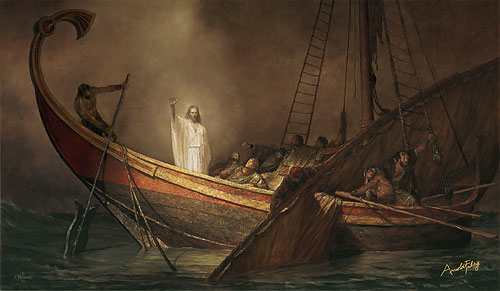
Peace be Still by Arnold Friberg

“Peace, be still,” by Arnold Friberg

The tragic mass shootings in El Paso and Dayton have many Americans on edge, as they struggle to understand what is causing it all. Sadly, such tragedies have become common in our country. The public and government responses to these shootings are predictable: the left calls for stricter gun control laws, while the right emphasizes the Constitutional right to bear arms and attributes the shootings to mental health problems. Unfortunately, most Americans fail to recognize the root cause of the problem. Why is this?  Perhaps it’s because we live in a country where, for many, the idea of good and evil has become an archaic concept, something associated with ancient religious superstitions.   

The Rev. Canon Phil Ashley of the American Anglican Council explained it like this. We face a culture that is “…increasingly shaped by the forces of aggressive secularism, moral relativism, religious pluralism, individual autonomy and a utopian hope in secular authority.” As more and more Americans push God out of their lives, social, cultural and spiritual chaos is filling the vacuum. When a country or society pushes God out, it opens the door for the enemy to come in. 1 Peter 5:8 says, Satan “…prowls around like a roaring lion looking for someone to devour.” Those lacking a solid spiritual foundation very easily become his prey. Yes, evil is real.

Chaos often breeds isolation, which for some people means empty lives nearly devoid of human contact. Isolated and confused, they might seek meaning in their lives through narcissism—an egoistic admiration of one’s self, which is a form of idolatry. Narcissism is easily fed through social media, where one can simply manufacture a false persona in an effort to gain approval from others.

Over prolonged periods, isolated individuals can  become enveloped by darkness.  Some may seek meaning or self-purpose through infamy—mass shooters are not soon forgotten.  Mass shootings are only one symptom of the problem however. It manifests itself in many other ways, including drug and alcohol addiction, pornography addiction, child abuse, human trafficking, suicide and countless others.

To begin to fix the problems in America, we don’t need more laws or more gun rights.  We need a spiritual revival of our Judeo-Christian roots. Dr. Jack Graham, the pastor of the Prestonwood Baptist Church in Plano, TX explains it like this, “All of us are involved in some kind of a spiritual battle—a warfare that’s going on increasing.  A battle that is getting hotter and hotter right now and predictably so.  In fact, the Bible tells us that in the final hours of human history that perilous times will come.  Difficult dangerous times will come.” Dangerous times are not exclusive to American Christians.  Persecution of Christians because of their faith is running rampant around the globe.

Of the shootings in El Paso and Dayton, the Rev. Franklin Graham wrote, “The Word of God tells us to ‘mourn with those who mourn,’ and that is what our nation is doing. We grieve the tragic and devastating loss of life in El Paso and Dayton this weekend. The number of victims of the mass shootings is much higher than the headlines reveal, because each mother, each father, each sister and brother, each wife and husband, is also a victim—a victim of the heinous and senseless evil unleashed by two murderous gunmen. Their loved ones have been stolen from them.” And “”As we mourn with these families and communities, let’s continue to sincerely lift them up in prayer before the Lord.” Despite what some politicians have said, prayer is a proper response to mass shootings.

Fortunately, Christians needn’t despair at what they see happening around them. They can be confident that God is in control of their lives, even when the world appears to be coming apart all around them. Throughout the scriptures Jesus remains as solid as a rock. We see this vividly portrayed in Mark chapter 4, when Jesus and His disciples are on a boat in the midst of a terrible storm. Jesus is asleep on a cushion when his frightened disciples wake Him, fearing they are about to perish. Jesus rises and speaks the words the simple words, “Peace, be still.”  Immediately, the wind ceases to blow and the water grows calm. His disciples then marvel that even the wind and the sea obey Him.    

The same Jesus who calmed the storm is in control of our lives today. Hebrews 12:28-29 says we live in an unshakeable kingdom. “Therefore, since we are receiving a kingdom that cannot be shaken, let us be thankful, and so worship God acceptably with reverence and awe, for our God is a consuming fire.”  

Christians have nothing to fear in the midst of today’s chaos.  As the late Rev. Dr. Billy Graham said, “I’ve read the last page of the Bible. It’s all going to turn out all right.” Christians need only do their best to imitate the life of Christ. God will take care of the rest.

Enduring Truths for Recent Graduates


Graduate [2]

Seven years ago I wrote an article  for my newspaper column with some advice for recent grads.  It has become one of the most popular pieces I ever wrote. I’ve received hundreds of emails thanking me for writing it.  Therefore, I decided to  republish it annually around graduation time.  I hope some of you might find it useful.  You can view the original article in the Tribune-Democrat news at this link: http://goo.gl/LtN72

For those who are graduating high school this year and beginning the long transition into adulthood, I’d like to offer you a gift. Here are five enduring truths I have learned. They will help you through life’s journey.

Choices

“If you decide to just go with the flow, you’ll end up where the flow goes, which is usually downhill, often leading to a big pile of sludge and a life of unhappiness. You’ll end up doing what everyone else is doing.” ― Sean Covey, The 7 Habits of Highly Effective Teens

 Life will deal you an endless string of choices along the way.  Some will be trivial, like deciding what to wear today.  Others will be weighty and their outcomes will affect you forever.  Weighty decisions should always be preceded by much thought and soul searching.  This includes decisions about who you date or marry, what you put into your body, bringing children into the world, what you do for a living, how much debt you incur and who you associate with.

All of these decisions will have a lasting effect on your life. Therefore, make them slowly and deliberately. Often you’ll discover that the right choice is not the easiest one.  A habit of making poor choices will, as the Sean Covey quote suggests, drag your life downhill.

I was recently contacted by a young man who had just received a bad conduct discharge from the Navy.  He asked me how the discharge would impact his future employability.  His mistake was choosing to drive a car while intoxicated and hitting a pedestrian. Fortunately, the victim wasn’t seriously injured. Had it been otherwise, the young sailor would probably be in prison.  It was my sad responsibility to inform him that with some employers the discharge would be a black mark for life. Choices matter!

 Learning

“Experience is a hard teacher because she gives the test first, the lesson afterwards.”    ―Vernon Saunders Law, former professional baseball pitcher and Cy Young Award winner

Some of you will go on to college or technical school.  Others will enter the workforce.  Even if your formal education is over, don’t quit learning. Make learning a lifelong adventure.  I did my undergraduate work at the University of Kentucky.  The school offers a fellowship program for individuals aged 65 and older to attend classes tuition free. Every year numerous senior citizens walk the stage to receive degrees ranging from Associate of Arts to Doctor of Philosophy.  It’s never too late to learn.

Even if you don’t choose to continue formal learning, make it point to learn from life. Observe others; note their successes and failures; then learn from their experiences.  More importantly, learn from your own mistakes.

Some of the greatest lessons I’ve learned, particularly those while serving in uniform, were the result of having made a terrible mistake.  This sort of lesson sticks, like the first time you grab the handle of a hot iron skillet with your bare hand.  The key to learning from mistakes is owning them.  Admit your mistakes and then move on, having learned something from the experience.  Don’t let, “It wasn’t my fault,” be part of your vocabulary.

 Work

“A dream doesn’t become reality through magic; it takes sweat, determination and hard work.”  ―Colin Powell, retired U.S. Army four-star general and former U.S. Secretary of State

Work isn’t always fun. If it were, they’d call it play.  Work can be downright unpleasant, but it’s an essential element of life! Along the way you’re going to have jobs you won’t like. Note what you don’t like and make it a point to improve yourself, so you’ll never again have to work at such a job.

Accepting a job means submitting to the authority of those placed over you.  Learn to work within this system.   You’ll inevitably have bosses you don’t like.  Learn to respect the position, if not the individual.

Fairness

“Life is not fair; get used to it.” ―Bill Gates, founder and former CEO, Microsoft Corporation

You will hear much discussion about fairness in this life. It’s all hot air.  Life isn’t fair.  Some good people die young, while some bad people live a long life.   Disease sometimes strikes arbitrarily, for no apparent reason.  Some people prosper while others suffer failure. A death or accident can change your life forever.

There is randomness to life that can’t be avoided.  Don’t expect kindness to be returned with kindness.  Don’t expect generosity to be returned with generosity.  The best choice is to be fair and kind to others and learn to accept what they return to you.

A wise man named Harry Browne ran for president of the United States on the Libertarian Party ticket. On Christmas day in 1966, Browne wrote his young daughter a letter aptly titled, “A Gift for My Daughter.”  I encourage every graduating senior to read it and digest it. In the letter, he explains to his daughter that, “Nobody owes you anything.”  Understanding what Browne meant can truly bless you. You can find it at:  www.harrybrowne.org/articles/GiftDaughter.htm.

Faith

“A faith is a necessity to a man. Woe to him who believes in nothing.”  ―Victor Hugo

I once had a senior Army officer tell me he preferred to work with men who possessed spiritual values, regardless of their religion.  He explained that having faith in a power higher than one’s self was an indicator of how one will perform under pressure; in this instance, the pressure meant combat.

Too many people place their faith in all the wrong places.  It might be in wealth, celebrity, good looks, talent, or even government.  Whatever the case, misplaced faith leads to disappointment after disappointment.

To avoid these disappointments, put your faith in God alone.  You, your loved ones and your friends will all inevitably let you down, but God will never fail you.

Easter 2019

hand-drawn-he-has-risen-luke-24-6-text-on-white-vector-20468630

Holy Week

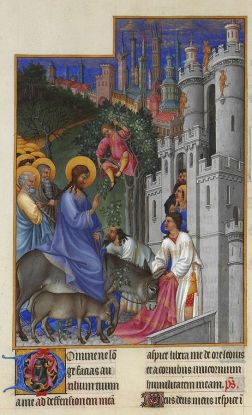
Triumphal Enter into Jerusalem - HosannaJesus entering Jerusalem

Traditionally, the week before Easter is called Holy Week. It starts on Palm Sunday. Holy week began today.  It is the last week of the penitential church Season of Lent. 

Palm Sunday
In the Bible, Holy Week begins with a religious festival. People have flocked to Jerusalem to celebrate Passover and see the controversial prophet Jesus. Many come to cheer him on as Jesus rides into Jerusalem. They wave palm Branches and shout “Hosanna,” which means “save us,” a Jewish call of lamentation that has since become a call of praise. Jesus enters Jerusalem riding on a Donkey.  Jesus’ triumphal entry fulfills an Old Testament prophecy and is seen as a sign of humility. Some who cheer him that day will inevitably cry “Crucify him” only a few days later, so the memory of Christ’s entrance into Jerusalem is a time of mixed joy and sadness.

Maundy Thursday
In the evening of this day Jesus met with his disciples for the last time before his death. Before the meal, he washes their feet, another sign of humility. During the meal, he prophesies that one of the disciples will betray him. On this evening, Christians are thinking of Christ’s establishment of the sacrament of Holy Communion. In many congregations, a worship service occurs in the evening, in which the congregants come together for a Eucharist meal, just as the first Christians celebrated it. Often after the communion, the altar is cleared, and left unadorned on Good Friday.

Good Friday
On Good Friday, Jesus was crucified. He was tortured and killed. His suffering is therefore at the heart of this day. But it also commemorates the suffering of mankind in general, because through Jesus, God has sided with the suffering. The day is quietly celebrated as Christians contemplate Jesus’ suffering and death. Together with Easter, Good Friday forms the centerpiece of the Christian message of good news: God is stronger than Death! On that day Jesus suffered all that a man can suffer to atone for the sins of mankind. Sin and Death did not have the last word. God raised Jesus as he will one day raise all believers who die in Christ.

Holy Saturday
On the evening of Good Friday, Jesus was taken down from the cross and buried. On Saturday, the Sabbath, that would not have been allowed. So Saturday is the full day that he was dead. In the creed, this means Jesus descended into Hell, or the realm of the dead. We aren’t sure what that is and what it is like there, but the message that Jesus was “resurrected on the third day” provides confidence that at the end of the age God will resurrect Christian believers.

Easter Night
The Bible doesn’t describe the physical resurrection of Jesus. On Easter morning, the women find the empty tomb and are told by an angel that Jesus was resurrected. That might have occurred at night, because in the Jewish Tradition the day begins with the night (“It was evening and it was morning, the first day”). Easter (Saturday) night belongs to Easter Sunday. The resurrection is celebrated on this “night,” mostly in the early hours of the morning, but in some places it is celebrated on Saturday evening. It is a celebration that, in its design, leads from darkness to light. At its climax many congregations light the new Pascal candle declaring “Hallelujah, Christ is risen; He is risen indeed.”

Easter Sunday
The women who discover Jesus empty tomb are the first to spread the Good News of Jesus’ resurrection. In the course of this and the next few days many people meet Jesus and witness the resurrected Son of God. In the early church congregations met regularly for a common Sacrament the day after the Sabbath to commemorate the resurrection. In the Christian context, Sunday was thus marked as the most important day of the week and as a day of rest.

An invitation:
Easter occurs on April 21st this year. For readers in the Sioux Falls area, you are invited to attend an Easter Sunrise service conducted by Church of the Resurrection (www.resurrectionsf.com). The service will begin at 7a.m. at the McKennan Park bandshell. Bring lawn chairs. The service will occur rain or shine.


Lent: a Season of Penitence and Prayer

Lenten Journey 3

As an Anglican, I follow a Church liturgical calendar, celebrating each of its many seasons.  Very soon the season of Lent will be upon us.  Lent this year is the period of 40 days from Ash Wednesday (March 6th) to Easter Sunday, commemorating Christ’s 40 days of fasting and temptation in the wilderness, His final journey to Jerusalem, where He was crucified, and His last hours with His disciples before His crucifixion. For believers, it is a period of penitence and alms giving. On Ash Wednesday, many Christians have their foreheads marked with ashes in the sign of the cross.  The ashes are often collected from burning the palm fronds used in the celebration of Psalm Sunday.

The Catholic and Anglican traditions regarding Lent are very similar.  In the Anglican tradition, which I practice, Lent is sometimes called the Paschal season (relating to Passover or Easter). It is a preparation time intimately connected to the most important Festival of the Church year, Easter, which marks Christ’s resurrection from the dead and His victor over sin and death. In celebration of the so-called Easter Triduum, Christians commemorates the passion (suffering), death, and resurrection of Jesus and thus the origin of the all Christian belief and the source of our faith and salvation. So, as Jesus spent 40 days fasting and praying in the desert, Anglicans prepare for 40 days for the encounter with Him in the Easter celebration. Traditionally, the Easter season begins with Ash Wednesday and ends on Holy (or Maundy) Thursday, a day we recall Jesus washing the feet of his disciples and having his last meal with them before his crucifixion.  Maundy Thursday reminds believers of their hunger for God by refraining from food and intensifying one’s prayer life and charitable giving. 

In the Orthodox tradition, Lent is an invitation to learn the salvation story  by studying the death and the resurrection of Christ. It is an exercise in which believers partake of suffering and resurrection of the Lord. The cross and resurrection are daily realities: we die every day in all trials of life with Christ, but we experience our resurrection every day when we unite with him in faith and prayer. It is important in the Orthodox tradition to recognize that the cross is symbolic of the resurrection, not death. Fasting during Lent is an exercise of self-restraint, by which believers overcome their physical passions and win true freedom. It helps us to the internalization, especially when we pray. The believers should fast and avoid meat. They should intensify their prayer life and dig deeper into the scriptures than usual.  On Wednesdays and Fridays during Lent, many Orthodox churches celebrate an evening service called “liturgy of the pre-sanctified gifts”. During these services, no elements are sanctified for the Holy Eucharist.  Instead, the bread and wine sanctified on the precious Sunday are used.  On these days, many Orthodox believers fast until evening.

Protestant denominations observe Lent in a wide variety of ways. Sadly, many traditional Protestant denominations barely observe Lent or the Church Calendar at all.  However, for some, fasting during Lent is a time for reflecting on the essentials of Christianity. The original purpose is to prepare one’s self internally for the coming of Easter. Many Protestants avoid certain things during Lent in a quest to learn the true necessities in life. They may deprive themselves of dependency-related risks such as alcohol, chocolate and other sweets, and even the consumption of social media. The Lenten season is a good time to reorder one’s life—restacking priorities.  

For those readers who have no set way of observing Lent, I urge you to consider adopting a Lenten tradition.  One simple way to begin is to read a daily Lenten devotion.  There are many available on the web, but my favorite is published by Lutheran Hour Ministries.  Beginning March 6 you will be able to find the devotions at this link:  https://www.lhm.org/lent/.

“…special (church) holidays give rise to various liturgical calendars that suggest we should mark our days not only with the cycles of the moon and seasons, but also with occasions to tell our children the stories of our faith community’s past so that this past will have a future, and so that our ancient way and its practices will be rediscovered and renewed every year.” 
         ― Brian D. McLaren,  Finding our Way Again: The Return of Ancient Practices