The triumphal entry of Jesus into Jerusalem, Matthew 21:1-11
The dominance of Rome
As a retired Army Officer, I find Roman history fascinating. The Roman Empire’s territory in Jesus’ time completely enveloped the Mediterranean Sea. Roman society was very militaristic. The military played a central role in the empire’s territorial expansion, governance, and social structure. Rome aggressively employed its strong military capabilities to conquer new territories and maintain control over its sprawling empire. Military prowess was a key aspect of Roman cultural identity.
The Roman Senate sometimes granted a festive procession through the streets of Rome to pay tribute to a general who was victorious in battle. Called a Triumph or a triumphal procession, it was a grand and elaborate ceremony designed to celebrate and publicly recognize the military achievements and conquests of the general being honored.
A Triumph was a blend of religious, political, and social elements, showcasing the glory of Rome. The general being honored wore a special ceremonial toga. He rode in a chariot drawn by four horses, followed by his troops, prisoners of war in chains, strange animals from the conquered lands and wagons filled with the spoils of war. Adoring citizens lined the streets, cheering as the different elements of the Triumph passed by them. The air was full of the sounds of music and chants, creating a jubilant, reverent atmosphere. The Triumph not only honored the general but also reinforced the power and splendor of the Roman state.
Jesus’ triumphal entry into Jerusalem
In Jerusalem a large crowd of Jews gave Jesus an impromptu Triumph of His own. His triumphal entry into Jerusalem is described in all four Gospels: Matthew 21:1-11, Mark 11:1-11, Luke 19:28-44, and John 12:12-19. Each provides a slightly different perspective on the event, but they all highlight the significance of Jesus’ arrival in Jerusalem as the fulfillment of prophecy. Jesus’ triumphal entry, in Christian tradition, marks the beginning of Holy Week. It sets the stage for the events leading up to His crucifixion and resurrection, which are central to the Christian belief that Jesus is the Messiah, the son of the living God.
According to the Gospels, Jesus entered Jerusalem riding on a donkey (or colt), fulfilling a prophecy found in both Isaiah 62:11 and Zechariah 9:9. As He approached the city, a large crowd gathered, spreading their cloaks and palm branches on the road before him. They shouted “Hosanna” (loosely translated as “save us” or “help us”) and praised Him as the “Son of David” and the “King of Israel.”
The atmosphere at Jesus’ triumphal entry was one of celebration and anticipation, as the jubilant Jews who were present believed him to be the promised Messiah, who they supposed would be a military leader who would free them from Roman oppression. However, in stark contrast to a Triumph for a Roman General, Jesus’ humble entry into Jerusalem symbolized the peaceful role of His mission as Messiah, the humble King of Israel who fed the hungry, healed the sick, cleansed the lepers, gave sight to the blind, prayed for His enemies, and washed the feet of His disciples.
Sadly, most of the Jewish people and religious leaders failed to recognize Jesus as Redeemer, the sacrificial Lamb of God who would suffer and die under the orders of Pontius Pilate and after three days gloriously rise from the dead, conquering sin and death once and for all. Jesus freely sacrificed himself for the sins of the world and offers eternal life to all who believe on Him and profess that He is the son of God. We all need the Most Holy Redeemer of the world. Jesus Christ is the Triumphant God.
Prayer to the Most Holy Redeemer
(Anima Christi)
Soul of Christ, sanctify me.
Body of Christ, save me.
Blood of Christ, embolden me.
Water from the side of Christ, wash me.
Passion of Christ, strengthen me.
O good Jesus, hear me.
Within thy wounds hide me.
Never permit me to be parted from you.
From the evil Enemy defend me.
In the hour of my death call me.
and bid me come to thee,
that with your saints I may praise thee
for age upon age. Amen.
2 Corinthians 2:14 – “But thanks be to God, who in Christ always leads us in triumphal procession…”
* All Bible quotes are ESV
Bing Copilot AI was used to assist with the historical research used to write this piece.
Afghan woman proudly displaying her purple forefinger, dipped in indelible ink at a voting station where she cast her vote in the national election. This was a way of ensuring voters voted only once.
It was sunny and warm in Louisville, Ky. on Saturday, June 28, 1975. That’s the day I boarded a bright yellow school bus at an Army recruiting station for a short journey to Fort Knox, where I was scheduled to undergo Army basic training or boot camp as it’s often called. Only a few weeks earlier I’d been a bright-eyed college student receiving his associate degree in Munich, Germany. My mother Phyllis and stepfather Ray were still in Germany—Ray was an Army officer with the rank of lieutenant colonel, assigned to the U.S. Army Europe headquarters in Heidelberg.
After what seemed like hours, the bus turned into the main gate of Fort Knox. Entering the post felt very familiar, as I’d lived there during my freshman and sophomore years of high school while Ray worked at the Armor School. About ten minutes after entering the post, the bus turned down a side street and then swung into the parking lot of Delta Company, 13th Training Battalion, 4th Training Brigade, home of the Delta Demons. Delta Company would be our home for the next several weeks.
Peering out the bus window I could see two tough looking fellows wearing olive drab fatigues and the iconic Smokey Bear hats that identified them as drill sergeants. Their fatigues were starched stiff with creases that looked sharp enough to slice an apple. Their uniforms fit like gloves. Their boots were polished to a mirror finish. Not a hair was out of place. All you needed was one look at these impressive gentlemen to know that they were pure badass!
The driver opened the bus door and we were greeted by a booming voice. “Off the bus and line up. Move it ladies!” After a clumsy exit, fumbling with our bags and bumping into each other, we school boys managed to get into something resembling a line. The empty bus quickly pulled away, leaving us feeling isolated and helpless. It was then that we were introduced to the two gentlemen who would fill the roles of father, mother, confessor, and mentor for all of us in the coming weeks, as our Drill Sergeants turned a bus full of boys into men.
Thus began my 26-year career in the United States Army, an adventure that ended in 2001 with my retirement from our nation’s “Big Green Fighting Machine.” My career led me to assignments in the United States, Western Europe, the Balkans, Africa, and the Middle East. Looking back, those were good years all in all. Sure, the hardships were many, but the adventures, excitement and camaraderie far outweighed the hardships. I can’t help growing a bit nostalgic every time I think about it.
I wish the United States still had a military draft. Even better would be three years of mandatory military service for every American girl and boy, starting at age 18. At least one year would be spent overseas, being exposed to other cultures and languages. It would be a better education than pursuing a four-year degree. It would also strengthen our nation by showing college age citizens how blessed they are to live in America.
Today’s world is full of danger. Look no farther than Ukraine or the Middle East for proof. Unfortunately, few of those in Congress have military experience as a frame of reference to help guide them when making decisions that could draw our nation into war.
The presidential election is only weeks away and the ugly political slurs are flying like bullets in a drive by shooting. Politicians from both side of the aisle are quick to tell us how bad we’ve got it and how it’s all the other side’s fault. Don’t believe it. One thing my time in the military taught me is that, despite what shifty politicians might say to the contrary, we Americans have much to be thankful for.
James 1:17 tells us, “Every good and perfect gift is from above, coming down from the Father of the heavenly lights, who does not change like shifting shadows.” Here are just a few gifts Americans should thank God for. Remember them when you lie down to go to sleep tonight.
Across the land we enjoy relative safety from the government and other people.
We enjoy the freedom to worship as we choose.
Our leaders are elected by the people.
Access to free, basic education is widely available.
Safe drinking water is usually readily available.
Sanitation services are available to help prevent sickness and disease.
We grow enough food to feed our population and have extra to export.
We have a robust transportation infrastructure to distribute the commodities we need.
We enjoy abundant natural resources to produce energy.
Electricity is generally available across the land.
The Lord bless you and keep you; the Lord make his face shine on you and be gracious to you; the Lord turn his face toward you and give you peace. –Numbers 6:24-26
My heart is stirred by a noble theme as I recite my verses for the king; my tongue is the pen of a skillful writer. –Psalm 45:1*
A large portion of my wife’s family tree is rooted in Lancaster County, Pennsylvania. Lancaster County is Amish country. Having rejected the modern world, these plain Christians, the descendants of Swiss-German Anabaptists, struggle to maintain an 18th century existence in fast-paced, 21st century America. The county has well over 30,000 Amish residents today.
The Amish are farmers and craftsmen. Stout work horses pull their plows through the fertile fields. They build their own houses and barns and heat them with stoves fired by wood and coal. They make their own furniture. Their houses have no electricity. They have neither television, radio, cell phones, computers, cars nor tractors. They educate their children in one-room schoolhouses. They hold church services in private homes. They know their neighbors and help them when needed. They revere God!
While I’m not ready to give up 21st century conveniences, I must admit there’s a part of me that envies the simple existence of the Amish. Inspired by Amish simplicity, I began writing this Divine Simplicity blog in September 2011 as a Christ-inspired self-help guide on simplifying one’s life.
My blog has evolved considerably over the years, with the topics growing ever broader, but all the while aiming to maintain a focus on Christ and scripture. When I started this blog, I never figured I’d still be at if after a decade. I don’t have many followers, which led me to question the blog’s value. Why I should continue to write it at all. After considerable thinking on this, it all boils down to three things.
I endeavor to ensure that every entry I write honors and glorifies Jesus.I write prayerfully, hoping to inspire serious thought and holy conversation. Billy Graham had this to say:
“Our dress, our posture, our actions should all be for the honor and glory of Christ. Much of our talk as Christians is secular, not spiritual. It is easy to fall into conversational conformity of the world and spend an evening discussing politics, new cars, and the latest entertainment. We often forget that we are to edify one another with holy conversation and that our conversation should be on heavenly, and not exclusively on earthly things.”
Create in me a pure heart, O God, and renew a steadfast spirit within me. –Psalm 51:10
I also write for my own spiritual renewal. Writing a blog entry almost always causes me to search through the Bible, seeking relevant passages supporting the topic I have chosen. For me, searching and studying scripture is cathartic. It draws me closer to God by shifting my thoughts from earthly cares and concerns to Godly thoughts inspired by the Holy Spirit. Writing about the scripture passages I discover reinforces what I learn from them.
I planted the seed, Apollos watered it, but God has been making it grow. So neither the one who plants nor the one who waters is anything, but only God, who makes things grow. –1 Corinthians 3:6-7
Finally, I write to sow seed containing the Good News of Jesus Christ. Perhaps if I, through my blogging, can plant a seed with the Gospel message in a reader’s heart, then maybe another will water it so that God will make it grow. I did some rough math and figure that during the course of nearly 13 years I’ve spent around 1,500 hours researching and writing this blog. If it has helped even one person find his or her way to Christ’s salvation, then I’m satisfied that it has done its job. Soli Deo gloria.
Whatever subject I preach, I do not stop until I reach the Savior, the Lord Jesus, for in Him are all things. –Charles Spurgeon
I am the Lord your God who takes hold of your right hand and says to you, Do not fear; I will help you. —Isaiah 41:13
Many people today fear a wide variety of things they see and hear around them. Fear is running rampant right here in America. Polls indicate that the majority of Americans now believe that their children’s lives will be harder than their own. They worry about unemployment and the economy. Many fear illegal immigration. Others are afraid to gather in public places for fear of violence. We see campus protests turn violent. School shootings don’t surprise us anymore.
On a cosmic scale we hear about giant solar flares that could destroy technology, pushing humankind back into the Stone Age. A large meteor or asteroid collision could destroy life on Earth.
In the natural world, we hear that a major eruption of a super volcano, like the one beneath Yellowstone National Park, could cause destruction and death on a planetary scale. Earthquakes and tsunamis in diverse places threaten millions of people. Climate change is blamed for killer storms, droughts, melting polar ice, coastal flooding, wildfires and more.
On the human plane, we read and hear about flesh eating bacteria, brain eating amoebas, and drug resistant bacteria and viruses. Abortion rights are a hot button topic that can trigger anger and rage. Some people hunker down in their homes, worried about riots, violence by and against the police, and other street violence. Others fear that computer hackers or scammers will steal their identities and wealth.
There are wars in Ukraine and Gaza, and rumors of a global war that’s coming. Religious persecution is increasing around the globe. There is a growing wave of antisemitism right here in America. There are ample reasons for fear.
The Bible mentions two very different types of fear. The first is fear of the Lord. This fear is not associated with being scared. It is an awe and reverence of God and is to be encouraged. According to Psalm 111, fear of the Lord is the beginning of wisdom and leads to rest and peace.
The second type of fear is detrimental. In the first chapter of 2 Timothy it is described as a “spirit of fear.” A person can be completely overcome by a spirit of fear, virtually frozen and unable to function. Such fear weighs a person down physically, emotionally and/or mentally.
Unfortunately, many Christians have succumbed to living with a spirit of fear. Some fear those of other religions and are reluctant to reach out to them in Christian love. Some fear those who are different from them culturally or racially. Others are hesitant to invite those in need into their lives for fear they might lose something or it might cost something. Some are afraid to leave the comfort of their homes and familiar surroundings in order to reach out to the needy. Others are hesitant to give of their wealth for fear they might later find themselves in need.
Many Christian fears boil down to a fear of losing something—possessions, comfort, safety, security. In Philippians chapter 3, verses 7-8, Paul describes how he has let go of the things of this world in order to focus on what is truly important:
But whatever gain I had, I counted as loss for the sake of Christ. Indeed, I count everything as loss because of the surpassing worth of knowing Christ Jesus my Lord.
One can’t grasp Christ’s outstretched hand while clinging to things of this world. As David tells us in Psalm 34, verses 4-7:
I sought the Lord, and he answered me and delivered me from all my fears. Those who look to him are radiant, and their faces shall never be ashamed. This poor man cried, and the Lord heard him and saved him out of all his troubles. The angel of the Lord encamps around those who fear him, and delivers them.
You may be facing a health crisis, unemployment, divorce, a call to Christian service, or other difficult challenges. Don’t live in fear. Take the fears you struggle with today and give them to the Lord in prayer. Make this a habit. I will not tell you to “let go and let God” because it makes letting go of fear sound so simple. Instead, I encourage you to explore the Bible and learn what it says about fear. Read and believe!
Begin with Psalm 23. Then read Psalm 118. Other relevant Psalms include 27, 34, 46, 61, 91, 103, and 121. Once you have read these Psalms, locate a red letter edition New Testament and read every word spoken by Jesus. Then read Paul’s epistles. Become steeped in scripture. Do this and you will be well on the way to giving your fears to the Lord.
The remarkable thing about God is that when you fear God, you fear nothing else, whereas if you do not fear God, you fear everything else. —Oswald Chambers
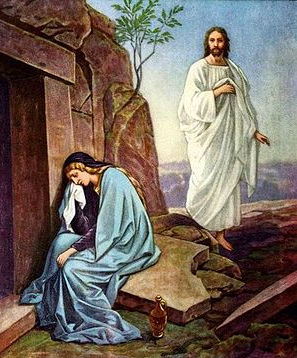
Now after the Sabbath, as the first day of the week began to dawn, Mary Magdalene and the other Mary came to see the tomb. 2 And behold, there was a great earthquake; for an angel of the Lord descended from heaven, and came and rolled back the stone from the door, and sat on it. 3 His countenance was like lightning, and his clothing as white as snow. 4 And the guards shook for fear of him, and became like dead men.
5 But the angel answered and said to the women, “Do not be afraid, for I know that you seek Jesus who was crucified. 6 He is not here; for He is risen, as He said. Come, see the place where the Lord lay. 7 And go quickly and tell His disciples that He is risen from the dead, and indeed He is going before you into Galilee; there you will see Him. Behold, I have told you.”
8 So they went out quickly from the tomb with fear and great joy, and ran to bring His disciples word.
The Women Worship the Risen Lord
9 And as they went to tell His disciples, behold, Jesus met them, saying, “Rejoice!” So they came and held Him by the feet and worshiped Him. 10
During this church season of Advent, Christians anxiously await the celebration of Jesus’ birth. We commemorate His arrival in this world on December 25, the Feast of the Nativity of Our Lord Jesus Christ.
As we await the arrival of the Christ child, my wife and I recently said goodbye to a departing friend who moved to another state to be near family. I’ll call him John for the sake of privacy. John was diagnosed with Autism Spectrum Disorder (ASD) about two years ago, but has displayed ASD symptoms most of his life. According to the Centers for Disease Control, an estimated 5,437,988 (2.21%) adults in the United States have ASD.
For the past three and a half years my wife and I walked alongside John, providing him companionship, counsel, and a small lifeboat to climb into during frequent storms he encountered. John first came into our lives by means of our church. One day our priest asked us if we would be willing to help a single man who had recently arrived in our community. We said yes without really knowing what to expect. I share the details below not to glorify my wife and me; give all the glory to God! I share this to make a point which I’ve discussed before—being a follower of Jesus Christ can be messy.
We answered 2 a.m. phone calls so John could rant about whatever was bothering him at the time. We shared meals with him and checked periodically on his welfare and the state of his small apartment. We tried to help smooth the situation when John irritated his neighbors. We helped him move to a new apartment.
We drove him to appointments and to help him tend to his local business affairs when something needed fixing. We provided in-person support when John’ family could not contact him because his phone was (frequently) broken or lost, or when he was simply not answering calls or emails.
We invested many conversations with some of his family members who are active stakeholders in John’s life–over lunch, dinner, coffee, phone calls, and Zoom meetings. We supported John and these same family members during the complex endeavor to have him evaluated for ASD. We coordinated the dedication of funds from our church’s rummage sale to help defer the costs of the evaluation; printed forms and obtained John’s signatures; and prayed for the process. We coordinated with our church members to provide overnight accommodations for John’s family members when they periodically visited the area to check on his welfare.
Walking with John was not easy, but it was very spiritually rewarding and has made us three new friends, including John and two very special members of his family—they know who I mean. As we anxiously await the Feast of the Nativity and the celebration of the Christ child’s birth, Christians should recall that following Christ can get messy—Just read the book of Acts and see.
Patience: an ability or willingness to suppress restlessness or annoyance when confronted with delay (source: http://www.dictionary.com).
Followers of this blog have likely heard the adage, “Patience is a virtue.” I would add, “Patience is in short supply.” A close look at modern American society reveals that collectively we are an impatient bunch. We detest delays caused by heavy highway traffic and long stoplights. We hate standing in lines. We love express checkout lanes at the grocery store, next day delivery, and express mail. We like on demand TV programs and complain if a webpage takes a few extra seconds to load on our phones and computers. At this time of year, the Christmas season, even little kids join in anxiously counting the days until Santa arrives with his bag full of presents.
Patience has suffered in the information age, especially since the advent of the Internet. We are bombarded with a flood of information from a multitude of directions and sources. It is impossible to take it all in. Consequently, we are increasingly fed information is small, easily digestible tidbits, whether it be news articles, sports reports, and even those pesky pop-up ads trying to sell us all kinds of stuff.
There are numerous studies indicating the way information is presented in compact form today alters the human brain, making it difficult for people to focus on long articles, books, etc. Many people today, especially younger adults, simply lack the patience to read a long book like the classic War and Peace or a James A. Michener novel, preferring the CliffsNotes version to the full-length one. With patience in short supply, who among us will write the next classic novel or paint the next masterpiece like the Sistine Chapel? Who will perform the long, grueling research projects to cure human diseases? Who will travel to the planets?
My wife and I are perfect examples of patience—she being a good example and me a bad one. She is the type who will write personal notes in each of the many Christmas cards she sends. I, on the other hand, sign them and stuff them in the envelope. She can solve a difficult jigsaw puzzle in record time. I would not dream of even starting one. She is great with handling our grandkids. I quickly slip into the drill sergeant mode when their antics irritate me. She frets about practically nothing. I fret about myriad things. She follows a straight and narrow path while I zig and zag along. She has put up with me for almost 50 years—now that’s patience!
I am blessed with a patient wife, but even more blessed with a patient God. When I consider my personal transgressions and the collective transgressions of our nation, I marvel that God has spared us his wrath thus far. God’s love for us is evident in His only son Jesus Christ. He suffered a cruel death on the cross as a propitiation for our sins. Through his glorious resurrection, Jesus overcame sin and death and opened the door to salvation for all who believe on His holy name. God is patient and gives us second chances, but only through the shed blood of Christ. Oh God, continue to be patient with us I pray!
Therefore, as God’s chosen people, holy and dearly loved, clothe yourselves with compassion, kindness, humility, gentleness, and patience. –Colossians 3:12
Wishing all my readers a very blessed Christmas and a happy, healthy 2023. See you next year! Please pray for those of us in the upper Midwest where we are currently experiencing polar-like temperatures, snow, and wind.
“The Bible is not an option; it is a necessity. You cannot grow spiritually strong without it.” –Billy Graham
I’m shocked at how many professing Christians I’ve met know very little about the Bible. How can this be? The biblical Hebrew faith placed great emphasis on reading the Scriptures aloud and then interpreting the reading. Luke 4:14-20 tells us:
“Jesus returned to Galilee in the power of the Spirit, and news about him spread through the whole countryside. He was teaching in their synagogues, and everyone praised him. He went to Nazareth, where he had been brought up, and on the Sabbath day he went into the synagogue, as was his custom. He stood up to read, and the scroll of the prophet Isaiah was handed to him. Unrolling it, he found the place where it is written: ‘The Spirit of the Lord is on me, because he has anointed me to proclaim good news to the poor. He has sent me to proclaim freedom for the prisoners and recovery of sight for the blind, to set the oppressed free, to proclaim the year of the Lord’s favor.’ Then he rolled up the scroll, gave it back to the attendant and sat down. The eyes of everyone in the synagogue were fastened on him. He began by saying to them, ‘Today this scripture is fulfilled in your hearing.’”
When the people of Israel returned to Jerusalem after years of Babylonian captivity, the scribe Ezra brought the Book of the Law of Moses before them to read. Nehemiah 8:3 tells us, “He read it aloud from daybreak till noon as he faced the square before the Water Gate in the presence of the men, women and others who could understand. And all the people listened attentively to the Book of the Law.” Not only did the people listen to the reading of the Law from early morning until midday; they paid attention; they rose to their feet when Ezra opened the book (v.5); answered “Amen, Amen,” at the reading of the book (v.6); stood in their places (v.7); they all wept when they heard the words of the Law (v.9); and the people departed with great joy “because they now understood the words that had been made known to them” on that day (v.12).
The early Christians adopted a model of the public reading and interpretation of Scripture in worship; it has remained the practice in most Christian churches through the centuries. I was raised as a Southern Baptist, a denomination that emphasizes lifelong Bible study and exposes children to the Scripture from a very early age. This occurs through the spoken word in sermons and Scripture readings during worship services; and by studying Scripture in Sunday school, Children’s Church, Bible studies, and other settings. The sermon is the centerpiece of the worship service. Immediately following the sermon there is a call by the preacher to respond to the sermon’s message by walking to the front of the sanctuary and professing one’s faith publicly or making a public rededication of one’s life to Christ.
Today I am an Anglican. Anglican worship services focus on “Word and Table,” the latter being the sacrament of Holy Communion. As for the word, Anglicans maintain a theological position that proclaiming the word is a means of grace; the word includes the sermon, but the emphasis is on proclaiming the witness to God in Jesus Christ and on God’s grace that flows through the proclamation. This proclamation is made both through Scripture reading and preaching a sermon. Sermons usually focus on one or more of the scripture selections in the appointed Lectionary readings of the day. The idea of the word places emphasis on the proclamation of Scripture as the spoken word of God that bears witness to the incarnate Word in Jesus Christ. However, it is not simply that it bears witness. The spoken word becomes the living and active word of God so that God speaks through the spoken word of Scripture. The spoken word becomes a means of grace.
Anglicans view the living word as a vehicle for performing God’s work in this world. As Hebrews 4:12 says, “For the word of God is alive and active. Sharper than any double-edged sword, it penetrates even to dividing soul and spirit, joints and marrow; it judges the thoughts and attitudes of the heart.’ Ephesians 8:17 calls the word “the Sword of the Spirit.” The sword imagery is significant, as a sword is a weapon used both to deflect blows from an adversary and to strike back at one’s adversary. When Jesus was tempted by Satan in the wilderness (Matthew 4:1-11), he refused Satan’s offers, citing Scripture as His defense and as a means of compelling Satan to depart from Him. Divine power flows from the words of Scripture.
So, circling back to where I began, Christians need to study Scripture and theology! The late Rev. Dr. R. C. Sproul explained it like this: “Many people believe that theological study holds little value. They say, ‘I don’t need theology; I just need to know Jesus.’ Yet theology is unavoidable for every Christian. It is our attempt to understand the truth that God has revealed to us—something every Christian does. So, it is not a question of whether we are going to engage in theology; it is a question of whether our theology is sound or unsound. It is important to study and learn because God has taken great pains to reveal Himself to His people. He gave us a book, one that is not meant to sit on a shelf pressing dried flowers, but to be read, searched, digested, studied, and chiefly to be understood.”
All Scripture is God-breathed and is useful for teaching, rebuking, correcting and training in righteousness, so that the servant of God may be thoroughly equipped for every good work. –2 Timothy 3:16-17
Beware of bartering the Word of God for a more suitable conception of your own. –Oswald Chambers, Disciples Indeed
Click the link below for ideas on how to start a daily devotional habit.
Now after the Sabbath, as the first day of the week began to dawn, Mary Magdalene and the other Mary came to see the tomb. 2 And behold, there was a great earthquake; for an angel of the Lord descended from heaven, and came and rolled back the stone from the door, and sat on it. 3 His countenance was like lightning, and his clothing as white as snow. 4 And the guards shook for fear of him, and became like dead men.
5 But the angel answered and said to the women, “Do not be afraid, for I know that you seek Jesus who was crucified. 6 He is not here; for He is risen, as He said. Come, see the place where the Lord lay. 7 And go quickly and tell His disciples that He is risen from the dead, and indeed He is going before you into Galilee; there you will see Him. Behold, I have told you.”
8 So they went out quickly from the tomb with fear and great joy, and ran to bring His disciples word.
The Women Worship the Risen Lord
9 And as they went to tell His disciples, behold, Jesus met them, saying, “Rejoice!” So they came and held Him by the feet and worshiped Him. 10
Prayer is like a battle. The enemy is constantly placing barriers in your way to keep you from reaching your final objective.
Life is a series of continual distractions that make it difficult to find time to commune with God. Even if one manages to slip away to a quiet place for a few minutes, odds are they will find themselves distracted by thoughts about what lies ahead in their day or week. I’ve heard so many people complain, “My days are so busy I just can’t find time to pray.” In reality, if you have a busy day ahead you can’t afford not to pray. Paul’s epistle to the Church at Philippi says:
Do not be anxious about anything, but in every situation, by prayer and petition, with thanksgiving, present your requests to God. And the peace of God, which transcends all understanding, will guard your hearts and your minds in Christ Jesus. –Philippians 4:6-7
This is tough advice! Who, after all, is not anxious about something, especially in the midst of the COVID-19 pandemic? And how difficult is it to present your prayers to God with thanksgiving in every situation? “Dear God, I thank you for allowing me to crash my car into that tree yesterday.” Prayer is tough work indeed.
The nation has just gone through a painful, extraordinarily divisive presidential election process. The political rhetoric is still turned up to near the boiling point. Political disagreements have resulted in many friendships ending and have even caused divorces. Sometime it feels like the entire world has gone mad amidst the name calling, threats, riots, burning and looting. Many politicians will tell you that they have the answers to all our problems, but they don’t. Only God can fix this mess!
I lift up my eyes to the mountains—where does my help come from? My help comes from the Lord, the Maker of heaven and earth. —Psalm 121:1-2
More than any time in recent history, America’s Christians need to join together in praying for our nation and those whom have been elected to serve. So, what about that politician from the “other” party? Should you pray for him or her? “God, please help this idiot to see how wrong he is.” Well, not exactly. You can certainly pray that the Holy Spirit would convict the individual politician to make decisions that honor God, especially politicians who profess to be Christ followers.
If you have a beef with a particular politician—get over it. I don’t mean this in the traditional fashion that contemporary culture says “get over it.” I mean that, as Christians, we are obliged to forgive those who have trespassed against us, just as we pray to God to forgive us our own sins.
“In Jesus, we experience freedom not only from sin and its hold on us but also from guilt, shame, worry, Satan’s lies, superstitions, false teaching, and eternal death. No longer hostages, we have freedom to show love to enemies, walk in kindness, live with hope, and love our neighbors. As we follow the Holy Spirit’s leading, we can forgive as we’ve been forgiven” —Patricia Raybon, Our Daily Bread
Now here’s where it really gets difficult. Not only are we told to “forgive as we’ve been forgiven,” but in Matthew 5, Jesus tells us to love our enemies:
You have heard that it was said, ‘Love your neighbor and hate your enemy.’ But I tell you, love your enemies and pray for those who persecute you, that you may be children of your Father in heaven. He causes his sun to rise on the evil and the good, and sends rain on the righteous and the unrighteous. —Matthew 5:43-45
Is there a politician or other leader whose behavior absolutely disgusts you? If so, think of that person, then pray for him or her. Really! Pray that God will soften their heart. It they profess to be a Christian, ask God to fill them with the Holy Spirit.
Since 2001, The Presidential Prayer Team has been the source thousands of Americans have turned to for encouragement and inspiration to pray for America’s leaders. It is a non-partisan organization. I encourage you click the “About Us” link below to visit their website and sign up for the daily prayer alerts.
Father God, good leaders, come from you. Lord, this nation needs leaders with discerning hearts and wise minds. I beseech you today asking you today to give us wise leaders that will lead this nation in the right direction. Remove wrong people that are corrupt and living against your word from influential positions. Let our leaders be people who honor your holy name for it is only from you that they will get true wisdom. It is in the mighty name of Jesus that we believe and pray, Amen. —Anonymous







 Divine Simplicity
Recent Comments