Posts Tagged ‘Bible’

Enduring Truths for Recent Grads

Graduate [2]

A couple of years ago I wrote an article  for my newspaper column with some advice for recent grads.  It has become one of the most popular pieces I ever wrote. I received dozens of emails thanking me for writing it.    I therefore decided to  re-publish it annually around graduation time.  I hope some of you find it useful.  You can view the original article at this link:  http://goo.gl/LtN72

For those who are graduating high school this year and beginning the long transition into adulthood, I’d like to offer you a gift. Here are five enduring truths I’ve learned. They will help you through life’s journey.

Choices

“If you decide to just go with the flow, you’ll end up where the flow goes, which is usually downhill, often leading to a big pile of sludge and a life of unhappiness. You’ll end up doing what everyone else is doing.” ― Sean Covey, The 7 Habits of Highly Effective Teens

 Life will deal you an endless string of choices along the way.  Some will be trivial, like deciding what to wear today.  Others will be weighty and their outcomes will affect you forever.  Weighty decisions should always be preceded by much thought and soul searching.  This includes decisions about who you date or marry, what you put into your body, bringing children into the world, what you do for a living, how much debt you incur and who you associate with.

All of these decisions will have a lasting effect on your life. Therefore, make them slowly and deliberately. Often you’ll discover that the right choice is not the easiest one.  A habit of making poor choices will, as the Sean Covey quote suggests, drag your life downhill.

I was recently contacted by a young man who had just received a bad conduct discharge from the Navy.  He asked me how the discharge would impact his future employability.  His mistake was choosing to drive a car while intoxicated and hitting a pedestrian. Fortunately, the victim wasn’t seriously injured. Had it been otherwise, the young sailor would probably be in prison.  It was my sad responsibility to inform him that with some employers the discharge would be a black mark for life. Choices matter!

 Learning

“Experience is a hard teacher because she gives the test first, the lesson afterwards.”    ―Vernon Saunders Law, former professional baseball pitcher and Cy Young Award winner

Some of you will go on to college or technical school.  Others will enter the workforce.  Even if your formal education is over, don’t quit learning. Make learning a lifelong adventure.  I did my undergraduate work at the University of Kentucky.  The school offers a fellowship program for individuals aged 65 and older to attend classes tuition free. Every year numerous senior citizens walk the stage to receive degrees ranging from Associate of Arts to Doctor of Philosophy.  It’s never too late to learn.

Even if you don’t choose to continue formal learning, make it point to learn from life. Observe others; note their successes and failures; then learn from their experiences.  More importantly, learn from your own mistakes.

Some of the greatest lessons I’ve learned, particularly those while serving in uniform, were the result of having made a terrible mistake.  This sort of lesson sticks, like the first time you grab the handle of a hot iron skillet with your bare hand.  The key to learning from mistakes is owning them.  Admit your mistakes and then move on, having learned something from the experience.  Don’t let, “It wasn’t my fault,” be part of your vocabulary.

 Work

“A dream doesn’t become reality through magic; it takes sweat, determination and hard work.”  ―Colin Powell, retired U.S. Army four-star general and former U.S. Secretary of State

Work isn’t always fun. If it were, they’d call it play.  Work can be downright unpleasant, but it’s an essential element of life! Along the way you’re going to have jobs you won’t like. Note what you don’t like and make it a point to improve yourself, so you’ll never again have to work at such a job.

Accepting a job means submitting to the authority of those placed over you.  Learn to work within this system.   You’ll inevitably have bosses you don’t like.  Learn to respect the position, if not the individual.

Fairness

“Life is not fair; get used to it.” ―Bill Gates, founder and former CEO, Microsoft Corporation

You will hear much discussion about fairness in this life. It’s all hot air.  Life isn’t fair.  Some good people die young, while some bad people live a long life.   Disease sometimes strikes arbitrarily, for no apparent reason.  Some people prosper while others suffer failure. A death or accident can change your life forever.

There is randomness to life that can’t be avoided.  Don’t expect kindness to be returned with kindness.  Don’t expect generosity to be returned with generosity.  The best choice is to be fair and kind to others and learn to accept what they return to you.

A wise man named Harry Browne ran for president of the United States on the Libertarian Party ticket. On Christmas day in 1966, Browne wrote his young daughter a letter aptly titled, “A Gift for My Daughter.”  I encourage every graduating senior to read it and digest it. In the letter, he explains to his daughter that, “Nobody owes you anything.”  Understanding what Browne meant can truly bless you. You can find it at:  www.harrybrowne.org/articles/GiftDaughter.htm.

Faith

“A faith is a necessity to a man. Woe to him who believes in nothing.”  ―Victor Hugo

I once had a senior Army officer tell me he preferred to work with men who possessed spiritual values, regardless of their religion.  He explained that having faith in a power higher than one’s self was an indicator of how one will perform under pressure; in this instance, the pressure meant combat.

Too many people place their faith in all the wrong places.  It might be in wealth, celebrity, good looks, talent, or even government.  Whatever the case, misplaced faith leads to disappointment after disappointment.

To avoid these disappointments, put your faith in God alone.  You, your loved ones and your friends will all inevitably let you down, but God will never fail you.

One Journey Ends, Another Begins

Man on a JourneyI know, O Lord, that the way of man is not in himself, that it is not in man who walks to direct his steps.    —Jeremiah 10:23 (ESV)

I just completed a long journey in my life.  This particular one, an 18-month job search, was extremely wearisome.  In retrospect, however, all of the waiting was worth it.  I have been blessed with a new job that appears to be a nearly perfect match for my skills and desires.

Finding good work in the current economy is challenging, particularly for those of us who are a little gray around the temples. To make my search more difficult, I had decided to take a new direction with my work. It was therefore necessary for me to convince potential employers that my skills accumulated over some 30 years were transferable into the new line of work I was seeking in the nonprofit field.

The long journey was fraught with emotion—anticipation, hope, disappointment, rejection, self-doubt and frustration.  I applied for dozens of jobs, preparing resume after resume and spending hours online completing application after application.  Oh, that businesses would all use the same application process!

In many cases, my applications went unanswered.  For others it was rejection letters or very impersonal emails stating simply, “We have decided to pursue another candidate.”  It was a situation in which I could have easily lost hope, but I found comfort in Saint Paul’s words, from 2 Timothy 4:7, “I have fought the good fight, I have finished the race, I have kept the faith.”  (ESV)

I focused intently on trying to remain faithful, casting worry and doubt aside as I searched for employment. Of course there were lapses along the way.  I had to constantly remind myself that I was working on God’s timeline, not my own.  I found peace in the knowledge that He would provide the right job at the right time.

Sizakele Lugojolo, director of Lutheran Hour Ministries – South Africa has written that the peace of God, “is the peace we experience when we put aside the selfishness and let God be the center. This is the peace we experience when we give God the glory and not take it for our own satisfaction. This is the peace we experience when the will of God prevails, not ours.”

Just as Jesus prayed in Gethsemane, during my job search I frequently prayed that God’s will might be done—that I would end up in a place where He could use me as he sees fit.  Many dear friends offered intercessory prayers for me.  I could feel their power; it sustained me from day to day.

Along the way I came to realize that reaching one’s destination is not the prize.   The reward lies in how one handles his present circumstances—getting through each day of the journey.  For my many networking friends who are still searching I have but one piece of advice, “Let go and let God!”   As Saint Paul so eloquently wrote:

Rejoice in the Lord always; again I will say, rejoice. Let your reasonableness be known to everyone. The Lord is at hand; do not be anxious about anything, but in everything by prayer and supplication with thanksgiving let your requests be made known to God.  And the peace of God, which surpasses all understanding, will guard your hearts and your minds in Christ Jesus.                                                                                                                                                             —Philippians 4: 4-7 (ESV)

With my new job begins a new journey.  Like a good soldier,  I’m calling it my mission. Oddly enough, it entails something I’ve learned a bit about over the past 18 months.  I’ll be helping recently unemployed individuals find a new job. If I can help even one person find employment in less time than it took me, I’ll feel like I’m contributing to a worthy cause.

 Once you have a mission, you can’t go back to having a job.  —Shai Agassi


In the Company of Others

Creation of Eve in Gen_02-22 by Michelangelo

  The Creation of  Eve by Michaelangelo

Several children’s lives remain in peril in the wake of a stabbing spree in a suburban Pittsburgh high school.  On April 9, a 16 year old male student, for reasons still unknown, randomly stabbed a school guard and 21 fellow students as he quickly moved through the school’s hallways wielding a steak knife in each hand. Miraculously, no one has died from his wounds.

The incident is yet another chapter in a string of senseless acts of  violence in American schools that includes mass killings at Columbine High School in Littleton, Co.; Virginia Tech University in Blacksburg, Va. (2007); and Sandy Hook Elementary School in Newton, Ct. (2012).  Unfortunately, there are several others I have not listed here.  In almost every case there is a common thread—the perpetrator was a loner. Whether this was the case in the attacks in Pittsburgh has yet to be determined.

Medical studies abound indicating that loneliness and isolation are health risks.  Social interaction, on the other hand, can improve health.  It has been scientifically shown to decrease the likelihood of premature death, improve the immune system’s response to infection and decreases inflammation in the body.

Regardless of the task at hand, be it raking the lawn, preparing a meal, searching for a new job, or simply going to see a movie or museum, it is usually a better experience when done with another.

There is also plenty of Biblical evidence indicating isolation is not good.   In Genesis chapter 2, God declares, “It is not good for the man to be alone.”  He then creates Eve to be Adam’s mate, companion and friend.

In Exodus chapter 18, Moses is extremely weary because he tries to govern the Jewish people by himself.  His father-in-law Jethro advises Moses to appoint judges to help him with his tasks.  Moses wisely takes the advice, relieving him of the heavy burden of trying to go it alone.

Ecclesiastes 4:9-12 (NIV), tells us, Two are better than one, because they have a good reward for their toil.  For if they fall, one will lift up his fellow. But woe to him who is alone when he falls and has not another to lift him up!  Again, if two lie together, they keep warm, but how can one keep warm alone?  And though a man might prevail against one who is alone, two will withstand him—a threefold cord is not quickly broken.”  There truly is strength in numbers.

Isolation is particularly risky for Christians.  Pastor Paul David Tripp discusses the perils of isolation for the clergy in his book titled, Dangerous Calling: Confronting the Unique Challenges of Pastoral Ministry. According to Tripp’s research, many pastors feel lonely and isolated.  A study by the Schaffer Institute showed that over 1,700 pastors leave the ministry every month. Seventy percent of pastors constantly fight depression. Eighty percent of believe their pastoral work has negatively affected their families.  However, feelings of loneliness and isolation are not limited to members of the clergy.

Christians are all members of God’s church on Earth.  1 Corinthians:12 describes how individual Christians, each blessed with different gifts from God, are necessary for the proper functioning of the church. Each body part serves the others.  Christians were designed by God to function best when working with and in the presence of other Christians.

Acts 17:1-2 says it was Paul’s custom to go to the synagogue on the Sabbath day.  Luke 4:16 tells us it was Jesus’ custom to go to the synagogue on the Sabbath day.   When Paul won new converts to the faith, he gathered them into small churches, which usually met in private homes.

With so many examples before us, how can Christians do otherwise?  Yet many choose not to attend church, insisting they can worship God on their own. Many have turned sour towards the church because of some sort of hurt they experienced there.

On the night when he was betrayed by Judas, Jesus told his disciples, “A new commandment I give to you, that you love one another: just as I have loved you, you also are to love one another.  By this all people will know that you are my disciples, if you have love for one another.”  (John 13:34-34, ESV)  Obeying this commandment requires reaching out to other people.  It cannot be done living in isolation.

Hebrews 10: 24-25 (ESV) tells us, “And let us consider how to stir up one another to love and good works, not neglecting to meet together, as is the habit of some, but encouraging one another, and all the more as you see the day drawing near.”

If you’re a Christian, attending church isn’t simply that you need the church; the church needs you as well!  Fellow believers can be blessed by your participation in ways you’ll never know. Likewise, you will be blessed by just “hanging out” with your brothers and sisters in Christ.  A church is not a building; it is a collection of people who gather together to seek God.  Don’t try to go it alone.  It will lead to loneliness and isolation.  Choose to participate!

“Despite the slowness, the infidelity, the errors and sins it committed and might still commit against its members, the Church, trust me, has no other meaning and goal but to live and witness Jesus.”

                                                                                                                                                     —Pope Francis

Good Friday, 2014 – The Passion of the Christ


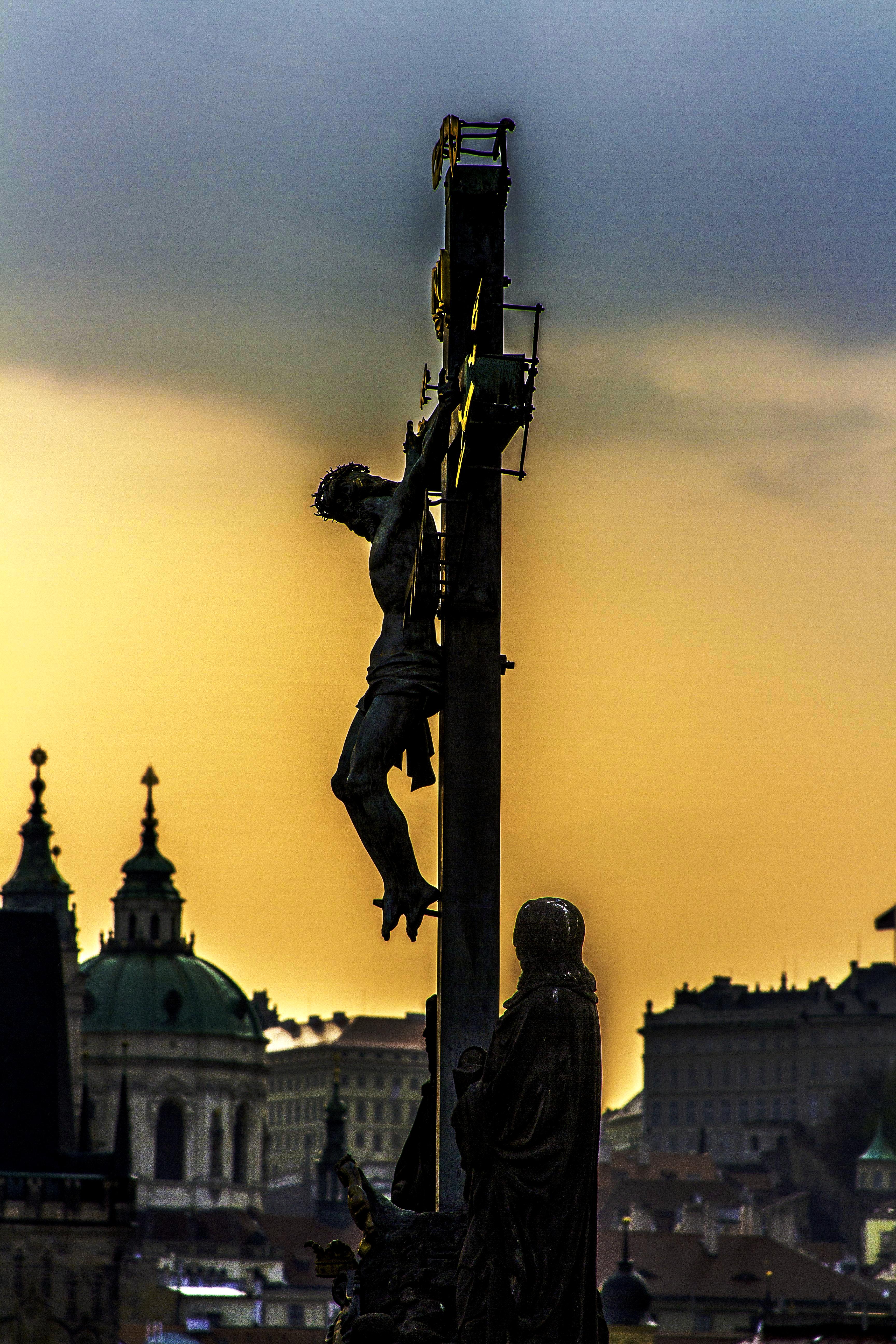
Jesus on Cross

 Surely he has borne our griefs and carried our sorrows; yet we esteemed him stricken, smitten by God, and afflicted. But he was pierced for our transgressions; he was crushed for our iniquities; upon him was the chastisement that brought us peace, and with his wounds we are healed.


Isaiah 53 (ESV) – The Prophet Describes the Coming Messiah

Who has believed what he has heard from us?
And to whom has the arm of the Lord been revealed?
For he grew up before him like a young plant,
and like a root out of dry ground;
he had no form or majesty that we should look at him,
and no beauty that we should desire him.
He was despised and rejected by men;
a man of sorrows, and acquainted with grief;
and as one from whom men hide their faces
he was despised, and we esteemed him not.

Surely he has borne our griefs

    and carried our sorrows;
yet we esteemed him stricken,
smitten by God, and afflicted.
But he was pierced for our transgressions;
he was crushed for our iniquities;
upon him was the chastisement that brought us peace,
and with his wounds we are healed.
All we like sheep have gone astray;
we have turned—every one—to his own way;
and the Lord has laid on him
the iniquity of us all.

He was oppressed, and he was afflicted,
yet he opened not his mouth;
like a lamb that is led to the slaughter,
and like a sheep that before its shearers is silent,
so he opened not his mouth.
By oppression and judgment he was taken away;
and as for his generation, who considered
that he was cut off out of the land of the living,
stricken for the transgression of my people?
And they made his grave with the wicked
and with a rich man in his death,
although he had done no violence,
and there was no deceit in his mouth.

10 Yet it was the will of the Lord to crush him;
he has put him to grief;
when his soul makes an offering for guilt,
he shall see his offspring; he shall prolong his days;
the will of the Lord shall prosper in his hand.
11 Out of the anguish of his soul he shall see and be satisfied;
by his knowledge shall the righteous one, my servant,
make many to be accounted righteous,
and he shall bear their iniquities.
12 Therefore I will divide him a portion with the many,
and he shall divide the spoil with the strong,
because he poured out his soul to death
and was numbered with the transgressors;
yet he bore the sin of many,
and makes intercession for the transgressors.

Luke 19: 41-44 (NIV) – Jesus Weeps Over Jerusalem    

41 And when he drew near and saw the city, he wept over it, 42 saying, “Would that you, even you, had known on this day the things that make for peace! But now they are hidden from your eyes. 43 For the days will come upon you, when your enemies will set up a barricade around you and surround you and hem you in on every side 44 and tear you down to the ground, you and your children within you. And they will not leave one stone upon another in you, because you did not know the time of your visitation.”

Luke 23: (NIV) – The Crucifixion of  Jesus

26 And as they led him away, they seized one Simon of Cyrene, who was coming in from the country, and laid on him the cross, to carry it behind Jesus. 27 And there followed him a great multitude of the people and of women who were mourning and lamenting for him. 28 But turning to them Jesus said, “Daughters of Jerusalem, do not weep for me, but weep for yourselves and for your children. 29 For behold, the days are coming when they will say, ‘Blessed are the barren and the wombs that never bore and the breasts that never nursed!’ 30 Then they will begin to say to the mountains, ‘Fall on us,’ and to the hills, ‘Cover us.’ 31 For if they do these things when the wood is green, what will happen when it is dry?”  32 Two others, who were criminals, were led away to be put to death with him. 33 And when they came to the place that is called The Skull, there they crucified him, and the criminals, one on his right and one on his left. 34 And Jesus said, “Father, forgive them, for they know not what they do.” And they cast lots to divide his garments. 35 And the people stood by, watching, but the rulers scoffed at him, saying, “He saved others; let him save himself, if he is the Christ of God, his Chosen One!”36 The soldiers also mocked him, coming up and offering him sour wine 37 and saying, “If you are the King of the Jews, save yourself!” 38 There was also an inscription over him, “This is the King of the Jews.”  39 One of the criminals who were hanged railed at him, saying, “Are you not the Christ? Save yourself and us!” 40 But the other rebuked him, saying, “Do you not fear God, since you are under the same sentence of condemnation? 41 And we indeed justly, for we are receiving the due reward of our deeds; but this man has done nothing wrong.” 42 And he said, “Jesus, remember me when you come into your kingdom.” 43 And he said to him, “Truly, I say to you, today you will be with me in Paradise.”

The Death of Jesus.  44 It was now about the sixth hour, and there was darkness over the whole land until the ninth hour, 45 while the sun’s light failed. And the curtain of the temple was torn in two. 46 Then Jesus, calling out with a loud voice, said, “Father, into your hands I commit my spirit!” And having said this he breathed his last. 47 Now when the centurion saw what had taken place, he praised God, saying, “Certainly this man was innocent!” 48 And all the crowds that had assembled for this spectacle, when they saw what had taken place, returned home beating their breasts. 49 And all his acquaintances and the women who had followed him from Galilee stood at a distance watching these things.

Jesus is Buried. 50 Now there was a man named Joseph, from the Jewish town of Arimathea. He was a member of the council, a good and righteous man, 51 who had not consented to their decision and action; and he was looking for the kingdom of God. 52 This man went to Pilate and asked for the body of Jesus. 53 Then he took it down and wrapped it in a linen shroud and laid him in a tomb cut in stone, where no one had ever yet been laid. 54 It was the day of Preparation, and the Sabbath was beginning.  55 The women who had come with him from Galilee followed and saw the tomb and how his body was laid.56   Then they returned and prepared spices and ointments.  On the Sabbath they rested according to the commandment.


St. Valentine’s Day 2014

Valentine Heart

Millions of dollars are spent on St. Valentine’s Day in displays of “love.”  Candy is purchased by the tons and flowers and cards by the millions. Many Valentine’s dinners are purchased and lavish gifts like diamonds and jewelry are given. It would be so much easier if people would only dispense with the copius spending and instead try to focus on applying these brief words of wisdom in their daily lives:

If I speak in the tongues of men and of angels, but have not love, I am a noisy gong or a clanging cymbal. And if I have prophetic powers, and understand all mysteries and all knowledge, and if I have all faith, so as to remove mountains, but have not love, I am nothing. If I give away all I have, and if I deliver up my body to be burned, but have not love, I gain nothing. Love is patient and kind; love does not envy or boast; it is not arrogant or rude. It does not insist on its own way; it is not irritable or resentful;it does not rejoice at wrongdoing, but rejoices with the truth. Love bears all things, believes all things, hopes all things, endures all things. Love never ends. As for prophecies, they will pass away; as for tongues, they will cease; as for knowledge, it will pass away. For we know in part and we prophesy in part, but when the perfect comes, the partial will pass away. When I was a child, I spoke like a child, I thought like a child, I reasoned like a child. When I became a man, I gave up childish ways. For now we see in a mirror dimly, but then face to face. Now I know in part; then I shall know fully, even as I have been fully known. So now faith, hope, and love abide, these three; but the greatest of these is love.  1 Corinthians 13:1-13

Be sure to show your love today and always!

Peace through Weakness

??????????????????

USS Dwight D. Eisenhower, CVN-69

As someone who served 24 years in the military, I naturally favor a strong national defense.  But I have to ask, just how much defense is enough?  Practically every day we hear one politician or another warning there’s not enough money for Obamacare, Medicare, Medicaid, Social Security, education, job creation and a host of other programs.  Even worse, there’s not enough money to help feed hungry Americans, so many children go to bed hungry every night.

The popular TV comedian Stephen Colbert, who is also an outspoken Christian, said of America, “If this is going to be a Christian nation that doesn’t help the poor, either we have to pretend that Jesus was just as selfish as we are, or we’ve got to acknowledge that He commanded us to love the poor and serve the needy without condition and then admit that we just don’t want to do it.”  Among the needy I include those who lack the health care, education and jobs that are essential to growing self-sufficient, productive citizens.

Despite our country’s perilous economic condition, some politicians wail and moan that we need to spend more on defense.  They warn that China is going to overtake us in military capacity.  Iran and Syria are threats to the world.  North Korea has the ability to strike America’s west coast with a nuclear missile. And the list goes on!  These are the talking points of the war hawks—and the hawks aren’t limited to those on the political right.

Many liberal politicians have joined the war hawk ranks on the premise that growing the defense industry can help bring jobs to their respective districts.  Perhaps that’s true, but manufacturing televisions or a host of other products that are no longer made in America would also create jobs.

According to the Center for Arms Control and Non-Proliferation, in 2012 (the last year for which full records are available), the United States spent 4.12 percent of its GDP ($645.7 billion) on defense.  China spent 1.24 percent ($102.4 billion).  In fact, the United States outspent all Asian countries combined, which had a total defense expenditure of $314.9 billion, less than half of America’s total.  In 2012, the United States accounted for 41 percent of global defense spending.  How much is enough?

“Every gun that is made, every warship launched, every rocket fired, signifies in the final sense a theft from those who hunger and are not fed, those who are cold and are not clothed.”                                                                                                                                                           —Dwight D. Eisenhower

I believe we need a strong national defense, but we have to balance defense with domestic needs.  If we can’t maintain a healthy, well educated, well nourished and self-sufficient population, then what is left to defend?

America is truly threatened from many directions, but the greatest threats stem from internal problems, not foreign countries or transnational groups.  Perhaps the biggest threat is our ignorance of history.  American society seems to have lost site of a key historical fact—the farther a nation separates itself from God, the more imperiled it becomes.

The Bible is full of examples validating this.  Those who don’t care to read the Bible should try reading Edward Gibbon’s “Decline and fall of the Roman Empire.”  The similarities between Rome’s decline and what is occurring in America today are astonishing.  (Sharie Pyke comments on this topic in an informative piece titled, “Is America like Rome in decline.”  http://goo.gl/7BgZFS)

“God is present in the places where our fears live.”   —Randy Kilgore, Our Daily Bread

Just as our nation is imperiled by pulling away from God, the more we humble ourselves before God the stronger we become.  1 Peter 5:6-7 says, “6Humble yourselves, therefore, under the mighty hand of God so that at the proper time he may exalt you, 7casting all your anxieties on him, because he cares for you.” (ESV)

Chapters 6 and 7 of the book of Judges provide a wonderful example of this. The Midianite people had impoverished the land of Israel through constant raids and pillaging of the countryside.  God chose Gideon to defeat the Midianites at a time when they were encamped in the land of Israel with a large Army.  From across the land, Gideon raised a great Army to defeat them.  But God had other plans.

God knew that Gideon’s army would overwhelm the Midianites, increasing their confidence in their own abilities to take care of themselves.   God wanted to teach Gideon’s followers to trust in Him, not in their own abilities.  He had Gideon select 300 of his best men and instructed him to have them surround the Midianite encampment.  With these 300 men and through a clever ruse God enabled Gideon to crush the Midianite force.  God delivers strength from our weakness.

I can do all things through Him who strengthens me.  —Philippians 4:13 (ESV)

Just as God wanted the Children of Israel to trust in him, he also wants us as individuals to trust in him. The law given under the Mosaic Covenant does not consider the moral weaknesses or infirmities of humans in their natural, fallen condition.  God’s law is absolute, demanding absolute morality and obedience before Him.  The law accepts no excuses.  When a person comes to this realization, his life seems an inescapable, fatal tragedy.

St. Paul describes this in Romans 7:9, “I was once alive apart from the law, but when the commandment came, sin came alive and I died.”  (ESV)  This is the powerful conviction of sin—a person coming to grips with his or her absolute weakness and inability to please God through works.  The cross of Christ is just a foolish notion to anyone who has never come to this realization. To believers, however, the cross is the only logical remedy for sin.

“A nation that continues year after year to spend more money on military defense than on programs of social uplift is approaching spiritual doom.”  —Rev. Dr. Martin Luther King, Jr.

Likewise, the cross of Christ is a foolish notion to anyone who believes our nation can prosper without God. Jesus doesn’t command us to have a strong national defense, but in the Sermon on the Mount (Matthew 5-7), he does say He will bless us if we are merciful, pure in heart, peacemakers, and hungry and thirsty for righteousness.  He also tells us to give to the needy, love our enemies and pray for those who persecute us.

The best form of national defense is unquestioning trust in God.  God will allow us to push him away from our government, schools, businesses, social organizations, sports teams, televisions, movies, homes and lives.  Unfortunately, those pushing God away do not understand that every vacuum created by God’s departure is filled by something less desirable.

A New Year’s Resolution Worth Keeping

New Years Eve Time Square

“Exercise is labor without weariness.”  —Samuel Johnson

Exercise is an important part of my life that was ingrained during a 24-year career in the U.S. Army.  I enjoy a good workout and feel out of sorts when I go too long without exercising.  In January there are always a lot of new faces in my local fitness center—mostly folks who made a new year’s resolution to exercise and lose weight.

Moving into February the numbers dwindle and by March, few of the new faces are still around.  We humans are great at making promises to ourselves that we never keep.  This year I’ve made a resolution worth keeping and it’s not the usual “lose some weight.”   Instead, I’m going to slow down.

“Adopt the pace of nature.  Her secret is patience.”  —Ralph Waldo Emerson

An Army career often requires one to maintain a “hair on fire” pace for long periods of time.  Mine was no exception. After retiring from the service, I continued the fast pace in my civilian work.  I can recall my mom continually advising me to slow down, but I never made an attempt to comply until fairly recently.  A couple of years ago I came to a realization that there are better ways to spend one’s time than to dash about in a frenzy trying to get as much done as humanly possible.

Slowing down doesn’t mean getting lazy, however.   It’s more about tempering the urgency in life and finding balance.  If I succeed at this, there won’t be sufficient time to do everything I might be inclined to do.   Therefore, I aim to re-evaluate what’s important in my life and then do my best to focus on the things that matter, while sweeping aside the trivial.

“The whole point of getting things done is knowing what to leave undone.”   —Oswald Chambers

I’ve been thinking about some of the things I can sweep aside this year.  Television ranks high on the list.  As my wife often reminds me, I watch some fairly mindless shows with no redeeming social value. Shows like ”Man vs. Food” come to mind.  If you’re not familiar with it, check it out on the Travel Channel website.  It’s about a fellow who travels the country seeking “pig out” restaurants  (www.travelchannel.com/tv-shows/man-v-food).

The “Colbert Report” is also on my “fuggedaboutit” TV list.   I enjoy the show immensely, but it truly is mindless entertainment.  There are others, but I’ll spare you the laundry list.

“Time is what we want most, but what we use worst.”  —William Penn

As a management consultant, I periodically presented time management seminars.  They were very well received by every audience. Unfortunately, I constantly find myself violating the time management techniques I know to be effective.   I aim to be more disciplined with my time this year.

One of the best techniques I know to save time is by turning off the TV.  Limiting time on Facebook and other unproductive Internet sites is also advisable.  Avoiding web surfing and clicking links on the web pages one must visit will also save an enormous amount of time.

I’m also going to avoid checking emails and messages on my phone every few minutes.  At present, I’m an email version of Pavlov’s dog—grabbing my cell phone every time an email or text message alert beeps.  (For those struggling with time management, the Mindtools.com website has a simple, 10-step approach to help you get on track http://goo.gl/RsWrQ1.)

“I find television very educating. Every time somebody turns on the set, I go into the other room and read a book.”  —Groucho Marx

By reducing the time spent in front of the boob tube and on unproductive websites, I hope to make some time for reading.  I’m not talking about casual reading either.  Gibbon’s classic The Decline and Fall of the Roman Empire has been sitting on my bookshelf for about three years.  This year I plan to dust it off and dive in.  I’m also going to try to read or reread several books by C.S. Lewis.

“Prayer does not equip us for the greater work, it is the greater work.” —Oswald Chambers

At the top of my “to do” list for 2014, however, is spending more time in the scriptures and prayer. Prayer is work and I plan to work a lot in this new year.   Romans 12:12 advises us, “Rejoice in hope, be patient in tribulation, be constant in prayer” (ESV).  Now that’s a new year’s resolution worth keeping.

Divine Simplicity: Focus on the things that matter…sweep aside the things that don’t.


A Christmas Alternative

Christmas Gifts

The cornucopia (or horn of plenty), a symbol from Greek mythology, is widely recognized as representing food and abundance.  Over the years, it has become associated with certain religious holidays in Christianity, Judaism and Islam—Christmas, Hanukkah and Eid al-Fitr respectively.

Most Americans enjoy a cornucopia of blessings every day.  The majority of us have enough to eat and adequate clothing and shelter to meet our basic needs. Some have far more than they need. Unfortunately, not everyone is so blessed.

Have you ever struggled with selecting a holiday gift for a relative or friend who has almost everything he or she needs?  Far too many people end up purchasing unneeded or unwanted gifts that eventually get stuffed in a drawer, tossed in the trash or simply set aside and forgotten. There’s a better way!

Alternative Gifts International (AGI) is a way to give meaningful presents to people who have virtually everything they need.  The AGI movement was begun in 1980 by Harriet Prichard, director of a Presbyterian children’s ministry in Pasadena, Calif. AGI started in a small market where shares of goods and livestock for needy people in Third World countries were sold.

The idea was to give gifts that could make a real difference to an individual, family or village. For instance, a present of a milk cow or a means to purify water can truly change lives for impoverished people living in remote areas of Africa.

Prichard’s idea was so popular that five Pasadena-area churches held markets the next year. By 2004, there were more than 325 Alternative Gifts markets in the United States. The movement has now spread to Britain, the Netherlands, Japan and Korea.  There are opportunities to give both domestically and in foreign countries.

Here is how Alternative Gifts works:  Instead of buying that symbolic gift that might soon be put away or discarded, consider making a donation to AGI on behalf of a friend or loved one. Instructions are located on the “give a gift” tab of AGI’s website at www.alternativegifts.org.

When you make a donation through the website you can write a short message to the individual you want to honor. AGI will send that person a card announcing your alternative gift.

Perhaps you would prefer helping people in your local community; the needs are great and the opportunities plentiful in whatever town you live in.  During this Advent season, when some of us tend to overeat, there are many who haven’t enough food.  You might consider supporting a local food pantry. Many of these are experiencing significant shortages.  Many local churches host food pantries that could use your support as well.  The Salvation Army also offers gifts of food, clothing, shelter and various other services to the needy in most areas.  Donations of time and treasure are all welcome.

Even if you’re short on money, you can still give a gift of time. Consider spending Christmas day volunteering at a local soup kitchen or homeless shelter.  I promise you will find it rewarding—a gift to yourself more than a gift to others.

For those who are able, I encourage you to share your blessings with others and consider giving alternative gifts this Christmas. Make a donation to AGI or one of the many worthy charities in your area. Better yet, consider alternative gifts throughout the year and make a real difference in someone’s life the next time you give.

Whatever you do, never forget the real meaning of Christmas as expressed in John 3:16:

“For God so loved the world, that he gave his only begotten Son, that whosoever believeth on him should not perish, but have eternal life.” (ASV)

May God bless us all in the coming year!

Beyond Thanksgiving

Army field worship service

Read:  Job chapter 1.

Tomorrow millions of Americans will gather with friends and family to give thanks for the blessings of the past year. Thanks will be voiced for many things—family, friends, gifts, wealth, and acts of kindness by others just to name a few.

Sometimes personal adversity makes it is hard to give thanks though.  Death, job loss, divorce, failing health and many other adverse circumstances can rob us of joy.   Yet we always have the assurance of Romans 8:28, “And we know that in all things God works for the good of those who love him, who have been called according to his purpose.”  Even when our personal lives become chaotic, we have the assurance that God remains in control.  According to St. Paul, we suffer, “…that we might not rely on ourselves but on God, who raises the dead.”  (2 Corinthians 1:9, NIV).

Regarding the promise of Romans 8:28, John Piper has observed, “So the rugged hope of the believer is not that we will escape distress or peril or hunger or slaughter, but that Almighty God will make every one of our agonies an instrument of his mercy to do us good. ‘You meant it for evil,’ Joseph said to his brothers who had sold him into slavery, ‘but God meant it for good.’  (Genesis 50:18-20) And so it is with every calamity of those who love God. God meant it for good!”

While it might be difficult to see the good in today’s circumstances, someday it will be perfectly clear. During our lives we have an imperfect understanding of divine things. But as 1Corinthians 13:12 promises,For now we see only a reflection as in a mirror; then we shall see face to face. Now I know in part; then I shall know fully, even as I am fully known.”

Even when our personal circumstances are tough we should always give thanks to God for the cross—that while we were yet sinners Christ died for us.  Jesus became sin for us and in our stead suffered the punishment we all deserve.

Beyond mere thanksgiving though, God is worthy of our worship.  Worship is an act of awe and reverence done in recognition of God for whom and what He is, not what he has done.  We can follow the example of Job, who remained blameless before God even as his personal world was caving in around him:

While he was still speaking, yet another messenger came and said, “Your sons and daughters were feasting and drinking wine at the oldest brother’s house, when suddenly a mighty wind swept in from the desert and struck the four corners of the house. It collapsed on them and they are dead, and I am the only one who has escaped to tell you!” At this, Job got up and tore his robe and shaved his head. Then he fell to the ground in worship and said: “Naked I came from my mother’s womb, and naked I will depart. The Lord gave and the Lord has taken away; may the name of the Lord be praised.” —Job 1:18-21 (NIV)

King David provided another example for us to follow. When his infant son grew ill, he fasted and prayed to God throughout the night to spare the child.  But, when he learned that the child has died, rather than having an emotional breakdown, David arose, bathed himself, put on clean clothes and then went to the Lord’s house to worship.   (2 Samuel 12:15-20).

In John 16:33 (NIV), Jesus tells us, “In this world you will have trouble. But take heart! I have overcome the world.”   In John 17, Jesus’ prayer reminds us that his followers are not of this world, even as He is not of this world.  We will all suffer at times during our lives, but we need look no farther than the cross to find peace amid life’s tribulations.

“There is no pit so deep that God’s love is not deeper still.”― Corrie ten Boom


Freedom Isn’t Free!

Memorial Day Flags

           Freedom isn’t free!

As a retired soldier, Memorial Day is always a special day of remembrance for me.  My stepfather and a dear friend, both of whom were also soldiers, lie buried only a few paces apart in Arlington National Cemetery, alongside thousands of our departed comrades.  It is good that we occasionally pause to remember those who served our country.

But as we memorialize departed comrades, may we never forget the true price of freedom.  No Soldier, Sailor, Airman or Marine died to set mankind free. It was a simple carpenter who walked the shores of Galilee some two thousand years ago.  Jesus paid it all!

Greater love has no one than this, than to lay down one’s life for his friends.  John 15:13 (NIV)

Jesus Crucified“For God so loved the world that he gave his only begotten son, that whosoever believes in him shall not perish, but have everlasting life.” John 3:16: NIV