Archive for the ‘Simple Living’ Category

An Unshakeable Kingdom

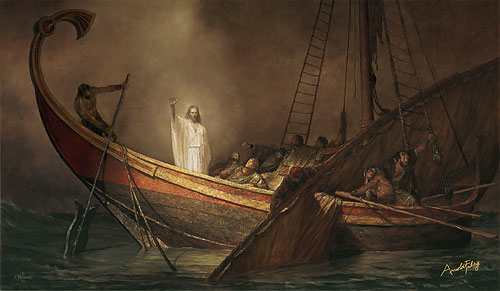
Peace be Still by Arnold Friberg

“Peace, be still,” by Arnold Friberg

The tragic mass shootings in El Paso and Dayton have many Americans on edge, as they struggle to understand what is causing it all. Sadly, such tragedies have become common in our country. The public and government responses to these shootings are predictable: the left calls for stricter gun control laws, while the right emphasizes the Constitutional right to bear arms and attributes the shootings to mental health problems. Unfortunately, most Americans fail to recognize the root cause of the problem. Why is this?  Perhaps it’s because we live in a country where, for many, the idea of good and evil has become an archaic concept, something associated with ancient religious superstitions.   

The Rev. Canon Phil Ashley of the American Anglican Council explained it like this. We face a culture that is “…increasingly shaped by the forces of aggressive secularism, moral relativism, religious pluralism, individual autonomy and a utopian hope in secular authority.” As more and more Americans push God out of their lives, social, cultural and spiritual chaos is filling the vacuum. When a country or society pushes God out, it opens the door for the enemy to come in. 1 Peter 5:8 says, Satan “…prowls around like a roaring lion looking for someone to devour.” Those lacking a solid spiritual foundation very easily become his prey. Yes, evil is real.

Chaos often breeds isolation, which for some people means empty lives nearly devoid of human contact. Isolated and confused, they might seek meaning in their lives through narcissism—an egoistic admiration of one’s self, which is a form of idolatry. Narcissism is easily fed through social media, where one can simply manufacture a false persona in an effort to gain approval from others.

Over prolonged periods, isolated individuals can  become enveloped by darkness.  Some may seek meaning or self-purpose through infamy—mass shooters are not soon forgotten.  Mass shootings are only one symptom of the problem however. It manifests itself in many other ways, including drug and alcohol addiction, pornography addiction, child abuse, human trafficking, suicide and countless others.

To begin to fix the problems in America, we don’t need more laws or more gun rights.  We need a spiritual revival of our Judeo-Christian roots. Dr. Jack Graham, the pastor of the Prestonwood Baptist Church in Plano, TX explains it like this, “All of us are involved in some kind of a spiritual battle—a warfare that’s going on increasing.  A battle that is getting hotter and hotter right now and predictably so.  In fact, the Bible tells us that in the final hours of human history that perilous times will come.  Difficult dangerous times will come.” Dangerous times are not exclusive to American Christians.  Persecution of Christians because of their faith is running rampant around the globe.

Of the shootings in El Paso and Dayton, the Rev. Franklin Graham wrote, “The Word of God tells us to ‘mourn with those who mourn,’ and that is what our nation is doing. We grieve the tragic and devastating loss of life in El Paso and Dayton this weekend. The number of victims of the mass shootings is much higher than the headlines reveal, because each mother, each father, each sister and brother, each wife and husband, is also a victim—a victim of the heinous and senseless evil unleashed by two murderous gunmen. Their loved ones have been stolen from them.” And “”As we mourn with these families and communities, let’s continue to sincerely lift them up in prayer before the Lord.” Despite what some politicians have said, prayer is a proper response to mass shootings.

Fortunately, Christians needn’t despair at what they see happening around them. They can be confident that God is in control of their lives, even when the world appears to be coming apart all around them. Throughout the scriptures Jesus remains as solid as a rock. We see this vividly portrayed in Mark chapter 4, when Jesus and His disciples are on a boat in the midst of a terrible storm. Jesus is asleep on a cushion when his frightened disciples wake Him, fearing they are about to perish. Jesus rises and speaks the words the simple words, “Peace, be still.”  Immediately, the wind ceases to blow and the water grows calm. His disciples then marvel that even the wind and the sea obey Him.    

The same Jesus who calmed the storm is in control of our lives today. Hebrews 12:28-29 says we live in an unshakeable kingdom. “Therefore, since we are receiving a kingdom that cannot be shaken, let us be thankful, and so worship God acceptably with reverence and awe, for our God is a consuming fire.”  

Christians have nothing to fear in the midst of today’s chaos.  As the late Rev. Dr. Billy Graham said, “I’ve read the last page of the Bible. It’s all going to turn out all right.” Christians need only do their best to imitate the life of Christ. God will take care of the rest.

Messy Christianity

Soup Kitchen

Many Christians love their big, opulent church buildings. They can be quite impressive, especially older ones that are massive relics of past centuries. Standing inside a pristine, beautifully ornamented Gothic cathedral can certainly give one a sense of awe. They’re a wonderful place in which to worship God.

The entire world was recently shaken by images of the beloved Notre Dame Cathedral on fire in Paris. Notre Dame is now closed for who knows how long, as the French government and people begin the long process of rebuilding. The church building is a mess.

Christianity is a messy business—in many ways messier than the scorched interior of Notre Dame.  In John 14:12, Jesus tells us, “Very truly I tell you, whoever believes in me will do the works I have been doing.”  Acts 10:38 tells us Jesus “went around going good.” As Christ’s disciples, we are to follow his example of doing good. Good works are not a condition for salvation. Salvation is a free gift for those who put their faith in Christ. But as the Book of James tells us, works are a manifestation of Christ’s love that is in those who put their faith in Him. 

We are to follow Christ’s example.  Matthew 9:35-38 says:

“Jesus went through all the towns and villages, teaching in their synagogues, proclaiming the good news of the kingdom and healing every disease and sickness.  When he saw the crowds, he had compassion on them, because they were harassed and helpless, like sheep without a shepherd.  Then he said to his disciples, “The harvest is plentiful but the workers are few.  Ask the Lord of the harvest, therefore, to send out workers into his harvest field.”

Jesus is the Lord of the harvest. The harvest he is speaking about has many faces including the sick and suffering, people in trouble, those who don’t know Christ and many others. They all need caring, compassionate Christ-believers who care about the wandering sheep.

Unfortunately, many Christians are too comfortable in the places where they currently are in their faith journey; perhaps they attend church regularly, give money to the church; and participate in church social events. They enjoy this and aren’t eager for change. People in this condition can find it difficult to reach out to the sheep of Jesus’ flock. In his video series on the Good Samaritan, Christian author Rev. John Ortberg likens this to someone sitting on a comfortable bench in a beautiful park—a place one doesn’t want to move from.

Christians who find themselves in such a comfortable condition today but recognize the need for change can rise from their bench in small steps.  It might mean spending a weekend working on a church project with a group of volunteers, inviting a new family on the block over for dinner, visiting a church member in a hospital or nursing home, or leading a Bible study. Taking such baby steps isn’t very messy, but it helps prepare one for Christ’s messy work.

Messy Christianity requires getting one’s hands dirty in both the figurative and literal sense. It’s found in places like soup kitchens and homeless shelters, getting involved in helping someone  who is being physically or mentally abused, inviting someone on the down and out into your home for awhile, giving someone in need a loan with no expectation of being repaid, or traveling to distant places to perform mission work such as flood or hurricane relief. It often requires taking personal risks and/or experiencing considerable discomfort.

Early Christians in Rome were noted for fearlessly caring for the sick and diseased. Many non-Christian Romans admired the Christians’ selfless acts. The Western Emperor Constantine the Great decriminalized Christianity in 313 AD by issuing the Edict of Milan.  Ten years later Christianity became the official religion of Rome. This occurred through a different kind of revolution marked not by violence and warfare, but by countless acts of Christian love, charity and sacrifice.

The Rev. Ken R. Klaus, Pastor Emeritus of the Lutheran Hour said, “All too often the job of reaching others is left to others. That can be unfortunate. After all, there are times when you may be the best person to reach someone who is lost or wandering.” You don’t have to be an evangelist or great orator to succeed either.  All you need do is open the door for the Holy Spirit to begin His work in another person’s life. Share your joy!”

If you believe in Jesus, you are not to spend all your time in the calm waters just inside the harbor, full of joy, but always tied to the dock. You have to get out past the harbor into the great depths of God, and begin to know things for yourself. –Oswald Chambers

*Note: all Bible references are NIV.

Holy Week

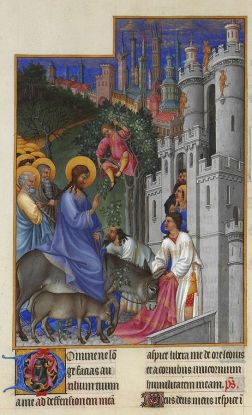
Triumphal Enter into Jerusalem - HosannaJesus entering Jerusalem

Traditionally, the week before Easter is called Holy Week. It starts on Palm Sunday. Holy week began today.  It is the last week of the penitential church Season of Lent. 

Palm Sunday
In the Bible, Holy Week begins with a religious festival. People have flocked to Jerusalem to celebrate Passover and see the controversial prophet Jesus. Many come to cheer him on as Jesus rides into Jerusalem. They wave palm Branches and shout “Hosanna,” which means “save us,” a Jewish call of lamentation that has since become a call of praise. Jesus enters Jerusalem riding on a Donkey.  Jesus’ triumphal entry fulfills an Old Testament prophecy and is seen as a sign of humility. Some who cheer him that day will inevitably cry “Crucify him” only a few days later, so the memory of Christ’s entrance into Jerusalem is a time of mixed joy and sadness.

Maundy Thursday
In the evening of this day Jesus met with his disciples for the last time before his death. Before the meal, he washes their feet, another sign of humility. During the meal, he prophesies that one of the disciples will betray him. On this evening, Christians are thinking of Christ’s establishment of the sacrament of Holy Communion. In many congregations, a worship service occurs in the evening, in which the congregants come together for a Eucharist meal, just as the first Christians celebrated it. Often after the communion, the altar is cleared, and left unadorned on Good Friday.

Good Friday
On Good Friday, Jesus was crucified. He was tortured and killed. His suffering is therefore at the heart of this day. But it also commemorates the suffering of mankind in general, because through Jesus, God has sided with the suffering. The day is quietly celebrated as Christians contemplate Jesus’ suffering and death. Together with Easter, Good Friday forms the centerpiece of the Christian message of good news: God is stronger than Death! On that day Jesus suffered all that a man can suffer to atone for the sins of mankind. Sin and Death did not have the last word. God raised Jesus as he will one day raise all believers who die in Christ.

Holy Saturday
On the evening of Good Friday, Jesus was taken down from the cross and buried. On Saturday, the Sabbath, that would not have been allowed. So Saturday is the full day that he was dead. In the creed, this means Jesus descended into Hell, or the realm of the dead. We aren’t sure what that is and what it is like there, but the message that Jesus was “resurrected on the third day” provides confidence that at the end of the age God will resurrect Christian believers.

Easter Night
The Bible doesn’t describe the physical resurrection of Jesus. On Easter morning, the women find the empty tomb and are told by an angel that Jesus was resurrected. That might have occurred at night, because in the Jewish Tradition the day begins with the night (“It was evening and it was morning, the first day”). Easter (Saturday) night belongs to Easter Sunday. The resurrection is celebrated on this “night,” mostly in the early hours of the morning, but in some places it is celebrated on Saturday evening. It is a celebration that, in its design, leads from darkness to light. At its climax many congregations light the new Pascal candle declaring “Hallelujah, Christ is risen; He is risen indeed.”

Easter Sunday
The women who discover Jesus empty tomb are the first to spread the Good News of Jesus’ resurrection. In the course of this and the next few days many people meet Jesus and witness the resurrected Son of God. In the early church congregations met regularly for a common Sacrament the day after the Sabbath to commemorate the resurrection. In the Christian context, Sunday was thus marked as the most important day of the week and as a day of rest.

An invitation:
Easter occurs on April 21st this year. For readers in the Sioux Falls area, you are invited to attend an Easter Sunrise service conducted by Church of the Resurrection (www.resurrectionsf.com). The service will begin at 7a.m. at the McKennan Park bandshell. Bring lawn chairs. The service will occur rain or shine.


A Balanced Life

Wheel of Life

The wheel of life graphic above is a tool I used a lot in my past life as a Management Consultant. The purpose of the wheel is to illustrate that people need to balance their activities/involvement in the six life areas depicted in the outer ring of the wheel. If any of these areas is neglected or over-indulged, the wheel (and ergo one’s life) becomes out of balance, which can result in a multitude of personal problems.

Looking at the wheel, some might be inclined to argue that it’s impossible to put too much emphasis on one’s spiritual life. However, renowned Scottish Theologian Oswald Chambers would disagree.  Chambers said:

 Days set apart for quiet can be a trap, detracting from the need to have daily quiet time with God. That is why we must “pitch our tents” where we will always have quiet times with Him, however noisy our times with the world may be. There are not three levels of spiritual life— worship, waiting, and work. Yet some of us seem to jump like spiritual frogs from worship to waiting, and from waiting to work. God’s idea is that the three should go together as one. They were always together in the life of our Lord and in perfect harmony. It is a discipline that must be developed; it will not happen overnight. Oswald Chambers, My Utmost for His Highest

Chambers would agree that days set apart for quiet time, such as for church retreats, spiritual renewal weekends, and even weekly worship services are all good. However, he would caution against letting these become one’s focus for spiritual rejuvenation. These days that are set apart are special times on the “mountain top” when we can see the transfigured Christ in all of his glory. They’re highly spiritual experiences that one hates to see end. 

On the other hand,   Chambers strongly advocates for daily quiet time when one enters God’s “throne room” and learns to commune with God not on the mountain top, but while walking through the demon infested valley below.  Daily quiet time with God is obedience to John 15:4-5 (NIV), which says:

Remain in me, as I also remain in you. No branch can bear fruit by itself; it must remain in the vine. Neither can you bear fruit unless you remain in me. I am the vine; you are the branches. If you remain in me and I in you, you will bear much fruit; apart from me you can do nothing.

The website Vibrant Christian Living recommends three secrets to a daily quite time habit:

#1: Do your quiet time first thing in the morning.  With all the distractions in our lives, this can be difficult, but it will pay big dividends.

#2: Start small and let your quiet times with God Grow.  Quite time is a spiritual discipline that can grow in depth as we become more mature in Christ.

#3: Make your quiet time with God about a life rhythm, not a religious schedule. Focus on how to make quiet time a regular part of your ever changing life. Sometimes you’ll fail, but God is quick to forgive when we ask him.

Worship the Lord with gladness; come before Him with joyful songs.
Know that the Lord is God. It is He who made us, and we are His;
we are His people, the sheep of His pasture.

Enter His gates with thanksgiving and His courts with praise;
give thanks to Him and praise His name.

Psalm 100:2-4 (NIV)

Give Thanks to God

Thanksgiving Turkey.jpg

May love and laughter light your days, and warm your heart and home.

May good and faithful friends be yours, wherever you may roam.

May peace and plenty bless your world with joy that long endures.

May all life’s passing seasons bring the best to you and yours!

                                                                             An Irish Blessing

Father Desmond O’Donnell, a Roman Catholic Priest in Northern Ireland, recently told the Belfast Telegraph newspaper that Christians should abandon the word “Christmas,” noting that the name has been “hijacked by Santa and reindeer” and commercialized to the point that it is virtually meaningless.  “We’ve lost Christmas, just like we lost Easter, and should abandon the word completely,” O’Donnell said.  

Just go to a mall today and see what he means.  You’ll find Christmas on display everywhere, even though we’ve yet to celebrate Thanksgiving. Check your mailbox today and you’re apt to find a pile of Christmas sale catalogs and flyers.  The Christmas theme is clear—buy, buy, buy!

Sadly, we can say the same thing about losing Thanksgiving.   What was originally a day set aside for Americans to thank God for our many blessings is now often referred to as “Turkey Day,” a time to overeat, over indulge in alcohol, and watch football on television. Indeed, a number of Thanksgiving Day football matches across the country are referred to as the “Turkey Bowl.” Thanksgiving has become irreversibly connected with Black Friday, the day Christmas buyers literally battle one another in malls and big box stores to get super bargain prices on anything and everything.  Some stores have even resorted to open at midnight on Thanksgiving to maximize the Black Friday “spend fest.”    

For many Americans, it might appear that there isn’t too much to be thankful for.  We see reports of multiple mass shootings; police officers are gunned down in our streets; there are dozens of reports of sexual misconduct by politicians and Hollywood celebrities; natural disasters hammer the land; and we have a government run by two feckless political parties that seemingly can’t even agree on when to hold the next meeting.  Sometimes it seems as if our whole system, our entire way of life, could be swept away in an instant (and it can, but that’s the Book of Revelation, which I won’t go into today).

So what does America have to be thankful for?  The answer is truly simple, although not necessarily obvious.  What a pity more Americans don’t travel abroad to Third World countries and countries with oppressive regimes like Afghanistan, Iran, and North Korea.  In such places it takes very little time to recognize how truly blessed we are.  I was blessed that my military career allowed me to see so much of the world. It changed me forever.

America isn’t perfect, but it is great enough that many people around the globe dream of coming here.  If you take time to thank God this coming Thursday, thank Him for these simple blessings:

  • We can go to the faucet and fill a glass with clear, clean water. In Somalia I watched people drink water drawn straight from the muddy Jubba River, where it was not uncommon to see the carcass of a hippopotamus or other large animal floating down the river. Diarrheic disease kills Somalis and other Third World citizens by the score.
  • Our country is relatively free of deadly infectious diseases like plague, cholera, and malaria that devastate many other countries.
  • We light our homes with the flip of a switch. Following the long civil war in the Former Yugoslavia, I was deployed to Sarajevo, Bosnia-Herzegovina. Most of the city was without electricity when I arrived, and much of it was still without when I returned home 13 months later.
  • We are well-fed compared with much of the world. Even many people living below the poverty level in America are better fed than people in some Third World countries.
  • One can travel freely in America. Oppressive regimes around the world control movement of the population. They use checkpoints with armed officials to prevent unrestricted movement about the country.
  • Americans can speak freely without fear of reprisal by the government. Sure, sometimes there are bad consequences for speaking freely, such as libel suites, but we aren’t silenced by the government.
  • While there is a problem with homelessness in America, most of us have a roof over our heads nevertheless. In Kuwait, Iraq, Somalia and Bosnia I saw thousands of people who had been violently forced from their homes or had their homes destroyed by war.
  • We have the freedom to worship God in the way we choose. While many Christians grumble about losing religious freedom (and some rightfully so), we enjoy more religious liberty than most of the world.

Truly America has its problems, but our country is blessed in many ways.  Despite its faults, it is still a place where many oppressed people dream of coming to.  Take time to pause and thank God for blessing America. May he continue to do so in the coming year!

‘Tis the gift to be simple, ’tis the gift to be free

‘Tis the gift to come down where we ought to be,

And when we find ourselves in the place just right,

‘Twill be in the valley of love and delight.*

*Lyrics from “Simple Gifts,” a traditional Quaker Tune

Count Your Blessings

faucet-with-drinking-water                                            Count your many blessings, name them one by one.

                                                                                                  —Johnson Oatman Jr.


Our Daily Bread is one of the daily devotionals I read regularly. A recent piece by David Roper titled Stage by Stage, focuses on the Old Testament book of Numbers 33.  The chapter tells us God commanded Moses to write down the story of the Jews’ 40-year pilgrimage that began with escaping from slavery in Egypt and ultimately took them to the plains of Moab, a strip of land that today is part of Jordan.

Roper speculates that God’s reason for commanding Moses to document this pilgrimage was to allow the Jews to “…retrace that journey in their thoughts and record God’s faithfulness at each location.”  The Seder meal the Jews celebrate to mark the beginning of Passover is closely tied to Numbers 33, which seems to support’s Roper’s argument.  Each course of the Seder meal recalls an event in God’s liberation of the Jews from slavery in Egypt, as told in the book of Exodus.

God is truly faithful and His faithfulness alone is blessing enough—but there are so many additional blessings in our lives if we will simply look for them. Focus determines attitude.  I’m no spring chicken, so I’ve developed a few medical problems over the years, like having four root canals.  What a blessing to have a root canal!  What did people do a hundred years ago?

I could focus on other, more lingering medical problems and quickly become depressed as I grow older.  Instead, I’ve tried to heed the lesson of St. Paul who says in Philippians 4:11 (NIV), “…I have learned in whatever situation I am to be content.”

Focus on the positives in life and you’ll find your blessings. For those of us fortunate enough to live in the United States and other developed countries in the West, it shouldn’t be difficult to compile a long list of blessings. Think about it!

                                              ‘Tis the gift to be simple, ’tis the gift to be free…                                                                             (From “Simple Gifts, a traditional Shaker tune by Elder Joseph Brackett, Jr., 1848)

During my military career I spent some time in Saudi Arabia. Unless you’ve been there, I could never begin to explain how lacking in personal freedom the average Saudi people are.  Saudi Arabia reminds me how blessed we in the Western World are to simply be free.    

Westerners can turn on a faucet and draw a drink of clear, clean water. This truly is a blessing that most people take for granted.  Serving in Somalia when I was in the Army drove the point home, as I watched Somali workers building a bridge drawing water directly from the muddy Juba River and drinking without disinfecting it. I’m frequently reminded of this blessing when I take a drink of cold water.  

Westerners can walk into a grocery store and find food in abundance that, 200 years ago, would have made the great kings of Europe envious.  Here in my hometown of Sioux Falls, S.D., we even have a Christian ministry called The Banquet that serves free meals to anyone who walks in the door—no questions asked (https://thebanquetsf.org/).  

My family and friends are all blessings to me. Proverbs 5:18 tells men to “rejoice in the wife of your youth” (NIV). I’ve been blessed with nearly 40 years of marriage to my wonderful wife who I met when I was 17 years old. We have both been blessed by children and grandchildren.

I have a good number of dear friends, some of whom I’ve known since high school. When I say dear friends, I’m talking about the ones I could easily trust with my money, my house keys, and caring for my children.

One such friend was recently involved in a head on collision.  He was banged up pretty badly, but I’m blessed to still have him around. I have a couple of friends who have died.  I was blessed to have had them in my life. I have another friend who has been blind for life; he taught me what a blessing it is to simply be able to see.

Comedian and actor Bill Murray recently received the Mark Twain Award for humor from the Kennedy Center.  He grew quite emotional during his acceptance speech and closed by saying to the ceremony attendees:  “Look at each other. Look at who we are. Look at how we are all together here right now. Alive! That’s pretty good, right?”

Bill Murray gets it! Do you?

“Many, Lord my God, are the wonders you have done, the things you planned for us. None can compare with you; were I to speak and tell of your deeds, they would be too many to declare.”

                                                                                                                          –Psalm 40:5 (NIV)

Don’t Worry be Happy

Madonna and Child“Joy to the world, the Lord is come.”

A few years ago singer-songwriter Bobby McFerrin composed a great little song titled “Don’t worry be happy.” His lyrics advise us:

In every life we have some trouble
When you worry you make it double
Don’t worry, be happy!

Sounds like some sound advice doesn’t it? However, McFerrin might have better named his tune “Don’t worry be joyful.” Joy and happiness are often used interchangeably, but there is quite a difference in their meanings—especially for Christians.

Happiness is an emotion that arises from external factors, either objects, circumstances or other people. Many people chase after happiness, often taking incredible risks to capture this elusive prey.  From the beginning of time man has sought happiness through a variety of means—romance, travel, adventure, possessions, work, wealth, fame, power, good looks, drugs, sex and countless others—but all fall short.  As King Solomon tells us in Ecclesiastes, all these are “vanity.”

Chasing after happiness is like chasing a wave at the beach. You might get your hands around it for a moment, but it eventually slips through your fingers because happiness is fleeting.  Attaining lasting happiness is impossible in a fallen world, where decay, sickness and death visit everyone. Even Jesus is, as Isaiah tells us, a “man of sorrows.” Upon his shoulders God placed the burden of the sins of all mankind.

Joy, on the other hand, comes from within. One characteristic of Christian joy is a growing feeling of confidence in God’s promise that He will never forsake us. For mature Christians, finding joy is possible even during the unhappiest times because as our faith grows we come to understand that God will carry us through every time of tribulation. This is illustrated clearly by Paul and Silas, who we see praying and singing hymns to God in Acts 16, only a short time after they have been beaten and unjustly thrown in prison.

Along with Christian joy comes a sense of contentment. St. Paul describes this in Philippians 4:11-13:

Not that I am speaking of being in need, for I have learned in whatever situation I am to be content. I know how to be brought low, and I know how to abound. In any and every circumstance, I have learned the secret of facing plenty and hunger, abundance and need. I can do all things through him who strengthens me.” (ESV)

As Christians mature and learn to be content in the various situations they find themselves, their worries will begin to dissipate when they place them in God’s hands. The American poet and diplomat James Russell Lowell said, “Let us be of good cheer, remembering that the misfortunes hardest to bear are those which will never happen.”

Worry is a waste of time that would be more wisely spent devoted to prayer. The next time you find yourself worrying about something, get on your knees and lift those worries up in prayer. Don’t worry, be joyful!

“May the God of hope fill you with all joy and peace in believing, so that by the power of the Holy Spirit you may abound in hope. —Romans 15-13 (ESV)

Click-to-Listen: “Don’t Worry be Happy” by Bobby McFerrin.

Stretch Yourself

??????????

“It is perilously possible to make our conceptions of God like molten lead poured into a specially designed mould, and when it is cold and hard we fling it at the heads of the religious people who don’t agree with us.”  —Oswald Chambers

Alison J. Head and Michael B. Eisenberg are the co-principal investigators and co-directors of Project Information Literacy at the University of Washington Information School in Seattle. One of the areas they study is information overload and multi-tasking.

Since 2008 the pair has surveyed over 10,000 college students. One of their most significant findings is that, “Information is now as infinite as the universe, but finding the answers needed is harder than ever.”

In today’s complex, often confusing wilderness of digital information, it’s important that people periodically take time to slow down and think!  Scottish theologian Oswald Chambers said, “Always keep in contact with those books and those people that enlarge your horizon and make it possible for you to stretch yourself mentally.”

I have to agree with his advice. I’ve found that a good way to slow down is to turn off the laptop or smartphone.  Instead, try engaging in meaningful conversations and reading.

My most meaningful conversations usually occur with my wife Linda.  She is one of the smartest people I know. Her logic and ability to find clarity in the midst of confusion have always amazed me. If she were the only person I ever talked with, my life would never lack for interesting, meaningful dialogue.

As for books, it’s hard to know where to begin, but I’d like to suggest a few good ones for Christians hoping to stretch their minds a little.  My top five, in no particular order are:

My Utmost for His Highest, by Oswald Chambers

Oswald Chambers, who died in 1917 at age 43, is widely regarded as one of the most influential theologians of the 20th century. He wrote only three books in his lifetime, but there are many bearing his name.  They are the products of his devoted wife Gertrude, a professional stenographer who recorded all of Chambers’ sermons verbatim in shorthand.

My Utmost for His Highest is a book of daily devotions written by Mrs. Chambers. It draws from dozens of her husband’s sermons. First published in 1924, it is the most popular Christian devotional ever written.  The idea of total abandonment, i.e. completely surrendering one’s life to God, is at the center of its message. As the book’s title suggests, we must strive daily to do our utmost for God.

Chambers said, “We have the idea that we can dedicate our gifts to God. However, you cannot dedicate what is not yours. There is actually only one thing you can dedicate to God, and that is your right to yourself (see Romans 12:1). If you will give God your right to yourself, He will make a holy experiment out of you— and His experiments always succeed.”

The language of the original text is somewhat challenging for modern day readers due to its use of Scottish vernacular. Fortunately, there are versions available in modern English.  Personally, I find that working through the original version simply adds to the exercise of stretching my mind. When read as intended—one short devotion per day—this book will help you stretch yourself for an entire year.

Your God is too Small, by J.B. Phillips

J.B. Phillips was a canon of the Anglican Church.  He died in 1982.  His seminal work, Your God is Too Small, was published in 1952. According to Phillips, from childhood we are taught to package God in a tiny box conforming to our personal beliefs and preferences.  Look for all of the answers and you’ll find them by turning God into something simple and understandable. Phillips calls this “God in a box,” which is also the title of the book’s seventh chapter.

Oswald Chambers cautioned us against such shaping God in our own image, saying, “Our danger is to water down God’s word to suit ourselves. God never fits His word to suit me; He fits me to suit His word.” (Not Knowing Whither, 901 R).

David wrote in Psalm 8, “When I look at your heavens, the work of your fingers, the moon and the stars, which you have set in place, what is man that you are mindful of him, and the son of man that you care for him?”

Your God it too Small leads its readers through a series of intellectual exercises designed to expand their concept of the God who created the universe. If you find yourself marveling at God’s creation, unable to wrap your mind around it all, this book will help you see God in a totally different way.

The Screwtape Letters, by C.S. Lewis

Clive Staples Lewis (1898-1963) is one of the most popular and prolific Christian authors and apologists who ever lived. He penned over 30 books.  Today he is best known for his classic series The Chronicles of Narnia, which have been transformed into an extremely successful series of films.

Originally published in 1942, The Screwtape Letters is arguably the Lewis’s most unusual book.  It is written in the format of a series of letters from an uncle attempting to mentor his young nephew through an important task. This would be nothing unusual, were it not for the fact that Screwtape is a senior demon and servant of Satan.  The letters are written to his nephew Wormwood, a junior tempter.  Wormwood has been given the task of ensuring the damnation of a British businessman who is referred to only as “the patient.”  Screwtape provides his nephew a clear strategy on how to undermine the patient’s faith and lead him into sin.

Lewis’s book is a dissertation on the human condition—a deep analysis of man’s inner makeup, with all of its strengths, frailties, temptations and struggles. Screwtape, through his keen understanding of human behavior, explains to Wormwood the best methods for ensuring the patient’s ultimate demise. The book paints an in-depth picture of spiritual warfare and the ultimate triumph of God.  It is guaranteed to make you think about your own inner self.

Luther:  Man between God and the Devil, by Heiko A. Oberman 

Originally published in German in 1982, this book is considered by many German scholars to be the most comprehensive biography every written on Martin Luther (1483-1546).  Luther was the central figure of the Protestant Reformation and remains one of the most influential theologians in history.

Even without the discussion of Luther, Oberman’s book would be worth reading just for its political, cultural and religious discussion of the Reformation.  However, it offers much, much more. Unlike many Luther biographers before him, Oberman attempts to describe Luther’s thoughts and deeds as something much more than just a medieval German monk who rebelled against the authority of the Catholic Church.

Oberman contends that Luther was convinced of the reality of the devil and viewed his own life as a continuous struggle against evil. (Not unlike The Screwtape Letters).  Luther viewed the world as an enormous battleground where God clashes with Satan. Approaching him from this angle lends a whole new perspective to Luther’s theology. This book is guaranteed to stretch your mind!

Jesus Under Fire: Modern Scholarship Reinvents the Historical Jesus, edited by Michael J. Wilkins and J.P. Moreland

If you’re a middle-aged Christian like me you might recall hearing about a popular movement in the 80’s and 90’s centered on “the quest for the historical Jesus.” The movement, which still has some momentum today, was epitomized by the Jesus Seminar.  The Jesus Seminar was organized by the Weststar Institute in 1985.

According to the institute’s website, its purpose was to, “to renew the quest of the historical Jesus and to report the results of its research to the general public, rather than just to a handful of gospel specialists. Initially, the goal of the Seminar was to review each of the sayings and deeds attributed to Jesus in the gospels and determine which of them could be considered authentic.

The seminar began with a group of 30 Bible scholars, but eventually grew to around 200. Put simply, this movement was an attempt by Bible scholars, not necessarily Christian scholars, to refute the divinity of Jesus Christ by framing him in history as nothing more than a typical, popular Jewish teacher of his day.

Jesus Under Fire is a compilation of essays by eight prominent Christian apologists written to challenge the methodology and conclusions of the Jesus Seminar.  The book’s introduction describes the furor surrounding Jesus:

“Today some people say that Jesus never said most of what is recorded of him in the Bible.  Some pronounce further that Jesus never did most of what the Bible records he did.  They claim that Jesus of Nazareth was a far different figure than church history and the creeds have believed him to be.  Therefore, if we are to be intelligent people, even intelligent religious people, we must not simply accept what the Bible records Jesus claimed for himself and what the early church claimed him to be.  If we are to be truly modern in our religious quest, we must not simplistically hope that Jesus’ actions as they are recorded in the Bible are factual, or that they have any relevance for us today.  Jesus must be stripped of ancient myths that surround him as to what he said and did, so that the modern person can hear his true message.  Jesus must be brought down to earth from the status to which the early church elevated him, so that we can understand who he was as he walked under Palestinian skies and comprehend what, if any, religious relevance he has for us today.”

The chapter titles of Jesus Under Fire describe the authors’ response to the Jesus Seminar:

  • Where do we start studying Jesus?
  • Who is Jesus? An introduction to Jesus studies.
  • The words of Jesus in the Gospels: Live, Jive or Memorex?
  • What did Jesus do?
  • Did Jesus perform miracles?
  • Did Jesus rise from the dead?
  • Is Jesus the only way?
  • Jesus outside the New Testament: What is the Evidence?

This book is for serious mind stretchers only.  It is probably the most difficult book I have ever read…and reread.  I found each of the essays intellectually stimulating—the sort of stuff that makes me go back and reread each paragraph, underlining sentences as I go.  I spent about six months working my way through it the first time…and it was time well spent. I hope you will find it equally as enjoyable.

Give yourself a special gift this Christmas and start reading one of these wonderful books.  You won’t regret it.


Simply Good News

Jesus on Cross

                                                            For I decided to know nothing among you,                                                                                                                  except Jesus Christ and him crucified.”                                                                                                                                        1 Corinthians 2:2 (ESV)

Life is becoming more and more complicated these days.  Wherever one turns he or she is met with new challenges.  Today’s new cars have more gadgets than did many airplanes just a few years ago. Simply watching television can require using several very different remote controls that must be used in a specific sequence to view the media one desires.  So-called smartphones often prove smarter than their users, leaving befuddled owners struggling to figure out how to use all of their phone’s capabilities.

Politics has also grown more complex. Many private interest groups today sponsor advertising in favor of one politician or another. It’s difficult to sort out the source and motivation behind each message and even harder to discern fact from fiction. Attack ads grow more vicious each year.

Even eating has become more challenging for those  concerned about health and fitness. Should you use butter or margarine?  Is coffee good for you or bad?  Is a little red wine really beneficial to your health? How much exercise does one really need?  Is it better to walk or jog? It’s hard to sort through it all.

Unfortunately, complexity has increased in religion as well.  Mainline Christian denominations are being divided by new doctrines and beliefs. Recently the National Cathedral, arguably the foremost Episcopal churches in the United States, hosted a Muslim prayer service.  And don’t even try to sort out what’s going on between Muslims, Jews and Christians in the Middle East! It’s enough to drive one mad.

Fortunately for Christians, St. Paul maintains a simple view of the Gospel. Listening to his words can help us cut through much of the confusion that exists today. In his first letter to the saints in Corinth he writes, “And I, when I came to you, brothers, I did not come proclaiming to you the testimony of God with lofty speech or wisdom. For I decided to know nothing among you except Jesus Christ and him crucified.”  (1 Corinthians 2:1-2, ESV)

Christ’s crucifixion for our sins and His resurrection from the dead are at the center of the Christian faith.  A highly educated and intelligent man, St. Paul professed a belief in Christ built on faith, not reason. He understood that reason could never lead to a full knowledge of God, because God is too big and too awesome for a simple human mind to fully comprehend. As the psalmist tells us:

O Lord, you have searched me and known me! You know when I sit down and when I rise up; you discern my thoughts from afar.  You search out my path and my lying down and are acquainted with all my ways.  Even before a word is on my tongue, beholding, O Lord, you know it altogether.  You hem me in, behind and before, and lay your hand upon me. Such knowledge is too wonderful for me; it is high; I cannot attain it.   —Psalm 39:1-6 (ESV)

Popular Christian pastor and author Ray Stedman wrote, “The main thing about being a Christian is to see that “the main thing remains the main thing.’ That is what Paul is saying (in 2 Corinthians 11:2). The ‘main thing’ is that at the heart and center of your life is the ‘simplicity that is in Christ,’ a simple thing. I have noticed over many years of observation that when religion becomes complicated, it is always a sign that it is drifting away from the realities and centralities of faith.”

The good news about Jesus that was preached by His apostles is quite simple: (all  citations taken from the ESV)

Jesus came to save all mankind.  1 Timothy 1:15 – The saying is trustworthy and deserving of full acceptance, that Christ Jesus came into the world to save sinners… —St. Paul

Jesus is mankind’s only pathway to God .  Acts 4: 11-12 – This Jesus is the stone that was rejected by you, the builders, which has become the cornerstone. And there is salvation in no one else, for there is no other name under heaven or given among men by which we must be saved.” —St. Peter

All people are born in a condition of sin, separated from God.  Romans 3:23 – “For all have sinned and fall short of the glory of God…” —St. Paul

There is nothing anyone can do on his own to earn God’s salvation.  Romans 3:10-12 – “None is righteous, no, not one; no one understands; no one seeks for God. All have turned aside; together they have become worthless; no one does good, not even one.”  —St. Paul

Christ came so save mankind from sin and death—separation from God. 1 Timothy 1:15 – “The saying is trustworthy and deserving of full acceptance, that Christ Jesus came into the world to save sinners, of whom I am the foremost.”  —St. Paul

Salvation is a gift freely given to those who put their faith in Christ.  Romans 10:9-10 – “…because, if you confess with your mouth that Jesus is Lord and believe in your heart that God raised him from the dead, you will be saved. For with the heart one believes and is justified, and with the mouth one confesses and is saved. —St. Paul

One needn’t be a Bible scholar to understand the Gospel.  The message is quite simple.  The gift of God’s salvation is free to those who, with faith and repentance, ask to receive it.

“Only through repentance and faith in Christ can anyone be saved. No religious activity will be sufficient, only true faith in Jesus Christ alone.  —Ravi Zacharias                                                                               


Exercise for the Soul

Exercise

I’m not a big fan of reality TV, but there is one show I really enjoy.  The Biggest Loser is about helping morbidly obese people lose weight and regain their health and vigor. The contestants, all of whom are obese and suffering from multiple weight-related ailments, live at an isolated health compound and work with world class trainers throughout their stay.  It’s fascinating to watch the amount of work Biggest Loser contestants need to correct years of behavior problems like overeating and under exercising.

One phenomenon that is readily evident to viewers of the show is how former athletes—those who at one time were accustomed to vigorous exercise and discipline—seem to progress much faster than those who have never routinely exercised or disciplined their bodies.

Besides weight loss, The Biggest Loser delves into the psychological struggles waged by each contestant. Some succeed, while others never quite make it.  Now in its 10th season, the show has generated a Biggest Loser fitness movement across the country.

Many Americans are dedicated to physical fitness routines. Yet a 2013 study by the Centers for Disease Control and Prevention indicated that 80 percent of American age 18 and above do not exercise sufficiently to maintain good health.

Far fewer practice a discipline of exercise for the soul.  What a shame we can’t seem to find a way to generate a spiritual fitness movement across our country!  For Christians, exercise for the soul is more important than physical exercise, because the Holy Spirit dwells within our bodies, which St. Paul calls, “the temple of the Holy Spirit.” Left neglected, either by sin, complacency or getting buried in the business of day-to-day life, the Holy Spirit cannot speak to us.  Our bodies require daily attention on both the physical and spiritual levels. Prayer must be at the center of attention. Personally, this is an area I’ve struggled with lately.

Popular evangelist and church pastor Rev. David Jeremiah has said, “Prayer is the hard-work business of Christianity, and it nets amazing results.”  German Lutheran pastor and theologian Dietrich Bonhoeffer was very specific in promoting the benefits of prayer, saying,

The entire day receives order and discipline when it acquires unity. This unity must be sought and found in morning prayer. The morning prayer determines the day.”

 Having practiced morning prayer for many years, I appreciate its importance to a Christian’s well being.

St. Ignatius of Loyola, founder of the Jesuit order of Roman Catholicism, was a Spanish knight who lived from 1491 to 1556.  As a young man, Ignatius kept a journal of his quest to grow in unity with God and discern God’s will in his life.  As his experience grew, the journal evolved into a well-defined set of prayers, meditations, reflections, and directions that are known today as the Spiritual Exercises of St. Ignatius.

These exercises are grouped into four stages, described as weeks but not literally seven-day periods, which are designed to be led by a director, or guide.  The Spiritual Exercises are intended to serve as a sort of lesson plan for the individual leading the exercises, not as a guide for individuals.

However, even without a director many aspects of the Spiritual Exercises can be useful to individuals seeking spiritual growth and greater commitment to serving God. This is particularly so for the way the Spiritual Exercises approach prayer through meditation and contemplation.

Meditation involves praying about the good and bad words, images and ideas that guide our lives.  Contemplation is emotion-driven, rather than thought-driven.  It focuses on placing ourselves in scenes from the Gospel and trying to imagine how it might have been.  Contemplation is praying through scripture rather than studying scripture.

One of the key elements of the Spiritual Exercises is the discernment of spirits.  According to St. Ignatius, the human spirit is influenced by three forces: an inward focus on self and selfish desires; Satanic power and suggestions; and God-inspired power and suggestions. Ignatius called these the “spiritual motions.”  The purpose of discernment is to discover the source of each spiritual motion in our lives, so as to help us help make good decisions.

Many contestants on The Biggest Loser reach so-called plateaus—a weight they just can’t seem to get below.  To overcome this barrier, they change their daily exercise routines, doing something different to restart the weight loss trend.

The same approach can be applied to spiritual exercises.  I do a fair job of exercising my body, but lately I’ve felt like my prayer life has slumped—I’ve hit a plateau.  I have difficulty concentrating and find my mind wandering when I pray. In the remaining days before the beginning of Advent, I plan to try a new prayer regimen built around the Spiritual Exercises of St. Ignatius Loyola.  Have you hit a prayer plateau?  Perhaps it’s time to change your exercise routine for the soul.

 “Prayer is exhaling the spirit of man and inhaling the spirit of God.”

                                                                                       Edwin Keith

An English text of the Spiritual Exercises of St. Ignatius Loyola is available online at: http://www.jesuit.org/jesuits/wp-content/uploads/The-Spiritual-Exercises-.pdf.  The Website “Ignatian Spirituality,” a service of Loyola University Press, was the primary source for this blog entry (www.ignatianspirituality.com).