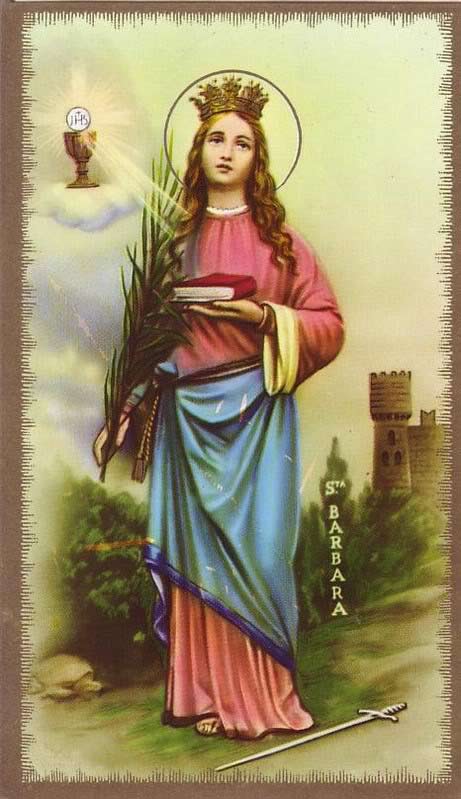
Happy St. Barbara’s Day to all of my Field Artillery brothers and sisters.
Legend has it that Saint Barbara, the patron saint of artillerymen, was tragically beheaded by her own father, a nobleman in the Roman Empire, for her devotion to Christianity. Shortly after, in a twist of fate, her father was struck down by lightning during a sudden, violent storm. Consequently, Saint Barbara is revered as the patroness of those facing thunderstorms, fire, explosions, or the risk of sudden death.
In the early days of warfare, artillerymen often encountered cannon misfires, muzzle bursts, and weapon explosions. Artillery crews turned to Saint Barbara for protection. She has been protecting artillerymen for hundreds of years and has become an integral part of the Field Artillery’s heritage. Today, she continues to be honored as the patron saint for all artillerymen, depicted standing by a cannon or holding a chalice and sacramental wafer.
Our nation has endured an extraordinary series of natural disasters over the past few months, including hurricanes, tornados, torrential rains, devastating floods, and enormous wildfires. If you’ve tuned in to the evening news lately you’ve probably seen disaster victims who have lost nearly all of their material possessions. Despite suffering tremendously, many of these people express gratitude for the simple fact that they are alive and still have their family and friends. They get it!
As I grow older, the things that truly matter in my life have become crystal clear. These are Faith, Family, Friends, and Freedom. I call them the 4Fs and I’ve written about them several times over the decade that I’ve written this blog.
Today, as we mark the annual Thanksgiving holiday, I’m offering a special thanks for my friends. I’ve heard it said that families are issued to you, but you choose your friends. This is just one of the many things that makes true friends so special.
So, what is a true friend? I don’t have all the answers, but here are some characteristics of my true friends that I’ve observed over the years:
They are there for you when others walk away.
They meet you where you are, warts, wrinkles, and all.
They are forgiving.
They will make time for you, even when they haven’t the time to spare.
They expect nothing in return and do not keep score.
They are good listeners.
They respect confidentiality.
They tell you what you need to hear, not what you want to hear.
They say, “Wow, you really made a mess of this! Now how can I help you fix it?”
They walk beside you in the demon filled valleys, propping you up.
They are at their best when you are at your worst.
A number of my dear friends are currently struggling with serious life challenges. These include the early onset of dementia, the death of a spouse, a spouse developing dementia, a spouse with cancer, a child abusing alcohol, and a child suffering with seizures. The longer one lives the more frequently such challenges seem to occur. So now I lift them up to the Lord.
Lord, hear my prayer. Father God, I pray for my friends who are struggling. I pray that you will grant them mercy and peace. You know exactly what they need at this moment. Draw near to them and let them feel your presence. Open their eyes, ears, and hearts to you. Protect them from the attacks of the evil one and shelter them in your loving arms. I pray this in the name of the Father, and the Son, and the Holy Spirit. Amen.
Sirach 6:14-16 (RSV)
Faithful friends are a sturdy shelter: whoever finds one has found a treasure. Faithful friends are beyond price; no amount can balance their worth. Faithful friends are life-saving medicine; and those who fear the Lord will find them.
My home is in heaven. I’m just traveling through this world. –Billy Graham
I served 24 years of active duty in the US Army. For my entire career my sweet wife stood by my side, sacrificing her own career in order to accommodate my needs. I was gone a lot, but somehow along the way we managed to birth and raise two children. We moved over a dozen times during my career. More than once we moved three times in a single year. This was done so that I could attend short, specialized training courses and schools between my permanent changes of station.
We lived in some wonderful locations, saw some incredible things, and had some great times. One thing we never had, however, was a place to call home. The idea of a place called home is almost magical for some people. Recall Dorothy’s most memorable line in the Wizard of Oz as she yearns to return to friends, family, and a little farm in Kansas, “There’s no place like home.” Or as American pioneer and writer Laura Ingalls Wilder said, “Home is the nicest word there is.
Then there’s this from Oliver Wendell Holmes Sr., “For there we loved, and where we love is home, home that our feet may leave, but not our hearts.” Home means different things to people, but a common thread is the thought of being in a safe, comfortable place surrounded by those we love the most.
Unfortunately, many people yearn for home during their lives, but never find it. Saint Paul often spoke of heaven as every believer’s true home. In Corinthians 2 5:1* he says:
“For we know that if the earthly tent we live in is destroyed, we have a building from God, an eternal house in heaven, not built by human hands.”
Here, Paul compares our temporary physical bodies to a tent and contrasts it with an “eternal house in heaven,” highlighting the permanence and divine nature of our heavenly home.
In Philippians 1:23-24, Paul writes:
“I am torn between the two: I desire to depart and be with Christ, which is better by far; but it is more necessary for you that I remain in the body.”
And in Philippians 3:20, he writes:
“But our citizenship is in heaven. And we eagerly await a Savior from there, the Lord Jesus Christ.”
This verse emphasizes that our true citizenship is in heaven; it reinforces the idea that our ultimate home is with God.
The ache for home lives in all of us. The safe place where we can go as we are and not be questioned.” — Maya Angelou
Taken together, the preceding passages from Paul show he understood that while we live on earth temporarily, our true eternal home is in heaven with God. And like the prodigal son’s return to his father’s house, our Father in heaven eagerly awaits the day when all his children will return to their heavenly home. So, if you’re a believer with an unquenchable ache to go home and be at peace, rest assured in the knowledge that the Father is eagerly awaiting your return and will run to embrace you when you come home to your rightful place in heaven at His appointed time.
I’m just a poor wayfaring stranger Traveling through this world below There is no sickness, no toil, no danger In that bright land to which I go I’m going there to see my father And all my loved ones who’ve gone on
I’m just going over Jordan I’m just going over home
My heart is stirred by a noble theme as I recite my verses for the king; my tongue is the pen of a skillful writer. –Psalm 45:1*
A large portion of my wife’s family tree is rooted in Lancaster County, Pennsylvania. Lancaster County is Amish country. Having rejected the modern world, these plain Christians, the descendants of Swiss-German Anabaptists, struggle to maintain an 18th century existence in fast-paced, 21st century America. The county has well over 30,000 Amish residents today.
The Amish are farmers and craftsmen. Stout work horses pull their plows through the fertile fields. They build their own houses and barns and heat them with stoves fired by wood and coal. They make their own furniture. Their houses have no electricity. They have neither television, radio, cell phones, computers, cars nor tractors. They educate their children in one-room schoolhouses. They hold church services in private homes. They know their neighbors and help them when needed. They revere God!
While I’m not ready to give up 21st century conveniences, I must admit there’s a part of me that envies the simple existence of the Amish. Inspired by Amish simplicity, I began writing this Divine Simplicity blog in September 2011 as a Christ-inspired self-help guide on simplifying one’s life.
My blog has evolved considerably over the years, with the topics growing ever broader, but all the while aiming to maintain a focus on Christ and scripture. When I started this blog, I never figured I’d still be at if after a decade. I don’t have many followers, which led me to question the blog’s value. Why I should continue to write it at all. After considerable thinking on this, it all boils down to three things.
I endeavor to ensure that every entry I write honors and glorifies Jesus.I write prayerfully, hoping to inspire serious thought and holy conversation. Billy Graham had this to say:
“Our dress, our posture, our actions should all be for the honor and glory of Christ. Much of our talk as Christians is secular, not spiritual. It is easy to fall into conversational conformity of the world and spend an evening discussing politics, new cars, and the latest entertainment. We often forget that we are to edify one another with holy conversation and that our conversation should be on heavenly, and not exclusively on earthly things.”
Create in me a pure heart, O God, and renew a steadfast spirit within me. –Psalm 51:10
I also write for my own spiritual renewal. Writing a blog entry almost always causes me to search through the Bible, seeking relevant passages supporting the topic I have chosen. For me, searching and studying scripture is cathartic. It draws me closer to God by shifting my thoughts from earthly cares and concerns to Godly thoughts inspired by the Holy Spirit. Writing about the scripture passages I discover reinforces what I learn from them.
I planted the seed, Apollos watered it, but God has been making it grow. So neither the one who plants nor the one who waters is anything, but only God, who makes things grow. –1 Corinthians 3:6-7
Finally, I write to sow seed containing the Good News of Jesus Christ. Perhaps if I, through my blogging, can plant a seed with the Gospel message in a reader’s heart, then maybe another will water it so that God will make it grow. I did some rough math and figure that during the course of nearly 13 years I’ve spent around 1,500 hours researching and writing this blog. If it has helped even one person find his or her way to Christ’s salvation, then I’m satisfied that it has done its job. Soli Deo gloria.
Whatever subject I preach, I do not stop until I reach the Savior, the Lord Jesus, for in Him are all things. –Charles Spurgeon
I am the Lord your God who takes hold of your right hand and says to you, Do not fear; I will help you. —Isaiah 41:13
Many people today fear a wide variety of things they see and hear around them. Fear is running rampant right here in America. Polls indicate that the majority of Americans now believe that their children’s lives will be harder than their own. They worry about unemployment and the economy. Many fear illegal immigration. Others are afraid to gather in public places for fear of violence. We see campus protests turn violent. School shootings don’t surprise us anymore.
On a cosmic scale we hear about giant solar flares that could destroy technology, pushing humankind back into the Stone Age. A large meteor or asteroid collision could destroy life on Earth.
In the natural world, we hear that a major eruption of a super volcano, like the one beneath Yellowstone National Park, could cause destruction and death on a planetary scale. Earthquakes and tsunamis in diverse places threaten millions of people. Climate change is blamed for killer storms, droughts, melting polar ice, coastal flooding, wildfires and more.
On the human plane, we read and hear about flesh eating bacteria, brain eating amoebas, and drug resistant bacteria and viruses. Abortion rights are a hot button topic that can trigger anger and rage. Some people hunker down in their homes, worried about riots, violence by and against the police, and other street violence. Others fear that computer hackers or scammers will steal their identities and wealth.
There are wars in Ukraine and Gaza, and rumors of a global war that’s coming. Religious persecution is increasing around the globe. There is a growing wave of antisemitism right here in America. There are ample reasons for fear.
The Bible mentions two very different types of fear. The first is fear of the Lord. This fear is not associated with being scared. It is an awe and reverence of God and is to be encouraged. According to Psalm 111, fear of the Lord is the beginning of wisdom and leads to rest and peace.
The second type of fear is detrimental. In the first chapter of 2 Timothy it is described as a “spirit of fear.” A person can be completely overcome by a spirit of fear, virtually frozen and unable to function. Such fear weighs a person down physically, emotionally and/or mentally.
Unfortunately, many Christians have succumbed to living with a spirit of fear. Some fear those of other religions and are reluctant to reach out to them in Christian love. Some fear those who are different from them culturally or racially. Others are hesitant to invite those in need into their lives for fear they might lose something or it might cost something. Some are afraid to leave the comfort of their homes and familiar surroundings in order to reach out to the needy. Others are hesitant to give of their wealth for fear they might later find themselves in need.
Many Christian fears boil down to a fear of losing something—possessions, comfort, safety, security. In Philippians chapter 3, verses 7-8, Paul describes how he has let go of the things of this world in order to focus on what is truly important:
But whatever gain I had, I counted as loss for the sake of Christ. Indeed, I count everything as loss because of the surpassing worth of knowing Christ Jesus my Lord.
One can’t grasp Christ’s outstretched hand while clinging to things of this world. As David tells us in Psalm 34, verses 4-7:
I sought the Lord, and he answered me and delivered me from all my fears. Those who look to him are radiant, and their faces shall never be ashamed. This poor man cried, and the Lord heard him and saved him out of all his troubles. The angel of the Lord encamps around those who fear him, and delivers them.
You may be facing a health crisis, unemployment, divorce, a call to Christian service, or other difficult challenges. Don’t live in fear. Take the fears you struggle with today and give them to the Lord in prayer. Make this a habit. I will not tell you to “let go and let God” because it makes letting go of fear sound so simple. Instead, I encourage you to explore the Bible and learn what it says about fear. Read and believe!
Begin with Psalm 23. Then read Psalm 118. Other relevant Psalms include 27, 34, 46, 61, 91, 103, and 121. Once you have read these Psalms, locate a red letter edition New Testament and read every word spoken by Jesus. Then read Paul’s epistles. Become steeped in scripture. Do this and you will be well on the way to giving your fears to the Lord.
The remarkable thing about God is that when you fear God, you fear nothing else, whereas if you do not fear God, you fear everything else. —Oswald Chambers
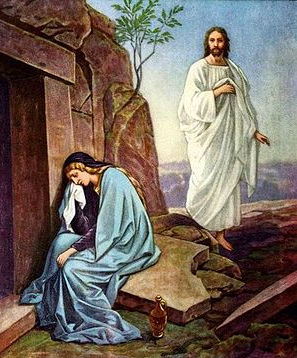
Now after the Sabbath, as the first day of the week began to dawn, Mary Magdalene and the other Mary came to see the tomb. 2 And behold, there was a great earthquake; for an angel of the Lord descended from heaven, and came and rolled back the stone from the door, and sat on it. 3 His countenance was like lightning, and his clothing as white as snow. 4 And the guards shook for fear of him, and became like dead men.
5 But the angel answered and said to the women, “Do not be afraid, for I know that you seek Jesus who was crucified. 6 He is not here; for He is risen, as He said. Come, see the place where the Lord lay. 7 And go quickly and tell His disciples that He is risen from the dead, and indeed He is going before you into Galilee; there you will see Him. Behold, I have told you.”
8 So they went out quickly from the tomb with fear and great joy, and ran to bring His disciples word.
The Women Worship the Risen Lord
9 And as they went to tell His disciples, behold, Jesus met them, saying, “Rejoice!” So they came and held Him by the feet and worshiped Him. 10
I recently read a book that poses the question, “What about your life before you were a Christian has changed since you became a Christ follower.” I can think of so many responses, but two stand out. First of all, as a Christian I have a profound sense of personal sin that wasn’t previously there. Note that I speak of “sin,” not “sins.” My personal sins are a countless laundry list of bad, harmful things I have done during my life. Many people are repulsed by being called a sinner. Yet sin (without an “s” on the end), is a condition we all live in. Martin Luther described it eloquently in a letter to Philip Melanchthon on August 1, 1521:
“Be a sinner, and let your sins be strong, but let your trust in Christ be stronger, and rejoice in Christ who is the victor over sin, death, and the world. We will commit sins while we are here, for this life is not a place where justice resides. We, however, says Peter (2 Peter 3:13) are looking forward to a new heaven and a new earth where justice will reign. It suffices that through God’s glory we have recognized the Lamb who takes away the sin of the world. No sin can separate us from Him, even if we were to kill or commit adultery thousands of times each day. Do you think such an exalted Lamb paid merely a small price with a meager sacrifice for our sins? Pray hard for you are quite a sinner.”
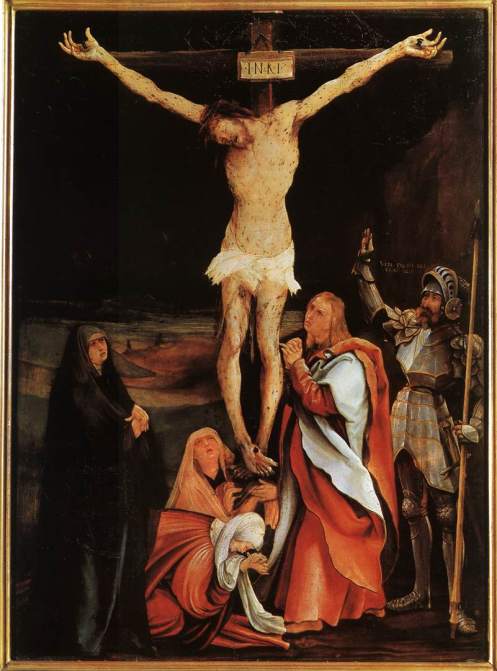
My second response to the question is that as a Christian I have a tremendous sense of gratitude that God has forgiven all my sins through Jesus Christ. Before becoming a Christian, I didn’t recognize my need for forgiveness. Now I understand that Jesus suffered, bled, and died on the cross as an atonement for not only my sins, but the sins of the entire world. Hebrews 9:15 tells us that Christ’s blood inaugurated a new covenant. Through His sacrifice, He became the mediator between God and humanity. The old system of blood offerings through sacrificing animals could only cover sin temporarily, but Christ’s blood provides complete forgiveness. His death on the cross bridged the gap between the holy God and fallen humanity. Jesus the risen Lord is now seated at the right hand of the Father, where he intercedes on our behalf, our great High Priest.
The process of forgiveness begins with repentance. Acknowledging our sins, we turn to God, seeking His mercy. Acts 2:38 stresses baptism in the name of Jesus Christ for the remission of sins. More than a mere ritual; it symbolizes our identification with Christ’s death and resurrection. Through faith in Jesus as the risen Son of God, we receive forgiveness—the slate is wiped clean and our sins are remembered no more.
As the season of Lent winds down and Easter approaches, let us all consider Christ’s atonement for our sins. Through His death on the cross, Jesus atoned for the sins all mankind, satisfying God’s demand for justice, and accomplishing reconciliation for all who seek redemption through Him. The obedience and selfless sacrifice of Christ, who felt human emotions and pain just like you and me, serve as the foundation of our salvation. The shedding of Jesus’s blood on the cross symbolizes the ultimate atonement, restoring us to God’s favor and demonstrating the Father’s divine love and mercy. Jesus willingly gave His life for our sins, bridging the gap between humanity and God. His sacrifice on Calvary’s cross paid the price for our transgressions, conquered sin and death, and brought about the resurrection from the dead, not just for Jesus, but eventually for all of His followers.
God proved His love on the Cross. When Christ hung, and bled, and died, it was God saying to the world, ‘I love you.’ –Billy Graham
This piece was originally posted to my blog on February 26, 2019. The church season of Lent in 2024 runs from Ash Wednesday (February 14) to Easter Sunday (March 31).
The United States is a debtor nation. The US Congress regularly borrows money to keep the government running. The national debt is the grand total of money the government owes, either to investors or to itself (source: USAfacts.org). The current national debt is approaching $35 trillion. That’s 35 followed by 12 zeros!
There is an intriguing concept of debt forgiveness in Jewish law that relates to the Shemitah year, which occurs every seven years. According to the Torah, in the Shemitah year, all personal loans between Jews are canceled, and lenders must release their debtors from their obligations. This is known as Shemitat Kesafim, or “release of money.” The purpose of this law is to foster generosity, faith, and social justice among the Jewish people, and to remind them that everything ultimately belongs to God. Imagine how different our lives would be if this form of debt relief were practiced in America today.
Average American citizens are debtors. Per the website Statista.com, the average American had $21,800 in non-mortgage debt in 2023. Much of this amount was accrued on credit cards used to fund consumer spending…I just had to have that new iPhone! Unlike older generations, younger consumers today often buy on credit those things that older generations would have saved up for and purchased in cash, like a new car…Why wait, you can have it now. You deserve it!
Today, the idea of saving enough money to buy a new car is as outdated as the idea of working one’s way through college. While not impossible, the skyrocketing cost of new cars and attending a four-year college make paying cash as one goes out of reach for most people.
According to a July 2023 article on Forbes.com (https://www.forbes.com/advisor/student-loans/average-student-loan-debt-statistics/), total student loan debt was $1.75 trillion. Around 55% of students from public four-year institutions had student loans. The average student loan debt for students coming out of public four-year institutions was $28,950.
There’s an old adage that says, “The borrower is slave to the lender.” There’s a lot of truth in this. The Bible describes our sins as debts to God. Sin debt to God is a concept describing the moral obligation that humans have to obey God’s law and the penalty that they incur when they fail to obey. Sin is disobedience to God’s will and commands. King David acknowledges in Psalm 51:3-4, that his sins are offenses against God, not man:
3 For I know my transgressions, and my sin is always before me. 4 Against you, you only, have I sinned and done what is evil in your sight; so you are right in your verdict and justified when you judge.
Sin separates humans from God’s presence and favor. The consequence of sin is death, both physical and spiritual, which means eternal separation from God.
The Bible teaches that God is merciful and gracious, and He has provided a way for humans to be forgiven and reconciled to Him. God sent His Son, Jesus Christ, to die on the cross as a substitute for sinners, paying the debt that they could not pay themselves. By trusting in Christ’s death and resurrection, sinners can receive God’s forgiveness and eternal life. This is the Good News (Gospel), of God’s salvation for sinners. God cancels the sin debt of those who believe in His Son and restores them to a right relationship with Him. While you may not receive government relief from your student loans or other debts, thanks be to God that forgiveness for our sin debt against Him is available.
Ephesians 2:1-10 As for you, you were dead in your transgressions and sins, 2 in which you used to live when you followed the ways of this world and of the ruler of the kingdom of the air, the spirit who is now at work in those who are disobedient. 3 All of us also lived among them at one time, gratifying the cravings of our flesh and following its desires and thoughts. Like the rest, we were by nature deserving of wrath. 4 But because of his great love for us, God, who is rich in mercy, 5 made us alive with Christ even when we were dead in transgressions—it is by grace you have been saved. 6 And God raised us up with Christ and seated us with him in the heavenly realms in Christ Jesus, 7 in order that in the coming ages he might show the incomparable riches of his grace, expressed in his kindness to us in Christ Jesus. 8 For it is by grace you have been saved, through faith—and this is not from yourselves, it is the gift of God— 9 not by works, so that no one can boast. 10 For we are God’s handiwork, created in Christ Jesus to do good works, which God prepared in advance for us to do.






 Divine Simplicity
Recent Comments