Archive for the ‘Holy Spirit’ Category

Too much to pray for!

Prayer

Renowned Scottish theologian Oswald Chambers said, ‘Prayer does not equip us for greater works— prayer is the greater work. Yet we think of prayer as some commonsense exercise of our higher powers that simply prepares us for God’s work. In the teachings of Jesus Christ, prayer is the working of the miracle of redemption in me, which produces the miracle of redemption in others, through the power of God.’

The older I grow, the more it seems like I have more to pray for than I can handle.  Is this is a common dilemma for Christians as they grow older?  I’d like to hear from readers who share the same or a similar problem.  

My prayer list is getting too long to manage.  It includes numerous categories including family (spouse, children, grandchildren, siblings, cousins, aunts, uncles, in-laws and extended family members); friends; colleagues at work; clergy; those persecuted for their Christian faith; my church; my former churches; local leaders; state leaders; national leaders; military service members; and even the abused and missing children on the evening TV network news.  Where should I begin praying on a prayer like this?

 I’ve tried ‘checklist’ praying–simply going down the list and asking God’s blessing for each category, but that feels very hollow. I’ve tried lifting up specific prayers for everyone and everything on the list, but my ability to concentrate usually fails after five or 10 minutes into the prayers.  I’ve segmented my prayers to pray for one category at a time on my prayer list.

When Jesus’ disciples asked him to teach them to pray, he gave them (and us) the ‘Lord’s Prayer’. It’s a beautiful model for praying, but should not be the only prayer we pray; one of the purposes of prayer is simply for us to be with God and to listen and experience the glory of his presence. Our Lord’s prayer goes like this:

Our Father who are in heaven (recognition of God’s supreme authority in all creation),

Hallowed be thy name (affirmation of God’s perfect nature),

Thy kingdom come, Thy will be done on Earth as it is in heaven (a petition for God to restore the perfect order on Earth that he has intended since creation),

Give us this day our daily bread (recognition that God sustains us),

And forgive us our trespasses (a plea for God’s forgiveness through Jesus Christ),

As we forgive those who trespass against us (an acknowledgement that we have all sinned and fall short of the glory of God and a reminder to forgive others),

And lead us not into temptation (a plea to God to spare us from testing, as Job, Jesus and so many Christian martyrs have been tested),

But deliver us from evil (protect us from Satanic forces),

For Thine is the kingdom, and the power, and glory forever, amen (a final acknowledgement of God’s supreme authority in all creation).

The Lord’s Prayer is a beautiful way to begin or end any prayer! 

St. Paul’s epistle to the Romans (8:26-27) tells us, ‘…We do not know what we ought to pray for, but the Spirit himself intercedes for us through wordless groans. And he who searches our hearts knows the mind of the Spirit, because the Spirit intercedes for God’s people in accordance with the will of God (NIV).’  I try to apply this wisdom when I’m feeling overwhelmed.  Sometimes my daily prayer is simply, “Holy Spirit, please pray for me and my family.”  I also pray this prayer for individuals, when I feel troubled about/for them, but I don’t know how to pray for them.

One thing I’ve learned is not to pray too much for myself.  When I do pray for myself, it usually entails asking God for forgiveness.  Psalm 51 and the Lord’s Prayer are my ‘go to’ prayers when I pray for myself. They are more than sufficient!

So how should we pray?  I would love to hear your comments and ideas on prayer. Please consider leaving a comment. 

To Be a Christian without prayer is no more possible than to be alive without breathing.    —Martin Luther
Living by the Calendar

Calendar.jpg

The here-and-now is no mere filling of time, but a filling of time with God.         

I work in the tech industry on a virtual business team.  We have people located across the country from Virginia to Hawaii and many places in between.  The team is run by the calendar.  It’s difficult scheduling conference calls with a team spread across five time zones, so we have to schedule carefully and stick closely to the schedule.

Personally, I would be pretty lost without the Microsoft Outlook calendar on my laptop. Between my work, volunteering, doctor appointments, shuttling grand kids around, birthday reminders, weddings, funerals and the like I simply couldn’t keep track of where to be when without a calendar.

While most adults in the Western World are familiar with calendars, there is one calendar that’s terribly overlooked in many circles.  I’m speaking about the Christian liturgical calendar.  The liturgical year (or Church year) is a continuous cycle of Christian seasons that include various feast days that mark celebrations of the Church.  The liturgical year also has a set list of readings for every day of the year.  Observing the liturgical calendar is highly enriching, providing a continuous commemoration of key events in the life of Christ and the church.  Sadly, many Christian denominations hardly recognize the liturgical calendar at all. 

According to the website The Voice, “The Christian calendar is organized around two major centers of Sacred Time: Advent, Christmas, and Epiphany; and Lent, Holy Week, and Easter, concluding at Pentecost. The rest of the year following Pentecost is known as Ordinary Time, from the word “ordinal,” which simply means counted time (First Sunday after Pentecost, etc.)  (http://www.crivoice.org/chyear.html).

liturgical-calendar.jpg

Let’s take a short tour of the Church liturgical year.  It begins with Advent, which occurs in December.  Advent commemorates Israel’s wait for the birth of the Messiah, which was promised in prophecy.  For modern Christians, it is symbolic of our waiting for Christ to “come again in glory to judge the living and the dead,” as many Christians frequently recite in the words of the Nicene Creed.

Advent is followed by Christmas on December 25, and Epiphany in January.  Christmas is the celebration of the birth of Jesus Christ, Israel’s promised Messiah and God’s only begotten son–the savior of the world.   It is followed by Epiphany, which is translated “appearance.”  Epiphany commemorates the visit by the Magi (or three wise men) to baby Jesus, when they reveal that Jesus is the Messiah and bring him gifts of gold, frankincense and myrrh.  Gold represents the kingship of Jesus.  Frankincense, which is sweet incense, represents His earthly priesthood.  Myrrh, a sweet spice used in preparing bodies for burial, represents Jesus’ coming crucifixion and death on the cross for the forgiveness of the sins of the world. The later part of January and the month of February are ordinary time on the liturgical calendar.

Lent, Easter and Pentecost follow the ordinary time in February. Lent is the period of 40 days from Ash Wednesday to Easter Sunday, commemorating Christ’s final journey to Jerusalem, where he will be crucified. It is a period of penitence and alms giving for the church.  On Ash Wednesday, many Christians have their foreheads marked with ashes in the sign of the cross.  

Palm Sunday occurs the Sunday before Easter.  It commemorates Jesus’ Triumphal Entry into Jerusalem and his final journey to the cross. He rode into the city on a donkey while the crowds shouted “Hosanna,” which is translated “save us,” and they laid palm leaves in his path. Modern day Christians often celebrate Palm Sunday by waving palm leaves during a processional at the beginning of their church service.  Palm leaves from the Palm Sunday service are burned and the ashes collected to be used during Ash Wednesday of the following year.

At the end of Lent comes a period of three days called the Paschal Triduum, which begins on Maundy Thursday, proceeds through Good Friday, and ends with a liturgy on the evening of Easter Sunday.  These all fall inside Holy Week, the week ending with Easter.  

Maundy Thursday marks the night before Christ’s crucifixion, when he celebrates the Last Supper with his disciples, giving us the gift of the Holy Eucharist.  Good Friday commemorates the crucifixion of Christ for the forgiveness of our sins and his burial.  Easter celebrates Christ’s glorious resurrection and his victory over sin and death.  Christ taught his disciples for 40 days following the resurrection, then he miraculously allowed them to see his Ascension into heaven, which occurred before their eyes; meanwhile, angels promised the disciples that just as they saw him ascend into heaven, they will also him descend back to the Earth to reign in glory forever.

Following the Ascension comes Pentecost. Pentecost commemorates God’s gift of the Holy Spirit to his disciples and marks the beginning of the Church.  Following the season of Pentecost, the months of June through November are ordinary time on the liturgical calendar.  At the end of November, on the Sunday before Advent begins, we celebrate Christ the King Sunday, a day reminding Christians that they owe their first allegiance to Christ, not earthly powers or rulers.

So there you have it.  Observing the Church liturgical calendar is a beautiful way of celebrating Christ’s birth, crucifixion, resurrection and the establishment of Christ’s Church on Earth.  If your personal tradition doesn’t observe the liturgical calendar, consider adopting it to add a new level of richness to your worship.  In doing so you you’ll find inspiration and hope.


Caring for the Temple of the Holy Spirit

OverweightAaaaggh!

I spent over 24 years of my adult life as an officer in the US Army.  To say that I was in good physical condition would be a gross understatement. I served a tour of duty in the 75th Ranger Regiment, one of the Army’s elite organizations. I was a paratrooper, jumping out of perfectly good airplanes and floating to Earth under a silk canopy.  I also served in the 10th Mountain Division, one of the Army’s toughest and most respected divisions.  Since 2001, the 10th Mountain has been the most deployed division in the US Army.  The Army encourages, even demands, good physical fitness of its soldiers. 

Fitness is in my DNA. I feel out of sorts if I can’t exercise three to four days per week.  Nevertheless, I find myself in a fitness conundrum today.  When I retired from the Army in 2001, I was a fit 205 pounds, well within the limits for my muscular, six-foot frame. Today I find myself about 30 pounds heavier; the extra weight can be attributed to a combination of age, indiscipline, and total knee replacement surgery, which I underwent about 11 months ago; the latter totally wrecked my physical fitness routine.  I’m still in recovery!

I’m not happy with my current weight.  Until a couple of weeks ago, I viewed my condition as purely a physical fitness challenge—a need to get back into shape to reverse the changes that have taken place since my surgery.  However, I recently experienced a healthy change of attitude. 

I credit the change to my dear friend Cliff, who also struggles with his weight.  He recently introduced me to a book called Every Body Matters, by Gary Thomas. As the book cover explains, it is about “Strengthening Your Body to Strengthen Your Soul.”

Having personally struggled with his weight, Thomas uses scripture to demonstrate that, for Christians, physical health is as important as spiritual health. Thomas demonstrates that physical fitness, rather than being something that make us more attractive to others, makes us more useful to God. I recommend his book to anyone who has struggled with physical fitness or being overweight. Thomas offers a Holy Spirit-led approach to developing a physical being that is of maximum use to God.

Thomas cites these words of St. Paul:  (All Bible citations were taken from the ESV.)

Or do you not know that your body is a temple of the Holy Spirit within you, whom you have from God?  You are not your own, for you were bought with a price. So glorify God in your body. 1 Corinthians 6:19-20

…I discipline my body and keep it under control, lest after preaching to others I myself should be disqualified. 1 Corinthians 9:27

…let us cleanse ourselves from every defilement of body and spirit, bringing holiness to completion in the fear of God. 2 Corinthians 7:1

Many Bible commentators interpret bodily sins to mean sexual sins.  While Thomas would agree with this, he goes on to discuss the need for developing discipline in what we put into our bodies (i.e. food).  As I previously noted, he frames the discussion in terms of disciplining our bodies, not to make us attractive to others, but to glorify God (…you were bought with a price. So glorify God in your body. 1 Corinthians 6:20)

I highly recommend Every Body Matters to all Christians who struggle with their weight. I promise it will change your perspective on being overweight and motivate you to do something about it.  It has led my wife and me to challenge each other.  During the upcoming season of Lent (Feb 14 – Mar 29), we will embark upon a 40-day regimen of time-restricted eating. 

In a nutshell, this means we’ll eat normally for 6 hours each day, while fasting the remaining 18 hours. By most accounts, this eating pattern is easy to adjust to and usually results in remarkable weight loss for those having the discipline to stick with it.  We’re not looking for a new diet or fad, but a lifestyle change. Wish us luck!  At some point in the future, I’ll share our experience.

Protecting your health is the same as protecting the vehicle with which God wants to change the world.  —Gary Thomas


What do you believe?

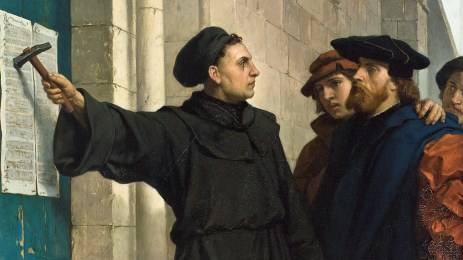
Martin Luther by Ferdinand Pauwels

Martin Luther by Ferdinand Pauwels

Tomorrow much of the world will commemorate the 500th anniversary of the 95 Theses, when a brave Roman Catholic monk named Martin Luther nailed a revolutionary document to the church door in Wittenburg, Germany (see http://www.luther.de/en/95thesen.html).   The document, consisting of 95 parts, denounced his church’s practice of selling “indulgences” to absolve sin, which ran contrary to Luther’s Bible-based belief that that salvation could be attained through faith and by God’s grace alone.  I call him brave, because Luther’s act put him at risk of excommunication and possibly even death.

When called before the Catholic Council (Reichstag) in the city of Worms and ordered to renounce the document, Luther refused, saying  the famous words, “Hier stehe ich. Ich kann kein anders.” (Here I stand.  I cannot do otherwise).   Rather than renouncing his 95 Theses,  Luther eventually renounced his monastic vows and married a former nun. His act of faith rocked the Catholic church and ultimately spawned what today is known as the Protestant Reformation.

What would you do if your Christian faith were challenged?  What if someone asked you about your Christian beliefs?  How would you reply? I’d like to think I’d be as brave as Luther, but in reality I probably wouldn’t. How many people are willing to risk everything for Christ? Recently, we’ve heard stories of Christians in Iraq and Syria identifying themselves to ISIS terrorists and being executed, rather than hide their Christian faith. How would you respond?

Have you ever really thought about what your Christian faith means to you?  Sure, you might recite the Apostle’s Creed or Nicene Creed at church every week, but did you ever really stop to think what those words mean?   I’m an Anglican.  My denomination, the Anglican Church in North America (ACNA), subscribes to three creeds:  the Nicene, Apostle’s, and Athanasian.  Unless you’re a relatively new Christian, you’re probably familiar with the first two, which are worded very similarly.  The Athanasian Creed is a bit harder to digest, as it  clearly discuss the three persons comprising the Holy Trinity, one of the most controversial tenets of the Christian faith.  It is accepted by many Western churches and often read at Trinity Sunday worship services in lieu of the Apostle’s or Nicene Creed.

I challenge you to set aside some quiet time and seriously consider the question, “What do I believe?” I can assure you that of the three great world religions, Christianity, Judaism, and Islam, the average Christians is the least well-equipped to answer this question.  Islam and Judaism emphasize reading and memorizing scriptures much more than does Christianity.

Here are a few things to consider if you accept the challenge.

  • The Holy Trinity (Matthew 28:19) – Do the words of the Bible or the Athanasian Creed’s take on the Trinity cause you to question your own beliefs?
  • Your Body (1 Corinthians 6:19-20) – Do you treat your body as if it is the Temple of the Holy Spirit? (Think about what you put into it).
  • Divorce (Matthew 19) – Do you accept Jesus teaching on divorce? He opposes it.
  • Abortion (Psalm 139:13-16; Jeremiah 1:5) – What are your beliefs about the early stages of life?
  • Gay Marriage (Romans 1) – What are your beliefs on gay marriage?
  • Love the Lord your God with all your heart (Mark 12:28-34) – Do you love God above everything else, or is something (addiction, idolatry) getting in the way?
  • Love your neighbor as yourself (Mark 12:28-34) – Are you at peace with your neighbor?
  • Sin (Romans 7:14-25) – What is sin? Are you a sinner?                   

This is a tough challenge—not something you can think through in a few minutes. Matthew 9 tells the story of a man who is imploring Jesus to heal his young son, who has an unclean spirit (demon) plaguing him.  Jesus says to the man (ESV), “If you can’! All things are possible for one who believes.”  Immediately the father of the child cried out and said, “I believe; help my unbelief!” I submit that most Christians who take the challenge will find themselves crying, “Help my unbelief!”

 “Today, many churches are taking God’s laws and saying, ‘These no longer are in effect.’ In Luther’s time the Church said, ‘You need to buy indulgences to be forgiven of your sin.’ Today, more than one church says, ‘Sin? What is sin?’” 

                                                                  Ken Klaus, Pastor Emeritus, The Lutheran Hour 

Back to Scripture: The Protestant Reformation and the Five Solas   https://www.christianheadlines.com/slideshows/back-to-scripture-the-protestant-reformation-and-the-five-solas.html