Archive for the ‘Christian’ Category

Is your God this big?

HubbelHubble Space Telescope Image

The heavens declare the glory of God;
    the skies proclaim the work of his hands.  —Psalms 19:1*

During my 24-year U.S. Army career I deployed to the Middle East and the horn of Africa for extended stays.  Much of my time there was spent in very remote areas of Saudi Arabia, Kuwait, Iraq and Somalia.  While I can’t say I enjoyed my time in these places, the deployments were great learning experiences that I wouldn’t trade for anything. 

One thing that I did enjoy, however, was the nighttime sky in the desert west of Kuwait City and in the plush south Jubba River valley of Somalia.  With no man-made light to interfere with my vision, I could look upward and literally see billions of stars.  God has created an unfathomable universe that defies human description. As the Psalmist says, truly the heavens declare the glory of God. 

My God can alter this vast universe in the blink of an eye. Is your God this big?

In the beginning you laid the foundations of the earth,
    and the heavens are the work of your hands.
They will perish, but you remain; they will all wear out like a garment.
Like clothing you will change them and they will be changed.
But you remain the same
 and your years will never end.  —Psalm 102:25-27

The King James Bible of 1611 paints an image of God reflecting the social order of Jacobean England—a king sitting on a throne, surrounded by throngs of courtiers. Many Christians have grown up with this image of God. God truly is our king; however, he is much, much more. English clergyman and Bible scholar J.B. Phillips is probably best known for his epic book, “Your God is Too Small.” Published in 1952, he might have just as easily called it, “Your Mind is Too Small.”  Phillips encourages us to set aside the limits human reason places on God and instead embrace Him as the omnipotent, omnipresent creator of the universe. Rather than having God conform to a man-made image of Him, which Phillips calls “God in a box,” Phillips challenges us to open our minds and embrace God’s reality—the creator of the universe, who is unconstrained by our concepts of time, speed, distance and space.

When I consider the work of your fingers, the moon and stars which you have set in place, what is mankind that you are mindful of them, human beings that you care for them?—Psalm 8:3-4

Perhaps what’s most amazing about my God is that the creator of the limitless universe is also the God who cares for you and for me as individuals.  As our father and creator, God knows our thoughts, our fears, our weaknesses and our individual needs. He wants to care for us.

See what great love the Father has lavished on us, that we should be called children of God! And that is what we are! —1 John 3:1

The glory of God can shine through us as individuals when we are in a right relationship with Him, but because of mankind’s fallen state, we cannot even look God in the face (Exodus 33:20). Therefore, our creator sent us a savior, His only begotten son Jesus Christ, who willingly set aside his heavenly glory and took on human form, being born of a virgin, for the express purpose of dying on the cross for your sins and mine. By his death and resurrection, we can be restored to a right relationship as children of God.

But the cross wasn’t the end, it was the beginning.  Through His glorious resurrection from the dead, Christ banished death and opened the gateway to eternal life for all who put their faith in Him as savior. There is nothing we can do by ourselves to be restored to a right relationship with God; it is a gift that must be accepted. Jesus Christ offers forgiveness and eternal life freely to those who confess their sins and trust in Him. Do you want to trust Jesus?  Click the link to find out how. 

https://www.youtube.com/watch?v=P8qWlN7c3lQ

If we confess our sins, he is faithful and just and will forgive us our sins and purify us from all unrighteousness. —1 John 1:9.     

*All Bible quotes are taken from the New International Version.

A Heart of Stone

Heart of Stone

Political discourse in America today has become vitriolic — constant lying, name-calling, bickering, accusations and spewing pent up anger. Indeed it has gotten so bad that even the president has joined the fray.  Social media outlets like Twitter, Instagram and Facebook only serve to exacerbate the situation, as they have become bully pulpits for angry politicians and journalists.  It’s gotten to the point where I dread looking at social media or reading/listening to the news, as there is a paucity of objective discussion and reporting everywhere. Personal civility and decorum in America is rapidly declining, particularly in the political realm.  

           Gracious words are a honeycomb, sweet to the soul and healing to the bones.                                           –Proverbs 16:24*

 Words are like bullets—once they’re let fly there’s no taking them back. The Epistle of James calls the tongue “a restless evil, full of deadly poison” (James 3:8).  By using this  strong comparison, James emphasizes that Christians must be mindful of the colossal power of what proceeds from their mouths.  The epistle goes on to note the inconsistency of praising God with one breath and cursing people made in God’s image with the next (vv. 9–10). Words can demean and destroy.

When you have learned to walk in the light of the Lord, bitterness and contention are impossible.”  —Oswald Chambers

This leads me to ask the question, “How radically would America change if suddenly all the politicians who profess to be Christians started behaving like Christ followers, becoming beacons of light in the dark political landscape?”

In January 2017, the New York Times reported that 91 percent of the new Congress identified as Christian.1 The Times went on to say that this figure was only slightly less than the 95 percent reported in 1961. Allmost all US presidents, including President Trump, have been Christians according to Pew Research.2

Christianity isn’t a label or tag; it’s a life, guided by the Holy Spirit, where an individual endeavors to be Christ-like in thoughts, words and deeds.  Inevitably, all Christians transgress and fall short of the glory of God along the way, but striving towards the ultimate goal of Christ-likeness remains a constant.

Restoration and transformation are two recurring themes in the Book of Ezekiel. Restoration is displayed in God saving the people of Israel from bad shepherds, giving them societal safety, reuniting tribes, and God’s children being restored to a right relationship with Him.  God’s ultimate restoration of his people is exemplified by Jesus’ crucifixion and resurrection. 

On the other hand, Ezekiel describes transformation as a personal, spiritual experience. To the ancient Hebrews, the heart was the locus of a person’s being, their mental processes, emotions and personal will. The Miriam Webster Dictionary defines hard-hearted as, “having or showing no kindness or sympathy for other people.”  In the passage from Ezekiel 36 below, evidence of spiritual transformation in God’s children is the softening of their hearts. 

I will give you a new heart and put a new spirit in you; I will remove from you your heart of stone and give you a heart of flesh. And I will put my Spirit in you and move you to follow my decrees and be careful to keep my laws.  —Ezekiel 36:26-27

One of those laws referred to in the Ezekiel passage is, “Love the Lord your God with all your heart and with all your soul and with all your strength. (Deuteronomy 6:5). Jesus quotes this verse in Mark 30:5, after being asked, “What is the greatest commandment?” In the next verse, Mark 30:6, Jesus adds to this, “Love your neighbor as yourself. There is no commandment greater than these.”   

This brings me back to politics.  Christians who also happen to be politicians don’t get a free pass when it comes to loving their neighbors.  Christian politicians contributing to the Capitol Hill vitriol need to take a long look in the mirror and ask themselves whether their actions glorify God. Are they being patient, humble, pure and obedient to God?

In Colossians 3:8, Paul tells us to put away anger, wrath, and malice; instead, he says in verse 12, we must, “…put on tender mercies, kindness, humility, meekness, longsuffering.”  This is the model Christ gave his followers through many examples in his own life; it’s the model all Christians should strive to adhere to in their actions towards believers and nonbelievers alike.

Christian politicians should display a Christ-like heart—Ezekiel’s “heart of flesh.”  Christians behaving like Christ can bring real healing transformation. Around 312 A.D, during the reign of Emperor Constantine, Rome recognized Christianity as a legal religion.   This remarkable feat, going from persecuted underground church to a legal religion, recognized by the Empire, was accomplished not by violent revolution, but through years of adhering to the tenets of the faith while suffering terrible persecution.

It was not political or military power that ultimately convinced Rome to accept Christianity, but the perseverance and faithfulness to Christ’s teachings by the early Christians. The tender mercies, kindness, humility, meekness, and longsuffering displayed by Christians prevailed over Roman cruelty and oppression. American politicians could achieve a lot by following their example.

 Most merciful God, we confess that we have sinned against you in thought, word, and deed, by what we have done, and by what we have left undone. We have not loved you with our whole heart; we have not loved our neighbors as ourselves. We are truly sorry and we humbly repent. For the sake of your Son Jesus Christ, have mercy on us and forgive us; that we may delight in your will, and walk in your ways, to the glory of your Name. Amen.  —from an Anglican Prayer of Confession

 1 https://www.nytimes.com/2017/01/03/us/politics/congress-religion-christians.html

2 https://www.pewresearch.org/fact-tank/2017/01/20/almost-all-presidents-have-been-christians/

* All Bible quotes are taken from the NIV Bible.


#SiouxFallsStrong: after the disaster

Tornado - SiouxFallsStrong

Tornado aftermath in Sioux Falls, SD (9/11/2019)

For most Americans 9/11 is an unforgettable date—the anniversary of the horrific terrorist attacks on the Twin Towers of New York’s World Trade Center, and the Pentagon. The residents of Sioux Falls, SD, have a new date to remember—9/10. Just after 11pm on 9/10/2019 a tornado warning was issued by the National Weather Service. Shortly thereafter three tornados touched down in Sioux Falls. They caused extensive destruction of structures, power lines, and trees. Instead of waking up on 9/11 and remembering the terrorist attacks, Sioux Falls awoke to the aftermath of a natural disaster of epic proportions.

For my family it was a good lesson.  After our cell phones began beeping the weather warning, we were too slow taking shelter, choosing instead to gawk at the spectacular storm outside through a patio sliding door. We finally came to our senses when the air rushing around the frames of our very airtight Anderson windows started making a screeching noise and it felt like the glass of the patio door buckled.

Thanks be to God, we only lost a large section of a big birch tree, but were spared damage to our home, despite one of the tornadoes touching down about 200 yards away as the crow flies.  There were also non-tornadic straight-line winds comparable to a Category 2 hurricane recorded. According to meteorologist Jeff Haby (www.theweatherprediction.com), “Straight-line wind is wind that comes out of a thunderstorm. If these winds meet or exceed 58 miles per hours then the storm is classified as severe by the National Weather Service. These winds are produced by the downward momentum in the downdraft region of a thunderstorm.” 

For in the day of trouble he will keep me safe in his dwelling; he will hide me in the shelter of his sacred tent and set me high upon a rock.  –Palm 27:5 (NIV).

The straight-line winds alone were bad enough to cause extensive damage. The tornados were like salt in Sioux Falls’ wounds. It was only by the grace of God that there was no loss of life.  Just a few blocks from our home several small children had to be dug out of the rubble after the roof and walls of their bedroom collapsed on top of them. Miraculously, they were unharmed. An employee of a heavily-damaged pancake restaurant rode out a tornado by hunkering down inside a walk-in freezer. There are dozens of similar survival stories.  

In our neighborhood alone, there were hundreds of trees and large tree limbs down, widespread roof damage, and numerous homes so severely damaged that many of them are likely to be condemned and demolished.  I saw several sturdy steel poles supporting basketball backboards that were bent at right angles by the ferocious winds.

A couple of miles to our east a hospital suffered extensive tornado damage.  Just a couple of miles to the northwest a section of a 41st street business district had an Advanced Auto Parts store totally destroyed, several other businesses severely damaged, and hundreds of structures suffered lesser damage.  

Disasters bring out the best and the worst in people. There was some scattered looting in the aftermath of the storm. A family in our neighborhood removed some valuables from the rubble of their home and locked them in their car—someone promptly broke into the car and helped themselves.  There were also stories of phony building contractors convincing several owners of damaged homes to pay advanced deposits for repairs, only to disappear with the money.

The Lord is good, a refuge in times of trouble. He cares for those who trust in Him,  –Nahum 1:7 (NIV)

While there were some bad actors in the storm’s aftermath, the disaster response was mostly a reminder that despite the bad news we’re bombarded with by the media every day, there are still many kind and loving people in this world. Volunteers armed with pickup trucks, trailers, chainsaws and other essential tools seemed to show up from nowhere and jumped right into the cleanup fray—sympathetic strangers helping the less fortunate.  

While my son-in-law and I were cutting up the downed birch tree in the front yard a nice lady named Deb saw us working.  She stopped her car, got out and offered to help.  We accepted of course and Deb helped turn a four-hour job into two hours. Similar examples occurred across the Sioux Falls area.

By September 12, the response was more organized, with scores of volunteers being directed to individuals in need of help by the local 2-1-1 Helpline. Many Sioux Falls churches provided squads of volunteer to help with the cleanup.  My wife Linda and I participated in a group from own church, Church of the Resurrection Anglican church (www.resurrectionsf.com).

For our initial assignment we were given an incorrect address and ended up helping out at another home that wasn’t on the Helpline list, but definitely needed help. We worked there to clean up yard debris and help cut up a fallen maple tree.  We worked alongside several members of the University of Sioux Falls men’s track team.

Tornado Volunteers

Church of the Resurrection Volunteers

The Church of the Resurrection finished that first house and moved to the location where we were originally intended to help. We made short work of that yard and then helped clear the next door neighbor’s yard.  A local resident with a pickup truck and trailer stopped by and let us load all the tree debris in his trailer.  He hauled the debris to one of several wood chipping sites set up by the city of Sioux Falls. The city’s overall response was fantastic! 

While we were working on these yards a roving patrol from God’s army—the Salvation Army—stopped by and gave us free snacks and cold drinks.  The Gatorade I received was a welcome relief on a warm summer afternoon. I’d seen the Salvation Army at work before, back in 1992 as an Army officer with the 10th Mountain Division doing disaster relief in the wake of Hurricane Andrew in south Florida.  I can’t say enough about the wonderful work they performed then and today.

In the aftermath of this natural disaster #SiouxFallsStrong was born. While this hashtag might seem trite to some readers, it means a lot to many Sioux Falls residents.  Just search for it on Twitter or Facebook to gain some insight to my community’s disaster response!  The true face of Sioux Falls—a thing of beauty—was clearly on display in the aftermath of the three tornados and storms of 9/10/2019. What a blessing it is to live in such a community!

Please lift up Sioux Falls in prayer.  While much has been accomplished in the almost two weeks since the tornados struck, much remains to be done.  The recovery efforts will continue for many weeks to come. Thanks be to God for those who continue to support this monumental effort.

An Unshakeable Kingdom

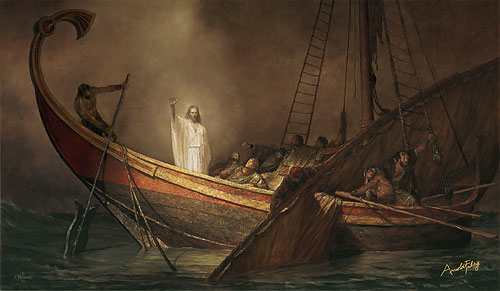
Peace be Still by Arnold Friberg

“Peace, be still,” by Arnold Friberg

The tragic mass shootings in El Paso and Dayton have many Americans on edge, as they struggle to understand what is causing it all. Sadly, such tragedies have become common in our country. The public and government responses to these shootings are predictable: the left calls for stricter gun control laws, while the right emphasizes the Constitutional right to bear arms and attributes the shootings to mental health problems. Unfortunately, most Americans fail to recognize the root cause of the problem. Why is this?  Perhaps it’s because we live in a country where, for many, the idea of good and evil has become an archaic concept, something associated with ancient religious superstitions.   

The Rev. Canon Phil Ashley of the American Anglican Council explained it like this. We face a culture that is “…increasingly shaped by the forces of aggressive secularism, moral relativism, religious pluralism, individual autonomy and a utopian hope in secular authority.” As more and more Americans push God out of their lives, social, cultural and spiritual chaos is filling the vacuum. When a country or society pushes God out, it opens the door for the enemy to come in. 1 Peter 5:8 says, Satan “…prowls around like a roaring lion looking for someone to devour.” Those lacking a solid spiritual foundation very easily become his prey. Yes, evil is real.

Chaos often breeds isolation, which for some people means empty lives nearly devoid of human contact. Isolated and confused, they might seek meaning in their lives through narcissism—an egoistic admiration of one’s self, which is a form of idolatry. Narcissism is easily fed through social media, where one can simply manufacture a false persona in an effort to gain approval from others.

Over prolonged periods, isolated individuals can  become enveloped by darkness.  Some may seek meaning or self-purpose through infamy—mass shooters are not soon forgotten.  Mass shootings are only one symptom of the problem however. It manifests itself in many other ways, including drug and alcohol addiction, pornography addiction, child abuse, human trafficking, suicide and countless others.

To begin to fix the problems in America, we don’t need more laws or more gun rights.  We need a spiritual revival of our Judeo-Christian roots. Dr. Jack Graham, the pastor of the Prestonwood Baptist Church in Plano, TX explains it like this, “All of us are involved in some kind of a spiritual battle—a warfare that’s going on increasing.  A battle that is getting hotter and hotter right now and predictably so.  In fact, the Bible tells us that in the final hours of human history that perilous times will come.  Difficult dangerous times will come.” Dangerous times are not exclusive to American Christians.  Persecution of Christians because of their faith is running rampant around the globe.

Of the shootings in El Paso and Dayton, the Rev. Franklin Graham wrote, “The Word of God tells us to ‘mourn with those who mourn,’ and that is what our nation is doing. We grieve the tragic and devastating loss of life in El Paso and Dayton this weekend. The number of victims of the mass shootings is much higher than the headlines reveal, because each mother, each father, each sister and brother, each wife and husband, is also a victim—a victim of the heinous and senseless evil unleashed by two murderous gunmen. Their loved ones have been stolen from them.” And “”As we mourn with these families and communities, let’s continue to sincerely lift them up in prayer before the Lord.” Despite what some politicians have said, prayer is a proper response to mass shootings.

Fortunately, Christians needn’t despair at what they see happening around them. They can be confident that God is in control of their lives, even when the world appears to be coming apart all around them. Throughout the scriptures Jesus remains as solid as a rock. We see this vividly portrayed in Mark chapter 4, when Jesus and His disciples are on a boat in the midst of a terrible storm. Jesus is asleep on a cushion when his frightened disciples wake Him, fearing they are about to perish. Jesus rises and speaks the words the simple words, “Peace, be still.”  Immediately, the wind ceases to blow and the water grows calm. His disciples then marvel that even the wind and the sea obey Him.    

The same Jesus who calmed the storm is in control of our lives today. Hebrews 12:28-29 says we live in an unshakeable kingdom. “Therefore, since we are receiving a kingdom that cannot be shaken, let us be thankful, and so worship God acceptably with reverence and awe, for our God is a consuming fire.”  

Christians have nothing to fear in the midst of today’s chaos.  As the late Rev. Dr. Billy Graham said, “I’ve read the last page of the Bible. It’s all going to turn out all right.” Christians need only do their best to imitate the life of Christ. God will take care of the rest.

Messy Christianity

Soup Kitchen

Many Christians love their big, opulent church buildings. They can be quite impressive, especially older ones that are massive relics of past centuries. Standing inside a pristine, beautifully ornamented Gothic cathedral can certainly give one a sense of awe. They’re a wonderful place in which to worship God.

The entire world was recently shaken by images of the beloved Notre Dame Cathedral on fire in Paris. Notre Dame is now closed for who knows how long, as the French government and people begin the long process of rebuilding. The church building is a mess.

Christianity is a messy business—in many ways messier than the scorched interior of Notre Dame.  In John 14:12, Jesus tells us, “Very truly I tell you, whoever believes in me will do the works I have been doing.”  Acts 10:38 tells us Jesus “went around going good.” As Christ’s disciples, we are to follow his example of doing good. Good works are not a condition for salvation. Salvation is a free gift for those who put their faith in Christ. But as the Book of James tells us, works are a manifestation of Christ’s love that is in those who put their faith in Him. 

We are to follow Christ’s example.  Matthew 9:35-38 says:

“Jesus went through all the towns and villages, teaching in their synagogues, proclaiming the good news of the kingdom and healing every disease and sickness.  When he saw the crowds, he had compassion on them, because they were harassed and helpless, like sheep without a shepherd.  Then he said to his disciples, “The harvest is plentiful but the workers are few.  Ask the Lord of the harvest, therefore, to send out workers into his harvest field.”

Jesus is the Lord of the harvest. The harvest he is speaking about has many faces including the sick and suffering, people in trouble, those who don’t know Christ and many others. They all need caring, compassionate Christ-believers who care about the wandering sheep.

Unfortunately, many Christians are too comfortable in the places where they currently are in their faith journey; perhaps they attend church regularly, give money to the church; and participate in church social events. They enjoy this and aren’t eager for change. People in this condition can find it difficult to reach out to the sheep of Jesus’ flock. In his video series on the Good Samaritan, Christian author Rev. John Ortberg likens this to someone sitting on a comfortable bench in a beautiful park—a place one doesn’t want to move from.

Christians who find themselves in such a comfortable condition today but recognize the need for change can rise from their bench in small steps.  It might mean spending a weekend working on a church project with a group of volunteers, inviting a new family on the block over for dinner, visiting a church member in a hospital or nursing home, or leading a Bible study. Taking such baby steps isn’t very messy, but it helps prepare one for Christ’s messy work.

Messy Christianity requires getting one’s hands dirty in both the figurative and literal sense. It’s found in places like soup kitchens and homeless shelters, getting involved in helping someone  who is being physically or mentally abused, inviting someone on the down and out into your home for awhile, giving someone in need a loan with no expectation of being repaid, or traveling to distant places to perform mission work such as flood or hurricane relief. It often requires taking personal risks and/or experiencing considerable discomfort.

Early Christians in Rome were noted for fearlessly caring for the sick and diseased. Many non-Christian Romans admired the Christians’ selfless acts. The Western Emperor Constantine the Great decriminalized Christianity in 313 AD by issuing the Edict of Milan.  Ten years later Christianity became the official religion of Rome. This occurred through a different kind of revolution marked not by violence and warfare, but by countless acts of Christian love, charity and sacrifice.

The Rev. Ken R. Klaus, Pastor Emeritus of the Lutheran Hour said, “All too often the job of reaching others is left to others. That can be unfortunate. After all, there are times when you may be the best person to reach someone who is lost or wandering.” You don’t have to be an evangelist or great orator to succeed either.  All you need do is open the door for the Holy Spirit to begin His work in another person’s life. Share your joy!”

If you believe in Jesus, you are not to spend all your time in the calm waters just inside the harbor, full of joy, but always tied to the dock. You have to get out past the harbor into the great depths of God, and begin to know things for yourself. –Oswald Chambers

*Note: all Bible references are NIV.

Easter 2019

hand-drawn-he-has-risen-luke-24-6-text-on-white-vector-20468630

The Seven Penitential Psalms


Saint Peter in Penitence by El Greco

St. Peter in Penitence, El Greco, (ca. 1580)

We are currently celebrating the church season of Lent, a 40-day period before Easter when Christians reflect upon the passion and sacrifice of Jesus Christ, who was crucified and died as atonement for our sins, setting believers free from sin and death. Easter celebrates Christ’s resurrection from the dead and the promise of eternal life for His believers.  Penitence, a solemn contemplation of one’s sins and request for God’s forgiveness, is foundational to Lent.

One Lenten discipline that I recommend is the prayerful reading of the Seven Penitential Psalms—Psalms 6, 32, 38, 51, 102, 130 and 143. These psalms (prayers) are generally attributed to David.  Psalm 51 is probably the most widely read of the seven. In Anglican and Catholic traditions, it is often recited by congregations on Ash Wednesday and at other times during the Lenten season.

Christian tradition suggests several possible reasons behind the writing of these psalms. Probably the most widely accepted explanation is they were King David’s prayers of repentance for his sins against Uriah and Uriah’s beautiful wife Bathsheba. David’s sinful lust for Bathsheba drove him to conspire to have Uriah killed in battle. With Uriah out of the way, David took Bathsheba for his wife.  She conceived and bore a baby son, but the child died shortly after birth.  Recalling the words of condemnation delivered to him by the prophet Nathan regarding David’s sin with Bathsheba (2 Samuel 12: 4-7), David believed the baby’s death was God’s punishment for his transgressions. Nathan said to David:

“Now a traveler came to the rich man, but the rich man refrained from taking one of his own sheep or cattle to prepare a meal for the traveler who had come to him. Instead, he took the ewe lamb that belonged to the poor man and prepared it for the one who had come to him.”David burned with anger against the man and said to Nathan, “As surely as the Lord lives, the man who did this must die! He must pay for that lamb four times over, because he did such a thing and had no pity.”  Then Nathan said to David, “You are the man! (NIV)

Another Christian tradition associate’s the Seven Penitential Psalms with the Seven Deadly Sins. We first encounter the Seven Deadly Sins in the writings of Pope Gregory I around the year 600.  The sins are pride, greed, lust, wrath, gluttony, envy, and sloth.

The writings of  French Roman Catholic theologian Cardinal Pierre d’Ailly (1351-1420) associates certain spiritual virtues with the Seven Penitential Psalms: Psalm 6, fear of punishment; Psalm32, sorrow and confession for sin; Psalm 38, hope;  Psalm 51, love of purity and mercy; Psalm102, longing for heaven, Psalm 130, distrust of one’s own strength and hope for mercy; and Psalm 143: joy.

During this year’s season of Lent, I’ve committed to prayerfully reading the Seven Penitential Psalms daily as part of my morning devotion.  It has been a deep spiritual experience, one that I plan to make part of my future Lenten discipline.  I encourage readers to give this a try.  You can find the Seven Penitential Psalms online at the following URL:

http://www.usccb.org/prayer-and-worship/liturgical-year/lent/seven-penitential-psalms-songs-of-suffering-servant.cfm

A Balanced Life

Wheel of Life

The wheel of life graphic above is a tool I used a lot in my past life as a Management Consultant. The purpose of the wheel is to illustrate that people need to balance their activities/involvement in the six life areas depicted in the outer ring of the wheel. If any of these areas is neglected or over-indulged, the wheel (and ergo one’s life) becomes out of balance, which can result in a multitude of personal problems.

Looking at the wheel, some might be inclined to argue that it’s impossible to put too much emphasis on one’s spiritual life. However, renowned Scottish Theologian Oswald Chambers would disagree.  Chambers said:

 Days set apart for quiet can be a trap, detracting from the need to have daily quiet time with God. That is why we must “pitch our tents” where we will always have quiet times with Him, however noisy our times with the world may be. There are not three levels of spiritual life— worship, waiting, and work. Yet some of us seem to jump like spiritual frogs from worship to waiting, and from waiting to work. God’s idea is that the three should go together as one. They were always together in the life of our Lord and in perfect harmony. It is a discipline that must be developed; it will not happen overnight. Oswald Chambers, My Utmost for His Highest

Chambers would agree that days set apart for quiet time, such as for church retreats, spiritual renewal weekends, and even weekly worship services are all good. However, he would caution against letting these become one’s focus for spiritual rejuvenation. These days that are set apart are special times on the “mountain top” when we can see the transfigured Christ in all of his glory. They’re highly spiritual experiences that one hates to see end. 

On the other hand,   Chambers strongly advocates for daily quiet time when one enters God’s “throne room” and learns to commune with God not on the mountain top, but while walking through the demon infested valley below.  Daily quiet time with God is obedience to John 15:4-5 (NIV), which says:

Remain in me, as I also remain in you. No branch can bear fruit by itself; it must remain in the vine. Neither can you bear fruit unless you remain in me. I am the vine; you are the branches. If you remain in me and I in you, you will bear much fruit; apart from me you can do nothing.

The website Vibrant Christian Living recommends three secrets to a daily quite time habit:

#1: Do your quiet time first thing in the morning.  With all the distractions in our lives, this can be difficult, but it will pay big dividends.

#2: Start small and let your quiet times with God Grow.  Quite time is a spiritual discipline that can grow in depth as we become more mature in Christ.

#3: Make your quiet time with God about a life rhythm, not a religious schedule. Focus on how to make quiet time a regular part of your ever changing life. Sometimes you’ll fail, but God is quick to forgive when we ask him.

Worship the Lord with gladness; come before Him with joyful songs.
Know that the Lord is God. It is He who made us, and we are His;
we are His people, the sheep of His pasture.

Enter His gates with thanksgiving and His courts with praise;
give thanks to Him and praise His name.

Psalm 100:2-4 (NIV)

My Superhero

Superheroes

Superheroes are all the rage these days.  They’re winning at the box office with blockbuster movies like “Wonder Woman,” “Black Panther”  “Aquaman” and yet another new episode in the Spiderman series.  Older superheroes like Superman and Batman remain tremendously popular too.

With Christmas approaching, the aisles of toy stores and toy departments are lined with superhero kitsch, mainly over-hyped, over-priced superhero-themed stuff that will make the kiddies giggle on Christmas morning and eventually be tossed into a corner with a dozen similar forgotten toys.  Superhero figures also fill the pages of comic books; some of these books are sold for incredible amounts of money—literally worth their weight in gold.

Many adults and kids alike are attracted to these imaginary superheroes, yet they pay little attention to a real superheroes in their midst.  This superhero is powerful.   He is fearless and always defeats his many enemies.  He never makes mistakes. He can’t be outsmarted. He never tells a lie. He is a clear thinker and never loses his cool. Millions of people have purchased figurines of the real superhero.

So far the real superhero sounds about the same as the imaginary ones doesn’t he?  However, there are really many differences between my superhero and the imaginary ones.

Unlike the imaginary superheroes, my superhero isn’t handsome.  According to one writer, there’s nothing about his appearance one would find particularly attractive.  The same writer described my superhero as a sad man. He doesn’t sound very exciting or charismatic does he?   

My superhero did the unthinkable.  He surrendered to the enemy!  Only a short time after his surrender he was violently put to death and buried in a tomb.  End of story?  Not quite!

My superhero has performed many miracles. He turned plain water into wine and controls all of nature. He gives sight to the blind and makes the lame walk again.  He can control the wind and the sea, calming storms and raging waves. He can walk on water. 

Headline:  Man surrenders himself in exchange for hostages.  Billions saved!

Yes, my superhero surrendered to the enemy, but it was done voluntarily. He freely sacrificed himself to free billions of hostages.  He was put to death by the enemy, but he rose from the dead after three days and now lives forever.  He has already raised men from the dead and will raise many more in the future. 

My superhero doesn’t wear a mask, he wears a golden crown.  He has been called the King of Kings, Lord of Lords, and the Prince of Peace. He is Immanuel—God with us, fully man and fully God! His name is Jesus. During this period of Advent Christians around the world reflect on the promised return of their Savior.  The book of Revelation describes him like this:

I saw heaven standing open and there before me was a white horse, whose rider is called Faithful and True. With justice he judges and wages war. His eyes are like blazing fire, and on his head are many crowns. He has a name written on him that no one knows but he himself. He is dressed in a robe dipped in blood, and his name is the Word of God.  –Revelation 19:11-13 (NIV)

The first chapter of the Gospel of John tells us that Jesus, the “Word of God” is the author of all creation.  All things were made by Him: 

In the beginning was the Word, and the Word was with God, and the Word was God. He was with God in the beginning. Through him all things were made; without him nothing was made that has been made. In him was life, and that life was the light of all mankind.  The light shines in the darkness, and the darkness has not overcome it.  –John 1:1-5 (NIV)

Darkness has never overcome my superhero and it never will.  He cannot be defeated.  Jesus sacrifice of himself defeated sin and death forever.  Jesus offers redemption freely to those who claim him as savior. His story is told in this passage of the Nicene Creed:

We believe in one Lord, Jesus Christ,

the only-begotten Son of God,

eternally begotten of the Father,

God from God, Light from Light,

true God from true God,

begotten, not made,

of one Being with the Father;

through Him all things were made.

 For us and for our salvation He came down from heaven,

was incarnate from the Holy Spirit and the Virgin Mary,

and was made man.

 For our sake he was crucified under Pontius Pilate;

he suffered death and was buried.

 On the third day He rose again in accordance with the Scriptures;

He ascended into heaven and is seated at the right hand of the Father.

 He will come again in glory to judge the living and the dead,

and his kingdom will have no end.

Now that’s what a real Superhero looks like!

…to him who loves us and has freed us from our sins by his blood, and has made us to be a kingdom and priests to serve his God and Father—to him be glory and power for ever and ever! Amen.  –Revelation 1: 5b-6 (NIV)

Taming the Tongue

Politician yelling cartoon

Note:  all Bible quotes are taken from the NIV.

The single most important rule for Christians who are public figures is “behave like Christians.” This is especially true for elected officials, of whom former slave and abolitionist Frederick Douglass once said, “Between the Christianity of this land and the Christianity of Christ, I recognize the widest possible difference.” Douglass was talking about the institution of slavery in America, but his words still ring true when it comes to American politics today.

Christianity is damaged when politicians claiming to be Christians don’t act like it. Probably the worst examples are ad hominem attacks on political opponents.  Christian politicians would do well to stick to criticizing their opponents’ policies and dispense with character assassination.

Christian politicians needn’t look far for advice; they can simply open their Bibles. Jesus told Pontius Pilate in John 18:36, “My kingdom is not of this world.” This is great wisdom reminding all Christians that we (including politicians) answer to a higher authority.  In 1 Kings 22, the story is told of the time the king of Israel had to decide whether or not to go to war against Syria. Jehoshaphat, the king of Judah, advised his fellow ruler, “First seek the counsel of the Lord” before making a decision (verse 5). This is sound advice that Christian politicians would do well to take to heart. Seek God’s guidance before seeking the guidance of man.  They should also note Matthew 5:16, “…let your light shine before others, that they may see your good deeds and glorify your Father in heaven.”

Many politicians seem to blurt out whatever comes to mind at the moment, without thinking things through. Then they often have to “walk back” their comments, leaving themselves open to criticism of being flip-floppers, liars racists and worse.  One of my former U.S. Army battalion commanders liked to remind his officers, “Engage your brain before operating your mouth.”

Ecclesiastes 5:2-3 says it even better: “Do not be quick with your mouth, do not be hasty in your heart to utter anything before God.  God is in heaven and you are on earth, so let your words be few. A dream comes when there are many cares, and many words mark the speech of a fool.”

Many politicians are too quick to become angry at comments from their opponents.  Proverbs 12:16 says, “Fools show their annoyance at once, but the prudent overlook an insult.”  Don’t be thin skinned!  Proverbs 17:27 says, “The one who has knowledge uses words with restraint, and whoever has understanding is even-tempered.”

I offer all politicians a final word of advice from Ecclesiastes 12:13-14 “Now all has been heard; here is the conclusion of the matter: Fear God and keep his commandments, for this is the duty of all mankind. For God will bring every deed into judgment, including every hidden thing, whether it is good or evil.” Politicians may do as they please for now, but there will ultimately be a day of reckoning.