Archive for the ‘Christian’ Category

Transformed not Conformed

Parthenon

The Parthenon (Temple of Athena) Athens, Greece

The lines between right and wrong are growing increasingly blurry in American society today.  Modern culture encourages us to be more accepting and inclusive. Our elected officials have passed many laws at the national, state and local levels that conflict with a Christian world view. Americans are bombarded with modern culture images, messages and social mores in the broadcast, cable, print and web news sites, as well as on the ever-increasing social media and other Internet websites.   

Despite the rapid social changes and pressures to conform, for matters of Christian faith and living the deciding question remains “what does the Bible say?”  When the Apostle Paul and Silas visited the city of Berea on a missionary journey, Paul preached the Gospel in the local synagogue, where it was received with great enthusiasm. Acts 17: 11 (NIV) says that the Berean Jews “…received the message with great eagerness and examined the Scriptures every day to see if what Paul said was true.” The Bereans recognized the authority of the Scriptures. Acts 17 goes on to tell us that as a result of Paul’s preaching there, many Berean Jews believed, as well as many prominent Greek women and men.

My wife and I are currently participating in a small group study examining the collision of Christian, Jewish, Roman and Hellenistic cultures during the ministry of the Apostle Paul.  Hellenistic culture was the pervasive Greek culture that influenced the entire Mediterranean region during Paul’s time.

Paul’s journeys led him to Corinth, a flourishing, modern Roman colony that Julius Caesar had intentionally populated with second rate Roman citizens, most of whom had failed in life while living in Rome. In Paul’s day, the city was wicked and corrupt, filled with prostitutes, crooks, swindlers and lowlifes. Corinth had a Jewish synagogue and Paul was eager to share the Gospel there.

Paul arrived in Corinth with only the possessions he was carrying.  Shortly after arriving, he met a Jewish, Christian married couple named Priscilla and Aquila. Like Paul, they were tentmakers by trade and they owned a business in Corinth.  They took Paul into their business and invited him to live in their home, where Corinth’s first house church was established. 

Paul frequented the synagogue in Corinth, but met with much resistance from the Jewish leaders.  Growing weary of Paul’s message, these leaders eventually drug him before the local Roman proconsul Gallio in AD 51 and brought a series of charges against him. When Gallio learned that the dispute was about Jewish law and that Paul had not violated any Roman laws, he refused to judge the case and told the Jewish leaders to settle the matter themselves. Paul’s attempt to convert the Corinthian Jews failed.

After this, Paul turned away from the Jews in Corinth and took his message to the local gentiles.  Subsequently, many converted to the faith.  These converts included a high-level Corinthian leader named Erastus. The NIV translation of Paul’s epistle to the Romans refers to him as the “Director of Public Work” in Corinth. After Paul’s eventual departure from Corinth, he wrote to the Corinthian church, telling them that their bodies are temples of the Holy Spirit (1 Cor. 6:19). What a concept for people surrounded by pagan shrines and magnificent Greek and Roman temples!

Paul also journeyed to Athens hoping to spread the Gospel.  Athens was the center of Hellenistic culture, a city full of temples and idols.  There Paul had the opportunity to preach to the Areopagite Council (or Areopagus), a powerful, court-like body made up of Athenian aristocrats.  Despite Paul’s immense knowledge of the Scriptures and his skills in persuasive speaking, he failed to persuade the Areopagus. Paul failed to establish a church in Athens and departed the city in disappointment. 

Like Paul, Christians today will not always succeed against the tide of negative cultural change and influences, but they can remain steadfast in their beliefs without succumbing to cultural pressures. Paul succeeded in forming churches in some places and failed in others, but his approach was always based upon the same foundation—a deep knowledge of the scriptures; reliance upon the guidance of the Holy Spirit; and living in a manner that glorified Christ.

As Christians living in modern American society, we can learn a lot from Paul. We live in a culture filled with idols—people or objects we value more than God.  We may not literally bow down to these idols, but we worship them all the same.  Rather than existing as statues and shrines, today’s idols are more likely to adorn the covers of gossip and fashion magazines, make movies, play professional sports, or work in politics, i.e. modern cults of personality.  Some people idolize inanimate objects like money, expensive cars, exquisite homes, extravagant vacations, or their jobs. Others make idols of wealth, drugs, alcohol, cell phones, social media or Internet porn. I shudder to think what negative effects the advent of the sex robots will have on our culture. 

Today, in a world that’s filled with idols, Paul’s warning to the church in Rome is more relevant than ever:

Do not conform to the pattern of this world, but be transformed by the renewing of your mind.  Then you will be able to test and approve what God’s will is—his good,  pleasing and perfect will.  Romans 12:2 (NIV)

J.B. Phillips’s, author of the bestselling book Your God is Too Small, paraphrases Romans 12:2 like this: “Don’t let the world around you squeeze you into its own mould, but let God re-mould your minds from within, so that you may prove in practice that the plan of God for you is good, meets all his demands and moves towards the goal of true maturity”

Christians must let God’s spirit shape their lives, not the influences of modern culture. Let Colossians 3:12 (NIV) be your guide:

Therefore, as God’s chosen people, holy and dearly loved,  clothe yourselves with compassion, kindness, humility, gentleness and patience.

Christians in the early Church influenced the culture around them because they loved one another and cared for the sick, the homeless, orphans, widows, lepers and other disenfranchised members of society.  The conversion of Rome to Christianity didn’t occur through power and intimidation, but through weakness and self-sacrifice. Think about these words from Paul:

That is why, for Christ’s sake, I delight in weaknesses, in insults,in hardships, in persecutions, in difficulties.  For when I am weak, then I am strong. 2 Corinthians 12:10 (NIV)

Christians in America cannot stem the tide of the negative cultural influences that constantly collide with our lives and Christian world view, but we can focus on the presence of God’s Holy Spirit to shape our hearts and minds. In this politically charged era, we still have certain obligations to our laws and government that we must adhere to as the price for living in this great nation; but as  Jesus said, we must “Render unto Caesar what is Caesar’s, and render unto God what is God’s.”  We must obey the laws of the land and work to change those laws when necessary, but we must not allow our Christian beliefs to be conformed to modern culture. In every situation, remember to ask, “What does the Bible say?”




Too much to pray for!

Prayer

Renowned Scottish theologian Oswald Chambers said, ‘Prayer does not equip us for greater works— prayer is the greater work. Yet we think of prayer as some commonsense exercise of our higher powers that simply prepares us for God’s work. In the teachings of Jesus Christ, prayer is the working of the miracle of redemption in me, which produces the miracle of redemption in others, through the power of God.’

The older I grow, the more it seems like I have more to pray for than I can handle.  Is this is a common dilemma for Christians as they grow older?  I’d like to hear from readers who share the same or a similar problem.  

My prayer list is getting too long to manage.  It includes numerous categories including family (spouse, children, grandchildren, siblings, cousins, aunts, uncles, in-laws and extended family members); friends; colleagues at work; clergy; those persecuted for their Christian faith; my church; my former churches; local leaders; state leaders; national leaders; military service members; and even the abused and missing children on the evening TV network news.  Where should I begin praying on a prayer like this?

 I’ve tried ‘checklist’ praying–simply going down the list and asking God’s blessing for each category, but that feels very hollow. I’ve tried lifting up specific prayers for everyone and everything on the list, but my ability to concentrate usually fails after five or 10 minutes into the prayers.  I’ve segmented my prayers to pray for one category at a time on my prayer list.

When Jesus’ disciples asked him to teach them to pray, he gave them (and us) the ‘Lord’s Prayer’. It’s a beautiful model for praying, but should not be the only prayer we pray; one of the purposes of prayer is simply for us to be with God and to listen and experience the glory of his presence. Our Lord’s prayer goes like this:

Our Father who are in heaven (recognition of God’s supreme authority in all creation),

Hallowed be thy name (affirmation of God’s perfect nature),

Thy kingdom come, Thy will be done on Earth as it is in heaven (a petition for God to restore the perfect order on Earth that he has intended since creation),

Give us this day our daily bread (recognition that God sustains us),

And forgive us our trespasses (a plea for God’s forgiveness through Jesus Christ),

As we forgive those who trespass against us (an acknowledgement that we have all sinned and fall short of the glory of God and a reminder to forgive others),

And lead us not into temptation (a plea to God to spare us from testing, as Job, Jesus and so many Christian martyrs have been tested),

But deliver us from evil (protect us from Satanic forces),

For Thine is the kingdom, and the power, and glory forever, amen (a final acknowledgement of God’s supreme authority in all creation).

The Lord’s Prayer is a beautiful way to begin or end any prayer! 

St. Paul’s epistle to the Romans (8:26-27) tells us, ‘…We do not know what we ought to pray for, but the Spirit himself intercedes for us through wordless groans. And he who searches our hearts knows the mind of the Spirit, because the Spirit intercedes for God’s people in accordance with the will of God (NIV).’  I try to apply this wisdom when I’m feeling overwhelmed.  Sometimes my daily prayer is simply, “Holy Spirit, please pray for me and my family.”  I also pray this prayer for individuals, when I feel troubled about/for them, but I don’t know how to pray for them.

One thing I’ve learned is not to pray too much for myself.  When I do pray for myself, it usually entails asking God for forgiveness.  Psalm 51 and the Lord’s Prayer are my ‘go to’ prayers when I pray for myself. They are more than sufficient!

So how should we pray?  I would love to hear your comments and ideas on prayer. Please consider leaving a comment. 

To Be a Christian without prayer is no more possible than to be alive without breathing.    —Martin Luther

Discipline and Discipleship

Discipline - Boot Camp summer 1975Army Boot Camp, July 1975

It was sunny and warm in Louisville, Ky. on June 28, 1975. That’s the day I boarded a bright yellow school bus at an Army recruiting station for a short journey to Fort Knox, where I was scheduled to undergo Army basic training or boot camp as it’s commonly called. Only a few weeks earlier I’d been a bright eyed college student receiving his associate degree in Munich, Germany.  My mother Phyllis and stepfather Ray were still in Germany—Ray was an Army officer and second in command of a tank brigade in Friedberg, about an hour north of Frankfurt.

I had departed Germany in early June to visit family in my home state Kentucky before attending boot camp.  The last stop was Louisville, at the home of my favorite aunt and uncle, Sarah and Carl.  At the end of that wonderful visit, it was Aunt Sarah who drove me to the induction station and hugged me goodbye as I began a nervous, one hour journey to Fort Knox.

After what seemed like hours, the bus turned into the main gate of Fort Knox. Entering the post felt very familiar, as I’d lived there during my freshman and sophomore years of high school while Ray was assigned to the Armor School. The familiarity helped quell my sense of dread that had been increasing steadily since we departed Louisville. The post was sprawling, hilly and hot. The eclectic mix of architecture ranged from a beautiful state-of-the-art hospital to drab three-story concrete barracks to the low slung, pale yellow wooden buildings dating back to World War II.

About ten minutes after entering the post, the bus turned down a side street and then swung into the parking lot of Delta Company, 13th Training Battalion, 4th Training Brigade, home of the ‘Delta Demons’. Peering out the window I could see two tough looking fellows wearing olive drab fatigues and the iconic Smoke Bear hats that identified them as drill sergeants. Their fatigues were starched stiff with creases that looked sharp enough to slice an apple. They fit like gloves. Their boots were polished to a mirror finish. Not a hair was out of place. All you needed was one look at these impressive gentlemen to know that they were pure badass!

The driver opened the bus door and we were greeted by a booming voice.  ‘Off the bus and line up.  Move it ladies’.  After a clumsy exit fumbling with our bags and bumping into each other, we managed to get into something resembling a line. The empty bus quickly pulled away, leaving us feeling isolated and helpless.  It was then that we were introduced to the two gentlemen who would fill the roles of father, mother, confessor and mentor for all of us in the coming weeks.

Staff Sergeant Hunter, the platoon sergeant, stood about five feet ten inches tall.  He was built like an NFL linebacker. Drill Sergeant Hunter was just tall enough that he could press the stiff brim of his Smoky Bear into the bridge of my nose as I stood at attention while receiving his instructions.  The assistant platoon sergeant, Sergeant Anderson, stood about five feet seven inches.  He was lean, wiry and just mean looking. They immediately commanded our attention.

These fine men, as I would learn they both were, taught us so much: military customs and courtesies; how to wear the uniform and properly groom ourselves; how to spit shine a boot; how to polish brass; how to make a bunk; how to roll our socks and underwear and store them in our lockers; how to make a barracks GI clean; how to get physically fit; how to do close order drill; how to march and sing ‘jodies’, those sometimes naughty songs marching troops sing to help them stay in step; how to fire and clean an M-16 rifle; how to fire M-60 and 50 caliber machineguns; how to fire a recoilless rifle; how to throw hand grenades; how to do fire and maneuver without shooting your buddy; how to take out a pillbox; how to use a field telephone and radio; how to give first aid; and how to doctor blisters on our feet.

But most of all, they taught us about how to be soldiers—about responsibility, self-discipline, and respect for country, Army, unit, comrades, family and ourselves.  At first we listened to them out of fear of punishment. One small misstep could lead to running laps around the compound holding your rifle above your head with two arms while yelling ‘I’m a s#!thead’ or the dreaded ‘Drop and give me fifty’, meaning pushups. Even worse, you could end up pulling ‘KP’ in the mess hall, peeling potatoes, dicing onions and mopping floors.   But there came a point in time when we listened out of a sense of respect for our drill sergeants and our fellow soldiers in the platoon.  In the end, a soldier’s sense of responsibility, respect and self-discipline becomes a normal way of life.

It’s easy to learn military discipline in Boot Camp, where you’re isolated, restrained, focused and under the watchful eye of a drill sergeant.  Sadly, developing discipline in one’s spiritual life isn’t so easy.  I often wonder why this is so.  I was the picture of discipline during my military career, yet my Christian discipline suffers. ‘Disciple’ is the root word of discipline.  A disciple is a student or follower who is trained by a teacher and subsequently spreads the teacher’s beliefs.  I had a lot of training and learning as a Christian, but have I ever really been a disciple?  I think not and I believe I’ve finally figured out why. 

In his book, The Spirit of the Disciplines: Understanding How God Changes Lives, the late Christian scholar Dr. Dallas Willard explains that self-transformation stems, in large part, from the practice of spiritual disciplines.  He cites many disciplines, which he divides into two broad categories of ‘abstinence’ and ‘engagement’.

Under abstinence Willard includes chastity, fasting, frugality, sacrifice, secrecy, silence and solitude. These deal with our physical bodies.  Engagement includes celebration, confession, fellowship, prayer, service, study, submission and worship. These deal with our spiritual lives.  The disciplines are the means to an end; just as we practice to learn a sport, we practice the disciplines to become more Christ-like.  Willard provides many scriptural references to the disciplines in the life of Jesus and the Apostles. The abstinence disciplines focus inward and help build self-discipline and restraint; they are about habits.  The engagement disciplines look outward, helping us become servants of Christ and others; they are about building Christian character.  

Using Willard’s criteria, a quick self-analysis reveals that while I’m strong in the engagement disciplines, I have a long way to go in the abstinence disciplines before I can become a true disciple of Christ.  I have a lot of work to do, but I’m going for it.  How do you measure up? Consider leaving a reply.


Who can you trust?

Trust.jpg

In his popular play All’s Well that Ends Well, William Shakespeare said, “Love all, trust a few, do wrong to none.”  This quote could introduce a number of discussions, but today I want to focus on trust.  The Miriam Webster Dictionary has several definitions of trust.  For this discussion, I’ll focus on the first, which is “assured reliance on the character, ability, strength, or truth of someone or something.”

Think about this question for a minute and then try to answer. Who can you trust?  I’ll bet you didn’t come up with a long list of people. The fact is that most of the people reading this blog aren’t very trusting. According to polls of American voters, trust in the U.S. Congress is running at near all-time lows, as is trust in many state and local governments. 

Much of this distrust is fueled by the pending insolvency of many so-called “trust funds,” like the Social Security “lock box,” which apparently isn’t locked tight enough to keep the Congress from raiding it and depleting the funds. Then there are numerous similar lock boxes at the state and local levels established to fund the retirements of teachers, firefighters and police. It seems that politicians have raided many of these as well, causing some states and municipalities to renege on their retirement promises to employees. 

Trust in amorous relationships is on the rocks. Social media is awash in “cheater” stories and videos.  Videos about catching cheaters in the act have become a popular form of entertainment. Websites with advice on how to cheat on your significant other without getting caught abound.    

You certainly can’t trust a lot information on the Internet. Internet sexual predators take on false identities to try to lure children into sexual encounters.  Internet news sites (and news outlets in general) are awash in so-called “fake news.”  Comparing the story lines of Fox News (right-leaning) and CNN (left-leaning), for instance, gives two very different views of reality.

You can’t trust advertising, especially when it comes to products like weight loss supplements, miracle cures, and get rich quick schemes.  Environmental news is questionable—global warming advocates and so-called global warming deniers are locked in seemingly mortal combat.  Do you have a financial adviser or auto mechanic you fully trust?  Do you have complete faith in your physician or dentist?  Do you trust the attendants in the nursing home that’s caring for your parent? Do you trust the weather forecaster on your TV? Do you even trust the clergyman in the pulpit?

So amidst all this distrust in the world, who can you trust?  The great entertainer Lawrence Welk, who was better known for Polkas than proverbs, might have said it best when he advised, “Never trust anyone completely but God. Love people, but put your full trust only in God.”  Scripture is full of similar advice (references are taken from the NIV):

Proverbs 3:5-6, Trust in the Lord with all your heart and lean not on your own understanding; in all your ways submit to him, and he will make your paths straight.

Micah 7:5-6,  Do not trust a neighbor; put no confidence in a friend.  Even with the woman who lies in your embrace guard the words of your lips. For a son dishonors his father, a daughter rises up against her mother, a daughter-in-law against her mother-in-law—a man’s enemies are the members of his own household.

1 Peter 2:6, For in Scripture it says: “See, I lay a stone in Zion, a chosen and precious cornerstone, and the one who trusts in him will never be put to shame.”

There are many other examples of scripture that speak to trust. The best advice I can provide is to trust in God alone.  Your friends and loved ones will inevitably let you down, but God will never fail you. You can trust me on this! 

Check out this short video – How to trust God.   https://youtu.be/OVDaq-drUh0

Hurry up and slow down!

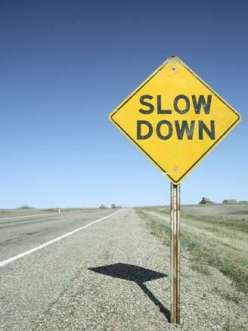
Slow Down

Be still, and know that I am God.  —Psalm 46:10a (ESV)

We live in a world of high-speed escape artists.  Everywhere one looks, people are rushing to and fro to get the next thing on their long list done. When they grow weary, many turn to adrenalin-pumping extremes to “relax.” There is extreme biking, extreme running (Parkour), building- and rock-climbing without safety equipment (free-climbing), half-pipe skiing and snowboarding, and base jumping, which is free fall parachuting from cliffs or high structures.

We watch extreme television entertainment, like American Ninja Warrior and Mixed Martial Arts (MMA) fighting.  If sports is not your thing, there are extreme game shows with names like Wipeout, where contestants crash and burn on crazy obstacle courses, and Fear Factor where contestants, among other feats, eat large volumes of worms and bugs.

Many escape reality through physical addictions, turning to drugs, alcohol or sex to remove them from reality. Others simply unplug from their daily grind, spending long periods of the day disconnected from the world. Video games are one way of escaping reality. The most extreme “unplugging” involves new virtual reality technology.  With this technology, one can don a pair of goggles and be instantly transported to a new 3-D “world.”  Anything goes on these virtual playgrounds, including extreme sports, extreme violence and extreme sexual fantasies.

For some, cell phone addiction provides a different kind of virtual reality.  Have you spoken with someone who constantly looks down at their phone? It’s like they don’t have time for you. It’s annoying, not to mention downright rude.  Or perhaps you’ve observed a family seated in a restaurant waiting for their orders to arrive—everyone is heads down playing with their phone instead of interacting with other family members.  In 2014, Charit Taneja wrote in “The Psychology of Excessive Cellular Phone Use” that:

Cell phones enable behavioral problems and disorders, particularly in adolescents. This fact has become more and more evident in communications media, inspiring new pathologies, such as “Nomophobia” (No-Mobile-Phobia), “FOMO” (Fear Of Missing Out) – the fear of being without a cell phone, disconnected or off the Internet, “Textaphrenia” and “Ringxiety” – the false sensation of having received a text message or call that leads to constantly checking the device, and “Textiety” – the anxiety of receiving and responding immediately to text messages. 

Some people escape auditory reality. In the fitness center where I exercise, about half of the people wear headphones or ear buds while using an exercise bike, treadmill, elliptical machine, stair-stepper or other exercise device. I assume most listen to music, hoping it will carry away them to another, less painful place as they push their bodies to the physical limit.  While such auditory isolation might reduce the agony of a heavy workout, it hinders socializing with others and can even be dangerous. At certain times of the year here in South Dakota it’s a good idea to keep one’s ears peeled for the sound of a tornado warning siren.   

A frantic pace combined with isolation can lead to perilous situations. Anyone who lives in a big city has seen drivers who dangerously weave in and out of traffic, desperately trying to get ahead a couple of car lengths while putting their own and other people’s safety at risk. Many of these drivers have so much on their “to do” lists that feel a need to constantly rush. Others live in their own private worlds where it’s all about satisfying their own needs, with no regard for the needs and safety of those around them.

 Far too often, erratic driving results in road rage.  According to analysis by performed by Trace, an independent, nonprofit news organization dedicated to expanding coverage of guns in the United States, instances of road rage where someone in a car brandished a gun or fired a gun at another driver or passenger more than doubled over the a three-year period, increasing from 247 in 2014 to a high of 620 in 2016.

The high-speed, escape mentality is tearing away the very fabric of our society. We’re becoming a bunch of one-armed jugglers with our eyes and ears covered. It’s easy to get caught up in the race and lose sight of what really matters in life.  Christians aren’t immune to this.  It’s easy to become distracted and let the day slip by without a thought of God.  I think Islam gets it right on one point—stopping to pray five times per day.  Christians would do well to adopt a similar practice. 1 Thessalonians: 5 encourages us to “pray without ceasing.” (ESV)

Psalm 46:10a (ESV) says, “Be still and know that I am God.” God wants us to slow down and focus on him in the midst of our daily hustle.  It’s during times of stillness that we can, if just for a moment, look God in the face and begin to gain a deeper understanding of Him. In Mark 4:39, Jesus is with his disciples in a small boat when a great storm occurs.  The terrified disciples appeal to Jesus to do something to save them.  He utters the simple command, “Peace! Be still.” Immediately the weather becomes calm.

This beautiful story is about much more than Jesus calming the weather.  It is about Jesus giving up a sense of Peace in Him that helps us through the storms that occur in our daily lives. In 1 Kings: 19 (ESV), God speaks to Elijah in “a low whisper.” My advice to you—slow down, be still, unplug, hear God’s whisper, and discover His peace. 

 “Rejoice in the Lord always; again I will say, rejoice. Let your reasonableness be known to everyone. The Lord is at hand; do not be anxious about anything, but in everything by prayer and supplication with thanksgiving let your requests be made known to God. And the peace of God, which surpasses all understanding, will guard your hearts and your minds in Christ Jesus.” —Philippians 4:4-7 (ESV)


Bluegrass in my Blood

Pine Mountain Kentucky

Pine Mountain, Kentucky

I was born in the small town of Harlan, deep in the Appalachian Mountains of southeastern Kentucky. Southeastern Kentucky has close ties to parts of western West Virginia, southwestern Virginia; western North Carolina; and eastern Tennessee.  The entire region has a distinct culture that includes its own spoken dialect, cuisine and music. The mountains, culture and good people living there get in your blood and they’re impossible to forget, no matter how long or far one roams.  The regional music, widely known as Bluegrass, traces its roots back to Ireland, Scotland and England.

I find the music particularly enjoyable.  Bluegrass is notable for its combination of stringed instruments—specifically the banjo, mandolin and fiddle. Acoustic guitar and upright bass are common as well.  The music is also notable for many singers who care more about belting out the lyrics than staying in tune.  My affinity for Bluegrass music is something my wife tolerates, but doesn’t quite understand.  I’m particularly fond of the Bluegrass Gospel subgenre.  I grew up hearing it at home, at church and places all around our home.

Gospel Bluegrass tells the story of Jesus Christ as only mountain people can tell it.   If you’re not familiar with this music, it’s only fitting that I introduce you to it with a piece by Bill Monroe, who is commonly recognized as the “Father of Bluegrass.”  Since this is Holy Week, a good place to begin exploring is:

Were you there (when they crucified my Lord), performed by Bill Monroe.  It describes the feelings that many of the onlookers at Jesus’ crucifixion must have felt.

https://youtu.be/5EHP5Nj2BdE

Power in the Blood, performed by Dolly Parton.  It’s impossible to discuss Bluegrass music without the name of Dolly Parton coming up.  Dolly is a Tennessee girl whose voice is perfectly suited for the genre.  Her song of redemption discusses the power of Jesus’ blood to wash away our sins. “There’s power in the blood of the Lamb.”

https://youtu.be/B1CV-HtsMvc

I’m ready to go, performed by Ricky Skaggs and Kentucky Thunder. Ricky Skaggs, a Kentucky native, is a multi-talented musician with a Bluegrass legacy dating back to the days of Lester Flat and Earl Scruggs.  Skaggs’ group Kentucky Thunder has a powerful, fast-paced style.  The group’s rendition of I’m ready to go is about salvation through Jesus Christ.  I promise it’ll get stuck in our head. “Jesus came in and saved my soul from sin, Hallelujah I’m ready to go.”

 https://youtu.be/pjrJKnVmQwQ

The darkest hour is just before dawn, performed by Emmylou Harris. Alabama native Emmylou Harris has proven herself in a variety of genres, including folk, rock, country and Bluegrass.  She slows down the tempo with a Ralph Stanley salvation song. “Lay down your soul, let Jesus in.”

https://youtu.be/_r0FtxqR9Pc

One can’t listen to Gospel Bluegrass without hearing a song about eternal life in heaven that’s promised to Christ’s believers.  Here are two examples.  The Stanley brothers slow it down with their rendition of Angel Band.   Alison Kraus and Gillian Welch pick it up with I’ll Fly Away.

Angel Band, performed by the Stanley Brothers. “Bear me away on your white wings to my immortal home.”

https://www.youtube.com/watch?v=WIHFxIQfSxc

I’ll fly away, performed by Alison Krauss and Gillian Welch. “Some glad morning when this life is o’er, I’ll fly away, to a home on God’s celestial shore.”

https://youtu.be/sdRdqp4N3Jw?list=PL3BDAEBE555FB3CBF

Go Rest High on that Mountain, performed by Vince Gill, Ricky Skaggs, and Alison Krauss. No discussion of Gospel Bluegrass music is complete without Vince Gill’s epic Go Rest High on That Mountain, a song he penned in response to the death of country music singer Keith Whitley. Gill, an Oklahoma boy, is a talented songwriter, singer and guitarist whose work spans Bluegrass, country and rock.  His Bluegrass skills come out in this performance. “Go to heaven a shoutin’ love for the Father and the Son.”

https://youtu.be/NwFiWCUkk4M

So there you go—my guided tour through some of my favorite Bluegrass music that just happens to be Gospel.  If you’re having trouble deciding how to introduce someone to the Gospel message of Jesus Christ, just head to YouTube, Spotify or one of your favorite streaming services and play them some Gospel Bluegrass music.  “Hallelujah, I’m ready to go!”