Posts Tagged ‘volunteers’

Feed My Sheep

The Good Shepherd (C.1650-60) by Philippe de Champaigne

My recent work with a struggling young man in my community has provided me a stark reminder of the reality of hunger in America. The US Department of Agriculture (USDA) defines food security as “having access, at all times, to enough food for an active, healthy life for all household members.”  According to USDA figures, 10.5 percent of American households in 2019 lacked proper food security. While the government’s 2020 food security figures are not yet available, indications are that this year’s numbers will be much higher.  The primary reason for this is the sharp increase in national unemployment due to the COVID-19 pandemic. As the map below shows, the food insecurity problem is widespread.
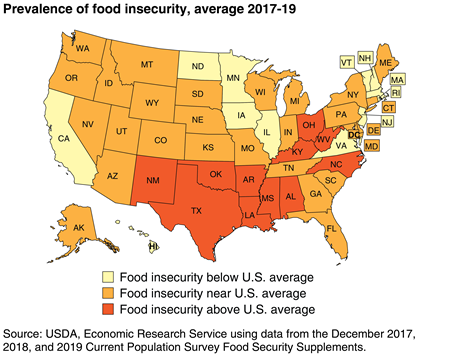
As a state workforce developer in Pennsylvania, I worked with hundreds of clients who had recently lost their jobs.  Food security was often a major concern of these displaced workers. Many had small children at home, making their situations even more dire.  More recently, as a volunteer job coach working with the elderly, I discovered that food security is a major concern for many of my clients. My typical client is age 70 or older, dependent upon a Social Security check of less than a thousand dollars a month as their primary income, and frequently has to decide between purchasing expensive prescription drugs or food, as they lack sufficient income to pay for both with what remains after paying the rent or mortgage.  

While the mission of Christ’s church is to spread the Gospel, it’s difficult to convey the Good News to someone with a growling, empty stomach. Jesus clearly recognized this. By feeding the five thousand in the miracle of the loaves described in John 6, Jesus provided for the physical needs of the crowd.  The very next day, he called Himself the “Bread of Life.” (John 6:35). Clearly, one needs food in the belly in order to be more open to partaking of the Bread of Life.  The level of involvement in feeding the needy varies significantly from church to church.  Many get involved in collecting and distributing holiday food baskets for the needy.  While this is a wonderful thing, such baskets only cover a few days of the annual 365 that people need to eat. Much more is needed.   

Food banks and pantries exist across the country to help support food security. Typically, a food bank supports a region (such as a county), while local food pantries serve small towns or communities within larger towns/cities. According to the non-profit organization Feeding America, a food bank is a non-profit that safely stores thousands to millions of pounds of food for bulk distribution to local food programs, like food pantries. Food banks come in all different sizes. In contrast, food pantries receive food shipments from food banks and run food distribution programs where hungry families can receive food directly. Pantries feed hundreds of people per week! Because every community is different, there are many different types of pantries. It is common for a food pantry to operate from inside a community school or church. Some areas even have mobile food pantries to serve seniors with limited mobility or rural communities with little transportation.  Some pantries require the clients to demonstrate financial need, while others serve anyone who shows up. Some communities also have food kitchens, where the needy can eat a hot, nutritious meal.

Churches and individuals can help their local food banks, pantries and kitchens in a number of ways by donating money and by volunteering their time. Check directly with your local organizations to ascertain the best way to help each. A general rule of thumb is that monetary donations are preferable to food, as it enables the organization to spend where the need is greatest. Another general rule is that volunteers are always needed; this is particularly so during the COVID-19 pandemic.  Many food banks, pantries and kitchens have adopted special precautions for COVID-19.  Those who might wish to volunteer should check with their local organization(s) to determine if they are comfortable volunteering in light of the precautions that have been adopted. In any case, I encourage you to reach out as you can to support food security in America. As James 2:15-16 tells us, “Suppose a brother or a sister is without clothes and daily food. If one of you says to them, “Go in peace; keep warm and well fed,” but does nothing about their physical needs, what good is it?

Jesus feeds the five thousand, John 6:1-13 (NIV).  Some time after this, Jesus crossed to the far shore of the Sea of Galilee (that is, the Sea of Tiberias), and a great crowd of people followed him because they saw the signs he had performed by healing the sick.  Then Jesus went up on a mountainside and sat down with his disciples. The Jewish Passover Festival was near.  When Jesus looked up and saw a great crowd coming toward him, he said to Philip, “Where shall we buy bread for these people to eat?” He asked this only to test him, for he already had in mind what he was going to do.

Philip answered him, “It would take more than half a year’s wages to buy enough bread for each one to have a bite!” Another of his disciples, Andrew, Simon Peter’s brother, spoke up, “Here is a boy with five small barley loaves and two small fish, but how far will they go among so many?”

Jesus said, “Have the people sit down.” There was plenty of grass in that place, and they sat down (about five thousand men were there). Jesus then took the loaves, gave thanks, and distributed to those who were seated as much as they wanted. He did the same with the fish.

When they had all had enough to eat, he said to his disciples, “Gather the pieces that are left over. Let nothing be wasted.” So, they gathered them and filled twelve baskets with the pieces of the five barley loaves left over by those who had eaten.

#SiouxFallsStrong: after the disaster

Tornado - SiouxFallsStrong

Tornado aftermath in Sioux Falls, SD (9/11/2019)

For most Americans 9/11 is an unforgettable date—the anniversary of the horrific terrorist attacks on the Twin Towers of New York’s World Trade Center, and the Pentagon. The residents of Sioux Falls, SD, have a new date to remember—9/10. Just after 11pm on 9/10/2019 a tornado warning was issued by the National Weather Service. Shortly thereafter three tornados touched down in Sioux Falls. They caused extensive destruction of structures, power lines, and trees. Instead of waking up on 9/11 and remembering the terrorist attacks, Sioux Falls awoke to the aftermath of a natural disaster of epic proportions.

For my family it was a good lesson.  After our cell phones began beeping the weather warning, we were too slow taking shelter, choosing instead to gawk at the spectacular storm outside through a patio sliding door. We finally came to our senses when the air rushing around the frames of our very airtight Anderson windows started making a screeching noise and it felt like the glass of the patio door buckled.

Thanks be to God, we only lost a large section of a big birch tree, but were spared damage to our home, despite one of the tornadoes touching down about 200 yards away as the crow flies.  There were also non-tornadic straight-line winds comparable to a Category 2 hurricane recorded. According to meteorologist Jeff Haby (www.theweatherprediction.com), “Straight-line wind is wind that comes out of a thunderstorm. If these winds meet or exceed 58 miles per hours then the storm is classified as severe by the National Weather Service. These winds are produced by the downward momentum in the downdraft region of a thunderstorm.” 

For in the day of trouble he will keep me safe in his dwelling; he will hide me in the shelter of his sacred tent and set me high upon a rock.  –Palm 27:5 (NIV).

The straight-line winds alone were bad enough to cause extensive damage. The tornados were like salt in Sioux Falls’ wounds. It was only by the grace of God that there was no loss of life.  Just a few blocks from our home several small children had to be dug out of the rubble after the roof and walls of their bedroom collapsed on top of them. Miraculously, they were unharmed. An employee of a heavily-damaged pancake restaurant rode out a tornado by hunkering down inside a walk-in freezer. There are dozens of similar survival stories.  

In our neighborhood alone, there were hundreds of trees and large tree limbs down, widespread roof damage, and numerous homes so severely damaged that many of them are likely to be condemned and demolished.  I saw several sturdy steel poles supporting basketball backboards that were bent at right angles by the ferocious winds.

A couple of miles to our east a hospital suffered extensive tornado damage.  Just a couple of miles to the northwest a section of a 41st street business district had an Advanced Auto Parts store totally destroyed, several other businesses severely damaged, and hundreds of structures suffered lesser damage.  

Disasters bring out the best and the worst in people. There was some scattered looting in the aftermath of the storm. A family in our neighborhood removed some valuables from the rubble of their home and locked them in their car—someone promptly broke into the car and helped themselves.  There were also stories of phony building contractors convincing several owners of damaged homes to pay advanced deposits for repairs, only to disappear with the money.

The Lord is good, a refuge in times of trouble. He cares for those who trust in Him,  –Nahum 1:7 (NIV)

While there were some bad actors in the storm’s aftermath, the disaster response was mostly a reminder that despite the bad news we’re bombarded with by the media every day, there are still many kind and loving people in this world. Volunteers armed with pickup trucks, trailers, chainsaws and other essential tools seemed to show up from nowhere and jumped right into the cleanup fray—sympathetic strangers helping the less fortunate.  

While my son-in-law and I were cutting up the downed birch tree in the front yard a nice lady named Deb saw us working.  She stopped her car, got out and offered to help.  We accepted of course and Deb helped turn a four-hour job into two hours. Similar examples occurred across the Sioux Falls area.

By September 12, the response was more organized, with scores of volunteers being directed to individuals in need of help by the local 2-1-1 Helpline. Many Sioux Falls churches provided squads of volunteer to help with the cleanup.  My wife Linda and I participated in a group from own church, Church of the Resurrection Anglican church (www.resurrectionsf.com).

For our initial assignment we were given an incorrect address and ended up helping out at another home that wasn’t on the Helpline list, but definitely needed help. We worked there to clean up yard debris and help cut up a fallen maple tree.  We worked alongside several members of the University of Sioux Falls men’s track team.

Tornado Volunteers

Church of the Resurrection Volunteers

The Church of the Resurrection finished that first house and moved to the location where we were originally intended to help. We made short work of that yard and then helped clear the next door neighbor’s yard.  A local resident with a pickup truck and trailer stopped by and let us load all the tree debris in his trailer.  He hauled the debris to one of several wood chipping sites set up by the city of Sioux Falls. The city’s overall response was fantastic! 

While we were working on these yards a roving patrol from God’s army—the Salvation Army—stopped by and gave us free snacks and cold drinks.  The Gatorade I received was a welcome relief on a warm summer afternoon. I’d seen the Salvation Army at work before, back in 1992 as an Army officer with the 10th Mountain Division doing disaster relief in the wake of Hurricane Andrew in south Florida.  I can’t say enough about the wonderful work they performed then and today.

In the aftermath of this natural disaster #SiouxFallsStrong was born. While this hashtag might seem trite to some readers, it means a lot to many Sioux Falls residents.  Just search for it on Twitter or Facebook to gain some insight to my community’s disaster response!  The true face of Sioux Falls—a thing of beauty—was clearly on display in the aftermath of the three tornados and storms of 9/10/2019. What a blessing it is to live in such a community!

Please lift up Sioux Falls in prayer.  While much has been accomplished in the almost two weeks since the tornados struck, much remains to be done.  The recovery efforts will continue for many weeks to come. Thanks be to God for those who continue to support this monumental effort.