Posts Tagged ‘Gospel’

The Steadfast Disciples

Samaritan woman and the living well

Women serving in church clergy has been a hot topic in the news of late. This is driven by the Southern Baptist Convention’s decision last month to uphold the expulsion of two member churches with female pastors—paving the way to speculation that many more could follow. The churches were Saddleback Church in southern California, and Fern Creek Baptist Church in Louisville, KY. The former is a megachurch, reportedly the largest church in California, that is widely known for its popular cofounder, pastor Rick Warren.  Warren authored the bestselling book The Purpose Driven Life.  Fern Creek Baptist Church has been led by Rev. Linda Barnes Popham for 30 years.

Galatians 3:27-28  …for all of you who were baptized into Christ have clothed yourselves with Christ. There is neither Jew nor Gentile, neither slave nor free, nor is there male and female, for you are all one in Christ Jesus. (NIV)

My aim in writing this piece is not to argue for or against women in the clergy.  I will, however, note that women have historically been an important part of the Christian church from its beginning and they remain so today. 

The Gospels and book of Acts identify many women who were actively involved in the Lord’s ministry.   At the time of Jesus earthly ministry, the Jews regarded a disciple as one who followed the teachings and lifestyle of a particular Jewish rabbi (teacher). Listed below are some notable women followers of Christ.  I believe all can accurately be described as Christ’s disciples.

  • Mary Magdalene, or Mary of Magdala as she is sometimes called, is one of the most prominent female disciples of Jesus. She is mentioned as being present during Jesus’ crucifixion, burial, and resurrection. She is the first person to witness the risen Jesus and was commanded by Him to tell Jesus’ apostles, His innermost circle of disciples, about Jesus’ resurrection (John 20:1-18). Mary Magdalene is mentioned in all four Gospels (Matthew 27:56, 61; 28:1; Mark 15:40, 47; 16:1-11; Luke 8:2; 24:10; John 19:25; 20:1-18).
  • Mary, the mother of Jesus: Although not specifically referred to as a disciple, Jesus’ mother, played a significant role in His life and ministry. She is present at various moments in the Gospels, including the wedding at Cana (John 2:1-12) and at the crucifixion (John 19:25-27).
  • Samaritan woman by the well – (John 4:1-42). As told in the Gospel of John, Jesus, on a journey through Samaria, stops at a well where he meets a Samaritan woman drawing water. Despite cultural and religious differences, He has a conversation with her, violating Jewish social norms, and revealing His total knowledge of her life. He offers her living water, a metaphor for salvation and eternal life. She recognized Jesus as the Messiah and might even be described as an early evangelist. John 4:30 says, “Many of the Samaritans from that town believed in him because of the woman’s testimony.”
  • Joanna: Joanna is mentioned in Luke 8:1-3 as a woman who accompanied Jesus and the 12 Apostles, providing financial support for their ministry. She is described as the wife of Chuza, Herod’s household manager.
  • Susanna: Susanna is mentioned along with Joanna in Luke 8:1-3 as one of the women who supported Jesus and the disciples in their ministry. However, little else is known about her.
  • Salome: Salome is mentioned in Mark 15:40 as one of the women who witnessed Jesus’ crucifixion. She is also mentioned as being present during Jesus’ burial and is among the women who discovered the empty tomb (Mark 16:1).
  • Martha and Mary: Martha and Mary are sisters mentioned in Luke 10:38-42 and John 11:1-44. They, along with their brother Lazarus whom Jesus raised from the dead, were close friends of Jesus; He frequented their home in Bethany. Martha is depicted as a diligent worker busy with serving others, while Mary is seen as a devoted listener to Jesus’ teachings.
  • Tabitha (also known by her Greek name Dorcas):  Tabitha lived in the town of Joppa by the sea. She is described as a faithful disciple of Jesus who went around doing good and helping the poor.   The Apostle Peter raised Tabitha from the dead after she suddenly fell ill and died (Acts 9: 36-42).

These are just a few examples of women who can rightly be called disciples of Jesus. Their roles varied, but they were actively involved in Jesus’ ministry and played important roles in helping spread the Gospel.

Looking at the roles played by the women above led me reflect on and give thanks for several key women in my family who significantly shaped my personal Christian formation. I was born in the Appalachian Mountains of southeastern Kentucky. My father and most of my uncles were World War II veterans. For the most part, mountain men worked while women stayed home to raise kids and manage the household. It was a maternally-centered culture. All the ladies below played instrumental roles in raising me.

Granny Myrtle: my maternal grandmother was born in 1900 in southwestern Virginia, near the town of Rose Hill. She had an 8th grade education which was typical for the time and place she was born. A Southern Baptist, Granny was a Bible scholar and memorized hundreds of Bible passages. She read me Bible stories at bedtime and taught me to pray. She cared for me in her home during school summer recess. She loved to witness for Christ and helped lead many people to accept Jesus as their personal savior, including me.

Mother Phyllis: my mother was born in Wallins Creek, Kentucky, a small town deep in the Appalachian Mountains. Her family lived in a large beautiful log home by a creek. She and my father Jack divorced when I was six years old. Following the divorce, mom worked as a nurse’s aide and put herself through night classes at the University of Louisville, eventually earning certification as a medical technician and landing a good job in the Veterans Administration medical system. She taught me the importance of worshipping regularly and ensured that I attended Sunday school, worship services on Sunday mornings and evenings, prayer meetings on Wednesday evenings, and Vacation Bible School in the summer. She lived a life of selfless sacrifice, ensuring our basic needs for food, clothing and shelter were always met, no matter how hard she had to work.   

Aunt Sarah: my mother’s sister Aunt Sarah was always there for me, along with her husband, Uncle Carl. Their home was a second home to me and a place of refuge at times when my working mother wasn’t available to solve my “crisis du jour.” Aunt Sarah had three miscarriages and was never able to have children of her own, but she mothered me continually.  She took me to church and told me Bible stories. She gifted me a plane ride on my 8th birthday—it was my first. Aunt Sarah suffered from multiple sclerosis for over 60 years, but I never heard her complain about it. She taught me love of family.

Aunt Betty: my mother’s sister, Aunt Betty lived in a small town in northern Alabama together with Uncle John and my cousins John III, David, and Philip. Philip and I were only a year apart in age. We fished, swam, biked, and played games together. Over a period of about six years, I visited every summer, staying 2-4 weeks. Having me there during school summer recess was a great help to my divorced, working mother. Aunt Betty was a stern but loving disciplinarian who ran a tight ship. She made sure the family went to church on Sundays. She taught us cousins to make our beds, dust our rooms, clean our shoes, clear dishes from the dinner table. Moreover, she taught us self-discipline, something that was invaluable during my military career.  

Wife Linda: Linda and I met in college in Munich, Germany, exactly 50 years ago next month. I was just shy of my 18th birthday.   We’ve been together ever since. She never ceases to amaze me. Throughout my 24-year military career, she was my strong right arm and remains so today. Linda is a powerful example of faith and peace in the midst of spiritual storms. She is a fountain of generosity and has a servant’s heart. She is blessed with an abundance of common sense and the gift of discernment. I thank God for bringing us together. (Proverbs 31:10-31)

All these women had several traits in common, including a love of God, a daily walk with Jesus, and an unconditional, steadfast love for me. By the grace of God, the man I am today is due, in large part, to the love, teaching, and care I received from these steadfast disciples of Christ. I couldn’t have made it this far without them.

“…nor is there male or female, for you are all one in Christ Jesus.”

Note: I used ChatGPT AI to research some of the Bible passages mentioned in this piece. I typically use BibleGateway. The AI was much faster, but I can’t vouch for its accuracy.

Do not let your hearts be troubled

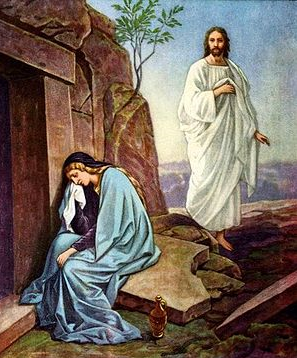
Jesus Watches Mary of Bethany Weeping at His Tomb

In John 14, Jesus’ disciples are troubled by the Lord’s words and behavior.  In John 13, Jesus washes His disciples’ feet and tells them that one who wishes to be a leader must be the servant of all.  He informs them that he is going away to a place where they cannot follow, foreshadowing his crucifixion, death and resurrection. Jesus tells them that one of the disciples will betray him. Finally, he tells Peter that he will deny Jesus three times. By this time, all the disciples are pretty shaken.  But next Jesus reassures and comforts them saying, “Do not let your hearts be troubled” (John 14:1) *.  He then goes on to explain that He is going away to prepare a place for them in heaven.

Such comforting words are needed today. The entire country is politically supercharged over the upcoming election.  Harsh words are spoken on both sizes of the aisle. Violent protests fill the streets of many major cities nightly. I continually hear people from the left, right, and middle expressing fears and worries over the future of America. This shouldn’t be a concern for Christians.

Here’s a news flash. The upcoming election has already been decided. The future of America has already been decided. Despite the hate and chaos, God’s divine plan is unfolding just as he wills it. The Father’s plan for Christ followers is the same as Jesus plan for His disciples.  He is preparing a place for Christians in Heaven. This plan was established before the Earth was created. It may seem to sometimes that God is moving slowly, but he isn’t.

But do not forget this one thing, dear friends: With the Lord a day is like a thousand years, and a thousand years are like a day. The Lord is not slow in keeping his promise, as some understand slowness. Instead he is patient with you, not wanting anyone to perish, but everyone to come to repentance. –2 Peter:8-9

Time is a perception that humans use to help wrap their minds around what occurs in life, but time is meaningless to God.  We see this clearly in Exodus 3:14, when God tells Moses that God’s name is “I am.”  We see this in Revelation 1:8, “I am the Alpha and the Omega,” says the Lord God, “who is, and who was, and who is to come, the Almighty.”  Mike Bennett, who writes for the Christian website Life, Hope and Truth, explains it like this:

The Bible tells us God “calls those things which do not exist as though they did” (Romans 4:17). In other words, God’s plans are so sure that it is as if they had already happened. So, when the One who became Jesus Christ volunteered to die for our sins from the foundation of the world (Revelation 13:8), it was as if He had already been slain. Jesus also described other things that were planned “from the foundation of the world,” and they are just as sure. “Then the King will say to those on His right hand, ‘Come, you blessed of My Father, inherit the kingdom prepared for you from the foundation of the world’” (Matthew 25:34).

“My spirit shakes with terror. How long God, how long? from Psalm 6

Rest assured that God is in control and nothing can change that. No matter what appears to be happening, God’s divine plan is unfolding just as He conceived it before creation. For many this is a difficult concept to grasp. Jesus is the key to God’s plan.  This is stated plainly in John 1:1-5, where John describes Jesus like this: “In the beginning was the Word, and the Word was with God, and the Word was God. He was with God in the beginning. Through him all things were made; without him nothing was made that has been made. In him was life, and that life was the light of all mankind. The light shines in the darkness, and the darkness has not overcome it.

If you are a Christian and find yourself fretting over the coming election or other events occurring in the nation, I encourage you to read (or reread) the Gospel of John.  I guarantee you will find great comfort in its words.  Even if you are not a Christ follower, I encourage you to read the Gospel of John and carefully consider its words, for it is a guide to eternity.

“Lord, to whom shall we go? You have the words of eternal life.” –John 6:68.

* All Bible passages are NIV.

Simplifying Life: the Pareto Principle

Pareto Principle

When I was working as a management consultant, one of my favorite lessons to convey to clients was the Pareto Principle, which is also known as the 80-20 Rule.  The principle was named for the 19th century Italian economist Vilfredo Pareto, who observed that an 80-20 percent relationship applied to many practical aspects of life. For instance, about 80 percent of nonprofit donations come from 20 percent of the donor base.  About 80 percent of sales come from 20 percent of your client base. 

The application of the 80-20 Rule I most like is that about 80 percent of the work on a project is accomplished through 20 percent of the effort.  For example, if it takes five hours to detail a car, you can finish 80 percent of the job in about an hour.  The remaining 20 percent of the tasks will take four hours to complete.  The lesson learned is that if you can accept something less than perfection in a practical task like vacuuming your house or maintaining your lawn, you can save yourself a lot of time and significantly simplify your life.

The Rev. Dr. Alexander Whyte (1836-1921), was a popular Scottish theologian in his day.  His biographer, G.F. Barbour tells an interesting story about Whyte’s encounter with a particular female parishioner who told him, “Dr. Whyte, I just love being in your presence. You are so saintly.”  Whyte replied, “Madam, if you could look into my soul, what you would see would make you spit in my face.”

While the Pareto Principle has many practical applications in everyday life, Rev. White knew that when it comes to God, giving 20 percent of yourself is not enough.  Whyte understood what Jesus means in Matthew 10:37-39 when he says, “Whoever loves father or mother more than me is not worthy of me, and whoever loves son or daughter more than me is not worthy of me. And whoever does not take his cross and follow me is not worthy of me. Whoever finds his life will lose it, and whoever loses his life for my sake will find it.” (ESV) 

Jesus wants all of you—not 20, or 80, or even 99 percent of you.  He makes this clear when He tells his disciples “If anyone would come after me, let him deny himself and take up his cross and follow me.  For whoever would save his life will lose it, but whoever loses his life for my sake will find it. For what will it profit a man if he gains the whole world and forfeits his soul?” (Matthew 16:24-26, ESV)

It’s easy to give part of yourself to God.  You can attend church every Sunday, pray to Him every morning, and tithe 10 percent of your income. Outwardly you might appear saintly, as the Rev. Whyte appeared to his parishioner, but God sees inside us all.  Scottish Theologian Oswald Chambers said, “We are only what we are in the dark; all the rest is reputation. What God looks at is what we are in the dark—the imaginations of our minds, the thoughts of our heart, the habits of our bodies; these are the things that mark us in God’s sight.”  This is why, St. Paul tells us in Philippians 2:12 (ESV), “work out your own salvation with fear and trembling.”

God wants all of you. Therefore endeavor constantly to place Him first in every aspect of your life. And when you fail, as you inevitably will, seek His forgiveness.  As St. Paul encourages us in 2 Timothy 4:7, continue to fight the good fight.   


Farewell My Friend

Jesus on CrossGreater love has no one than this,  that someone lay down his life for his friends.

                                                                                                                            John 15:13 (ESV)

The digital age we live in is truly amazing. It has enabled me to land two jobs with companies I never set foot in before being hired. In both cases, I was recruited online, interviewed by phone and hired sight unseen.

I worked a total of over seven years in these positions, all the while communicating via email telephone and Skype and exchanging data through encrypted virtual private networks. I visited each company only once. When I was born in 1955, such technologies existed only in the minds of science fiction writers. Today they’re quite common.

One of the most amazing digital wonders I’ve enjoyed is having cultivated three good friendships with individuals whom I’ve never met face-to-face. I’m not speaking about Facebook friendships either. These friendships are with people whom I’ve shared things about my life and theirs of the sort that can only be shared with people you trust.

I was recently shocked to learn that one of these friends, Bob, has been diagnosed with a terminal form of cancer that will take his life in a few short months.

Bob is a good man who has spent much of his life working to make others’ lives easier.   Sadly, I know that being good isn’t enough. He has not been open to believing the Gospel message and remains to this day an agnostic.

Bob is spending his last days surrounded by family, many of whom practice the Serbian Orthodox form of the Christian faith. Please join me in praying that during this time of transition his heart might be opened to receive Christ, so that in the final hour he might say:

“The time of my departure is at hand. I have fought the good fight, I have finished the race, I have kept the faith. Finally, there is laid up for me the crown of righteousness, which the Lord, the righteous Judge, will give to me on that Day, and not to me only but also to all who have loved His appearing”                                      

                                                                                                                                2 Tim. 4:6-8 (ESV)

Postscript August 3, 2015–my friend Bob Hall passed away peacefully on July 28, 2015.

Stretch Yourself

??????????

“It is perilously possible to make our conceptions of God like molten lead poured into a specially designed mould, and when it is cold and hard we fling it at the heads of the religious people who don’t agree with us.”  —Oswald Chambers

Alison J. Head and Michael B. Eisenberg are the co-principal investigators and co-directors of Project Information Literacy at the University of Washington Information School in Seattle. One of the areas they study is information overload and multi-tasking.

Since 2008 the pair has surveyed over 10,000 college students. One of their most significant findings is that, “Information is now as infinite as the universe, but finding the answers needed is harder than ever.”

In today’s complex, often confusing wilderness of digital information, it’s important that people periodically take time to slow down and think!  Scottish theologian Oswald Chambers said, “Always keep in contact with those books and those people that enlarge your horizon and make it possible for you to stretch yourself mentally.”

I have to agree with his advice. I’ve found that a good way to slow down is to turn off the laptop or smartphone.  Instead, try engaging in meaningful conversations and reading.

My most meaningful conversations usually occur with my wife Linda.  She is one of the smartest people I know. Her logic and ability to find clarity in the midst of confusion have always amazed me. If she were the only person I ever talked with, my life would never lack for interesting, meaningful dialogue.

As for books, it’s hard to know where to begin, but I’d like to suggest a few good ones for Christians hoping to stretch their minds a little.  My top five, in no particular order are:

My Utmost for His Highest, by Oswald Chambers

Oswald Chambers, who died in 1917 at age 43, is widely regarded as one of the most influential theologians of the 20th century. He wrote only three books in his lifetime, but there are many bearing his name.  They are the products of his devoted wife Gertrude, a professional stenographer who recorded all of Chambers’ sermons verbatim in shorthand.

My Utmost for His Highest is a book of daily devotions written by Mrs. Chambers. It draws from dozens of her husband’s sermons. First published in 1924, it is the most popular Christian devotional ever written.  The idea of total abandonment, i.e. completely surrendering one’s life to God, is at the center of its message. As the book’s title suggests, we must strive daily to do our utmost for God.

Chambers said, “We have the idea that we can dedicate our gifts to God. However, you cannot dedicate what is not yours. There is actually only one thing you can dedicate to God, and that is your right to yourself (see Romans 12:1). If you will give God your right to yourself, He will make a holy experiment out of you— and His experiments always succeed.”

The language of the original text is somewhat challenging for modern day readers due to its use of Scottish vernacular. Fortunately, there are versions available in modern English.  Personally, I find that working through the original version simply adds to the exercise of stretching my mind. When read as intended—one short devotion per day—this book will help you stretch yourself for an entire year.

Your God is too Small, by J.B. Phillips

J.B. Phillips was a canon of the Anglican Church.  He died in 1982.  His seminal work, Your God is Too Small, was published in 1952. According to Phillips, from childhood we are taught to package God in a tiny box conforming to our personal beliefs and preferences.  Look for all of the answers and you’ll find them by turning God into something simple and understandable. Phillips calls this “God in a box,” which is also the title of the book’s seventh chapter.

Oswald Chambers cautioned us against such shaping God in our own image, saying, “Our danger is to water down God’s word to suit ourselves. God never fits His word to suit me; He fits me to suit His word.” (Not Knowing Whither, 901 R).

David wrote in Psalm 8, “When I look at your heavens, the work of your fingers, the moon and the stars, which you have set in place, what is man that you are mindful of him, and the son of man that you care for him?”

Your God it too Small leads its readers through a series of intellectual exercises designed to expand their concept of the God who created the universe. If you find yourself marveling at God’s creation, unable to wrap your mind around it all, this book will help you see God in a totally different way.

The Screwtape Letters, by C.S. Lewis

Clive Staples Lewis (1898-1963) is one of the most popular and prolific Christian authors and apologists who ever lived. He penned over 30 books.  Today he is best known for his classic series The Chronicles of Narnia, which have been transformed into an extremely successful series of films.

Originally published in 1942, The Screwtape Letters is arguably the Lewis’s most unusual book.  It is written in the format of a series of letters from an uncle attempting to mentor his young nephew through an important task. This would be nothing unusual, were it not for the fact that Screwtape is a senior demon and servant of Satan.  The letters are written to his nephew Wormwood, a junior tempter.  Wormwood has been given the task of ensuring the damnation of a British businessman who is referred to only as “the patient.”  Screwtape provides his nephew a clear strategy on how to undermine the patient’s faith and lead him into sin.

Lewis’s book is a dissertation on the human condition—a deep analysis of man’s inner makeup, with all of its strengths, frailties, temptations and struggles. Screwtape, through his keen understanding of human behavior, explains to Wormwood the best methods for ensuring the patient’s ultimate demise. The book paints an in-depth picture of spiritual warfare and the ultimate triumph of God.  It is guaranteed to make you think about your own inner self.

Luther:  Man between God and the Devil, by Heiko A. Oberman 

Originally published in German in 1982, this book is considered by many German scholars to be the most comprehensive biography every written on Martin Luther (1483-1546).  Luther was the central figure of the Protestant Reformation and remains one of the most influential theologians in history.

Even without the discussion of Luther, Oberman’s book would be worth reading just for its political, cultural and religious discussion of the Reformation.  However, it offers much, much more. Unlike many Luther biographers before him, Oberman attempts to describe Luther’s thoughts and deeds as something much more than just a medieval German monk who rebelled against the authority of the Catholic Church.

Oberman contends that Luther was convinced of the reality of the devil and viewed his own life as a continuous struggle against evil. (Not unlike The Screwtape Letters).  Luther viewed the world as an enormous battleground where God clashes with Satan. Approaching him from this angle lends a whole new perspective to Luther’s theology. This book is guaranteed to stretch your mind!

Jesus Under Fire: Modern Scholarship Reinvents the Historical Jesus, edited by Michael J. Wilkins and J.P. Moreland

If you’re a middle-aged Christian like me you might recall hearing about a popular movement in the 80’s and 90’s centered on “the quest for the historical Jesus.” The movement, which still has some momentum today, was epitomized by the Jesus Seminar.  The Jesus Seminar was organized by the Weststar Institute in 1985.

According to the institute’s website, its purpose was to, “to renew the quest of the historical Jesus and to report the results of its research to the general public, rather than just to a handful of gospel specialists. Initially, the goal of the Seminar was to review each of the sayings and deeds attributed to Jesus in the gospels and determine which of them could be considered authentic.

The seminar began with a group of 30 Bible scholars, but eventually grew to around 200. Put simply, this movement was an attempt by Bible scholars, not necessarily Christian scholars, to refute the divinity of Jesus Christ by framing him in history as nothing more than a typical, popular Jewish teacher of his day.

Jesus Under Fire is a compilation of essays by eight prominent Christian apologists written to challenge the methodology and conclusions of the Jesus Seminar.  The book’s introduction describes the furor surrounding Jesus:

“Today some people say that Jesus never said most of what is recorded of him in the Bible.  Some pronounce further that Jesus never did most of what the Bible records he did.  They claim that Jesus of Nazareth was a far different figure than church history and the creeds have believed him to be.  Therefore, if we are to be intelligent people, even intelligent religious people, we must not simply accept what the Bible records Jesus claimed for himself and what the early church claimed him to be.  If we are to be truly modern in our religious quest, we must not simplistically hope that Jesus’ actions as they are recorded in the Bible are factual, or that they have any relevance for us today.  Jesus must be stripped of ancient myths that surround him as to what he said and did, so that the modern person can hear his true message.  Jesus must be brought down to earth from the status to which the early church elevated him, so that we can understand who he was as he walked under Palestinian skies and comprehend what, if any, religious relevance he has for us today.”

The chapter titles of Jesus Under Fire describe the authors’ response to the Jesus Seminar:

  • Where do we start studying Jesus?
  • Who is Jesus? An introduction to Jesus studies.
  • The words of Jesus in the Gospels: Live, Jive or Memorex?
  • What did Jesus do?
  • Did Jesus perform miracles?
  • Did Jesus rise from the dead?
  • Is Jesus the only way?
  • Jesus outside the New Testament: What is the Evidence?

This book is for serious mind stretchers only.  It is probably the most difficult book I have ever read…and reread.  I found each of the essays intellectually stimulating—the sort of stuff that makes me go back and reread each paragraph, underlining sentences as I go.  I spent about six months working my way through it the first time…and it was time well spent. I hope you will find it equally as enjoyable.

Give yourself a special gift this Christmas and start reading one of these wonderful books.  You won’t regret it.


Rescue the Weak and Needy

Homeless

 Whoever gives to the poor will not want, but he who hides his eyes will get many a curse.

                                                                                                                                   —Proverbs 28:27

After enduring over 10 years with a dismal economy, many Americans today find themselves in perilous positions far exceeding anything they could have imagined. The middle class is quickly shrinking, leaving a fractured nation that is increasingly becoming a land of haves and have-nots.

The average American family has somewhere around $5,000 in savings, placing them in a position where losing a job can mean losing nearly everything.  Paying big mortgages, which is common for young working couples today, often depends on the salaries of two working spouses. Only two or three missed paychecks can lead to foreclosure! To stay afloat they tap into savings and then into retirement accounts, darkening their prospects for the future while also paying the federal government large tax bills for early retirement withdrawals.

The global economy has given rise to large companies having loyalty neither to their country of origin nor to their employees.   Workers are increasingly becoming disposable commodities that are brushed into the trash bin like rubbish on a picnic table.

Highly educated and experienced working professionals who lose their jobs and end up turning to the government for assistance are common today.  In my job working with the unemployed, I’ve heard far too many lament, “I never imagined that I could end up in this situation.”  This must change.

Churches, especially those in large urban areas, are often unaware of the financial struggles of individuals and families in their area—even when the strugglers are members of the church. Too many churches have lost touch with early traditions.

The scriptures speak frequently about caring for those who share the faith.  This is an essential part of discipleship that helps the church set its own house in order.  In Acts chapter 6, the Apostles appointed seven deacons to assist in the distribution of food to local widows, who were followers of Christ.  James 1:27 tells us,

Religion that is pure and undefiled before God, the Father, is this: to visit orphans and widows in their affliction, and to keep oneself unstained from the world.” (ESV)

Even clearer guidance comes straight from the mouth of our Lord in John 13:34-35:

 “A new commandment I give to you, that you love one another: just as I have loved you, you also are to love one another. By this all people will know that you are my disciples, if you have love for one another.”

Building a healthy church family is essential.  Brett Eastman has served as the small groups champion in several of the largest mega churches in the country including Pastor Rick Warren’s Saddleback Church.  Eastman writes:

“If you want to create a church community that really cares for one another, the best way to do it is through small groups. When small groups become the vehicle for care-giving, the whole church gets involved in sharing one another’s burdens—a much more personal approach than relegating the task to a committee.  The whole congregation should be making hospital visits, taking meals to people when they’re sick or something’s happened, doing childcare when someone’s in crisis and giving money when somebody’s lost a job.”

Small groups in churches set the conditions for encouraging personal intimacy and trust building—essential elements of loving Christian relationships.  Only by sharing our hopes, fears, cares and concerns do we really get to know other believers well.

Small groups also enable churches to develop many outreach ministries. One way to quickly make a difference is by reaching out to Christian charities in your church’s local area.  These organizations are always in need of volunteers, financial supporters, prayer warriors and other resources.  The possibilities are endless. You can’t take care of everybody, but you can take care of somebody.

Look closely and see that behind the face of every downtrodden man and woman is the face of Christ.

                                                                                                                                        –Oswald Chambers

Christians are partly to blame!

St Francis

“Preach the Gospel and if necessary use words.”
                     —Attributed to St. Francis of Assisi

As the book of Ecclesiastes tells us, there is truly nothing new under the sun. Listen to the words of Psalm 12 (NKJV):

Help, LORD, for the godly man ceases!
For the faithful disappear from among the sons of men.
2 They speak idly everyone with his neighbor;
With flattering lips and a double heart they speak.
3 May the LORD cut off all flattering lips,
And the tongue that speaks proud things,
4 Who have said,
“With our tongue we will prevail;
Our lips are our own;
Who is lord over us?”
5 “For the oppression of the poor, for the sighing of the needy,
Now I will arise,” says the LORD;
“I will set him in the safety for which he yearns.”
6 The words of the LORD are pure words,
Like silver tried in a furnace of earth,
Purified seven times.
7 You shall keep them, O LORD,
You shall preserve them from this generation forever.
8 The wicked prowl on every side,
When vileness is exalted among the sons of men.

Things in King David’s time sound remarkably similar to today. I hear many fellow believers complain that our country is slowly slipping into the cultural/social abyss—pick one. They use countless examples to justify their positions: the staggering divorce rate; rampant abortion; sexual promiscuity; widespread drug abuse; trashy movies and TV shows; endless wars; political corruption; greed; and extensive fraud, waste and abuse in government spending.

We Christians are free to blame anyone we choose for America’s current woes, but we should start by taking a good look in the mirror. We are partly to blame. Many of today’s social and cultural problems could be reduced and in some cases even eliminated if Christians would just start living like Christ taught us.

Once a person accepts God’s gift of salvation by placing faith in Christ as his personal Savior, something important happens. Like it or not, that person becomes a walking billboard for Christ to all of the unbelievers he knows. What unbelievers see in this Christian’s behavior serves to either honor or dishonor Christ. Does the Christian strive to be more Christlike, as the Bible teaches, or does he simply fall in and conform to the secular world’s pursuit of wealth, position, power and other forms of self-gratification?

A Christian’s behavior should reflect the Gospel to unbelievers. As the saying goes, “actions speak louder than words.” Christ teaches us we should love one another and we should love our neighbors as ourselves. This requires work—getting one’s hands dirty from time to time. It’s usually messy dealing with human problems.  It’s not the sort of work that earns one a place in eternity. Christ did that for us and presented it as a free gift to those who accept him as Savior. Rather, it’s the kind of work that exemplifies the wisdom attributed to St. Francis, “Preach the Gospel and if necessary use words.”

According to an article I recently read , there are approximately 350,000 Christian church congregations in the United States. That figure amounts to a staggering 27 times more Christian congregations than McDonald’s restaurants. Just imagine how much different our country could be if each of these congregations dedicated itself to performing relational ministry in its surrounding community. We could change the direction of America’s social and cultural decline. The biggest mission field in the world is waiting just outside the door of your church.

There are millions of people in this country who need a helping hand and more importantly, need to hear the Gospel. Helping others can be a risky business. Are you willing to take a risk for Christ?  Know that He will provide you all the help you need.  Recall St. Paul’s words to the Philippians: “I can do all things through Christ who strengthens me.” Take the gifts God has given you and put them to work outside the walls of your church. We can change the world!