In case you missed me, I’ve been on a health dictated hiatus from writing for about four months. This came in the wake of a medical diagnosis of a progressive condition that will impact me for the remainder of my days. I’ve had to make a lot of adjustments to my life. It also came at a time when my wife and I are in the midst of making a move back to the east coast. In a few weeks we will depart South Dakota, our home for nearly 10 years, for a new life in Maryland. By the end of the month I hope to resume writing. In the meantime I would appreciate your prayers. See you soon!
Zack
Philippians 4:13 I can do all things through Christ who strengthens me.
The Apostle Paul frequently emphasized the importance of declaring Jesus as “Lord” and believing in His resurrection from the dead for salvation. This declaration might sound fairly straightforward at first, but upon closer examination it raises deep theological and spiritual questions regarding the early Church as it existed in the Roman Empire. In his letter to the Romans, Paul says plainly, “If you declare with your mouth, ‘Jesus is Lord,’ and believe in your heart that God raised him from the dead, you will be saved” (Romans 10:9*). So, what does Paul teach us about declaring Jesus as one’s personal Lord?
Context
The early Christian church grew up in a Roman-dominated world that was highly influenced by Greek literature, philosophy, art, and other lesser facets of Greek culture. The term “lord” (Greek: kyrios) was generally used to denote authority and ownership. It was a title often bestowed upon emperors, kings, gods, and other figures of ultimate authority. Those who watched Game of Thrones might recall hearing someone commanded to “bend the knee,” i.e. bow before another, often under a threat of death, and swear to faithfully serve them.
By urging believers to declare Jesus as “Lord,” Paul was challenging Roman culture and Rome’s political good order. This declaration was a direct affront to a large number of Romans who professed Caesar as the ultimate “lord.” Paul’s assertion that Jesus is Lord was a declaration of His ultimate authority, above all earthly rulers and powers.
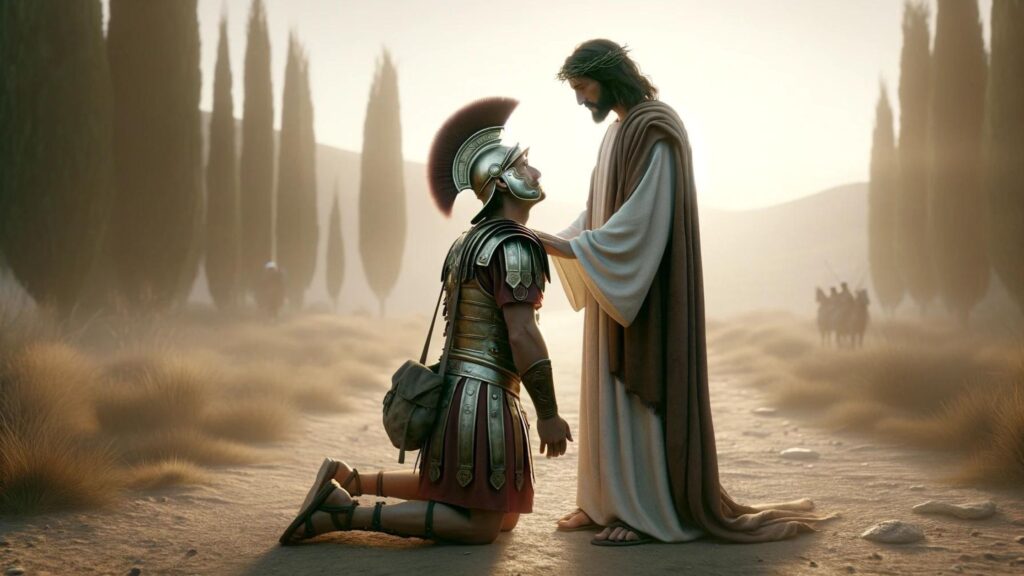
In this context, Paul’s message becomes a threat of insurrection. To declare Jesus as “Lord” was to “bend the knee” to Him above all other authority. It demands a complete makeover of one’s life and priorities, aligning them with Jesus’ teachings and the example of how He lived. For early Christians, declaring Jesus “Lord” was much more than a public profession of faith. It was a dangerous political declaration that invited Roman persecution and risked ostracism in public, religious, and political sectors.
Pronouncing Jesus as “Lord” encompasses several key aspects of Christian beliefs. Foremost, it acknowledges Jesus’ divinity. In Philippians 2:9-11, Paul describes how God exalted Jesus and bestowed upon Him “the name that is above every name,” such that “at the name of Jesus every knee should bow… and every tongue acknowledge that Jesus Christ is Lord, to the glory of God the Father.” This passage highlights the divine authority and honor accorded to Jesus, reinforcing His central role in God’s plan of salvation that has existed from God’s foundation of the world.
Pronouncing Jesus “Lord” affirms His sovereignty over every facet of one’s life. It implies a surrender to Jesus’ will and guidance, trusting in His lordship to guide and transform one’s life. This declaration is inseparably linked to the believer’s acknowledgment of Jesus’ resurrection from the dead. Paul points to the resurrection as definitive proof of Jesus’ divine power and authority. The resurrection is a transformative truth in that it enables believers to live in accordance with Jesus’ teachings.
Personal Transformation
On an individual level, declaring Jesus as “Lord” signifies a deep internal transformation. It requires a conscious decision to turn away from sin and self-centeredness and embrace a life of discipleship. Christian discipleship is marked by love, humility, and service. Paul describes this transformation in terms of a “new creation” in 2 Corinthians 5:17 and “putting on the new self” in Ephesians 4:24. These highlight the radical change in personal priorities and purpose that occur when one becomes abandoned to Jesus.
Declaring Jesus “Lord” is the central point of unity and shared identity among believers, who are often referred to as “brothers and sisters in Christ.” With Jesus as “Lord” Christians are joined together in a common faith and mission. This communal aspect is evident in Paul’s frequent use of the metaphor of the body of Christ, where each believer is a member with unique gifts and roles, all contributing to the health and growth of the whole (1 Corinthians 12:12-27). The lordship of Jesus rises above cultural, social, racial, and ethnic divisions, creating a diverse yet highly cohesive community of faith. Praise the Lord!
Doxology
“For I am convinced that neither death nor life, neither angels nor demons, neither the present nor the future, nor any powers, neither height nor depth, nor anything else in all creation, will be able to separate us from the love of God that is in Christ Jesus our Lord.”—Romans 8:38-39
* All Bible quotations are NIV unless otherwise noted.
Copilot AI was used to assist with historical research for this article.
On January 20th Donald Trump was sworn in (again) as President of the United States. For some Americans it was a day of celebration, while for others it was a day of dread and fear. This is not uncommon when the political pendulum makes a big swing to the left or right in this country. The media circus on both left and right during the presidential campaign and since has been enough to depress just about anyone who listens or reads too much news.
Just in case the noise of partisan politics hasn’t depressed you, we’ve been bombarded lately with news of torrential rains, mudslides, hail storms, wildfires in LA, tornados and hurricanes in places they don’t belong, and snow on our Gulf coast beaches. Then there are wars and rumors of war around the globe, like in Israel, Lebanon, Yemen, Somalia, Ukraine, Nagorno-Karabakh, and elsewhere.
These are indeed fear-provoking times. Sometimes it looks like no one is in charge. The good news is that there’s one great master plan in motion for all mankind, and neither Donald Trump, Vladimir Putin, Xi Jinping or any other man is in control. God is still in control of everything in creation and always will be.
Not long before he died, the Rev. Dr. Charles Stanley, Pastor Emeritus of the First Baptist Church of Atlanta, recorded a homily titled, A Comforting Message in Fearful Times. Just as the Apostle Paul encourages believers to “put on the full armor of God” in Ephesians 6, Dr. Stanley’s message encourages us to “soak” our minds and hearts in the word of God, where believers can find peace, comfort, and courage in the midst of the spiritual warfare surrounding our daily lives. Dr. Stanley cites a treasure trove of scripture during the homily, which I have listed below. I encourage you to read through the entire list, then go back and look at each passage in the context of the full chapter it comes from.
Philippians 4:6-7 — “Be anxious for nothing, but in everything by prayer and supplication, with thanksgiving, let your requests be made known to God; and the peace of God, which surpasses all comprehension, will guard your hearts and minds in Christ Jesus”.
Psalm 16:7-8 — “I will bless the Lord who has counseled me; indeed, my mind instructs me in the night. I have set the Lord continually before me; because He is at my right hand, I will not be shaken”.
Psalm 4:8 — “In peace I will both lie down and sleep, For You, O Lord, make me to dwell in safety”.
Psalm 27:1 — “The Lord is my light and my salvation; Whom shall I fear? The Lord is the defense of my life; Whom shall I dread”?
Psalm 139:23 — “Search me, O God, and know my heart; try me and know my anxious thoughts; and see if there’s any hurtful way in me, and lead me in the everlasting way”.
Psalm 138:7 — “Though I walk in the midst of trouble, You will revive me; You will stretch forth Your hand against the wrath of my enemies, and Your right hand will save me”.
Psalm 138:8 — “The Lord will accomplish what concerns me; Your lovingkindness, O Lord, is everlasting”.
Psalm 138:3 — “On the day I called, You answered me; You made me bold with strength in my soul”.
Philippians 4:19 — “My God will supply all your needs according to His riches in glory in Christ Jesus”.
Isaiah 41:10 — “Do not fear for I am with you; do not anxiously look about you, for I am your God. I will strengthen you, surely I will help you with my righteous right hand”.
John 3:16 — “For God so loved the world that He gave His only begotten Son, that whoever believes in Him shall not perish, but have everlasting life”.
1 John 1:9 — “If we confess our sins He is faithful and just to forgive us our sins and to cleanse us from all unrighteousness”.
Psalm 121:1-8 — “I will lift up my eyes to the mountains; From where shall my help come? My help comes from the Lord, Who made heaven and earth. He will not allow your foot to slip; He will keep you and He will not slumber. Behold, He who keeps Israel will neither slumber nor sleep. The Lord is your keeper, the Lord is your shade on your right hand. The sun will not smite you by day, nor the moon by night. The Lord will protect you from all evil; He will keep your soul. The Lord will guard your going out and your coming in from this time forth and forever”.
Isaiah 54:17 — “No weapon that is formed against you will prosper; and every tongue that accuses you in judgment, you will condemn. This is the heritage of the servants of the Lord, and their vindication is from Me”, declares the Lord.
Psalm 32:7 — “You are my hiding place; You preserve me from trouble. You surround me with songs of deliverance”.
Psalm 94:19 — “When my anxious thoughts multiply within me, Your consolations delights my soul”.
Psalm 23:4 — “Even though I walk through the shadow of death, I fear no evil, for You are with me. Your rod and Your staff they comfort me”.
Psalm 139:3 — “You scrutinize my path and my lying down, and are intimately acquainted with all my ways”.
All in all, the difference between the believers and non-believers is this: in tough situations the believer accepts God’s wisdom and control. His prayer is for patience and to say as Jesus said, “Not My will, but Yours, be done” (Luke 22:42b). On the other hand, the non-believer challenges God, neglecting to believe in Him unless he has proof. (Based on a sermon by Rev. Dr. Ken Klaus, former Speaker of The Lutheran Hour).
For to us a child is born, to us a son is given, and the government will be on his shoulders. And he will be called Wonderful Counselor, Mighty God, Everlasting Father, Prince of Peace.
Christmas, the celebration of the birth of Jesus Christ, is quickly approaching. As we prepare for a merry celebration of his birth, let us not forget that he came to us as a Savior, destined to suffer agony and death for you and for me. Jesus is the “lamb of God who takes away the sin of the world” (John 1:29). God did not send us his only begotten son out of pity for mankind. He was sent because only God’s son was a sufficient sacrifice to take away the sin that dwells in all of us. “But he was pierced for our transgressions; he was crushed for our iniquities; upon him was the chastisement that brought us peace, and with his wounds we are healed” (Isaiah 53:5). Everyone needs a savior. I hope you enjoy this reblog from December 21, 2017.
Happy St. Barbara’s Day to all of my Field Artillery brothers and sisters.
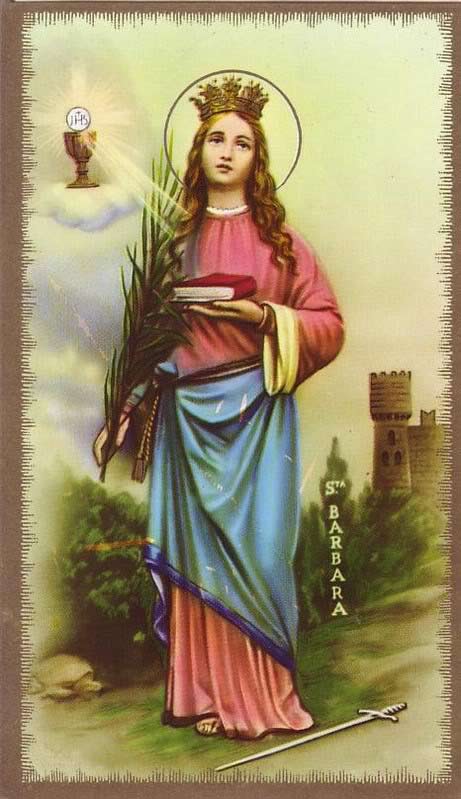
Legend has it that Saint Barbara, the patron saint of artillerymen, was tragically beheaded by her own father, a nobleman in the Roman Empire, for her devotion to Christianity. Shortly after, in a twist of fate, her father was struck down by lightning during a sudden, violent storm. Consequently, Saint Barbara is revered as the patroness of those facing thunderstorms, fire, explosions, or the risk of sudden death.
In the early days of warfare, artillerymen often encountered cannon misfires, muzzle bursts, and weapon explosions. Artillery crews turned to Saint Barbara for protection. She has been protecting artillerymen for hundreds of years and has become an integral part of the Field Artillery’s heritage. Today, she continues to be honored as the patron saint for all artillerymen, depicted standing by a cannon or holding a chalice and sacramental wafer.
Our nation has endured an extraordinary series of natural disasters over the past few months, including hurricanes, tornados, torrential rains, devastating floods, and enormous wildfires. If you’ve tuned in to the evening news lately you’ve probably seen disaster victims who have lost nearly all of their material possessions. Despite suffering tremendously, many of these people express gratitude for the simple fact that they are alive and still have their family and friends. They get it!
As I grow older, the things that truly matter in my life have become crystal clear. These are Faith, Family, Friends, and Freedom. I call them the 4Fs and I’ve written about them several times over the decade that I’ve written this blog.
Today, as we mark the annual Thanksgiving holiday, I’m offering a special thanks for my friends. I’ve heard it said that families are issued to you, but you choose your friends. This is just one of the many things that makes true friends so special.
So, what is a true friend? I don’t have all the answers, but here are some characteristics of my true friends that I’ve observed over the years:
They are there for you when others walk away.
They meet you where you are, warts, wrinkles, and all.
They are forgiving.
They will make time for you, even when they haven’t the time to spare.
They expect nothing in return and do not keep score.
They are good listeners.
They respect confidentiality.
They tell you what you need to hear, not what you want to hear.
They say, “Wow, you really made a mess of this! Now how can I help you fix it?”
They walk beside you in the demon filled valleys, propping you up.
They are at their best when you are at your worst.
A number of my dear friends are currently struggling with serious life challenges. These include the early onset of dementia, the death of a spouse, a spouse developing dementia, a spouse with cancer, a child abusing alcohol, and a child suffering with seizures. The longer one lives the more frequently such challenges seem to occur. So now I lift them up to the Lord.
Lord, hear my prayer. Father God, I pray for my friends who are struggling. I pray that you will grant them mercy and peace. You know exactly what they need at this moment. Draw near to them and let them feel your presence. Open their eyes, ears, and hearts to you. Protect them from the attacks of the evil one and shelter them in your loving arms. I pray this in the name of the Father, and the Son, and the Holy Spirit. Amen.
Sirach 6:14-16 (RSV)
Faithful friends are a sturdy shelter: whoever finds one has found a treasure. Faithful friends are beyond price; no amount can balance their worth. Faithful friends are life-saving medicine; and those who fear the Lord will find them.
The triumphal entry of Jesus into Jerusalem, Matthew 21:1-11
The dominance of Rome
As a retired Army Officer, I find Roman history fascinating. The Roman Empire’s territory in Jesus’ time completely enveloped the Mediterranean Sea. Roman society was very militaristic. The military played a central role in the empire’s territorial expansion, governance, and social structure. Rome aggressively employed its strong military capabilities to conquer new territories and maintain control over its sprawling empire. Military prowess was a key aspect of Roman cultural identity.
The Roman Senate sometimes granted a festive procession through the streets of Rome to pay tribute to a general who was victorious in battle. Called a Triumph or a triumphal procession, it was a grand and elaborate ceremony designed to celebrate and publicly recognize the military achievements and conquests of the general being honored.
A Triumph was a blend of religious, political, and social elements, showcasing the glory of Rome. The general being honored wore a special ceremonial toga. He rode in a chariot drawn by four horses, followed by his troops, prisoners of war in chains, strange animals from the conquered lands and wagons filled with the spoils of war. Adoring citizens lined the streets, cheering as the different elements of the Triumph passed by them. The air was full of the sounds of music and chants, creating a jubilant, reverent atmosphere. The Triumph not only honored the general but also reinforced the power and splendor of the Roman state.
Jesus’ triumphal entry into Jerusalem
In Jerusalem a large crowd of Jews gave Jesus an impromptu Triumph of His own. His triumphal entry into Jerusalem is described in all four Gospels: Matthew 21:1-11, Mark 11:1-11, Luke 19:28-44, and John 12:12-19. Each provides a slightly different perspective on the event, but they all highlight the significance of Jesus’ arrival in Jerusalem as the fulfillment of prophecy. Jesus’ triumphal entry, in Christian tradition, marks the beginning of Holy Week. It sets the stage for the events leading up to His crucifixion and resurrection, which are central to the Christian belief that Jesus is the Messiah, the son of the living God.
According to the Gospels, Jesus entered Jerusalem riding on a donkey (or colt), fulfilling a prophecy found in both Isaiah 62:11 and Zechariah 9:9. As He approached the city, a large crowd gathered, spreading their cloaks and palm branches on the road before him. They shouted “Hosanna” (loosely translated as “save us” or “help us”) and praised Him as the “Son of David” and the “King of Israel.”
The atmosphere at Jesus’ triumphal entry was one of celebration and anticipation, as the jubilant Jews who were present believed him to be the promised Messiah, who they supposed would be a military leader who would free them from Roman oppression. However, in stark contrast to a Triumph for a Roman General, Jesus’ humble entry into Jerusalem symbolized the peaceful role of His mission as Messiah, the humble King of Israel who fed the hungry, healed the sick, cleansed the lepers, gave sight to the blind, prayed for His enemies, and washed the feet of His disciples.
Sadly, most of the Jewish people and religious leaders failed to recognize Jesus as Redeemer, the sacrificial Lamb of God who would suffer and die under the orders of Pontius Pilate and after three days gloriously rise from the dead, conquering sin and death once and for all. Jesus freely sacrificed himself for the sins of the world and offers eternal life to all who believe on Him and profess that He is the son of God. We all need the Most Holy Redeemer of the world. Jesus Christ is the Triumphant God.
Prayer to the Most Holy Redeemer
(Anima Christi)
Soul of Christ, sanctify me.
Body of Christ, save me.
Blood of Christ, embolden me.
Water from the side of Christ, wash me.
Passion of Christ, strengthen me.
O good Jesus, hear me.
Within thy wounds hide me.
Never permit me to be parted from you.
From the evil Enemy defend me.
In the hour of my death call me.
and bid me come to thee,
that with your saints I may praise thee
for age upon age. Amen.
2 Corinthians 2:14 – “But thanks be to God, who in Christ always leads us in triumphal procession…”
* All Bible quotes are ESV
Bing Copilot AI was used to assist with the historical research used to write this piece.
Recent Comments