Archive for the ‘spiritual’ Category

Caring for the Temple of the Holy Spirit

OverweightAaaaggh!

I spent over 24 years of my adult life as an officer in the US Army.  To say that I was in good physical condition would be a gross understatement. I served a tour of duty in the 75th Ranger Regiment, one of the Army’s elite organizations. I was a paratrooper, jumping out of perfectly good airplanes and floating to Earth under a silk canopy.  I also served in the 10th Mountain Division, one of the Army’s toughest and most respected divisions.  Since 2001, the 10th Mountain has been the most deployed division in the US Army.  The Army encourages, even demands, good physical fitness of its soldiers. 

Fitness is in my DNA. I feel out of sorts if I can’t exercise three to four days per week.  Nevertheless, I find myself in a fitness conundrum today.  When I retired from the Army in 2001, I was a fit 205 pounds, well within the limits for my muscular, six-foot frame. Today I find myself about 30 pounds heavier; the extra weight can be attributed to a combination of age, indiscipline, and total knee replacement surgery, which I underwent about 11 months ago; the latter totally wrecked my physical fitness routine.  I’m still in recovery!

I’m not happy with my current weight.  Until a couple of weeks ago, I viewed my condition as purely a physical fitness challenge—a need to get back into shape to reverse the changes that have taken place since my surgery.  However, I recently experienced a healthy change of attitude. 

I credit the change to my dear friend Cliff, who also struggles with his weight.  He recently introduced me to a book called Every Body Matters, by Gary Thomas. As the book cover explains, it is about “Strengthening Your Body to Strengthen Your Soul.”

Having personally struggled with his weight, Thomas uses scripture to demonstrate that, for Christians, physical health is as important as spiritual health. Thomas demonstrates that physical fitness, rather than being something that make us more attractive to others, makes us more useful to God. I recommend his book to anyone who has struggled with physical fitness or being overweight. Thomas offers a Holy Spirit-led approach to developing a physical being that is of maximum use to God.

Thomas cites these words of St. Paul:  (All Bible citations were taken from the ESV.)

Or do you not know that your body is a temple of the Holy Spirit within you, whom you have from God?  You are not your own, for you were bought with a price. So glorify God in your body. 1 Corinthians 6:19-20

…I discipline my body and keep it under control, lest after preaching to others I myself should be disqualified. 1 Corinthians 9:27

…let us cleanse ourselves from every defilement of body and spirit, bringing holiness to completion in the fear of God. 2 Corinthians 7:1

Many Bible commentators interpret bodily sins to mean sexual sins.  While Thomas would agree with this, he goes on to discuss the need for developing discipline in what we put into our bodies (i.e. food).  As I previously noted, he frames the discussion in terms of disciplining our bodies, not to make us attractive to others, but to glorify God (…you were bought with a price. So glorify God in your body. 1 Corinthians 6:20)

I highly recommend Every Body Matters to all Christians who struggle with their weight. I promise it will change your perspective on being overweight and motivate you to do something about it.  It has led my wife and me to challenge each other.  During the upcoming season of Lent (Feb 14 – Mar 29), we will embark upon a 40-day regimen of time-restricted eating. 

In a nutshell, this means we’ll eat normally for 6 hours each day, while fasting the remaining 18 hours. By most accounts, this eating pattern is easy to adjust to and usually results in remarkable weight loss for those having the discipline to stick with it.  We’re not looking for a new diet or fad, but a lifestyle change. Wish us luck!  At some point in the future, I’ll share our experience.

Protecting your health is the same as protecting the vehicle with which God wants to change the world.  —Gary Thomas


Faith, Family, Friends and Freedom

                                  cornucopia-by-edvard-munch

Cornucopia, oil on canvas by Edvard Munch (1863-1944)

­­­­­

And let the peace of Christ rule in your hearts, to which indeed you were called in one body. And be thankful.  Let the word of Christ dwell in you richly, teaching and admonishing one another in all wisdom, singing psalms and hymns and spiritual songs, with thankfulness in your hearts to God. And whatever you do, in word or deed, do everything in the name of the Lord Jesus, giving thanks to God the Father through him.  –Colossians 3: 15-17 (ESV)

Besides getting senior discounts in restaurants and AARP rates on hotel rooms, one of the benefits I’ve reaped by growing older is developing a clearer understanding of what really matters in my life. When I was young, most of my attention was focused inward, which I suppose if fairly normal. 

As a new Army lieutenant, fresh out of college, I loved the excitement of living a soldier’s life.  I liked going out and having fun with friends. I also enjoyed playing all kinds of sports and outdoor recreation like skiing and cycling. Sadly, there were many things I neglected during this phase of my life.

As I got a bit older, I began to pay more attention to the incredible woman I had married. I grew to realize that Linda’s physical beauty was exceeded by even greater inner beauty. I grew to admire her patience—especially with me and my antics—and her fortitude.  When she sets her mind on something, it’s going to get done.  I also began to comprehend how wise Linda is—blessed with more common sense than anyone I’ve ever known.  She is also one of the humblest and most generous people I know!

Having our first child was a wake-up call greater than any drill instructor ever delivered to a barracks full of sleepy-eyed soldiers.  It was one of those ‘blinding glimpse of the obvious’ moments when selfish me suddenly realized I’m responsible for more than just myself.  While a wife is easily neglected, a screaming newborn is an entirely different matter.  Sad that I didn’t figure this out earlier!

My newfound sense of responsibility led me back to the Church, something I’d managed to neglect since the time I entered college some seven years earlier. This sudden change of direction came as quite a surprise to my then, non-Christian wife.  Thankfully, she was steered towards God.  Sadly, it happened without much help on my part.  Thank you Holy Spirit!

Over the course of my 24-year Army career there were many long deployments and other periods away from home.  During these busy years Linda faithfully kept the home fires burning, managing a busy household and doing the lion’s share of parenting our two daughters. My military travels around the world helped me develop a deep appreciation for the blessings we enjoy as Americans—something that many of us simply don’t recognize.

Fast forward to the present and I can’t help but feel blessed every day. Linda and I are reaping the benefits of having honored our marriage vows for nearly 40 years.  Our daughters are both grown and successful, we have a wonderful son-in-law, and we’ve been blessed with three adorable grandsons. We’re fortunate to be able to see our grandsons daily. We have loving, extended families in diverse locations around the world. We’ve made many lifelong friends along the way, all of whom have blessed and enriched our lives. Most of all, we’ve been blessed by a loving God who was willing to sacrifice His only Son to redeem our souls.

This is the day that many Americans pause to give thanks to God for the blessings in their lives.  I urge everyone to take a few moments to consider your blessings and give thanks for your Faith, Family, Friends and Freedom—the  things that truly matter in life.

Simplifying Life: the Pareto Principle

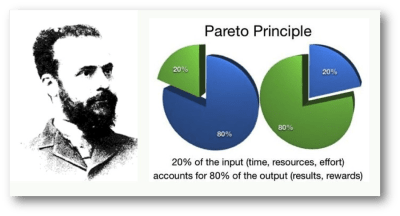
Pareto Principle

When I was working as a management consultant, one of my favorite lessons to convey to clients was the Pareto Principle, which is also known as the 80-20 Rule.  The principle was named for the 19th century Italian economist Vilfredo Pareto, who observed that an 80-20 percent relationship applied to many practical aspects of life. For instance, about 80 percent of nonprofit donations come from 20 percent of the donor base.  About 80 percent of sales come from 20 percent of your client base. 

The application of the 80-20 Rule I most like is that about 80 percent of the work on a project is accomplished through 20 percent of the effort.  For example, if it takes five hours to detail a car, you can finish 80 percent of the job in about an hour.  The remaining 20 percent of the tasks will take four hours to complete.  The lesson learned is that if you can accept something less than perfection in a practical task like vacuuming your house or maintaining your lawn, you can save yourself a lot of time and significantly simplify your life.

The Rev. Dr. Alexander Whyte (1836-1921), was a popular Scottish theologian in his day.  His biographer, G.F. Barbour tells an interesting story about Whyte’s encounter with a particular female parishioner who told him, “Dr. Whyte, I just love being in your presence. You are so saintly.”  Whyte replied, “Madam, if you could look into my soul, what you would see would make you spit in my face.”

While the Pareto Principle has many practical applications in everyday life, Rev. White knew that when it comes to God, giving 20 percent of yourself is not enough.  Whyte understood what Jesus means in Matthew 10:37-39 when he says, “Whoever loves father or mother more than me is not worthy of me, and whoever loves son or daughter more than me is not worthy of me. And whoever does not take his cross and follow me is not worthy of me. Whoever finds his life will lose it, and whoever loses his life for my sake will find it.” (ESV) 

Jesus wants all of you—not 20, or 80, or even 99 percent of you.  He makes this clear when He tells his disciples “If anyone would come after me, let him deny himself and take up his cross and follow me.  For whoever would save his life will lose it, but whoever loses his life for my sake will find it. For what will it profit a man if he gains the whole world and forfeits his soul?” (Matthew 16:24-26, ESV)

It’s easy to give part of yourself to God.  You can attend church every Sunday, pray to Him every morning, and tithe 10 percent of your income. Outwardly you might appear saintly, as the Rev. Whyte appeared to his parishioner, but God sees inside us all.  Scottish Theologian Oswald Chambers said, “We are only what we are in the dark; all the rest is reputation. What God looks at is what we are in the dark—the imaginations of our minds, the thoughts of our heart, the habits of our bodies; these are the things that mark us in God’s sight.”  This is why, St. Paul tells us in Philippians 2:12 (ESV), “work out your own salvation with fear and trembling.”

God wants all of you. Therefore endeavor constantly to place Him first in every aspect of your life. And when you fail, as you inevitably will, seek His forgiveness.  As St. Paul encourages us in 2 Timothy 4:7, continue to fight the good fight.   


Radical Christianity

Jesus Calms the Storm

And Jesus awoke and rebuked the wind and said to the sea,

“Peace! Be still!” And the wind ceased, and there was a great calm.

                                                                           —Mark 4:39*

Today it is nearly impossible to read a newspaper or watch a TV newscast without hearing something about “radical Islam.” The images of beheadings, torture, human rights abuses of women and the ethnic cleansing of Christians and other religious minorities send chills down one’s spine.

Our political leaders can’t agree on a proper response to radical Islam, but they all seem to agree that doing nothing is not a viable option. Many push for military action—even all out war. Others see diplomacy as the answer.  I believe the only effective response to radical Islam is radical Christianity.

History has shown that nothing can be more effective than Christianity in its purest form. It was radical Christianity that survived by hiding in the catacombs beneath Rome and slowly emerged to peacefully convert it from a pagan empire to a nation united under the banner of Jesus Christ. It was radical Christianity that led a small group of religiously oppressed pilgrims to establish a colony near Plymouth Rock.

Today it is radical Christianity that leads missionaries to leave the comforts of life in America to spread the Gospel in places where they face persecution and even death. It drives some men and women to refuse to renounce their faith in Christ, even if it means being tortured or killed.

Radical Christianity can counter radical Islam. What could be more radical than a religion that professes God became incarnate in human flesh, born of a virgin for the sole purpose of suffering a hideous death to set mankind free from sin?

For one will scarcely die for a righteous person—though perhaps for a good person one would dare even to die— but God shows his love for us in that while we were still sinners, Christ died for us. —Romans 5: 7-8

What could be more radical than a religion that professes that there are no “good” people; that all men have sinned and fall short in the eyes of God; that it is impossible to earn one’s way into heaven?

…as it is written, “None is righteous, no, not one; no one understands; no one seeks for God. All have turned aside; together they have become worthless; no one does good, not even one.” —Roman: 7-8

What could be more radical than a religion that professes that salvation and eternal life are given freely by God to those who accept Jesus as their personal savior, profess that He is the son of God, believe that he died for the forgiveness of their sins and rose from the dead, and ask him into their lives?

For by grace you have been saved through faith. And this is not your own doing; it is the gift of God, not a result of works, so that no one may boast. —Ephesians 2: 8-9  

A U.S. State Department spokesperson Marie Harf recently came under intense criticism when she suggested one way to counter Islamic terrorism was through helping terrorists find jobs. She went on to suggest that “We can’t kill our way out of a way.” Now perhaps this is a bit simplistic, but Jesus’ radicalism turns logic on its head when he says:

You have heard that it was said, “You shall love your neighbor and hate your enemy.” But I say to you, Love your enemies and pray for those who persecute you, so that you may be sons of your Father who is in heaven.   —Matthew 5:43-45

While our elected officials seek various solutions for curbing radical Islam, radical Christians can follow Christ’s example and pray for our enemies. Adopt a Terrorist for Prayer is a radical Christian approach to countering radical Islam (www.atfp.org) through prayer. The organization’s website explains the approach as follows:

The Christian Response: Where is the Christian response to terrorism? If the struggle against violence done in the name of Islam is primarily spiritual, then defeating it requires a spiritual response.

Overcoming Fear: Terrorism inspires fear. According to Jesus, the antidote to fear is love. When we hate, we are reactive victims. When we love we have the initiative.  Love for country helps soldiers to risk their lives. Love for children enables parents to discipline them without being intimidated. Love for us took Jesus to the cross. Love for enemies will give courage to face, overcome, and transform them and the environment that breeds them.

Historical Precedent: Historically, Stephen was the first fatality in terrorism directed against Jesus’ followers. As Stephen died from stoning, he prayed, “Lord, do not hold this sin against them.” Later, Paul, who had supervised Stephen’s stoning, met Jesus in a vision and repented. Can we pray today like Stephen prayed then? Would Paul have repented if Stephen hadn’t prayed?

Are you willing to get radical for Christ? Visit the ATFP website and adopt a terrorist for prayer.

*All Bible quotes are taken from the English Standard Version   

Stretch Yourself

??????????

“It is perilously possible to make our conceptions of God like molten lead poured into a specially designed mould, and when it is cold and hard we fling it at the heads of the religious people who don’t agree with us.”  —Oswald Chambers

Alison J. Head and Michael B. Eisenberg are the co-principal investigators and co-directors of Project Information Literacy at the University of Washington Information School in Seattle. One of the areas they study is information overload and multi-tasking.

Since 2008 the pair has surveyed over 10,000 college students. One of their most significant findings is that, “Information is now as infinite as the universe, but finding the answers needed is harder than ever.”

In today’s complex, often confusing wilderness of digital information, it’s important that people periodically take time to slow down and think!  Scottish theologian Oswald Chambers said, “Always keep in contact with those books and those people that enlarge your horizon and make it possible for you to stretch yourself mentally.”

I have to agree with his advice. I’ve found that a good way to slow down is to turn off the laptop or smartphone.  Instead, try engaging in meaningful conversations and reading.

My most meaningful conversations usually occur with my wife Linda.  She is one of the smartest people I know. Her logic and ability to find clarity in the midst of confusion have always amazed me. If she were the only person I ever talked with, my life would never lack for interesting, meaningful dialogue.

As for books, it’s hard to know where to begin, but I’d like to suggest a few good ones for Christians hoping to stretch their minds a little.  My top five, in no particular order are:

My Utmost for His Highest, by Oswald Chambers

Oswald Chambers, who died in 1917 at age 43, is widely regarded as one of the most influential theologians of the 20th century. He wrote only three books in his lifetime, but there are many bearing his name.  They are the products of his devoted wife Gertrude, a professional stenographer who recorded all of Chambers’ sermons verbatim in shorthand.

My Utmost for His Highest is a book of daily devotions written by Mrs. Chambers. It draws from dozens of her husband’s sermons. First published in 1924, it is the most popular Christian devotional ever written.  The idea of total abandonment, i.e. completely surrendering one’s life to God, is at the center of its message. As the book’s title suggests, we must strive daily to do our utmost for God.

Chambers said, “We have the idea that we can dedicate our gifts to God. However, you cannot dedicate what is not yours. There is actually only one thing you can dedicate to God, and that is your right to yourself (see Romans 12:1). If you will give God your right to yourself, He will make a holy experiment out of you— and His experiments always succeed.”

The language of the original text is somewhat challenging for modern day readers due to its use of Scottish vernacular. Fortunately, there are versions available in modern English.  Personally, I find that working through the original version simply adds to the exercise of stretching my mind. When read as intended—one short devotion per day—this book will help you stretch yourself for an entire year.

Your God is too Small, by J.B. Phillips

J.B. Phillips was a canon of the Anglican Church.  He died in 1982.  His seminal work, Your God is Too Small, was published in 1952. According to Phillips, from childhood we are taught to package God in a tiny box conforming to our personal beliefs and preferences.  Look for all of the answers and you’ll find them by turning God into something simple and understandable. Phillips calls this “God in a box,” which is also the title of the book’s seventh chapter.

Oswald Chambers cautioned us against such shaping God in our own image, saying, “Our danger is to water down God’s word to suit ourselves. God never fits His word to suit me; He fits me to suit His word.” (Not Knowing Whither, 901 R).

David wrote in Psalm 8, “When I look at your heavens, the work of your fingers, the moon and the stars, which you have set in place, what is man that you are mindful of him, and the son of man that you care for him?”

Your God it too Small leads its readers through a series of intellectual exercises designed to expand their concept of the God who created the universe. If you find yourself marveling at God’s creation, unable to wrap your mind around it all, this book will help you see God in a totally different way.

The Screwtape Letters, by C.S. Lewis

Clive Staples Lewis (1898-1963) is one of the most popular and prolific Christian authors and apologists who ever lived. He penned over 30 books.  Today he is best known for his classic series The Chronicles of Narnia, which have been transformed into an extremely successful series of films.

Originally published in 1942, The Screwtape Letters is arguably the Lewis’s most unusual book.  It is written in the format of a series of letters from an uncle attempting to mentor his young nephew through an important task. This would be nothing unusual, were it not for the fact that Screwtape is a senior demon and servant of Satan.  The letters are written to his nephew Wormwood, a junior tempter.  Wormwood has been given the task of ensuring the damnation of a British businessman who is referred to only as “the patient.”  Screwtape provides his nephew a clear strategy on how to undermine the patient’s faith and lead him into sin.

Lewis’s book is a dissertation on the human condition—a deep analysis of man’s inner makeup, with all of its strengths, frailties, temptations and struggles. Screwtape, through his keen understanding of human behavior, explains to Wormwood the best methods for ensuring the patient’s ultimate demise. The book paints an in-depth picture of spiritual warfare and the ultimate triumph of God.  It is guaranteed to make you think about your own inner self.

Luther:  Man between God and the Devil, by Heiko A. Oberman 

Originally published in German in 1982, this book is considered by many German scholars to be the most comprehensive biography every written on Martin Luther (1483-1546).  Luther was the central figure of the Protestant Reformation and remains one of the most influential theologians in history.

Even without the discussion of Luther, Oberman’s book would be worth reading just for its political, cultural and religious discussion of the Reformation.  However, it offers much, much more. Unlike many Luther biographers before him, Oberman attempts to describe Luther’s thoughts and deeds as something much more than just a medieval German monk who rebelled against the authority of the Catholic Church.

Oberman contends that Luther was convinced of the reality of the devil and viewed his own life as a continuous struggle against evil. (Not unlike The Screwtape Letters).  Luther viewed the world as an enormous battleground where God clashes with Satan. Approaching him from this angle lends a whole new perspective to Luther’s theology. This book is guaranteed to stretch your mind!

Jesus Under Fire: Modern Scholarship Reinvents the Historical Jesus, edited by Michael J. Wilkins and J.P. Moreland

If you’re a middle-aged Christian like me you might recall hearing about a popular movement in the 80’s and 90’s centered on “the quest for the historical Jesus.” The movement, which still has some momentum today, was epitomized by the Jesus Seminar.  The Jesus Seminar was organized by the Weststar Institute in 1985.

According to the institute’s website, its purpose was to, “to renew the quest of the historical Jesus and to report the results of its research to the general public, rather than just to a handful of gospel specialists. Initially, the goal of the Seminar was to review each of the sayings and deeds attributed to Jesus in the gospels and determine which of them could be considered authentic.

The seminar began with a group of 30 Bible scholars, but eventually grew to around 200. Put simply, this movement was an attempt by Bible scholars, not necessarily Christian scholars, to refute the divinity of Jesus Christ by framing him in history as nothing more than a typical, popular Jewish teacher of his day.

Jesus Under Fire is a compilation of essays by eight prominent Christian apologists written to challenge the methodology and conclusions of the Jesus Seminar.  The book’s introduction describes the furor surrounding Jesus:

“Today some people say that Jesus never said most of what is recorded of him in the Bible.  Some pronounce further that Jesus never did most of what the Bible records he did.  They claim that Jesus of Nazareth was a far different figure than church history and the creeds have believed him to be.  Therefore, if we are to be intelligent people, even intelligent religious people, we must not simply accept what the Bible records Jesus claimed for himself and what the early church claimed him to be.  If we are to be truly modern in our religious quest, we must not simplistically hope that Jesus’ actions as they are recorded in the Bible are factual, or that they have any relevance for us today.  Jesus must be stripped of ancient myths that surround him as to what he said and did, so that the modern person can hear his true message.  Jesus must be brought down to earth from the status to which the early church elevated him, so that we can understand who he was as he walked under Palestinian skies and comprehend what, if any, religious relevance he has for us today.”

The chapter titles of Jesus Under Fire describe the authors’ response to the Jesus Seminar:

  • Where do we start studying Jesus?
  • Who is Jesus? An introduction to Jesus studies.
  • The words of Jesus in the Gospels: Live, Jive or Memorex?
  • What did Jesus do?
  • Did Jesus perform miracles?
  • Did Jesus rise from the dead?
  • Is Jesus the only way?
  • Jesus outside the New Testament: What is the Evidence?

This book is for serious mind stretchers only.  It is probably the most difficult book I have ever read…and reread.  I found each of the essays intellectually stimulating—the sort of stuff that makes me go back and reread each paragraph, underlining sentences as I go.  I spent about six months working my way through it the first time…and it was time well spent. I hope you will find it equally as enjoyable.

Give yourself a special gift this Christmas and start reading one of these wonderful books.  You won’t regret it.



Simply Good News

Jesus on Cross

                                                            For I decided to know nothing among you,                                                                                                                  except Jesus Christ and him crucified.”                                                                                                                                        1 Corinthians 2:2 (ESV)

Life is becoming more and more complicated these days.  Wherever one turns he or she is met with new challenges.  Today’s new cars have more gadgets than did many airplanes just a few years ago. Simply watching television can require using several very different remote controls that must be used in a specific sequence to view the media one desires.  So-called smartphones often prove smarter than their users, leaving befuddled owners struggling to figure out how to use all of their phone’s capabilities.

Politics has also grown more complex. Many private interest groups today sponsor advertising in favor of one politician or another. It’s difficult to sort out the source and motivation behind each message and even harder to discern fact from fiction. Attack ads grow more vicious each year.

Even eating has become more challenging for those  concerned about health and fitness. Should you use butter or margarine?  Is coffee good for you or bad?  Is a little red wine really beneficial to your health? How much exercise does one really need?  Is it better to walk or jog? It’s hard to sort through it all.

Unfortunately, complexity has increased in religion as well.  Mainline Christian denominations are being divided by new doctrines and beliefs. Recently the National Cathedral, arguably the foremost Episcopal churches in the United States, hosted a Muslim prayer service.  And don’t even try to sort out what’s going on between Muslims, Jews and Christians in the Middle East! It’s enough to drive one mad.

Fortunately for Christians, St. Paul maintains a simple view of the Gospel. Listening to his words can help us cut through much of the confusion that exists today. In his first letter to the saints in Corinth he writes, “And I, when I came to you, brothers, I did not come proclaiming to you the testimony of God with lofty speech or wisdom. For I decided to know nothing among you except Jesus Christ and him crucified.”  (1 Corinthians 2:1-2, ESV)

Christ’s crucifixion for our sins and His resurrection from the dead are at the center of the Christian faith.  A highly educated and intelligent man, St. Paul professed a belief in Christ built on faith, not reason. He understood that reason could never lead to a full knowledge of God, because God is too big and too awesome for a simple human mind to fully comprehend. As the psalmist tells us:

O Lord, you have searched me and known me! You know when I sit down and when I rise up; you discern my thoughts from afar.  You search out my path and my lying down and are acquainted with all my ways.  Even before a word is on my tongue, beholding, O Lord, you know it altogether.  You hem me in, behind and before, and lay your hand upon me. Such knowledge is too wonderful for me; it is high; I cannot attain it.   —Psalm 39:1-6 (ESV)

Popular Christian pastor and author Ray Stedman wrote, “The main thing about being a Christian is to see that “the main thing remains the main thing.’ That is what Paul is saying (in 2 Corinthians 11:2). The ‘main thing’ is that at the heart and center of your life is the ‘simplicity that is in Christ,’ a simple thing. I have noticed over many years of observation that when religion becomes complicated, it is always a sign that it is drifting away from the realities and centralities of faith.”

The good news about Jesus that was preached by His apostles is quite simple: (all  citations taken from the ESV)

Jesus came to save all mankind.  1 Timothy 1:15 – The saying is trustworthy and deserving of full acceptance, that Christ Jesus came into the world to save sinners… —St. Paul

Jesus is mankind’s only pathway to God .  Acts 4: 11-12 – This Jesus is the stone that was rejected by you, the builders, which has become the cornerstone. And there is salvation in no one else, for there is no other name under heaven or given among men by which we must be saved.” —St. Peter

All people are born in a condition of sin, separated from God.  Romans 3:23 – “For all have sinned and fall short of the glory of God…” —St. Paul

There is nothing anyone can do on his own to earn God’s salvation.  Romans 3:10-12 – “None is righteous, no, not one; no one understands; no one seeks for God. All have turned aside; together they have become worthless; no one does good, not even one.”  —St. Paul

Christ came so save mankind from sin and death—separation from God. 1 Timothy 1:15 – “The saying is trustworthy and deserving of full acceptance, that Christ Jesus came into the world to save sinners, of whom I am the foremost.”  —St. Paul

Salvation is a gift freely given to those who put their faith in Christ.  Romans 10:9-10 – “…because, if you confess with your mouth that Jesus is Lord and believe in your heart that God raised him from the dead, you will be saved. For with the heart one believes and is justified, and with the mouth one confesses and is saved. —St. Paul

One needn’t be a Bible scholar to understand the Gospel.  The message is quite simple.  The gift of God’s salvation is free to those who, with faith and repentance, ask to receive it.

“Only through repentance and faith in Christ can anyone be saved. No religious activity will be sufficient, only true faith in Jesus Christ alone.  —Ravi Zacharias                                                                               


Exercise for the Soul

Exercise

I’m not a big fan of reality TV, but there is one show I really enjoy.  The Biggest Loser is about helping morbidly obese people lose weight and regain their health and vigor. The contestants, all of whom are obese and suffering from multiple weight-related ailments, live at an isolated health compound and work with world class trainers throughout their stay.  It’s fascinating to watch the amount of work Biggest Loser contestants need to correct years of behavior problems like overeating and under exercising.

One phenomenon that is readily evident to viewers of the show is how former athletes—those who at one time were accustomed to vigorous exercise and discipline—seem to progress much faster than those who have never routinely exercised or disciplined their bodies.

Besides weight loss, The Biggest Loser delves into the psychological struggles waged by each contestant. Some succeed, while others never quite make it.  Now in its 10th season, the show has generated a Biggest Loser fitness movement across the country.

Many Americans are dedicated to physical fitness routines. Yet a 2013 study by the Centers for Disease Control and Prevention indicated that 80 percent of American age 18 and above do not exercise sufficiently to maintain good health.

Far fewer practice a discipline of exercise for the soul.  What a shame we can’t seem to find a way to generate a spiritual fitness movement across our country!  For Christians, exercise for the soul is more important than physical exercise, because the Holy Spirit dwells within our bodies, which St. Paul calls, “the temple of the Holy Spirit.” Left neglected, either by sin, complacency or getting buried in the business of day-to-day life, the Holy Spirit cannot speak to us.  Our bodies require daily attention on both the physical and spiritual levels. Prayer must be at the center of attention. Personally, this is an area I’ve struggled with lately.

Popular evangelist and church pastor Rev. David Jeremiah has said, “Prayer is the hard-work business of Christianity, and it nets amazing results.”  German Lutheran pastor and theologian Dietrich Bonhoeffer was very specific in promoting the benefits of prayer, saying,

The entire day receives order and discipline when it acquires unity. This unity must be sought and found in morning prayer. The morning prayer determines the day.”

 Having practiced morning prayer for many years, I appreciate its importance to a Christian’s well being.

St. Ignatius of Loyola, founder of the Jesuit order of Roman Catholicism, was a Spanish knight who lived from 1491 to 1556.  As a young man, Ignatius kept a journal of his quest to grow in unity with God and discern God’s will in his life.  As his experience grew, the journal evolved into a well-defined set of prayers, meditations, reflections, and directions that are known today as the Spiritual Exercises of St. Ignatius.

These exercises are grouped into four stages, described as weeks but not literally seven-day periods, which are designed to be led by a director, or guide.  The Spiritual Exercises are intended to serve as a sort of lesson plan for the individual leading the exercises, not as a guide for individuals.

However, even without a director many aspects of the Spiritual Exercises can be useful to individuals seeking spiritual growth and greater commitment to serving God. This is particularly so for the way the Spiritual Exercises approach prayer through meditation and contemplation.

Meditation involves praying about the good and bad words, images and ideas that guide our lives.  Contemplation is emotion-driven, rather than thought-driven.  It focuses on placing ourselves in scenes from the Gospel and trying to imagine how it might have been.  Contemplation is praying through scripture rather than studying scripture.

One of the key elements of the Spiritual Exercises is the discernment of spirits.  According to St. Ignatius, the human spirit is influenced by three forces: an inward focus on self and selfish desires; Satanic power and suggestions; and God-inspired power and suggestions. Ignatius called these the “spiritual motions.”  The purpose of discernment is to discover the source of each spiritual motion in our lives, so as to help us help make good decisions.

Many contestants on The Biggest Loser reach so-called plateaus—a weight they just can’t seem to get below.  To overcome this barrier, they change their daily exercise routines, doing something different to restart the weight loss trend.

The same approach can be applied to spiritual exercises.  I do a fair job of exercising my body, but lately I’ve felt like my prayer life has slumped—I’ve hit a plateau.  I have difficulty concentrating and find my mind wandering when I pray. In the remaining days before the beginning of Advent, I plan to try a new prayer regimen built around the Spiritual Exercises of St. Ignatius Loyola.  Have you hit a prayer plateau?  Perhaps it’s time to change your exercise routine for the soul.

 “Prayer is exhaling the spirit of man and inhaling the spirit of God.”

                                                                                       Edwin Keith

An English text of the Spiritual Exercises of St. Ignatius Loyola is available online at: http://www.jesuit.org/jesuits/wp-content/uploads/The-Spiritual-Exercises-.pdf.  The Website “Ignatian Spirituality,” a service of Loyola University Press, was the primary source for this blog entry (www.ignatianspirituality.com).