Archive for the ‘spiritual’ Category

Saying goodbye to a brother in arms

Until this year, Veterans Day had become a relatively mundane affair for me.  As a 24-year veteran of the US Army, I’ve had my share of “Thank you for your service,” free meals from a special menu at (name your restaurant), and 10% discounts “for one day only” at various stores.  However, after this year Veteran’s Day will never be the same, as it is henceforth the day I said goodbye to a brother in arms.

In 1981 my wife and I were assigned military quarters in a duplex on a hilltop overlooking Godman Army Airfield at Fort Knox, Kentucky. I was a young captain serving in the Field Artillery. The couple living on the other side of the unit was approaching the end of their tour of duty at Fort Knox. It wasn’t long before they were gone and a new family moved in.  Although we were unaware at the time, God’s hand was moving in our lives by giving us these new neighbors.

Bill and Susan were a unique couple.  Susan was a former Army officer and a member of the last generation of the Women’s Army Corps—the women’s element of the US Army. The WAC, as it was called, was disbanded in 1978, and all units were integrated with male units. Bill, or “Flip” as he was better known to many of his friends, was a figure larger than life. He was a soldier’s soldier—what every professional soldier aspires to be.  Commissioned as an Infantry officer, Flip was highly decorated in Vietnam, winning a Silver Star for valor in action against the enemy, two Purple Hearts in recognition of his status as a twice-wounded soldier, the Legion of Merit, and two Vietnam Crosses of Gallantry. He also earned the Ranger tab and a coveted Combat Infantryman Badge, or C.I.B., in recognition as his service as an Infantryman in combat. When I met him, Flip was an officer in the Army’s Aviation Branch, a helicopter pilot flying Bell UH-1 Iroquois helicopters, better known as “the Huey.” I was in awe!

Despite my being 10+ years younger and of lesser rank, Flip never let that stand between us.  He quickly became both a friend and mentor. Most importantly, he was a man of God.  Flip had a deep faith that he was not shy about sharing with others. He and Susan introduced my wife Linda and me to the Anglican form of liturgical worship, which eventually led to us becoming Anglicans ourselves. What a wonderful gift!  Bill and Susan would later become the godparents of our two daughters and, in turn, their two children would become like daughters to us.

My friend Flip died on August 21, 2020. During this time of pandemic, we were fortunate to participate in his online memorial service on Veterans Day.  Like too many Vietnam veterans, late in life Flip suffered numerous ailments connected with his military service.  The brave men and women who served in Vietnam are quickly declining in numbers today—many have reached their 70’s and 80’s and there are even a few in their 90’s. They deserve our thanks and admiration, as well as the Veterans Administration’s medical support and other services that a grateful nation owes them.

For those who might have served as Army officers at Ft. Knox, KY in the early 1980’s, you’ll understand when I tell you that Flip and I often shared time together at the Fiddler’s Green.  But unlike forlorn cavalrymen in the poem by the same name, who are eternally destined to quench their thirst at an old-time canteen, the passing of my friend is no cause for sorrow or melancholy.  It’s a time for celebrating a life lived for God, family and country.  As with the passing of every Christian brother in arms whom I’ve bid a similar farewell, I rest assured knowing that I’ll see Flip again on that day when Christ restores all things on Earth to the original order that God intended. His departure leaves us with an emptiness which only Flip could fill, but we take comfort in assurance of the glorious reunion to come. Until that day, rest in peace brother!

In Memoriam

Lieutenant Colonel (Ret) William John Filippini

August 26, 1944 – August 21, 2020

Fiddler’s Green

Managing Change

Changes“There are far better things ahead than any we leave behind.” –C.S. Lewis


(Note: All Bible quotes are NIV.)

Most people naturally resist change. Some scientists have theorized this is caused by an innate survival response programmed into human beings at the genetic level. Businesses desiring to grow and remain competitive are often forced to change or face failure.   Change Management is a business discipline used to bring about organizational change while minimizing the impact on the affected individuals (employees, suppliers,  customers etc.).  Dr. Rosabeth Moss Kanter is a professor at the Harvard Business School.  She has written about the 10 common reasons people resist business change. They are:

  1. Loss of Control – Change interferes with autonomy and can make people feel that they’ve lost control over their territory.
  2. Excess Uncertainty – If change feels like walking off a cliff blindfolded, then people will reject it.
  3. Surprise, Surprise – Decisions imposed on people suddenly, with no time to get used to the idea or prepare for the consequences, are generally resisted.
  4. Everything Seems Different – Change is meant to bring something different, but how different? We are creatures of habit.
  5. Loss of Face (dignity) – By definition, change is a departure from the past.
  6. Concerns About Competence – Can I do it? Change is resisted when it makes people feel stupid.
  7. More Work – Here is a universal challenge. Change is indeed more work.
  8. Ripple Effects – Like tossing a pebble into a pond, change creates ripples, reaching distant spots in ever-widening circles.
  9. Past Resentment – The ghosts of the past are always lying in wait to haunt us. As long as everything is steady state, they remain out of sight.
  10. Real Threats – Now we get to true pain and politics. Change is resisted because it can hurt.

Fortunately, the business world has amassed a substantial body of knowledge describing effective methods for managing organizational change. Change Management consulting is a lucrative field of business and can be very effective in ushering in change.   

The seasons of our lives are full of changes as well. People resist life changes for many of the same reasons they resist business change. Human lives are in a constant state of flux. Ecclesiastes 3:1-8 describes this quite poetically:

There is a time for everything,

and a season for every activity under the heavens:

a time to be born and a time to die,

a time to plant and a time to uproot,

a time to kill and a time to heal,

a time to tear down and a time to build,

a time to weep and a time to laugh,

a time to mourn and a time to dance,

a time to scatter stones and a time to gather them,

a time to embrace and a time to refrain from embracing,

a time to search and a time to give up,

a time to keep and a time to throw away,

a time to tear and a time to mend,

a time to be silent and a time to speak,

a time to love and a time to hate,

 a time for war and a time for peace.  

Life changes come in two overarching categories. The first encompasses personal lifestyle changes one might need to make, like losing weight, exercising more, eating healthier, quitting tobacco, eliminating or reducing alcohol consumption, getting more sleep, spending more time with family, reducing social media time and the like. These changes often never come about because they usually involve great individual effort, sacrifice and self-discipline. When one accomplishes such a change, it can be one of the most exhilarating experiences in their life.

The second category of life changes consists of unplanned/unexpected events that life seems to drop on one’s head. Each morning one awakes never knowing what the day might bring—a serious accident, grim medical diagnosis, stroke, heart attack or other life changing event might occur. This category also includes external influences such as political upheaval and societal changes. Unfortunately, the body of knowledge for managing this sort of change is very broad, continually evolving and is riddled with disagreements between the so-called “experts.”  Several fields of study offer solutions for managing the changes of life. These include psychology, psychiatry, sociology and their related disciplines.  

Fortunately, for believers there is a body of knowledge for managing life changes that is totally reliable, one-hundred percent accurate, and immutable. Of course, I’m referring to the Bible. Biblical truth never changes because God never changes. Jesus Christ is a solid rock, an unalterable holy alter upon which we may lay all our hopes and fears.

Every good and perfect gift is from above, coming down from the Father of the heavenly lights, who does not change like shifting shadows.  James 1:17

God is not human, that he should lie, not a human being, that he should change his mind.  Does he speak and then not act?  Does he promise and not fulfill?  Numbers 23:19

Jesus Christ is the same yesterday and today and forever.  Hebrews 13:8

Believers have no reason to fear changes in their circumstances.  Scripture assures of this:

Have I not commanded you? Be strong and courageous. Do not be afraid; do not be discouraged, for the Lord your God will be with you wherever you go. Joshua 1:9

The Lord himself goes before you and will be with you; He will never leave you nor forsake you. Do not be afraid; do not be discouraged.  Deuteronomy 31:8   

Trust in the Lord with all your heart and lean not on your own understanding; in all your ways submit to him, and he will make your paths straight.  Proverbs 3:5-6

The Lord is my rock, my fortress and my deliverer; my God is my rock, in whom I take refuge, my shield and the horn of my salvation, my stronghold. Psalm 18:2

Peace I leave with you; my peace I give you. I do not give to you as the world gives. Do not let your hearts be troubled and do not be afraid. John 14:27

Do not be anxious about anything, but in every situation, by prayer and petition, with thanksgiving, present your requests to God. And the peace of God, which transcends all understanding, will guard your hearts and your minds in Christ Jesus. Philippians 4:6-7

As children of God, believers have no reason be afraid of life changes. Oswald Chambers said it like this, “If your faith is in experiences, anything that happens is likely to upset that faith. But nothing can ever change God or the reality of redemption. Base your faith on that, and you are as eternally secure as God Himself. Once you have a personal relationship with Jesus Christ, you will never be moved again.” 

Blessed is the one who trusts in the Lord, who does not look to the proud, to those who turn aside to false gods.  Psalm 40:4

Prayer: the Greater Work

Prayer

Prayer does not equip us for greater works— prayer is the greater work. Yet we think of prayer as some commonsense exercise of our higher powers that simply prepares us for God’s work. In the teachings of Jesus Christ, prayer is the working of the miracle of redemption in me, which produces the miracle of redemption in others, through the power of God. The way fruit remains firm is through prayer, but remember that it is prayer based on the agony of Christ in redemption, not on my own agony. We must go to God as His child, because only a child gets his prayers answered; a “wise” man does not.  –Oswald Chambers

As if this time of pandemic isn’t bad enough, one can hardly look at the news without seeing a “peaceful” protest turned violent in another one of our cities. The Rev. Canon Phil Ashley of the American Anglican Council has explained the situation like this. We face a culture that is “…increasingly shaped by the forces of aggressive secularism, moral relativism, religious pluralism, individual autonomy and a Utopian hope in secular authority.” As more and more Americans push God out of their lives, social, cultural and spiritual chaos is filling the vacuum. When a country or society pushes God out, it opens the door for the enemy to come in.

It’s easy to despair in situations such as this, but hopelessness is not a state of mind Christians should possess.  The same Jesus who calmed the storm by saying “Peace, be still” on the Sea of Galilee is in control of our lives today. Hebrews 12:28-29 says we live in an unshakable kingdom: “Therefore, since we are receiving a kingdom that cannot be shaken, let us be thankful, and so worship God acceptably with reverence and awe, for our God is a consuming fire.” 

Christians have nothing to fear in the midst of today’s chaos.  Our kingdom is unshakable. As the late Rev. Dr. Billy Graham said, “I’ve read the last page of the Bible. It’s all going to turn out all right.” It doesn’t matter whether you believe “Black Lives Matter,” or “Blue Lives Matter,” or “All Lives Matter.” These are all summed up in two words, “Jesus Matters.” Politicians will tell you that we need this or that, but all we need is Jesus. Now is the time for Christians to focus on the greater work and pray to almighty God for the revival of our nation, while we share our faith with those we encounter who have lost all hope.  

A Prayer for the Nation

Lord God, we have not been faithful people in these recent times. As a result, our peaceful and quiet nation has turned into a chaotic one. So many bad things are happening all around because we have given the enemy a footing over our lives and nation. O heavenly Father, turn our hearts towards you. Help us to live peaceful and quiet lives. Let our leaders advocate for peace and love instead of chaos. May the words that come from their mouths be words that edify the nation. May we find peace within our borders. In Jesus’ name, I believe and pray, Amen.

Getting Right With God

Get Right With God

“Get right with God” is a popular saying often seen on t-shirts, bumper stickers, church marquees, roadside billboards and the like.  Grammy award winner Lucinda Williams even recorded a song with this title. If you ask someone what getting right with God means, it’s highly likely that if they have an answer at all it will center around trying to be a “good person” or living a “good life.”  However, any moral answer to this question that fails to address the issue of sin is incomplete.

Paul described sin as the bondage of humanity, not just the bondage of the individual. Sin is more than a moral lapse, more than a failure of the moral action of individual human beings, but describes the problem of a destroyed relationship—in the cosmic realm, sin is not an act, but a condition of separation from God that is a result of man following his own will instead of God’s.  Sin, in this case, is a form of idolatry where we become our own God. As the Psalmist confesses to God in Psalm 51, “Against you, you only, have I sinned and done what is evil in your sight, so that you may be justified in your words and blameless in your judgement.”

For the mind that is set on the flesh is hostile to God, for it does not submit to God’s law; indeed, it cannot. Those who are in the flesh cannot please God.  –Romans 8:7-8

The Jewish Pharisees viewed sin in terms of moral misbehavior. Fearing a never-ending list of possible sins, Jewish leaders developed new laws containing prohibitions aimed at steering the people away from an immoral life. Jesus shook up the Jewish culture by continually going beyond moral laws and seeking relationships with people the Jewish leaders called sinners; instead of condemning such people, Jesus offered the communion of His healing and forgiveness. As He told the woman caught in the act of adultery in John chapter 8, “…go and from now on sin no more.” (John 8)

They criticized Jesus for his relationships with a tax collector, a prostitute, a Samaritan woman by a well, and a woman caught in the act of adultery just to name a few.  The reason for Jesus’ relationship seeking is because sin is centered on broken relationships—with neighbors, friends and family. More importantly, sin at the cosmic level is centered on mankind’s broken relationship with the Creator.  

Christ atoned for our personal sins by his death on the cross and glorious resurrection from the dead.  More importantly, however, He restored the right relation that God desired to have with us from the beginning. German writer Thomas Weißenborn in his book Das Geheimnis der Hoffnung: Einführung in den christlichen Glauben (The Secret of Hope: Introduction to the Christian Faith) said, “…if guilt and forgiveness are only understood personally, the cosmic aspect of the New Testament is lost.” One of Christ’s gifts, for those who confess their sins and accept Jesus as their Savior, is restoration into God’s eternal family; Christ offers each of us a chance to become a prodigal son or daughter (Luke 15). “By the giving up of His sinless life sacrificially, Christ annuls the power of sin to separate between God and the believer” (Propitiation – excerpt from Vines Dictionary of New Testament Words).  Only through Jesus Christ can we get right with God.

For I am sure that neither death nor life, nor angels nor rulers, nor things present nor things to come, nor powers, nor height nor depth, nor anything else in all creation, will be able to separate us from the love of God in Christ Jesus our Lord.                                               –Romans 8:38-39

Note: All Bible quotes are ESVUK.

A son is given: Christmas 2019

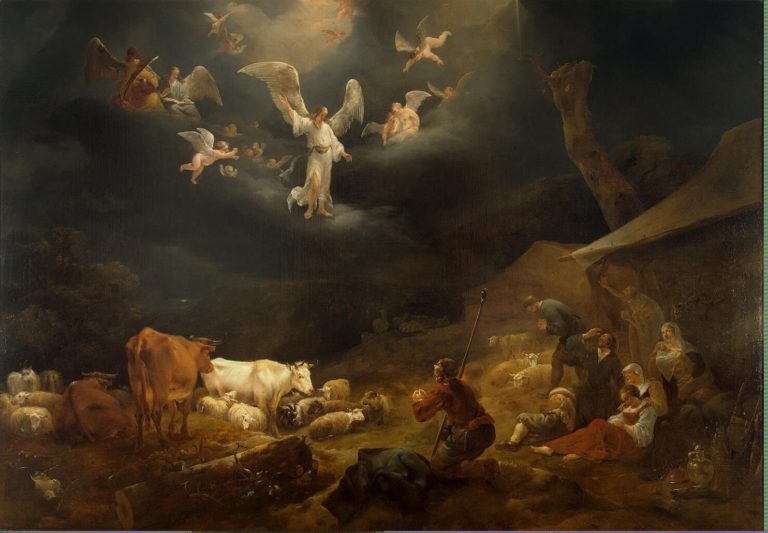
Annunciation-to-the-Shepherds-Berchem-Nicolaes-Pietersz-oil-painting-2-768x533

Annunciation to the Shepherds by Berchem Nicolaes Pietersz

And there were in the same country shepherds abiding in the field, keeping watch over their flock by night. And, lo, the angel of the Lord came upon them, and the glory of the Lord shone round about them: and they were sore afraid. And the angel said unto them, Fear not: for, behold, I bring you good tidings of great joy, which shall be to all people. For unto you is born this day in the city of David a Saviour, which is Christ the Lord. And this shall be a sign unto you; Ye shall find the babe wrapped in swaddling clothes, lying in a manger. And suddenly there was with the angel a multitude of the heavenly host praising God, and saying, Glory to God in the highest, and on earth peace, good will toward men. And it came to pass, as the angels were gone away from them into heaven, the shepherds said one to another, Let us now go even unto Bethlehem, and see this thing which is come to pass, which the Lord hath made known unto us. And they came with haste, and found Mary, and Joseph, and the babe lying in a manger. And when they had seen it, they made known abroad the saying which was told them concerning this child. And all they that heard it wondered at those things which were told them by the shepherds. But Mary kept all these things, and pondered them in her heart. And the shepherds returned, glorifying and praising God for all the things that they had heard and seen, as it was told unto them. Luke 2: 8-20 (KJV)


The Joy of the Holy Spirit

christmas-2017

This is the month, and this the happy morn, Wherein the Son of Heav’n’s eternal King, Of wedded Maid, and Virgin Mother born, Our great redemption from above did bring; For so the holy sages once did sing, That he our deadly forfeit should release, And with his Father work us a perpetual peace. —John Milton, from his poem ‘On the Morning of Christ’s Nativity’

The word Joy is a much-overused in secular communications around Christmas time.  One sees the word frequently on secular Christmas tree ornaments, gift wrapping paper, greeting cards and the like. Joy is an extremely important word for Christians; it appears frequently in the Bible, in both the Old and New Testaments. Galatians 5:22 tells us that joy is a fruit of the Holy Spirit, along with love, peace, forbearance, kindness, goodness, faithfulness, gentleness and self-control (NIV).

According to one Jesuit explanation of this, a fruit of the Holy Spirit is “an observable behavior in people who have allowed the grace of the Holy Spirit to be effective in them.”  With this interpretation, two things become clear.  First, the fruits of the Holy Spirit do not appear automatically once a person accepts Christ as his or her Savior.  To reap the fruits, we must surrender our right to ourselves and allow the Holy Spirit to work in us.  Secondly, Christian joy is not the same as happiness.  Christian joy can be experienced in the midst of pain and sadness. In fact, James 1:2-3 (NIV) tells us, “Consider it pure joy, my brothers and sisters, whenever you face trials of many kinds, because you know that the testing of your faith produces perseverance.”

In Philippians 4:4, the Apostle Paul tells us to “rejoice in the Lord always.” He penned this epistle from prison.   Some people confuse joy with happiness.  They are not the same.  Christian joy comes from within, while happiness stems from external sources.  I’m happy when my wife bakes her famous apple pie.  I’m joyful in the knowledge that Christ is my Savior. I can savor Christian joy even in difficult times, just like Paul writing words of encouragement from prison.

I recently visited a friend who is quickly approaching death. He’s the godfather of my children and a friend of over 35 years. While it was sad knowing I probably won’t see him again in this life, it was also joyful to know that he is secure in his salvation through Jesus Christ and we will see each other again in God’s eternal kingdom.  

But the angel said to them, ‘Do not be afraid. I bring you good news that will cause great joy for all the people. Today in the town of David a Savior has been born to you; he is the Messiah, the Lord. —Luke 2: 10-11

My prayer for you is that you will allow the joy of the Holy Spirit to work in your life. May your heart be filled with the joy and peace of Jesus Christ during this Christmas Season and in the coming New Year!

What can I give Him, poor as I am? If I were a shepherd, I would bring a lamb; If I were a Wise Man, I would do my part; Yet what I can I give Him: give my heart. —Christina Rossetti from her poem ‘In the bleak midwinter’


A Balanced Life

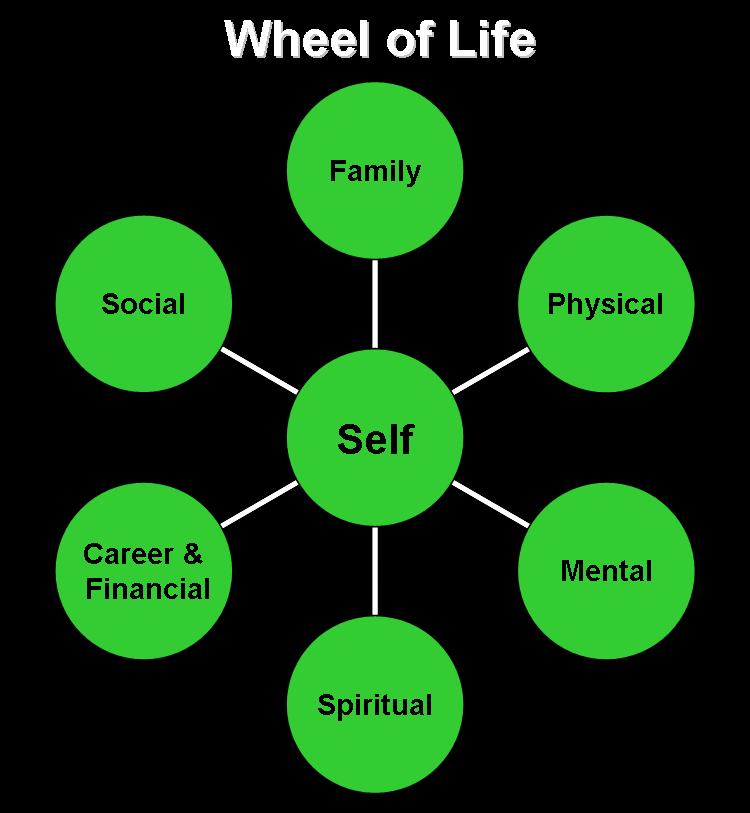
Wheel of Life

The wheel of life graphic above is a tool I used a lot in my past life as a Management Consultant. The purpose of the wheel is to illustrate that people need to balance their activities/involvement in the six life areas depicted in the outer ring of the wheel. If any of these areas is neglected or over-indulged, the wheel (and ergo one’s life) becomes out of balance, which can result in a multitude of personal problems.

Looking at the wheel, some might be inclined to argue that it’s impossible to put too much emphasis on one’s spiritual life. However, renowned Scottish Theologian Oswald Chambers would disagree.  Chambers said:

 Days set apart for quiet can be a trap, detracting from the need to have daily quiet time with God. That is why we must “pitch our tents” where we will always have quiet times with Him, however noisy our times with the world may be. There are not three levels of spiritual life— worship, waiting, and work. Yet some of us seem to jump like spiritual frogs from worship to waiting, and from waiting to work. God’s idea is that the three should go together as one. They were always together in the life of our Lord and in perfect harmony. It is a discipline that must be developed; it will not happen overnight. Oswald Chambers, My Utmost for His Highest

Chambers would agree that days set apart for quiet time, such as for church retreats, spiritual renewal weekends, and even weekly worship services are all good. However, he would caution against letting these become one’s focus for spiritual rejuvenation. These days that are set apart are special times on the “mountain top” when we can see the transfigured Christ in all of his glory. They’re highly spiritual experiences that one hates to see end. 

On the other hand,   Chambers strongly advocates for daily quiet time when one enters God’s “throne room” and learns to commune with God not on the mountain top, but while walking through the demon infested valley below.  Daily quiet time with God is obedience to John 15:4-5 (NIV), which says:

Remain in me, as I also remain in you. No branch can bear fruit by itself; it must remain in the vine. Neither can you bear fruit unless you remain in me. I am the vine; you are the branches. If you remain in me and I in you, you will bear much fruit; apart from me you can do nothing.

The website Vibrant Christian Living recommends three secrets to a daily quite time habit:

#1: Do your quiet time first thing in the morning.  With all the distractions in our lives, this can be difficult, but it will pay big dividends.

#2: Start small and let your quiet times with God Grow.  Quite time is a spiritual discipline that can grow in depth as we become more mature in Christ.

#3: Make your quiet time with God about a life rhythm, not a religious schedule. Focus on how to make quiet time a regular part of your ever changing life. Sometimes you’ll fail, but God is quick to forgive when we ask him.

Worship the Lord with gladness; come before Him with joyful songs.
Know that the Lord is God. It is He who made us, and we are His;
we are His people, the sheep of His pasture.

Enter His gates with thanksgiving and His courts with praise;
give thanks to Him and praise His name.

Psalm 100:2-4 (NIV)

Too much to pray for!

Prayer

Renowned Scottish theologian Oswald Chambers said, ‘Prayer does not equip us for greater works— prayer is the greater work. Yet we think of prayer as some commonsense exercise of our higher powers that simply prepares us for God’s work. In the teachings of Jesus Christ, prayer is the working of the miracle of redemption in me, which produces the miracle of redemption in others, through the power of God.’

The older I grow, the more it seems like I have more to pray for than I can handle.  Is this is a common dilemma for Christians as they grow older?  I’d like to hear from readers who share the same or a similar problem.  

My prayer list is getting too long to manage.  It includes numerous categories including family (spouse, children, grandchildren, siblings, cousins, aunts, uncles, in-laws and extended family members); friends; colleagues at work; clergy; those persecuted for their Christian faith; my church; my former churches; local leaders; state leaders; national leaders; military service members; and even the abused and missing children on the evening TV network news.  Where should I begin praying on a prayer like this?

 I’ve tried ‘checklist’ praying–simply going down the list and asking God’s blessing for each category, but that feels very hollow. I’ve tried lifting up specific prayers for everyone and everything on the list, but my ability to concentrate usually fails after five or 10 minutes into the prayers.  I’ve segmented my prayers to pray for one category at a time on my prayer list.

When Jesus’ disciples asked him to teach them to pray, he gave them (and us) the ‘Lord’s Prayer’. It’s a beautiful model for praying, but should not be the only prayer we pray; one of the purposes of prayer is simply for us to be with God and to listen and experience the glory of his presence. Our Lord’s prayer goes like this:

Our Father who are in heaven (recognition of God’s supreme authority in all creation),

Hallowed be thy name (affirmation of God’s perfect nature),

Thy kingdom come, Thy will be done on Earth as it is in heaven (a petition for God to restore the perfect order on Earth that he has intended since creation),

Give us this day our daily bread (recognition that God sustains us),

And forgive us our trespasses (a plea for God’s forgiveness through Jesus Christ),

As we forgive those who trespass against us (an acknowledgement that we have all sinned and fall short of the glory of God and a reminder to forgive others),

And lead us not into temptation (a plea to God to spare us from testing, as Job, Jesus and so many Christian martyrs have been tested),

But deliver us from evil (protect us from Satanic forces),

For Thine is the kingdom, and the power, and glory forever, amen (a final acknowledgement of God’s supreme authority in all creation).

The Lord’s Prayer is a beautiful way to begin or end any prayer! 

St. Paul’s epistle to the Romans (8:26-27) tells us, ‘…We do not know what we ought to pray for, but the Spirit himself intercedes for us through wordless groans. And he who searches our hearts knows the mind of the Spirit, because the Spirit intercedes for God’s people in accordance with the will of God (NIV).’  I try to apply this wisdom when I’m feeling overwhelmed.  Sometimes my daily prayer is simply, “Holy Spirit, please pray for me and my family.”  I also pray this prayer for individuals, when I feel troubled about/for them, but I don’t know how to pray for them.

One thing I’ve learned is not to pray too much for myself.  When I do pray for myself, it usually entails asking God for forgiveness.  Psalm 51 and the Lord’s Prayer are my ‘go to’ prayers when I pray for myself. They are more than sufficient!

So how should we pray?  I would love to hear your comments and ideas on prayer. Please consider leaving a comment. 

To Be a Christian without prayer is no more possible than to be alive without breathing.    —Martin Luther

Discipline and Discipleship

Discipline - Boot Camp summer 1975Army Boot Camp, July 1975

It was sunny and warm in Louisville, Ky. on June 28, 1975. That’s the day I boarded a bright yellow school bus at an Army recruiting station for a short journey to Fort Knox, where I was scheduled to undergo Army basic training or boot camp as it’s commonly called. Only a few weeks earlier I’d been a bright eyed college student receiving his associate degree in Munich, Germany.  My mother Phyllis and stepfather Ray were still in Germany—Ray was an Army officer and second in command of a tank brigade in Friedberg, about an hour north of Frankfurt.

I had departed Germany in early June to visit family in my home state Kentucky before attending boot camp.  The last stop was Louisville, at the home of my favorite aunt and uncle, Sarah and Carl.  At the end of that wonderful visit, it was Aunt Sarah who drove me to the induction station and hugged me goodbye as I began a nervous, one hour journey to Fort Knox.

After what seemed like hours, the bus turned into the main gate of Fort Knox. Entering the post felt very familiar, as I’d lived there during my freshman and sophomore years of high school while Ray was assigned to the Armor School. The familiarity helped quell my sense of dread that had been increasing steadily since we departed Louisville. The post was sprawling, hilly and hot. The eclectic mix of architecture ranged from a beautiful state-of-the-art hospital to drab three-story concrete barracks to the low slung, pale yellow wooden buildings dating back to World War II.

About ten minutes after entering the post, the bus turned down a side street and then swung into the parking lot of Delta Company, 13th Training Battalion, 4th Training Brigade, home of the ‘Delta Demons’. Peering out the window I could see two tough looking fellows wearing olive drab fatigues and the iconic Smoke Bear hats that identified them as drill sergeants. Their fatigues were starched stiff with creases that looked sharp enough to slice an apple. They fit like gloves. Their boots were polished to a mirror finish. Not a hair was out of place. All you needed was one look at these impressive gentlemen to know that they were pure badass!

The driver opened the bus door and we were greeted by a booming voice.  ‘Off the bus and line up.  Move it ladies’.  After a clumsy exit fumbling with our bags and bumping into each other, we managed to get into something resembling a line. The empty bus quickly pulled away, leaving us feeling isolated and helpless.  It was then that we were introduced to the two gentlemen who would fill the roles of father, mother, confessor and mentor for all of us in the coming weeks.

Staff Sergeant Hunter, the platoon sergeant, stood about five feet ten inches tall.  He was built like an NFL linebacker. Drill Sergeant Hunter was just tall enough that he could press the stiff brim of his Smoky Bear into the bridge of my nose as I stood at attention while receiving his instructions.  The assistant platoon sergeant, Sergeant Anderson, stood about five feet seven inches.  He was lean, wiry and just mean looking. They immediately commanded our attention.

These fine men, as I would learn they both were, taught us so much: military customs and courtesies; how to wear the uniform and properly groom ourselves; how to spit shine a boot; how to polish brass; how to make a bunk; how to roll our socks and underwear and store them in our lockers; how to make a barracks GI clean; how to get physically fit; how to do close order drill; how to march and sing ‘jodies’, those sometimes naughty songs marching troops sing to help them stay in step; how to fire and clean an M-16 rifle; how to fire M-60 and 50 caliber machineguns; how to fire a recoilless rifle; how to throw hand grenades; how to do fire and maneuver without shooting your buddy; how to take out a pillbox; how to use a field telephone and radio; how to give first aid; and how to doctor blisters on our feet.

But most of all, they taught us about how to be soldiers—about responsibility, self-discipline, and respect for country, Army, unit, comrades, family and ourselves.  At first we listened to them out of fear of punishment. One small misstep could lead to running laps around the compound holding your rifle above your head with two arms while yelling ‘I’m a s#!thead’ or the dreaded ‘Drop and give me fifty’, meaning pushups. Even worse, you could end up pulling ‘KP’ in the mess hall, peeling potatoes, dicing onions and mopping floors.   But there came a point in time when we listened out of a sense of respect for our drill sergeants and our fellow soldiers in the platoon.  In the end, a soldier’s sense of responsibility, respect and self-discipline becomes a normal way of life.

It’s easy to learn military discipline in Boot Camp, where you’re isolated, restrained, focused and under the watchful eye of a drill sergeant.  Sadly, developing discipline in one’s spiritual life isn’t so easy.  I often wonder why this is so.  I was the picture of discipline during my military career, yet my Christian discipline suffers. ‘Disciple’ is the root word of discipline.  A disciple is a student or follower who is trained by a teacher and subsequently spreads the teacher’s beliefs.  I had a lot of training and learning as a Christian, but have I ever really been a disciple?  I think not and I believe I’ve finally figured out why. 

In his book, The Spirit of the Disciplines: Understanding How God Changes Lives, the late Christian scholar Dr. Dallas Willard explains that self-transformation stems, in large part, from the practice of spiritual disciplines.  He cites many disciplines, which he divides into two broad categories of ‘abstinence’ and ‘engagement’.

Under abstinence Willard includes chastity, fasting, frugality, sacrifice, secrecy, silence and solitude. These deal with our physical bodies.  Engagement includes celebration, confession, fellowship, prayer, service, study, submission and worship. These deal with our spiritual lives.  The disciplines are the means to an end; just as we practice to learn a sport, we practice the disciplines to become more Christ-like.  Willard provides many scriptural references to the disciplines in the life of Jesus and the Apostles. The abstinence disciplines focus inward and help build self-discipline and restraint; they are about habits.  The engagement disciplines look outward, helping us become servants of Christ and others; they are about building Christian character.  

Using Willard’s criteria, a quick self-analysis reveals that while I’m strong in the engagement disciplines, I have a long way to go in the abstinence disciplines before I can become a true disciple of Christ.  I have a lot of work to do, but I’m going for it.  How do you measure up? Consider leaving a reply.


Bluegrass in my Blood

Pine Mountain Kentucky

Pine Mountain, Kentucky

I was born in the small town of Harlan, deep in the Appalachian Mountains of southeastern Kentucky. Southeastern Kentucky has close ties to parts of western West Virginia, southwestern Virginia; western North Carolina; and eastern Tennessee.  The entire region has a distinct culture that includes its own spoken dialect, cuisine and music. The mountains, culture and good people living there get in your blood and they’re impossible to forget, no matter how long or far one roams.  The regional music, widely known as Bluegrass, traces its roots back to Ireland, Scotland and England.

I find the music particularly enjoyable.  Bluegrass is notable for its combination of stringed instruments—specifically the banjo, mandolin and fiddle. Acoustic guitar and upright bass are common as well.  The music is also notable for many singers who care more about belting out the lyrics than staying in tune.  My affinity for Bluegrass music is something my wife tolerates, but doesn’t quite understand.  I’m particularly fond of the Bluegrass Gospel subgenre.  I grew up hearing it at home, at church and places all around our home.

Gospel Bluegrass tells the story of Jesus Christ as only mountain people can tell it.   If you’re not familiar with this music, it’s only fitting that I introduce you to it with a piece by Bill Monroe, who is commonly recognized as the “Father of Bluegrass.”  Since this is Holy Week, a good place to begin exploring is:

Were you there (when they crucified my Lord), performed by Bill Monroe.  It describes the feelings that many of the onlookers at Jesus’ crucifixion must have felt.

https://youtu.be/5EHP5Nj2BdE

Power in the Blood, performed by Dolly Parton.  It’s impossible to discuss Bluegrass music without the name of Dolly Parton coming up.  Dolly is a Tennessee girl whose voice is perfectly suited for the genre.  Her song of redemption discusses the power of Jesus’ blood to wash away our sins. “There’s power in the blood of the Lamb.”

https://youtu.be/B1CV-HtsMvc

I’m ready to go, performed by Ricky Skaggs and Kentucky Thunder. Ricky Skaggs, a Kentucky native, is a multi-talented musician with a Bluegrass legacy dating back to the days of Lester Flat and Earl Scruggs.  Skaggs’ group Kentucky Thunder has a powerful, fast-paced style.  The group’s rendition of I’m ready to go is about salvation through Jesus Christ.  I promise it’ll get stuck in our head. “Jesus came in and saved my soul from sin, Hallelujah I’m ready to go.”

 https://youtu.be/pjrJKnVmQwQ

The darkest hour is just before dawn, performed by Emmylou Harris. Alabama native Emmylou Harris has proven herself in a variety of genres, including folk, rock, country and Bluegrass.  She slows down the tempo with a Ralph Stanley salvation song. “Lay down your soul, let Jesus in.”

https://youtu.be/_r0FtxqR9Pc

One can’t listen to Gospel Bluegrass without hearing a song about eternal life in heaven that’s promised to Christ’s believers.  Here are two examples.  The Stanley brothers slow it down with their rendition of Angel Band.   Alison Kraus and Gillian Welch pick it up with I’ll Fly Away.

Angel Band, performed by the Stanley Brothers. “Bear me away on your white wings to my immortal home.”

https://www.youtube.com/watch?v=WIHFxIQfSxc

I’ll fly away, performed by Alison Krauss and Gillian Welch. “Some glad morning when this life is o’er, I’ll fly away, to a home on God’s celestial shore.”

https://youtu.be/sdRdqp4N3Jw?list=PL3BDAEBE555FB3CBF

Go Rest High on that Mountain, performed by Vince Gill, Ricky Skaggs, and Alison Krauss. No discussion of Gospel Bluegrass music is complete without Vince Gill’s epic Go Rest High on That Mountain, a song he penned in response to the death of country music singer Keith Whitley. Gill, an Oklahoma boy, is a talented songwriter, singer and guitarist whose work spans Bluegrass, country and rock.  His Bluegrass skills come out in this performance. “Go to heaven a shoutin’ love for the Father and the Son.”

https://youtu.be/NwFiWCUkk4M

So there you go—my guided tour through some of my favorite Bluegrass music that just happens to be Gospel.  If you’re having trouble deciding how to introduce someone to the Gospel message of Jesus Christ, just head to YouTube, Spotify or one of your favorite streaming services and play them some Gospel Bluegrass music.  “Hallelujah, I’m ready to go!”