Archive for the ‘Freedom’ Category

Count Your Blessings

faucet-with-drinking-water                                            Count your many blessings, name them one by one.

                                                                                                  —Johnson Oatman Jr.


Our Daily Bread is one of the daily devotionals I read regularly. A recent piece by David Roper titled Stage by Stage, focuses on the Old Testament book of Numbers 33.  The chapter tells us God commanded Moses to write down the story of the Jews’ 40-year pilgrimage that began with escaping from slavery in Egypt and ultimately took them to the plains of Moab, a strip of land that today is part of Jordan.

Roper speculates that God’s reason for commanding Moses to document this pilgrimage was to allow the Jews to “…retrace that journey in their thoughts and record God’s faithfulness at each location.”  The Seder meal the Jews celebrate to mark the beginning of Passover is closely tied to Numbers 33, which seems to support’s Roper’s argument.  Each course of the Seder meal recalls an event in God’s liberation of the Jews from slavery in Egypt, as told in the book of Exodus.

God is truly faithful and His faithfulness alone is blessing enough—but there are so many additional blessings in our lives if we will simply look for them. Focus determines attitude.  I’m no spring chicken, so I’ve developed a few medical problems over the years, like having four root canals.  What a blessing to have a root canal!  What did people do a hundred years ago?

I could focus on other, more lingering medical problems and quickly become depressed as I grow older.  Instead, I’ve tried to heed the lesson of St. Paul who says in Philippians 4:11 (NIV), “…I have learned in whatever situation I am to be content.”

Focus on the positives in life and you’ll find your blessings. For those of us fortunate enough to live in the United States and other developed countries in the West, it shouldn’t be difficult to compile a long list of blessings. Think about it!

                                              ‘Tis the gift to be simple, ’tis the gift to be free…                                                                             (From “Simple Gifts, a traditional Shaker tune by Elder Joseph Brackett, Jr., 1848)

During my military career I spent some time in Saudi Arabia. Unless you’ve been there, I could never begin to explain how lacking in personal freedom the average Saudi people are.  Saudi Arabia reminds me how blessed we in the Western World are to simply be free.    

Westerners can turn on a faucet and draw a drink of clear, clean water. This truly is a blessing that most people take for granted.  Serving in Somalia when I was in the Army drove the point home, as I watched Somali workers building a bridge drawing water directly from the muddy Juba River and drinking without disinfecting it. I’m frequently reminded of this blessing when I take a drink of cold water.  

Westerners can walk into a grocery store and find food in abundance that, 200 years ago, would have made the great kings of Europe envious.  Here in my hometown of Sioux Falls, S.D., we even have a Christian ministry called The Banquet that serves free meals to anyone who walks in the door—no questions asked (https://thebanquetsf.org/).  

My family and friends are all blessings to me. Proverbs 5:18 tells men to “rejoice in the wife of your youth” (NIV). I’ve been blessed with nearly 40 years of marriage to my wonderful wife who I met when I was 17 years old. We have both been blessed by children and grandchildren.

I have a good number of dear friends, some of whom I’ve known since high school. When I say dear friends, I’m talking about the ones I could easily trust with my money, my house keys, and caring for my children.

One such friend was recently involved in a head on collision.  He was banged up pretty badly, but I’m blessed to still have him around. I have a couple of friends who have died.  I was blessed to have had them in my life. I have another friend who has been blind for life; he taught me what a blessing it is to simply be able to see.

Comedian and actor Bill Murray recently received the Mark Twain Award for humor from the Kennedy Center.  He grew quite emotional during his acceptance speech and closed by saying to the ceremony attendees:  “Look at each other. Look at who we are. Look at how we are all together here right now. Alive! That’s pretty good, right?”

Bill Murray gets it! Do you?

“Many, Lord my God, are the wonders you have done, the things you planned for us. None can compare with you; were I to speak and tell of your deeds, they would be too many to declare.”

                                                                                                                          –Psalm 40:5 (NIV)

Easter 2016 – Resurrection Sunday

“Worthy is the Lamb who was slain, to receive power and wealth and wisdom and might and honor and glory and blessing!”

 Resurrection of Christ by Raphael

The resurrection of Christ by Raphael

 1 Corinthians 15 (ESV), The Resurrection of Christ

15 Now I would remind you, brothers, of the gospel I preached to you, which you received, in which you stand, and by which you are being saved, if you hold fast to the word I preached to you—unless you believed in vain. For I delivered to you as of first importance what I also received: that Christ died for our sins in accordance with the Scriptures, that he was buried, that he was raised on the third day in accordance with the Scriptures, and that he appeared to Cephas, then to the twelve. Then he appeared to more than five hundred brothers at one time, most of whom are still alive, though some have fallen asleep. Then he appeared to James, then to all the apostles. Last of all, as to one untimely born, he appeared also to me. For I am the least of the apostles, unworthy to be called an apostle, because I persecuted the church of God. 10 But by the grace of God I am what I am, and his grace toward me was not in vain. On the contrary, I worked harder than any of them, though it was not I, but the grace of God that is with me. 11 Whether then it was I or they, so we preach and so you believed.

The Resurrection of the Dead

12 Now if Christ is proclaimed as raised from the dead, how can some of you say that there is no resurrection of the dead? 13 But if there is no resurrection of the dead, then not even Christ has been raised. 14 And if Christ has not been raised, then our preaching is in vain and your faith is in vain.15 We are even found to be misrepresenting God, because we testified about God that he raised Christ, whom he did not raise if it is true that the dead are not raised. 16 For if the dead are not raised, not even Christ has been raised. 17 And if Christ has not been raised, your faith is futile and you are still in your sins. 18 Then those also who have fallen asleep in Christ have perished. 19 If in Christ we have hope in this life only, we are of all people most to be pitied.  20 But in fact Christ has been raised from the dead, the firstfruits of those who have fallen asleep.21 For as by a man came death, by a man has come also the resurrection of the dead. 22 For as in Adam all die, so also in Christ shall all be made alive.

 May God bless you and keep you on this holiest of days!

Exercise for the Soul

Exercise

I’m not a big fan of reality TV, but there is one show I really enjoy.  The Biggest Loser is about helping morbidly obese people lose weight and regain their health and vigor. The contestants, all of whom are obese and suffering from multiple weight-related ailments, live at an isolated health compound and work with world class trainers throughout their stay.  It’s fascinating to watch the amount of work Biggest Loser contestants need to correct years of behavior problems like overeating and under exercising.

One phenomenon that is readily evident to viewers of the show is how former athletes—those who at one time were accustomed to vigorous exercise and discipline—seem to progress much faster than those who have never routinely exercised or disciplined their bodies.

Besides weight loss, The Biggest Loser delves into the psychological struggles waged by each contestant. Some succeed, while others never quite make it.  Now in its 10th season, the show has generated a Biggest Loser fitness movement across the country.

Many Americans are dedicated to physical fitness routines. Yet a 2013 study by the Centers for Disease Control and Prevention indicated that 80 percent of American age 18 and above do not exercise sufficiently to maintain good health.

Far fewer practice a discipline of exercise for the soul.  What a shame we can’t seem to find a way to generate a spiritual fitness movement across our country!  For Christians, exercise for the soul is more important than physical exercise, because the Holy Spirit dwells within our bodies, which St. Paul calls, “the temple of the Holy Spirit.” Left neglected, either by sin, complacency or getting buried in the business of day-to-day life, the Holy Spirit cannot speak to us.  Our bodies require daily attention on both the physical and spiritual levels. Prayer must be at the center of attention. Personally, this is an area I’ve struggled with lately.

Popular evangelist and church pastor Rev. David Jeremiah has said, “Prayer is the hard-work business of Christianity, and it nets amazing results.”  German Lutheran pastor and theologian Dietrich Bonhoeffer was very specific in promoting the benefits of prayer, saying,

The entire day receives order and discipline when it acquires unity. This unity must be sought and found in morning prayer. The morning prayer determines the day.”

 Having practiced morning prayer for many years, I appreciate its importance to a Christian’s well being.

St. Ignatius of Loyola, founder of the Jesuit order of Roman Catholicism, was a Spanish knight who lived from 1491 to 1556.  As a young man, Ignatius kept a journal of his quest to grow in unity with God and discern God’s will in his life.  As his experience grew, the journal evolved into a well-defined set of prayers, meditations, reflections, and directions that are known today as the Spiritual Exercises of St. Ignatius.

These exercises are grouped into four stages, described as weeks but not literally seven-day periods, which are designed to be led by a director, or guide.  The Spiritual Exercises are intended to serve as a sort of lesson plan for the individual leading the exercises, not as a guide for individuals.

However, even without a director many aspects of the Spiritual Exercises can be useful to individuals seeking spiritual growth and greater commitment to serving God. This is particularly so for the way the Spiritual Exercises approach prayer through meditation and contemplation.

Meditation involves praying about the good and bad words, images and ideas that guide our lives.  Contemplation is emotion-driven, rather than thought-driven.  It focuses on placing ourselves in scenes from the Gospel and trying to imagine how it might have been.  Contemplation is praying through scripture rather than studying scripture.

One of the key elements of the Spiritual Exercises is the discernment of spirits.  According to St. Ignatius, the human spirit is influenced by three forces: an inward focus on self and selfish desires; Satanic power and suggestions; and God-inspired power and suggestions. Ignatius called these the “spiritual motions.”  The purpose of discernment is to discover the source of each spiritual motion in our lives, so as to help us help make good decisions.

Many contestants on The Biggest Loser reach so-called plateaus—a weight they just can’t seem to get below.  To overcome this barrier, they change their daily exercise routines, doing something different to restart the weight loss trend.

The same approach can be applied to spiritual exercises.  I do a fair job of exercising my body, but lately I’ve felt like my prayer life has slumped—I’ve hit a plateau.  I have difficulty concentrating and find my mind wandering when I pray. In the remaining days before the beginning of Advent, I plan to try a new prayer regimen built around the Spiritual Exercises of St. Ignatius Loyola.  Have you hit a prayer plateau?  Perhaps it’s time to change your exercise routine for the soul.

 “Prayer is exhaling the spirit of man and inhaling the spirit of God.”

                                                                                       Edwin Keith

An English text of the Spiritual Exercises of St. Ignatius Loyola is available online at: http://www.jesuit.org/jesuits/wp-content/uploads/The-Spiritual-Exercises-.pdf.  The Website “Ignatian Spirituality,” a service of Loyola University Press, was the primary source for this blog entry (www.ignatianspirituality.com).

Memorial Day 2014

?????????????????????????????????????????????????????????????????????????????????????????????????????????????????????????????????????????????????????????????????????????????????????????????????????????????????????????????????????????????????????????????????????????????????????????????????????????????????????????????????????????????????????????????????????????????????????????????????????????????????????????????????????????Memorial Day isn’t just another three-day weekend!

In Flanders Fields

by Lt. Col. John McCrae, MD (1872-1918) 
    Canadian Army, World War I

In Flanders Fields the poppies blow
Between the crosses row on row,
That mark our place; and in the sky
The larks, still bravely singing, fly
Scarce heard amid the guns below.

We are the Dead. Short days ago
We lived, felt dawn, saw sunset glow,
Loved and were loved, and now we lie
In Flanders fields.

Take up our quarrel with the foe:
To you from failing hands we throw
The torch; be yours to hold it high.
If ye break faith with us who die
We shall not sleep, though poppies grow
In Flanders fields.

Tommy

by Rudyard Kipling

I went into a public-‘ouse to get a pint o’ beer,

The publican ‘e up an’ sez, “We serve no red-coats here.”

The girls be’ind the bar they laughed an’ giggled fit to die,

I outs into the street again an’ to myself sez I:

O it’s Tommy this, an’ Tommy that, an’ “Tommy, go away”;

But it’s “Thank you, Mister Atkins”, when the band begins to play,

The band begins to play, my boys, the band begins to play,

O it’s “Thank you, Mister Atkins”, when the band begins to play.

I went into a theatre as sober as could be,

They gave a drunk civilian room, but ‘adn’t none for me;

They sent me to the gallery or round the music-‘alls,

But when it comes to fightin’, Lord! they’ll shove me in the stalls!

For it’s Tommy this, an’ Tommy that, an’ “Tommy, wait outside”;

But it’s “Special train for Atkins” when the trooper’s on the tide,

The troopship’s on the tide, my boys, the troopship’s on the tide,

O it’s “Special train for Atkins” when the trooper’s on the tide.

Yes, makin’ mock o’ uniforms that guard you while you sleep

Is cheaper than them uniforms, an’ they’re starvation cheap;

An’ hustlin’ drunken soldiers when they’re goin’ large a bit

Is five times better business than paradin’ in full kit.

Then it’s Tommy this, an’ Tommy that, an’ “Tommy, ‘ow’s yer soul?”

But it’s “Thin red line of ‘eroes” when the drums begin to roll,

The drums begin to roll, my boys, the drums begin to roll,

O it’s “Thin red line of ‘eroes” when the drums begin to roll.

We aren’t no thin red ‘eroes, nor we aren’t no blackguards too,

But single men in barricks, most remarkable like you;

An’ if sometimes our conduck isn’t all your fancy paints,

Why, single men in barricks don’t grow into plaster saints;

While it’s Tommy this, an’ Tommy that, an’ “Tommy, fall be’ind”,

But it’s “Please to walk in front, sir”, when there’s trouble in the wind,

There’s trouble in the wind, my boys, there’s trouble in the wind,

O it’s “Please to walk in front, sir”, when there’s trouble in the wind.

You talk o’ better food for us, an’ schools, an’ fires, an’ all:

We’ll wait for extry rations if you treat us rational.

Don’t mess about the cook-room slops, but prove it to our face

The Widow’s Uniform is not the soldier-man’s disgrace.

For it’s Tommy this, an’ Tommy that, an’ “Chuck him out, the brute!”

But it’s “Saviour of ‘is country” when the guns begin to shoot;

An’ it’s Tommy this, an’ Tommy that, an’ anything you please;

An’ Tommy ain’t a bloomin’ fool — you bet that Tommy sees!


In the Company of Others

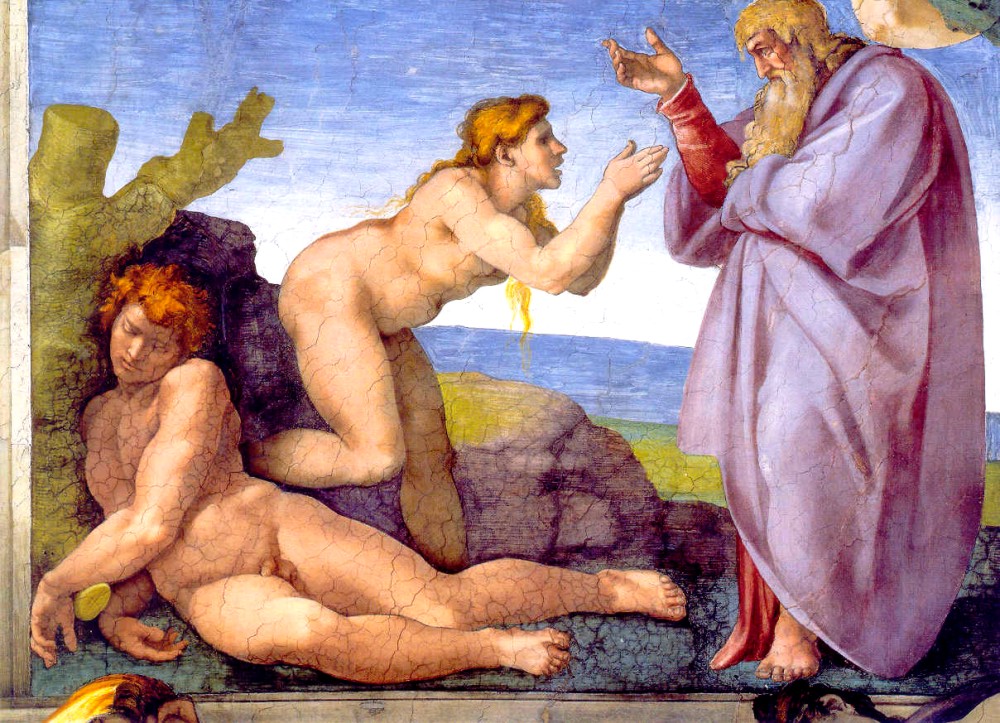
Creation of Eve in Gen_02-22 by Michelangelo

  The Creation of  Eve by Michaelangelo

Several children’s lives remain in peril in the wake of a stabbing spree in a suburban Pittsburgh high school.  On April 9, a 16 year old male student, for reasons still unknown, randomly stabbed a school guard and 21 fellow students as he quickly moved through the school’s hallways wielding a steak knife in each hand. Miraculously, no one has died from his wounds.

The incident is yet another chapter in a string of senseless acts of  violence in American schools that includes mass killings at Columbine High School in Littleton, Co.; Virginia Tech University in Blacksburg, Va. (2007); and Sandy Hook Elementary School in Newton, Ct. (2012).  Unfortunately, there are several others I have not listed here.  In almost every case there is a common thread—the perpetrator was a loner. Whether this was the case in the attacks in Pittsburgh has yet to be determined.

Medical studies abound indicating that loneliness and isolation are health risks.  Social interaction, on the other hand, can improve health.  It has been scientifically shown to decrease the likelihood of premature death, improve the immune system’s response to infection and decreases inflammation in the body.

Regardless of the task at hand, be it raking the lawn, preparing a meal, searching for a new job, or simply going to see a movie or museum, it is usually a better experience when done with another.

There is also plenty of Biblical evidence indicating isolation is not good.   In Genesis chapter 2, God declares, “It is not good for the man to be alone.”  He then creates Eve to be Adam’s mate, companion and friend.

In Exodus chapter 18, Moses is extremely weary because he tries to govern the Jewish people by himself.  His father-in-law Jethro advises Moses to appoint judges to help him with his tasks.  Moses wisely takes the advice, relieving him of the heavy burden of trying to go it alone.

Ecclesiastes 4:9-12 (NIV), tells us, Two are better than one, because they have a good reward for their toil.  For if they fall, one will lift up his fellow. But woe to him who is alone when he falls and has not another to lift him up!  Again, if two lie together, they keep warm, but how can one keep warm alone?  And though a man might prevail against one who is alone, two will withstand him—a threefold cord is not quickly broken.”  There truly is strength in numbers.

Isolation is particularly risky for Christians.  Pastor Paul David Tripp discusses the perils of isolation for the clergy in his book titled, Dangerous Calling: Confronting the Unique Challenges of Pastoral Ministry. According to Tripp’s research, many pastors feel lonely and isolated.  A study by the Schaffer Institute showed that over 1,700 pastors leave the ministry every month. Seventy percent of pastors constantly fight depression. Eighty percent of believe their pastoral work has negatively affected their families.  However, feelings of loneliness and isolation are not limited to members of the clergy.

Christians are all members of God’s church on Earth.  1 Corinthians:12 describes how individual Christians, each blessed with different gifts from God, are necessary for the proper functioning of the church. Each body part serves the others.  Christians were designed by God to function best when working with and in the presence of other Christians.

Acts 17:1-2 says it was Paul’s custom to go to the synagogue on the Sabbath day.  Luke 4:16 tells us it was Jesus’ custom to go to the synagogue on the Sabbath day.   When Paul won new converts to the faith, he gathered them into small churches, which usually met in private homes.

With so many examples before us, how can Christians do otherwise?  Yet many choose not to attend church, insisting they can worship God on their own. Many have turned sour towards the church because of some sort of hurt they experienced there.

On the night when he was betrayed by Judas, Jesus told his disciples, “A new commandment I give to you, that you love one another: just as I have loved you, you also are to love one another.  By this all people will know that you are my disciples, if you have love for one another.”  (John 13:34-34, ESV)  Obeying this commandment requires reaching out to other people.  It cannot be done living in isolation.

Hebrews 10: 24-25 (ESV) tells us, “And let us consider how to stir up one another to love and good works, not neglecting to meet together, as is the habit of some, but encouraging one another, and all the more as you see the day drawing near.”

If you’re a Christian, attending church isn’t simply that you need the church; the church needs you as well!  Fellow believers can be blessed by your participation in ways you’ll never know. Likewise, you will be blessed by just “hanging out” with your brothers and sisters in Christ.  A church is not a building; it is a collection of people who gather together to seek God.  Don’t try to go it alone.  It will lead to loneliness and isolation.  Choose to participate!

“Despite the slowness, the infidelity, the errors and sins it committed and might still commit against its members, the Church, trust me, has no other meaning and goal but to live and witness Jesus.”

                                                                                                                                                     —Pope Francis

Recalling Some Life Lessons

Traffic Jam

Normal is getting dressed in clothes you buy for work and driving through traffic in a car that you are still paying for – in order to get to the job you need to pay for the clothes and the car, and the house you leave vacant all day so you can afford to live in it.   ―Ellen Goodman

Time has been called “a great healer” because it helps ease the pain of physical and emotional wounds.  Unfortunately, time also sometimes causes us to forget some of the best lessons life teaches—lessons we ought to have held on to.

Such was the case for a life lesson I recently recalled—something I originally learned while serving as a Civil-Military Operations Officer in southern Somalia some 20 years ago.

In 1993, Somalia was engulfed in civil war, much like today.  One day I visited a refugee camp run by the United Nations. Hundreds of Bantu people were housed there in small, igloo-like huts made from long bent sticks covered with plastic sheeting.

???????????????????????????????

The Bantus were brought to Somalia as slaves in the 19th century and remain so to this day. They are a small people of very different ethnicity and appearance than the Somalis.

The Bantus I saw that day were living in absolute squalor. Yet despite their situation they seemed remarkably happy.  When I asked a UN worker about the reason for the Bantus’ apparent joy, he provided a life lesson.  “These people were once slaves,” he said, “but now they’re free, well fed and together.”  The things they held dearest were freedom, family and a full belly.  They enjoyed all of these in the squalid camp where they were living.

Over the course of my time in Somalia and several other deployments during my Army career, I learned other lessons about how little we humans truly need.  For months at a time I lived with no possessions beyond what would fit in my rucksack and duffel bag.

With no car to wash, no lawn to mow, no gutters to clean, no leaves to rake, no Internet, no TV and no long commute to work, one has freedom to discover the gift of time.  Personal productivity can increase significantly in such situations, as can relaxation and renewal.

My unscientific observations suggest that as possessions increase, freedom decreases. A multitude of possessions tend to chip away at the gift of time. While I am not a practicing minimalist, I do believe it would behoove most Americans to consider reducing their material possessions.  Garages were designed for cars, not unopened moving boxes. The primary purpose of an attic is to allow proper ventilation of a house, not to store a lot of stuff.   According to the Wall Street Journal, only about 20 percent of the clothes in a person’s closet are regularly worn. You get the picture.

Relearning Some Past Life Lessons

After each long military deployment, I returned home with renewed enthusiasm for life and a deeper appreciation for my freedom, family and the many blessings God had given us. Unfortunately, the enthusiasm and appreciation always slowly faded as I became increasingly re-engaged in the daily, mundane distractions of life and work. After awhile, many life lessons just seem to vanish.  Some of us are fortunate enough to be have an opportunity to relearn some of them.

About a year ago, two major changes in my life occurred.  First, my wife and I moved from a house in Johnstown into a condo near Pittsburgh. Then, only four weeks later, I lost my job.

I had wanted more free time and I got it.  Sometimes God has a real sense of humor!

Laughing Jesus

Two of the main reasons we moved into a condo were to reduce our material possessions and to escape the workload that accompanies owning and maintaining a house. We simply wanted more freedom to do the things we enjoy.  Losing my job wasn’t part of the plan.

However, over the course of the past year I’ve relearned some valuable life lessons, ones I should never have forgotten.

First of all, I remembered that I really don’t need a lot to make me happy.  We have a lot less space and a lot fewer possessions than a year ago, but we also have more time and more freedom to enjoy life.  It has been a great tradeoff—so much, in fact, that my wife and I are already discussing another major downsizing.

Living without abundance makes one more aware of God’s daily provisions.  Instead of asking Him for specific blessings, I’ve learned to pray each day that God will provide my family and me just enough to satisfy our needs and that His perfect will may be done in our lives.

During the past year I also remembered how little it takes to make me truly happy.  We have adjusted to living on my military pension, something that seemed nearly impossible a year ago.  I also have remembered that it doesn’t take much more than my freedom, family and a full belly to make me happy–just like the joyful Bantu people I observed in Somalia many years ago,

Well, there is one other thing. The gift of time has allowed me to dig deeper into the Scriptures than ever before, bringing me closer to the only true source of joy. As the Rev. Dr. Sam Storms so clearly explains, “Joy is not necessarily the absence of suffering, it is the presence of God.”

May you find true joy and peace in your pilgrim’s journey!

“Lay not up for yourselves treasures upon the earth, where moth and rust consume, and where thieves break through and steal: but lay up for yourselves treasures in heaven, where neither moth nor rust doth consume, and where thieves do not break through nor steal: for where thy treasure is, there will thy heart be also.”  —Matthew 6:19-21 (ASV)

Winning Isn’t the Goal

Wrestling

“Defenders of the faith are inclined to be bitter until they learn to walk in the light of the Lord. When you have learned to walk in the light of the Lord, bitterness and contention are impossible.” —Oswald Chambers

If maintenance on a house is neglected for years, the house eventually becomes derelict.  Once a house has been neglected for too long, the owner is faced with two choices: save it by performing a costly renovation or simply demolish it and haul away the rubble.

Saving a house through renovation requires a sizeable investment of time, patience, and tender loving care—not to mention the monetary investment. Demolition, on the other hand, is the easiest path.  It simply requires that the house be vacated and demolished.  It is faster than renovation and usually much cheaper, but in the end there is no shelter remaining.

According to my unscientific observations, in many ways modern Christianity is like a house that has become derelict. The greatest threats to this house (the Church) come not from the outside, but from the inside where in many places the foundation is crumbling and the framework is rotting.  Just like a real house, repairing the damage the Church has suffered in recent years, much of it self-inflicted, will take a large amount of time, patience and tender loving care.  The Church today needs a major renovation.

Many Christians are disturbed, even outraged by social changes they perceive as threats to their religion.  Some of the most controversial perceived threats are the gay marriage movement, the “pro choice” abortion rights movement, prohibitions on prayer in public schools and prohibitions on the display of the Ten Commandments and other religious symbols on public property. There are many, many other examples, but these four seem to frequently make the news.

Some Christians have become activists against these perceived threats. While activism aimed at keeping the government from encroaching on the freedom of religion is certainly appropriate, Christians must be careful to follow in Christ’s footsteps and show love to those who disagree with them and even to those who might hate them!

Some Christian activists exude anger and hate, contrary to Christ’s teachings. In isolated instances, there has even been violence and threats of violence. Extreme examples of activism, like that displayed by the Westboro Baptist Church in Topeka, Kansas, have made national headlines and are harmful to Christianity as a whole.  Members of this church have adopted a radical anti-gay stance that includes picketing funerals carrying signs declaring “God hates fags.”  The church’s website claims its members have participated in over 50 thousand pickets.

While the Westboro example is extreme, there are many other examples where Christian churches have become embroiled in nasty political battles. Rather than worrying about perceived threats from the outside, Christians would benefit more from focusing on the real threats from within the church.  Indeed, we see that much of the hate and anger exuded by some Christians today is directed towards fellow believers, as denominational infighting is ripping many mainstream denominations apart. How can we expect the lost to listen to us when they see the shameful behavior Christians display towards one another?  How can we hope to convince them we offer a better way?

In Revelation 2:3-4 (NIV), Jesus admonished the church in Ephesus for “having left your first love,” indicating the church needed to get back to the basics.  This ties in directly with Colossians 3:8 (NIV), where St. Paul tells us to put away anger, wrath, and malice; instead, he says in verse 12, we must, “…put on tender mercies, kindness, humility, meekness, longsuffering.”  This is the model Christ gave his followers through many examples in his own life; it is the model Christians should adhere to in our actions towards believers and nonbelievers alike.

Far from trying to overturn Roman rule, as many Jews had hoped he would, Jesus did not resist Rome’s temporal authority. When asked whether the Jews should pay taxes to Rome, Jesus replied, “Give back to Caesar what is Caesar’s, and to God what is God’s.” (Matthew 22:21 NIV)

When interrogated by Pontius Pilate, the cruel Roman Governor of Judea, Jesus did not question Pilate’s authority.  Instead Jesus told the man who could release Him or order His crucifixion, “My kingdom is not of this world. If My kingdom were of this world, My servants would fight, so that I should not be delivered to the Jews; but now My kingdom is not from here.” (John 18:36 NIV) Afterwards, when addressing the Jewish leaders who had delivered Jesus to him to be crucified, Pilate said of Jesus, “I find no basis for a charge against him.” (John 18:38 NIV)

Around 312 A.D, during the reign of Emperor Constantine, Rome recognized Christianity as a legal religion.   This remarkable feat, going from persecuted underground church to a legal religion recognized by the Empire, was accomplished not through violent revolution, but by years of adhering to the tenets of the faith while suffering terrible persecution.

It was not political activism that ultimately convinced Rome to accept Christianity, but perseverance and faithfulness to Christ’s teachings by the early Christians. The tender mercies, kindness, humility, meekness, and longsuffering displayed by Christians prevailed over Roman cruelty and oppression.

John 3:17 (NIV) tells us, “…God did not send His Son into the world to condemn the world, but that the world through Him might be saved.” Will the modern Christian Church continue to demolish itself from within or will it choose the more difficult path and renovate?  In the meantime, will the Church show hatred and cruelty towards those it disagrees with, or will it win them over in the manner that Christ commanded?

When you come across someone you disagree with, or someone whose behavior you condemn lying injured by the side of the road, what will you do?  Will you stop to give help or simply cross the road and pass by on the opposite side? Jesus answered this question in the parable of the Good Samaritan. (Luke 10:25-37)

If we are commanded to so show so much concern for a stranger’s physical wellbeing, shouldn’t we care even more about his or her spiritual welfare?  Think about this the next time you become angered by something in our changing society or something in Christ’s Church.

Our time would be better spent repairing our own house than trying to demolish the house of our neighbor.  Remember that the kingdom we serve is not of this world (John 18:36).  Winning arguments with those we disagree with isn’t the goal of Christianity—the goal is winning souls for Christ.

Ephesians 5:2 (NIV) tells us,Walk in love, as Christ also has loved us and given Himself for us, an offering and a sacrifice to God.”  If more Christians would focus on doing this, everything else would simply fall into place.   

Freedom Isn’t Free!

Memorial Day Flags

           Freedom isn’t free!

As a retired soldier, Memorial Day is always a special day of remembrance for me.  My stepfather and a dear friend, both of whom were also soldiers, lie buried only a few paces apart in Arlington National Cemetery, alongside thousands of our departed comrades.  It is good that we occasionally pause to remember those who served our country.

But as we memorialize departed comrades, may we never forget the true price of freedom.  No Soldier, Sailor, Airman or Marine died to set mankind free. It was a simple carpenter who walked the shores of Galilee some two thousand years ago.  Jesus paid it all!

Greater love has no one than this, than to lay down one’s life for his friends.  John 15:13 (NIV)

Jesus Crucified“For God so loved the world that he gave his only begotten son, that whosoever believes in him shall not perish, but have everlasting life.” John 3:16: NIV