Archive for the ‘forgiveness’ Category

A Heart of Stone

Heart of Stone

Political discourse in America today has become vitriolic — constant lying, name-calling, bickering, accusations and spewing pent up anger. Indeed it has gotten so bad that even the president has joined the fray.  Social media outlets like Twitter, Instagram and Facebook only serve to exacerbate the situation, as they have become bully pulpits for angry politicians and journalists.  It’s gotten to the point where I dread looking at social media or reading/listening to the news, as there is a paucity of objective discussion and reporting everywhere. Personal civility and decorum in America is rapidly declining, particularly in the political realm.  

           Gracious words are a honeycomb, sweet to the soul and healing to the bones.                                           –Proverbs 16:24*

 Words are like bullets—once they’re let fly there’s no taking them back. The Epistle of James calls the tongue “a restless evil, full of deadly poison” (James 3:8).  By using this  strong comparison, James emphasizes that Christians must be mindful of the colossal power of what proceeds from their mouths.  The epistle goes on to note the inconsistency of praising God with one breath and cursing people made in God’s image with the next (vv. 9–10). Words can demean and destroy.

When you have learned to walk in the light of the Lord, bitterness and contention are impossible.”  —Oswald Chambers

This leads me to ask the question, “How radically would America change if suddenly all the politicians who profess to be Christians started behaving like Christ followers, becoming beacons of light in the dark political landscape?”

In January 2017, the New York Times reported that 91 percent of the new Congress identified as Christian.1 The Times went on to say that this figure was only slightly less than the 95 percent reported in 1961. Allmost all US presidents, including President Trump, have been Christians according to Pew Research.2

Christianity isn’t a label or tag; it’s a life, guided by the Holy Spirit, where an individual endeavors to be Christ-like in thoughts, words and deeds.  Inevitably, all Christians transgress and fall short of the glory of God along the way, but striving towards the ultimate goal of Christ-likeness remains a constant.

Restoration and transformation are two recurring themes in the Book of Ezekiel. Restoration is displayed in God saving the people of Israel from bad shepherds, giving them societal safety, reuniting tribes, and God’s children being restored to a right relationship with Him.  God’s ultimate restoration of his people is exemplified by Jesus’ crucifixion and resurrection. 

On the other hand, Ezekiel describes transformation as a personal, spiritual experience. To the ancient Hebrews, the heart was the locus of a person’s being, their mental processes, emotions and personal will. The Miriam Webster Dictionary defines hard-hearted as, “having or showing no kindness or sympathy for other people.”  In the passage from Ezekiel 36 below, evidence of spiritual transformation in God’s children is the softening of their hearts. 

I will give you a new heart and put a new spirit in you; I will remove from you your heart of stone and give you a heart of flesh. And I will put my Spirit in you and move you to follow my decrees and be careful to keep my laws.  —Ezekiel 36:26-27

One of those laws referred to in the Ezekiel passage is, “Love the Lord your God with all your heart and with all your soul and with all your strength. (Deuteronomy 6:5). Jesus quotes this verse in Mark 30:5, after being asked, “What is the greatest commandment?” In the next verse, Mark 30:6, Jesus adds to this, “Love your neighbor as yourself. There is no commandment greater than these.”   

This brings me back to politics.  Christians who also happen to be politicians don’t get a free pass when it comes to loving their neighbors.  Christian politicians contributing to the Capitol Hill vitriol need to take a long look in the mirror and ask themselves whether their actions glorify God. Are they being patient, humble, pure and obedient to God?

In Colossians 3:8, Paul tells us to put away anger, wrath, and malice; instead, he says in verse 12, we must, “…put on tender mercies, kindness, humility, meekness, longsuffering.”  This is the model Christ gave his followers through many examples in his own life; it’s the model all Christians should strive to adhere to in their actions towards believers and nonbelievers alike.

Christian politicians should display a Christ-like heart—Ezekiel’s “heart of flesh.”  Christians behaving like Christ can bring real healing transformation. Around 312 A.D, during the reign of Emperor Constantine, Rome recognized Christianity as a legal religion.   This remarkable feat, going from persecuted underground church to a legal religion, recognized by the Empire, was accomplished not by violent revolution, but through years of adhering to the tenets of the faith while suffering terrible persecution.

It was not political or military power that ultimately convinced Rome to accept Christianity, but the perseverance and faithfulness to Christ’s teachings by the early Christians. The tender mercies, kindness, humility, meekness, and longsuffering displayed by Christians prevailed over Roman cruelty and oppression. American politicians could achieve a lot by following their example.

 Most merciful God, we confess that we have sinned against you in thought, word, and deed, by what we have done, and by what we have left undone. We have not loved you with our whole heart; we have not loved our neighbors as ourselves. We are truly sorry and we humbly repent. For the sake of your Son Jesus Christ, have mercy on us and forgive us; that we may delight in your will, and walk in your ways, to the glory of your Name. Amen.  —from an Anglican Prayer of Confession

 1 https://www.nytimes.com/2017/01/03/us/politics/congress-religion-christians.html

2 https://www.pewresearch.org/fact-tank/2017/01/20/almost-all-presidents-have-been-christians/

* All Bible quotes are taken from the NIV Bible.


Easter 2019

hand-drawn-he-has-risen-luke-24-6-text-on-white-vector-20468630

My Superhero

Superheroes

Superheroes are all the rage these days.  They’re winning at the box office with blockbuster movies like “Wonder Woman,” “Black Panther”  “Aquaman” and yet another new episode in the Spiderman series.  Older superheroes like Superman and Batman remain tremendously popular too.

With Christmas approaching, the aisles of toy stores and toy departments are lined with superhero kitsch, mainly over-hyped, over-priced superhero-themed stuff that will make the kiddies giggle on Christmas morning and eventually be tossed into a corner with a dozen similar forgotten toys.  Superhero figures also fill the pages of comic books; some of these books are sold for incredible amounts of money—literally worth their weight in gold.

Many adults and kids alike are attracted to these imaginary superheroes, yet they pay little attention to a real superheroes in their midst.  This superhero is powerful.   He is fearless and always defeats his many enemies.  He never makes mistakes. He can’t be outsmarted. He never tells a lie. He is a clear thinker and never loses his cool. Millions of people have purchased figurines of the real superhero.

So far the real superhero sounds about the same as the imaginary ones doesn’t he?  However, there are really many differences between my superhero and the imaginary ones.

Unlike the imaginary superheroes, my superhero isn’t handsome.  According to one writer, there’s nothing about his appearance one would find particularly attractive.  The same writer described my superhero as a sad man. He doesn’t sound very exciting or charismatic does he?   

My superhero did the unthinkable.  He surrendered to the enemy!  Only a short time after his surrender he was violently put to death and buried in a tomb.  End of story?  Not quite!

My superhero has performed many miracles. He turned plain water into wine and controls all of nature. He gives sight to the blind and makes the lame walk again.  He can control the wind and the sea, calming storms and raging waves. He can walk on water. 

Headline:  Man surrenders himself in exchange for hostages.  Billions saved!

Yes, my superhero surrendered to the enemy, but it was done voluntarily. He freely sacrificed himself to free billions of hostages.  He was put to death by the enemy, but he rose from the dead after three days and now lives forever.  He has already raised men from the dead and will raise many more in the future. 

My superhero doesn’t wear a mask, he wears a golden crown.  He has been called the King of Kings, Lord of Lords, and the Prince of Peace. He is Immanuel—God with us, fully man and fully God! His name is Jesus. During this period of Advent Christians around the world reflect on the promised return of their Savior.  The book of Revelation describes him like this:

I saw heaven standing open and there before me was a white horse, whose rider is called Faithful and True. With justice he judges and wages war. His eyes are like blazing fire, and on his head are many crowns. He has a name written on him that no one knows but he himself. He is dressed in a robe dipped in blood, and his name is the Word of God.  –Revelation 19:11-13 (NIV)

The first chapter of the Gospel of John tells us that Jesus, the “Word of God” is the author of all creation.  All things were made by Him: 

In the beginning was the Word, and the Word was with God, and the Word was God. He was with God in the beginning. Through him all things were made; without him nothing was made that has been made. In him was life, and that life was the light of all mankind.  The light shines in the darkness, and the darkness has not overcome it.  –John 1:1-5 (NIV)

Darkness has never overcome my superhero and it never will.  He cannot be defeated.  Jesus sacrifice of himself defeated sin and death forever.  Jesus offers redemption freely to those who claim him as savior. His story is told in this passage of the Nicene Creed:

We believe in one Lord, Jesus Christ,

the only-begotten Son of God,

eternally begotten of the Father,

God from God, Light from Light,

true God from true God,

begotten, not made,

of one Being with the Father;

through Him all things were made.

 For us and for our salvation He came down from heaven,

was incarnate from the Holy Spirit and the Virgin Mary,

and was made man.

 For our sake he was crucified under Pontius Pilate;

he suffered death and was buried.

 On the third day He rose again in accordance with the Scriptures;

He ascended into heaven and is seated at the right hand of the Father.

 He will come again in glory to judge the living and the dead,

and his kingdom will have no end.

Now that’s what a real Superhero looks like!

…to him who loves us and has freed us from our sins by his blood, and has made us to be a kingdom and priests to serve his God and Father—to him be glory and power for ever and ever! Amen.  –Revelation 1: 5b-6 (NIV)

Too much to pray for!

Prayer

Renowned Scottish theologian Oswald Chambers said, ‘Prayer does not equip us for greater works— prayer is the greater work. Yet we think of prayer as some commonsense exercise of our higher powers that simply prepares us for God’s work. In the teachings of Jesus Christ, prayer is the working of the miracle of redemption in me, which produces the miracle of redemption in others, through the power of God.’

The older I grow, the more it seems like I have more to pray for than I can handle.  Is this is a common dilemma for Christians as they grow older?  I’d like to hear from readers who share the same or a similar problem.  

My prayer list is getting too long to manage.  It includes numerous categories including family (spouse, children, grandchildren, siblings, cousins, aunts, uncles, in-laws and extended family members); friends; colleagues at work; clergy; those persecuted for their Christian faith; my church; my former churches; local leaders; state leaders; national leaders; military service members; and even the abused and missing children on the evening TV network news.  Where should I begin praying on a prayer like this?

 I’ve tried ‘checklist’ praying–simply going down the list and asking God’s blessing for each category, but that feels very hollow. I’ve tried lifting up specific prayers for everyone and everything on the list, but my ability to concentrate usually fails after five or 10 minutes into the prayers.  I’ve segmented my prayers to pray for one category at a time on my prayer list.

When Jesus’ disciples asked him to teach them to pray, he gave them (and us) the ‘Lord’s Prayer’. It’s a beautiful model for praying, but should not be the only prayer we pray; one of the purposes of prayer is simply for us to be with God and to listen and experience the glory of his presence. Our Lord’s prayer goes like this:

Our Father who are in heaven (recognition of God’s supreme authority in all creation),

Hallowed be thy name (affirmation of God’s perfect nature),

Thy kingdom come, Thy will be done on Earth as it is in heaven (a petition for God to restore the perfect order on Earth that he has intended since creation),

Give us this day our daily bread (recognition that God sustains us),

And forgive us our trespasses (a plea for God’s forgiveness through Jesus Christ),

As we forgive those who trespass against us (an acknowledgement that we have all sinned and fall short of the glory of God and a reminder to forgive others),

And lead us not into temptation (a plea to God to spare us from testing, as Job, Jesus and so many Christian martyrs have been tested),

But deliver us from evil (protect us from Satanic forces),

For Thine is the kingdom, and the power, and glory forever, amen (a final acknowledgement of God’s supreme authority in all creation).

The Lord’s Prayer is a beautiful way to begin or end any prayer! 

St. Paul’s epistle to the Romans (8:26-27) tells us, ‘…We do not know what we ought to pray for, but the Spirit himself intercedes for us through wordless groans. And he who searches our hearts knows the mind of the Spirit, because the Spirit intercedes for God’s people in accordance with the will of God (NIV).’  I try to apply this wisdom when I’m feeling overwhelmed.  Sometimes my daily prayer is simply, “Holy Spirit, please pray for me and my family.”  I also pray this prayer for individuals, when I feel troubled about/for them, but I don’t know how to pray for them.

One thing I’ve learned is not to pray too much for myself.  When I do pray for myself, it usually entails asking God for forgiveness.  Psalm 51 and the Lord’s Prayer are my ‘go to’ prayers when I pray for myself. They are more than sufficient!

So how should we pray?  I would love to hear your comments and ideas on prayer. Please consider leaving a comment. 

To Be a Christian without prayer is no more possible than to be alive without breathing.    —Martin Luther

Bluegrass in my Blood

Pine Mountain Kentucky

Pine Mountain, Kentucky

I was born in the small town of Harlan, deep in the Appalachian Mountains of southeastern Kentucky. Southeastern Kentucky has close ties to parts of western West Virginia, southwestern Virginia; western North Carolina; and eastern Tennessee.  The entire region has a distinct culture that includes its own spoken dialect, cuisine and music. The mountains, culture and good people living there get in your blood and they’re impossible to forget, no matter how long or far one roams.  The regional music, widely known as Bluegrass, traces its roots back to Ireland, Scotland and England.

I find the music particularly enjoyable.  Bluegrass is notable for its combination of stringed instruments—specifically the banjo, mandolin and fiddle. Acoustic guitar and upright bass are common as well.  The music is also notable for many singers who care more about belting out the lyrics than staying in tune.  My affinity for Bluegrass music is something my wife tolerates, but doesn’t quite understand.  I’m particularly fond of the Bluegrass Gospel subgenre.  I grew up hearing it at home, at church and places all around our home.

Gospel Bluegrass tells the story of Jesus Christ as only mountain people can tell it.   If you’re not familiar with this music, it’s only fitting that I introduce you to it with a piece by Bill Monroe, who is commonly recognized as the “Father of Bluegrass.”  Since this is Holy Week, a good place to begin exploring is:

Were you there (when they crucified my Lord), performed by Bill Monroe.  It describes the feelings that many of the onlookers at Jesus’ crucifixion must have felt.

https://youtu.be/5EHP5Nj2BdE

Power in the Blood, performed by Dolly Parton.  It’s impossible to discuss Bluegrass music without the name of Dolly Parton coming up.  Dolly is a Tennessee girl whose voice is perfectly suited for the genre.  Her song of redemption discusses the power of Jesus’ blood to wash away our sins. “There’s power in the blood of the Lamb.”

https://youtu.be/B1CV-HtsMvc

I’m ready to go, performed by Ricky Skaggs and Kentucky Thunder. Ricky Skaggs, a Kentucky native, is a multi-talented musician with a Bluegrass legacy dating back to the days of Lester Flat and Earl Scruggs.  Skaggs’ group Kentucky Thunder has a powerful, fast-paced style.  The group’s rendition of I’m ready to go is about salvation through Jesus Christ.  I promise it’ll get stuck in our head. “Jesus came in and saved my soul from sin, Hallelujah I’m ready to go.”

 https://youtu.be/pjrJKnVmQwQ

The darkest hour is just before dawn, performed by Emmylou Harris. Alabama native Emmylou Harris has proven herself in a variety of genres, including folk, rock, country and Bluegrass.  She slows down the tempo with a Ralph Stanley salvation song. “Lay down your soul, let Jesus in.”

https://youtu.be/_r0FtxqR9Pc

One can’t listen to Gospel Bluegrass without hearing a song about eternal life in heaven that’s promised to Christ’s believers.  Here are two examples.  The Stanley brothers slow it down with their rendition of Angel Band.   Alison Kraus and Gillian Welch pick it up with I’ll Fly Away.

Angel Band, performed by the Stanley Brothers. “Bear me away on your white wings to my immortal home.”

https://www.youtube.com/watch?v=WIHFxIQfSxc

I’ll fly away, performed by Alison Krauss and Gillian Welch. “Some glad morning when this life is o’er, I’ll fly away, to a home on God’s celestial shore.”

https://youtu.be/sdRdqp4N3Jw?list=PL3BDAEBE555FB3CBF

Go Rest High on that Mountain, performed by Vince Gill, Ricky Skaggs, and Alison Krauss. No discussion of Gospel Bluegrass music is complete without Vince Gill’s epic Go Rest High on That Mountain, a song he penned in response to the death of country music singer Keith Whitley. Gill, an Oklahoma boy, is a talented songwriter, singer and guitarist whose work spans Bluegrass, country and rock.  His Bluegrass skills come out in this performance. “Go to heaven a shoutin’ love for the Father and the Son.”

https://youtu.be/NwFiWCUkk4M

So there you go—my guided tour through some of my favorite Bluegrass music that just happens to be Gospel.  If you’re having trouble deciding how to introduce someone to the Gospel message of Jesus Christ, just head to YouTube, Spotify or one of your favorite streaming services and play them some Gospel Bluegrass music.  “Hallelujah, I’m ready to go!”

Everyone Needs a Savior

Jesus on Cross

Watching the evening news these days can be seriously disturbing.  It seems like every day there’s a new name or two on the list of politicians, Hollywood celebrities and officers of large corporations accused of sexual misbehavior of one type or another.  It sometimes seems like it will never end.

It’s easy to become angry at these individuals—to wag an accusatory finger in their direction. If the truth be told, however, few of us would survive intact after having our lives laid bare before the court of public opinion. Virtually everyone has something in their past or present that they wouldn’t want exposed to public scrutiny, or even to a spouse or other loved one.

While some of us escape public scrutiny of our lives, it’s a sobering thought to know that everything we do is seen by God. 

We are only what we are in the dark; all the rest is reputation. What God looks at is what we are in the dark—the imaginations of our minds; the thoughts of our heart; the habits of our bodies; these are the things that mark us in God’s sight. Oswald Chambers

The Apostle Paul tells us, “All have sinned and fallen short of the glory of God.” (Romans 3:23, ESV).  This begs the question, “Then who can be saved?”  It’s important to understand Romans 3:23 in context, because it answers this worried question.  Taken in context, we see:

… there is no distinction: for all have sinned and fall short of the glory of God, and are justified by His grace as a gift, through the redemption that is in Christ Jesus, whom God put forth as propitiation by His blood, to be received by faith.   Romans 3:22b-25a

An act of propitiation is a redeeming sacrifice that atones for sin.  In the Bible, this term always refers to an act of God, not a sacrifice offered by man to God. 

In a just a few days we will celebrate the nativity of our Lord Jesus Christ.  While we are taking joy in the celebration of the Lord’s birth, we must not forget that he was born for only one purpose—to redeem us from our sins and return us to a natural relationship with God. This return to the natural order as God originally planned it was made possible by Christ’s death on the cross and his resurrection from the dead. This redemption cannot be earned.  It is offered as a free gift to all that place their faith in Jesus as savior.  Through Him we are made blameless before God.

Now to him who is able to keep you from stumbling and to present you blameless before the presence of his glory with great joy,  to the only God, our Savior, through Jesus Christ our Lord, be glory, majesty, dominion, and authority, before all time and now and forever. Amen.  Jude 1:24-25

May God bless and keep us all during the coming Christmas season and New Year!

Simplifying Life: the Pareto Principle

Pareto Principle

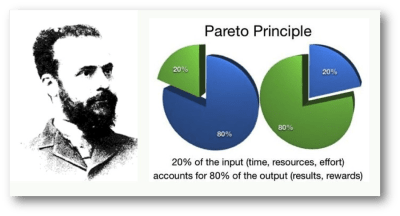
When I was working as a management consultant, one of my favorite lessons to convey to clients was the Pareto Principle, which is also known as the 80-20 Rule.  The principle was named for the 19th century Italian economist Vilfredo Pareto, who observed that an 80-20 percent relationship applied to many practical aspects of life. For instance, about 80 percent of nonprofit donations come from 20 percent of the donor base.  About 80 percent of sales come from 20 percent of your client base. 

The application of the 80-20 Rule I most like is that about 80 percent of the work on a project is accomplished through 20 percent of the effort.  For example, if it takes five hours to detail a car, you can finish 80 percent of the job in about an hour.  The remaining 20 percent of the tasks will take four hours to complete.  The lesson learned is that if you can accept something less than perfection in a practical task like vacuuming your house or maintaining your lawn, you can save yourself a lot of time and significantly simplify your life.

The Rev. Dr. Alexander Whyte (1836-1921), was a popular Scottish theologian in his day.  His biographer, G.F. Barbour tells an interesting story about Whyte’s encounter with a particular female parishioner who told him, “Dr. Whyte, I just love being in your presence. You are so saintly.”  Whyte replied, “Madam, if you could look into my soul, what you would see would make you spit in my face.”

While the Pareto Principle has many practical applications in everyday life, Rev. White knew that when it comes to God, giving 20 percent of yourself is not enough.  Whyte understood what Jesus means in Matthew 10:37-39 when he says, “Whoever loves father or mother more than me is not worthy of me, and whoever loves son or daughter more than me is not worthy of me. And whoever does not take his cross and follow me is not worthy of me. Whoever finds his life will lose it, and whoever loses his life for my sake will find it.” (ESV) 

Jesus wants all of you—not 20, or 80, or even 99 percent of you.  He makes this clear when He tells his disciples “If anyone would come after me, let him deny himself and take up his cross and follow me.  For whoever would save his life will lose it, but whoever loses his life for my sake will find it. For what will it profit a man if he gains the whole world and forfeits his soul?” (Matthew 16:24-26, ESV)

It’s easy to give part of yourself to God.  You can attend church every Sunday, pray to Him every morning, and tithe 10 percent of your income. Outwardly you might appear saintly, as the Rev. Whyte appeared to his parishioner, but God sees inside us all.  Scottish Theologian Oswald Chambers said, “We are only what we are in the dark; all the rest is reputation. What God looks at is what we are in the dark—the imaginations of our minds, the thoughts of our heart, the habits of our bodies; these are the things that mark us in God’s sight.”  This is why, St. Paul tells us in Philippians 2:12 (ESV), “work out your own salvation with fear and trembling.”

God wants all of you. Therefore endeavor constantly to place Him first in every aspect of your life. And when you fail, as you inevitably will, seek His forgiveness.  As St. Paul encourages us in 2 Timothy 4:7, continue to fight the good fight.   


Easter 2016 – Resurrection Sunday

“Worthy is the Lamb who was slain, to receive power and wealth and wisdom and might and honor and glory and blessing!”

 Resurrection of Christ by Raphael

The resurrection of Christ by Raphael

 1 Corinthians 15 (ESV), The Resurrection of Christ

15 Now I would remind you, brothers, of the gospel I preached to you, which you received, in which you stand, and by which you are being saved, if you hold fast to the word I preached to you—unless you believed in vain. For I delivered to you as of first importance what I also received: that Christ died for our sins in accordance with the Scriptures, that he was buried, that he was raised on the third day in accordance with the Scriptures, and that he appeared to Cephas, then to the twelve. Then he appeared to more than five hundred brothers at one time, most of whom are still alive, though some have fallen asleep. Then he appeared to James, then to all the apostles. Last of all, as to one untimely born, he appeared also to me. For I am the least of the apostles, unworthy to be called an apostle, because I persecuted the church of God. 10 But by the grace of God I am what I am, and his grace toward me was not in vain. On the contrary, I worked harder than any of them, though it was not I, but the grace of God that is with me. 11 Whether then it was I or they, so we preach and so you believed.

The Resurrection of the Dead

12 Now if Christ is proclaimed as raised from the dead, how can some of you say that there is no resurrection of the dead? 13 But if there is no resurrection of the dead, then not even Christ has been raised. 14 And if Christ has not been raised, then our preaching is in vain and your faith is in vain.15 We are even found to be misrepresenting God, because we testified about God that he raised Christ, whom he did not raise if it is true that the dead are not raised. 16 For if the dead are not raised, not even Christ has been raised. 17 And if Christ has not been raised, your faith is futile and you are still in your sins. 18 Then those also who have fallen asleep in Christ have perished. 19 If in Christ we have hope in this life only, we are of all people most to be pitied.  20 But in fact Christ has been raised from the dead, the firstfruits of those who have fallen asleep.21 For as by a man came death, by a man has come also the resurrection of the dead. 22 For as in Adam all die, so also in Christ shall all be made alive.

 May God bless you and keep you on this holiest of days!

Farewell My Friend

Jesus on CrossGreater love has no one than this,  that someone lay down his life for his friends.

                                                                                                                            John 15:13 (ESV)

The digital age we live in is truly amazing. It has enabled me to land two jobs with companies I never set foot in before being hired. In both cases, I was recruited online, interviewed by phone and hired sight unseen.

I worked a total of over seven years in these positions, all the while communicating via email telephone and Skype and exchanging data through encrypted virtual private networks. I visited each company only once. When I was born in 1955, such technologies existed only in the minds of science fiction writers. Today they’re quite common.

One of the most amazing digital wonders I’ve enjoyed is having cultivated three good friendships with individuals whom I’ve never met face-to-face. I’m not speaking about Facebook friendships either. These friendships are with people whom I’ve shared things about my life and theirs of the sort that can only be shared with people you trust.

I was recently shocked to learn that one of these friends, Bob, has been diagnosed with a terminal form of cancer that will take his life in a few short months.

Bob is a good man who has spent much of his life working to make others’ lives easier.   Sadly, I know that being good isn’t enough. He has not been open to believing the Gospel message and remains to this day an agnostic.

Bob is spending his last days surrounded by family, many of whom practice the Serbian Orthodox form of the Christian faith. Please join me in praying that during this time of transition his heart might be opened to receive Christ, so that in the final hour he might say:

“The time of my departure is at hand. I have fought the good fight, I have finished the race, I have kept the faith. Finally, there is laid up for me the crown of righteousness, which the Lord, the righteous Judge, will give to me on that Day, and not to me only but also to all who have loved His appearing”                                      

                                                                                                                                2 Tim. 4:6-8 (ESV)

Postscript August 3, 2015–my friend Bob Hall passed away peacefully on July 28, 2015.