Archive for the ‘work’ Category

Don’t worry away the blessings of today!

Image

In every life we have some trouble,

                      When you worry you make it double,               

Don’t worry, be happy. 

Lyrics from “Don’t worry be happy” by Bobby McFerrin 

The Psalms tell us, “This is the day the Lord has made; we will rejoice and be glad in it.” (118:24). Well, this is a cold day in Pittsburgh.  No—on second thought it’s freezing.  When I awoke this morning it was a frigid one degree above zero and quite windy, driving the wind chill well below zero.  As I worked through my morning devotional I remembered to thank God that I was warm and snug inside my home.  By midday it had already reached the predicted high, a sweltering 12 degrees.

I’m unemployed and looking hard for a good job these days, so I spend a lot of time at my computer.  Today as I sat working on the laptop in my home office, I found myself spending long periods just staring out the window at the beautiful snow-covered woods before me.  I couldn’t help but marvel at the amount of activity outside.

Birds were fluttering about despite the brutal weather. I keep my copy of the Peterson Field Guide® for Eastern Birds nearby. With it, I was able to identify cardinals, blue jays, robins (weird for winter), wrens, house finches, creepers, titmice, chickadees, and at least three kinds of woodpeckers.  Watching so many birds going about their business despite the difficulties presented by the harsh weather was inspiring.  It made me recall the scripture:

“Therefore I say to you, do not worry about your life, what you will eat or what you will drink; nor about your body, what you will put on. Is not life more than food and the body more than clothing? Look at the birds of the air, for they neither sow nor reap nor gather into barns; yet your heavenly Father feeds them. Are you not of more value than they? Which of you by worrying can add one cubit to his stature?  Matthew 6:25-34 (NKJV)

I belong to a faith-based job networking group where there are lots of unemployed folks like me. For the unemployed, it’s easy to become overwhelmed with worry. Yet worrying about what might be tomorrow strips the joy from what is today. I find it helpful each day to review the inventory of the things I have to be thankful for.  Faith, family, and friends are always at the top of my list—blessings that unemployment can never take away and for which I will always be thankful.   

Ralph Waldo Emerson said, “Sorrow looks back, worry looks around, faith looks up.” Being unemployed can be one of the greatest tests of faith a Christian will ever endure.  Each time you find worry creeping into your thoughts, turn it into an opportunity for prayer.

Be anxious for nothing, but in everything by prayer and supplication, with thanksgiving, let your requests be made known to God.  Philippians 4:6 (NKJV)

Enduring Truths for Recent Grads

A couple of months ago I wrote a piece for my newspaper column with some advice for recent grads.  Several individuals have asked me to reprint the article in my blog, so here you go!  You can follow this link to a web version of the article.  http://goo.gl/LtN72

For those who are graduating high school this year and beginning the long transition into adulthood, I’d like to offer you a gift. Here are five enduring truths I’ve learned. They will help you through life’s journey.

Choices

“If you decide to just go with the flow, you’ll end up where the flow goes, which is usually downhill, often leading to a big pile of sludge and a life of unhappiness. You’ll end up doing what everyone else is doing.”
― Sean Covey, The 7 Habits of Highly Effective Teens

 Life will deal you an endless string of choices along the way.  Some will be trivial, like deciding what to wear today.  Others will be weighty and their outcomes will affect you forever.  Weighty decisions should always be preceded by much thought and soul searching.  This includes decisions about who you date or marry, what you put into your body, bringing children into the world, what you do for a living, how much debt you incur and who you associate with.

All of these decisions will have a lasting effect on your life. Therefore, make them slowly and deliberately. Often you’ll discover that the right choice is not the easiest one.  A habit of making poor choices will, as the Sean Covey quote suggests, drag your life downhill.

I was recently contacted by a young man who had just received a bad conduct discharge from the Navy.  He asked me how the discharge would impact his future employability.  His mistake was choosing to drive a car while intoxicated and hitting a pedestrian. Fortunately, the victim wasn’t seriously injured. Had it been otherwise, the young sailor would probably be in prison.  It was my sad responsibility to inform him that with some employers the discharge would be a black mark for life. Choices matter!

 Learning

“Experience is a hard teacher because she gives the test first, the lesson afterwards.”    ―Vernon Saunders Law, former professional baseball pitcher and Cy Young Award winner

Some of you will go on to college or technical school.  Others will enter the workforce.  Even if your formal education is over, don’t quit learning. Make learning a lifelong adventure.  I did my undergraduate work at the University of Kentucky.  The school offers a fellowship program for individuals aged 65 and older to attend classes tuition free. Every year numerous senior citizens walk the stage to receive degrees ranging from Associate of Arts to Doctor of Philosophy.  It’s never too late to learn.

Even if you don’t choose to continue formal learning, make it point to learn from life. Observe others; note their successes and failures; then learn from their experiences.  More importantly, learn from your own mistakes.

Some of the greatest lessons I’ve learned, particularly those while serving in uniform, were the result of having made a terrible mistake.  This sort of lesson sticks, like the first time you grab the handle of a hot iron skillet with your bare hand.  The key to learning from mistakes is owning them.  Admit your mistakes and then move on, having learned something from the experience.  Don’t let, “It wasn’t my fault,” be part of your vocabulary.

 Work

“A dream doesn’t become reality through magic; it takes sweat, determination and hard work.”
 ―Colin Powell, retired U.S. Army four-star general and former U.S. Secretary of State

Work isn’t always fun. If it were, they’d call it play.  Work can be downright unpleasant, but it’s an essential element of life! Along the way you’re going to have jobs you won’t like. Note what you don’t like and make it a point to improve yourself, so you’ll never again have to work at such a job.

Accepting a job means submitting to the authority of those placed over you.  Learn to work within this system.   You’ll inevitably have bosses you don’t like.  Learn to respect the position, if not the individual.

Fairness

“Life is not fair; get used to it.” ―Bill Gates, founder and former CEO, Microsoft Corporation

You will hear much discussion about fairness in this life. It’s all hot air.  Life isn’t fair.  Some good people die young, while some bad people live a long life.   Disease sometimes strikes arbitrarily, for no apparent reason.  Some people prosper while others suffer failure. A death or accident can change your life forever.

There is randomness to life that can’t be avoided.  Don’t expect kindness to be returned with kindness.  Don’t expect generosity to be returned with generosity.  The best choice is to be fair and kind to others and learn to accept what they return to you.

A wise man named Harry Browne ran for president of the United States on the Libertarian Party ticket. On Christmas day in 1966, Browne wrote his young daughter a letter aptly titled, “A Gift for My Daughter.”  I encourage every graduating senior to read it and digest it. In the letter, he explains to his daughter that, “Nobody owes you anything.”  Understanding what Browne meant can truly bless you. You can find it at:  www.harrybrowne.org/articles/GiftDaughter.htm.

Faith

“A faith is a necessity to a man. Woe to him who believes in nothing.”  ―Victor Hugo

I once had a senior Army officer tell me he preferred to work with men who possessed spiritual values, regardless of their religion.  He explained that having faith in a power higher than one’s self was an indicator of how one will perform under pressure; in this instance, the pressure meant combat.

Too many people place their faith in all the wrong places.  It might be in wealth, celebrity, good looks, talent, or even government.  Whatever the case, misplaced faith leads to disappointment after disappointment.

To avoid these disappointments, put your faith in God alone.  You, your loved ones and your friends will all inevitably let you down, but God will never fail you.

Wikipedia: D is the fourth letter in the basic modern Latin alphabet.

Making Time for Family Time

  “A family in harmony will prosper in everything.”  –Chinese Proverb

Time Management

As a management consultant, I have found that business managers at all levels overwhelmingly agree that time is one of their most precious resources, yet few proactively manage it.  Consequently, many businesses are plagued by continual over-scheduling and scheduling conflicts.  Frequent scheduling conflicts in a business can lead to communications problems, employee frustration and poor morale.  The end result is always decreased productivity and profits.  Some studies have shown that improved time management can increase productivity by as much as 40 percent in certain companies!

Managing Family Time

The same holds true for families.  Many families units today have a single parent or two working parents.  Add school age children to the mix and you have an almost certain recipe for scheduling difficulties. Failure to properly manage your family’s time can lead to unnecessary stress, strife and even financial troubles. For families, most activities can be classified into one of four categories:  1) business, 2) household, 3) personal, and 4) family. Each category is essential to a family and each requires good time management.

Business Time is the time one spends on preparing for work, commuting to and from work, other work-related travel, and working.  It’s the most difficult time to manage from an individual perspective, since most workers are tied to a fairly inflexible work schedule.  They arise from sleep at a predetermined time and then spend an amount of time getting ready for work, commuting to and from work, and actually performing their work. It’s fairly easy to estimate the minimum amount time a worker will spend on each of these tasks.  Predicting the maximum is much more difficult, especially for those having long commutes, frequent business trips, and who are salaried rather than hourly laborers.

Household Time it spent doing the chores and other activities required to run and maintain a household.  This includes time spent on business correspondence, bill paying, preparing tax returns, dealing with home maintenance, meal preparation etc.  Many of these activities can be performed on a flexible schedule.

Personal Time includes periods of sleep, relaxation, exercise (including organized sports), personal hygiene and grooming, learning/studying, and spiritual renewal. For good mental and physical health, it is essential that none of these activities be neglected.  Unfortunately, far too many people sacrifice personal time in exchange for more business or household time.

Family Time is defined differently for every family.  Broadly speaking, it includes time spent on communicating, bonding, learning and enjoying one another’s company and love.  Family time includes worship services and other activities at church.  Since it is loosely defined, it is frequently the most neglected category.

Scheduling Your Family Time

As the ancient Chinese proverb at the head of this post suggests, family time is the most important category of time for families.  Mismanaging family time will hamper family harmony.  Sadly, in many American homes today family time hardly exists at all.

To maximize your family time, try this:

1.  Have a family meeting (parents only), to discuss and define what the most important, non-negotiable family time should be for your particular family.  During the meeting, try to set a day (better several days) for family dinner time.  The value of sitting around the table and sharing a family meal is well recognized.

2.  Next, bring any school age children into the discussion.  The purpose of this is primarily to inform them of your decision, but it’s also an opportunity to hear their thoughts and maybe even modify your initial decision.

3.  Use monthly, weekly and daily calendars to plan and list your schedule.  Refer to each frequently and keep them updated.  Time management consultants universally agree that having calendars is essential to success.  Use paper or electronic calendars, or a combination of both—whatever you’re comfortable with.  Free, printable calendars online can be downloaded at this link: http://www.vertex42.com/ExcelTemplates/schedules.html

Maximizing Your Family Time

Here are some rules to help you maximize family time when planning your family’s schedule:

1.  Use only one set of calendars (monthly, weekly, daily) for the entire family.  This will help preclude scheduling conflicts.

2.  On your calendars, enter dad’s and/or mom’s business time first, since it usually the least flexible.

3.  Next, enter your family time events.  This should include those non-negotiable, recurring events like attending church, designated family dinner nights, movie nights, board game nights etc., plus important non-recurring events like birthday parties, graduation ceremonies, recitals, ball games etc.

4.  Next list personal time for each family member.  This time is essential for mental and physical well being.  If you neglect either of these areas, it will have a negative impact on the other areas of your life.

5.  Next, schedule your household time, which is your most flexible time and can be squeezed in between other activities on our calendar.

Parents should take 10 minutes at the end of each evening to review and refine the next day’s schedule.  If you forget to do this or you’re just too tired, take 10 minutes at the beginning of the next day.  Once you’ve reviewed and made any required adjustments to the daily schedule, review it with the kids as necessary.

As with most things that are important to a family, managing your family’s time takes discipline. It also requires being flexible and willing to negotiate. There will always be scheduling conflicts for parents to deal with.  Every day will require trade-offs. Be willing to go to extreme lengths to protect your designated family time. Failure to be flexible and/or an unwillingness to negotiate on the part of either parent will disrupt family harmony and cause a ripple effect throughout the family unit. Remember to do all things with love.

Love is patient and kind; love does not envy or boast; it is not arrogant or rude. It does not insist on its own way; it is not irritable or resentful; it does not rejoice at wrongdoing, but rejoices with the truth. Love bears all things, believes all things, hopes all things, endures all things. 1 Corinthians 13:4-7 (NIV)

Life’s Balancing Act

You shall not go out with haste, . . . for the Lord will go before you, and the God of Israel will be your rear guard —Isaiah 52:12

If you’ve been to a circus or watched one on television, it’s likely you were entertained by a tightrope walker performing amazing stunts while balancing on a thin wire suspended between two large poles.  It’s an incredible feat and most of us can’t imagine doing something requiring such skill, concentration and coordination.  Unfortunately, the older you grow the more likely it becomes you will have to perform an even more difficult balancing act–maintaining balance in your life.

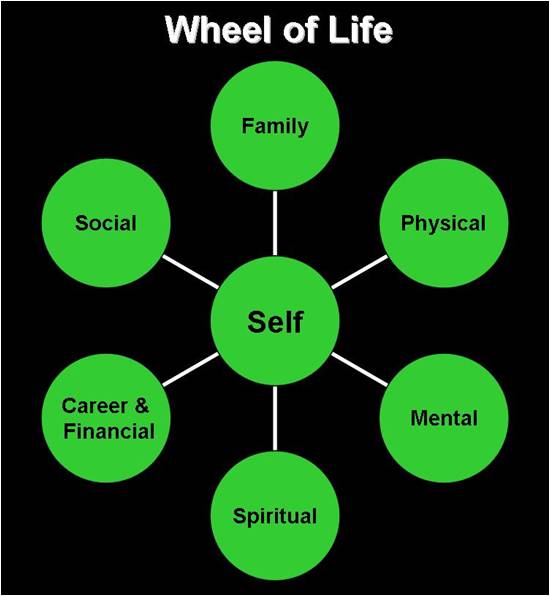
As a management consultant, the “Wheel of Life” illustration at the head of this post is something I use frequently when conducting time management seminars and coaching.  How can you tell when a wheel is badly out of balance on your car?  You might feel a “shimmy” in the steering wheel.  Your life is like a wheel, constantly spinning as you go and go.  If  a part of your personal wheel of life is out of  balance, it tends to affect all of the other parts on the wheel.

      FAMILY – PHYSICAL – MENTAL – SPIRITUAL – CAREER & FINANCIAL – SOCIAL

Science had shown that trying to keep the six areas on the outer perimeter of the “Wheel of Life” in balance will lead to a higher quality of life.  It will also make you more efficient and content with your life in the workplace and at home. This doesn’t mean you should devote an equal amount of time to each area on the wheel.  At certain points in life you will have to devote a lot of time to one area over all of the others.   Those caring for aging parents, raising young children or dealing with serious health concerns know exactly what I mean.

However, it’s a certainty that if any area on the wheel is neglected for too long it will have a serious impact on many or all of the others. For instance, if you fail to pay attention to your health and let yourself become morbidly obese, it’s fairly clear this will affect other areas on your wheel.

Many of my clients have such busy schedules that they feel like there’s insufficient time in the day to stop and plan out their actions.  They live each day in full “reaction” mode, bouncing back and forth between whatever task demands the most attention at the moment.  They start work early, stay late and constantly feel tired and swamped.  Worst of all, at the end of the day they have no feeling of accomplishment, which leads to frustration and unnecessary fretting.

Periodically taking time to stop and evaluate the situation is guaranteed to give you clarity and make your life simpler.  I advise my business clients to spend 10-15 minutes at the beginning of each day reviewing their calendars and organizing their daily tasks.  This helps ensure that they focus on the most important tasks on their “to do” lists.

The same principle applies to everyone.  Taking just a few minutes of quiet time each morning to pray, study the scriptures and reflect on the day ahead will add clarity and purpose to your day.  Christians could learn a lesson from the followers of Islam.  Muslims stop five times per day to pray–morning, noon, afternoon, sunset and evening. Periodically pausing for prayer throughout each day is guaranteed to help you cope with daily stress and worries.

It seems that I’ve spent a good deal of my life in a hurry.  My mother was always telling me to slow down. It took me years to figure out what she meant.  As we begin a new year, it’s a great time to reassess how we spend our time.  As we move forward in 2012, let’s proceed with the power of knowing that the God of Israel goes before us and clears a pathway for us, if only we will follow Him.

Need some extra time? Try this simple trick.

‘Tis the gift to be simple, ’tis the gift to be free…                                                                                                                                                                        (taken from “Simple Gifts,  a traditional Shaker tune by Elder Joseph Brackett, Jr. – 1848)

Are you one of those people who never seems to have enough time in your day?  If so, there might be an easy way to fix that.  It just  requires a bit of  simple behavior modification…and it’s easier than giving up chocolate for Lent.

As a second lieutenant in the U.S. Army, my first assignment after completing the Officer’s Basic Course was at an isolated air defense missile site in the German state of  Westfalen (Westphalia).  The year was 1977. Westkirchen was truly a village in the purest sense of the word.  With a population of only several hundred,  it had one stoplight, a church, a butcher shop, a bakery, a barber-drugstore combination and a pub, more properly called a “gasthaus” in German.  Westkirchen was surrounded by similar villages.  The county seat of Warendorf , which was nearly 10 miles away, offered only a few more conveniences.

Military duty in Westkirchen was tough on the soldiers and their families alike, mainly due to the isolation.  Counting soldiers and family members, there were less than 50 Americans in the village.  My wife and I were fortunate to have lived in Germany previously, so we both spoke the language passably.  Unfortunately, few of the enlisted soldiers or their wives spoke German. Most of the soldiers were young and single; the majority were teenagers or in their early twenties.  Few were married.  Of the married ones, most were young with young wives and infants at home. The American elementary school was located in the city of Muenster, about a 45-minute drive to the north.  Fortunately, there were no teenage children, as they would have been required to be boarding students living in a dorm at the American High School in the city of Giessen, nearly three hours to the south.

One particular aspect of our family life in Westkirchen was quite unique for Americans.  For the year my wife and I lived there, we had no television in our home.  There were two reasons for this.  First, there were no American stations available.  It was 1977 and there was no cable TV, just German broadcast stations.  Second, German television programming was abysmal in those days.  Stations didn’t sign on until late morning and signed off around midnight. The stations offered a very boring line-up.   There were a couple of decent weekly series, but German TV consisted mostly of news programs and a lot of dry documentaries.  The later had deep subjects like “sheep farming in the north German plain,” or “the trials and tribulations of life as a prostitute in a Berlin brothel.”  You get the picture!

Life without the “boob tube” was a bit difficult at first, but we soon adapted and developed a routine without TV.  Like our grandparents and parents before us, we turned to radio as the entertainment medium of choice.  In Westkirchen, we could pick up the American Armed Forces Network (AFN) and British Forces Broadcasting System radio stations on the AM dial.  The AFN station was best by far, as it provided news from home, familiar music selections and old-time radio serials.  It didn’t take us long to become fans of  Dick Tracy, The Shadow, Jack Benny, and the Lone Ranger.  Although one might have some difficulty finding these programs on the radio today, there are still lots of great programs available on broadcast radio and on stations that stream their signals over the Internet.

If you want to simplify your life and add some much needed time to your day, try turning off the TV and turning on the radio.  Radio has some great advantages over television. Foremost is that radio doesn’t require your undivided attention, because it lacks a visual dimension.  You can listen to a radio program and do something productive simultaneously.  I like to work with classical music playing softly on the radio.  Best of all, unlike TV, you can listen to radio and interact with other human beings simultaneously, providing you don’t have the volume blasting.

Another feature of our television-free Westkirchen home was board games.  We must have purchased a dozen during our time there and we still have many of them.  Unlike TV, board games require interaction with another person.  Generally speaking, the more people playing the game, the more fun it is for all.  Baby Boomers might recall a Monopoly game many years ago, with a roomful of players packed around the board.  If you think back hard enough, you’ll probably remember the talking, laughter, eating, drinking and people generally having fun.

Compare this to a common scene today, where a teenager sits alone for hours in front of  a computer screen, playing video games with earphones on and the volume cranked up, totally isolated from reality.  Many of these games, like  Dungeon and Dragons, have dark themes.  Ask yourself which scenario is healthier.

According to the Nielsen Company, in 2010 Americans watched more TV than ever–an average of 34 hours per person, per week. That’s enough time to work a second job!  Try taking this challenge. For one week limit your TV viewing to two hours per day (OK, we’ll make it three hours on days the Steelers or Penguins play). At the end of the week, do an assessment of  your time utilization and you might just discover that television viewing has become a time thief in your life.

Many readers will find that by limiting TV viewing, they suddenly  have a lot of extra time on their hands.  If this is the case with you, try filling your time “bonus” time with something productive.  Give the kids some extra help with their homework, begin reading that good book you’ve had by the bed for a long time, take an online course, or start a new hobby…maybe even blogging. Just turn off the tube and turn on to life! It’s really quite simple.