Archive for the ‘advice’ Category

Life’s Balancing Act

You shall not go out with haste, . . . for the Lord will go before you, and the God of Israel will be your rear guard —Isaiah 52:12

If you’ve been to a circus or watched one on television, it’s likely you were entertained by a tightrope walker performing amazing stunts while balancing on a thin wire suspended between two large poles.  It’s an incredible feat and most of us can’t imagine doing something requiring such skill, concentration and coordination.  Unfortunately, the older you grow the more likely it becomes you will have to perform an even more difficult balancing act–maintaining balance in your life.

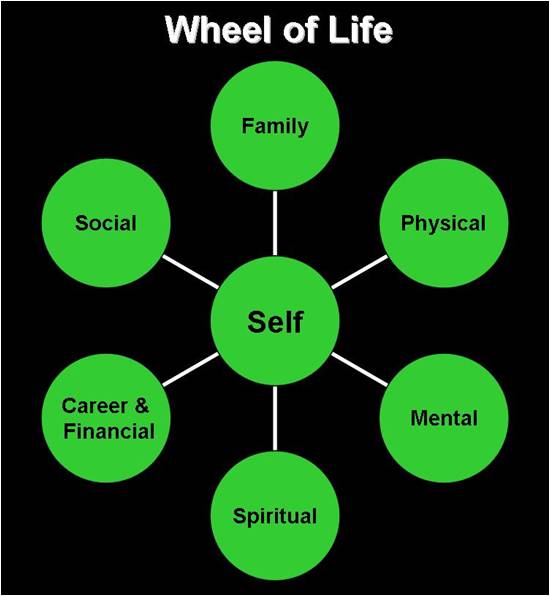
As a management consultant, the “Wheel of Life” illustration at the head of this post is something I use frequently when conducting time management seminars and coaching.  How can you tell when a wheel is badly out of balance on your car?  You might feel a “shimmy” in the steering wheel.  Your life is like a wheel, constantly spinning as you go and go.  If  a part of your personal wheel of life is out of  balance, it tends to affect all of the other parts on the wheel.

      FAMILY – PHYSICAL – MENTAL – SPIRITUAL – CAREER & FINANCIAL – SOCIAL

Science had shown that trying to keep the six areas on the outer perimeter of the “Wheel of Life” in balance will lead to a higher quality of life.  It will also make you more efficient and content with your life in the workplace and at home. This doesn’t mean you should devote an equal amount of time to each area on the wheel.  At certain points in life you will have to devote a lot of time to one area over all of the others.   Those caring for aging parents, raising young children or dealing with serious health concerns know exactly what I mean.

However, it’s a certainty that if any area on the wheel is neglected for too long it will have a serious impact on many or all of the others. For instance, if you fail to pay attention to your health and let yourself become morbidly obese, it’s fairly clear this will affect other areas on your wheel.

Many of my clients have such busy schedules that they feel like there’s insufficient time in the day to stop and plan out their actions.  They live each day in full “reaction” mode, bouncing back and forth between whatever task demands the most attention at the moment.  They start work early, stay late and constantly feel tired and swamped.  Worst of all, at the end of the day they have no feeling of accomplishment, which leads to frustration and unnecessary fretting.

Periodically taking time to stop and evaluate the situation is guaranteed to give you clarity and make your life simpler.  I advise my business clients to spend 10-15 minutes at the beginning of each day reviewing their calendars and organizing their daily tasks.  This helps ensure that they focus on the most important tasks on their “to do” lists.

The same principle applies to everyone.  Taking just a few minutes of quiet time each morning to pray, study the scriptures and reflect on the day ahead will add clarity and purpose to your day.  Christians could learn a lesson from the followers of Islam.  Muslims stop five times per day to pray–morning, noon, afternoon, sunset and evening. Periodically pausing for prayer throughout each day is guaranteed to help you cope with daily stress and worries.

It seems that I’ve spent a good deal of my life in a hurry.  My mother was always telling me to slow down. It took me years to figure out what she meant.  As we begin a new year, it’s a great time to reassess how we spend our time.  As we move forward in 2012, let’s proceed with the power of knowing that the God of Israel goes before us and clears a pathway for us, if only we will follow Him.

The Trouble With Stuff

“A house is just a pile of stuff with a cover on it.”  –George Carlin  

The final casualty reports are in:  one dead and over 40 seriously injured by a combination of hostile fire, chemical irritants and hand to hand combat.  In case you’re wondering, this isn’t a report from Afghanistan. It’s the end results of America’s obsession for stuff that was so graphically acted out on Black Friday last week.  The casualties occurred in malls and big box stores across the country as American consumers, driven into a greedy frenzy by the mere thought of cheap stuff, attacked each other with guns, pepper spray and fisticuffs, all in the name of shopping.

From the women’s intimate apparel section to the aisle with the XBox 360’s, tempers were boiling over and fists were flying.  Things were so bad that the media broadcast images of  American greed  around the globe.  My barber, an immigrant from Italy, even received a phone call from his brother-in-law in Sicily who asked him, “are you Americans crazy?”

That’s a great question, because by all indications our overly materialistic society is slowly slipping into some sort of psychotic consumer abyss.  We just can’t seem to get enough stuff. Like the late comedian George Carlin, who is quoted at the beginning of this post, I have lots of stuff.  I bet you do too.  I used to have more stuff, but I got rid of a lot of it before I moved back to Pennsylvania. I used to have a two-car garage, but I could only fit one car into it because I had too much stuff.

I didn’t want to get rid of any of my stuff, because deep inside me there was a small voice whispering that I might need some of that stuff someday.  Most of my neighbors had two-car garages too. Many of them couldn’t fit even one car into their garage because of their stuff.  After I had accumulated enough stuff, I realized that weekends were made for taking care of my stuff.  But most weekends weren’t long enough to take care of all of my stuff, so I had to take care of some of it in the evenings when I got home from work. I even took an occasional vacation day so I could take care of my stuff.

Unfortunately, our society tends to measure success by the amount of stuff one possesses–big boats, fancy cars, gigantic homes, and corner offices. Truth is you can have all of these and still be the most miserable person on Earth. The Scottish theologian Oswald Chambers said, “The test of the life of a saint is not success, but faithfulness in human life as it actually is. We will set up success in Christian work as the aim; the aim is to manifest the glory of God in human life, to live the life hid with Christ in God in human conditions. Our human relationships are the actual conditions in which the ideal life of God is to be exhibited.” 

I challenge you to avoid buying a bunch of stuff for friends and family this Christmas season. Sure, go ahead and get those special toys for the kids, but don’t buy “stuff” for the adults on your list.  Who hasn’t struggled with buying a gift for a friend or loved one who has almost everything he or she needs?  Here’s a suggestion.

Alternative Gifts International (AGI) was begun in 1980 by Harriet Prichard, director of a Presbyterian children’s ministry in Pasadena, California.  AGI began as a small market where shares of goods and livestock for needy people in the Third World were sold.  The idea was to give gifts that could make a real difference to an individual, family, or village.  For instance, a gift of a milk cow or a means to purify water can truly change lives for impoverished people living in remote areas of Africa.  Ms. Prichard’s idea was so popular that five Pasadena area churches held markets the next year.  By 2004 there were over 325 Alternative Gifts markets in the United States. The movement has now spread to England, the Netherlands, Japan and Korea.

Here is how AGI works.  Instead of buying that symbolic gift (scarf, gloves, socks, tie etc. ) that might soon be put away or discarded, consider making a donation to AGI on behalf of your friend or loved one. Instructions on how to donate are on the “projects” section of AGI’s web site at www.alternativegifts.org. When you make a donation through the web site you can write a short message to the individual you want to remember.  AGI will send that person a card announcing your alternative gift. Gifting in this fashion will significantly simplify your Christmas shopping and will provide gifts that truly impact the lives of the recipients.

May you and yours enjoy the true spirit of Christmas this year.

Need some extra time? Try this simple trick.

‘Tis the gift to be simple, ’tis the gift to be free…                                                                                                                                                                        (taken from “Simple Gifts,  a traditional Shaker tune by Elder Joseph Brackett, Jr. – 1848)

Are you one of those people who never seems to have enough time in your day?  If so, there might be an easy way to fix that.  It just  requires a bit of  simple behavior modification…and it’s easier than giving up chocolate for Lent.

As a second lieutenant in the U.S. Army, my first assignment after completing the Officer’s Basic Course was at an isolated air defense missile site in the German state of  Westfalen (Westphalia).  The year was 1977. Westkirchen was truly a village in the purest sense of the word.  With a population of only several hundred,  it had one stoplight, a church, a butcher shop, a bakery, a barber-drugstore combination and a pub, more properly called a “gasthaus” in German.  Westkirchen was surrounded by similar villages.  The county seat of Warendorf , which was nearly 10 miles away, offered only a few more conveniences.

Military duty in Westkirchen was tough on the soldiers and their families alike, mainly due to the isolation.  Counting soldiers and family members, there were less than 50 Americans in the village.  My wife and I were fortunate to have lived in Germany previously, so we both spoke the language passably.  Unfortunately, few of the enlisted soldiers or their wives spoke German. Most of the soldiers were young and single; the majority were teenagers or in their early twenties.  Few were married.  Of the married ones, most were young with young wives and infants at home. The American elementary school was located in the city of Muenster, about a 45-minute drive to the north.  Fortunately, there were no teenage children, as they would have been required to be boarding students living in a dorm at the American High School in the city of Giessen, nearly three hours to the south.

One particular aspect of our family life in Westkirchen was quite unique for Americans.  For the year my wife and I lived there, we had no television in our home.  There were two reasons for this.  First, there were no American stations available.  It was 1977 and there was no cable TV, just German broadcast stations.  Second, German television programming was abysmal in those days.  Stations didn’t sign on until late morning and signed off around midnight. The stations offered a very boring line-up.   There were a couple of decent weekly series, but German TV consisted mostly of news programs and a lot of dry documentaries.  The later had deep subjects like “sheep farming in the north German plain,” or “the trials and tribulations of life as a prostitute in a Berlin brothel.”  You get the picture!

Life without the “boob tube” was a bit difficult at first, but we soon adapted and developed a routine without TV.  Like our grandparents and parents before us, we turned to radio as the entertainment medium of choice.  In Westkirchen, we could pick up the American Armed Forces Network (AFN) and British Forces Broadcasting System radio stations on the AM dial.  The AFN station was best by far, as it provided news from home, familiar music selections and old-time radio serials.  It didn’t take us long to become fans of  Dick Tracy, The Shadow, Jack Benny, and the Lone Ranger.  Although one might have some difficulty finding these programs on the radio today, there are still lots of great programs available on broadcast radio and on stations that stream their signals over the Internet.

If you want to simplify your life and add some much needed time to your day, try turning off the TV and turning on the radio.  Radio has some great advantages over television. Foremost is that radio doesn’t require your undivided attention, because it lacks a visual dimension.  You can listen to a radio program and do something productive simultaneously.  I like to work with classical music playing softly on the radio.  Best of all, unlike TV, you can listen to radio and interact with other human beings simultaneously, providing you don’t have the volume blasting.

Another feature of our television-free Westkirchen home was board games.  We must have purchased a dozen during our time there and we still have many of them.  Unlike TV, board games require interaction with another person.  Generally speaking, the more people playing the game, the more fun it is for all.  Baby Boomers might recall a Monopoly game many years ago, with a roomful of players packed around the board.  If you think back hard enough, you’ll probably remember the talking, laughter, eating, drinking and people generally having fun.

Compare this to a common scene today, where a teenager sits alone for hours in front of  a computer screen, playing video games with earphones on and the volume cranked up, totally isolated from reality.  Many of these games, like  Dungeon and Dragons, have dark themes.  Ask yourself which scenario is healthier.

According to the Nielsen Company, in 2010 Americans watched more TV than ever–an average of 34 hours per person, per week. That’s enough time to work a second job!  Try taking this challenge. For one week limit your TV viewing to two hours per day (OK, we’ll make it three hours on days the Steelers or Penguins play). At the end of the week, do an assessment of  your time utilization and you might just discover that television viewing has become a time thief in your life.

Many readers will find that by limiting TV viewing, they suddenly  have a lot of extra time on their hands.  If this is the case with you, try filling your time “bonus” time with something productive.  Give the kids some extra help with their homework, begin reading that good book you’ve had by the bed for a long time, take an online course, or start a new hobby…maybe even blogging. Just turn off the tube and turn on to life! It’s really quite simple.

Do you sometimes find yourself bouncing off the walls?

“Simplicity is an act of the will to reduce the fracturedness of life by centering life around a singleness of purpose.” — Ann Hagman

Do you sometimes find yourself bouncing off the walls–unable to focus on anything? Do you wake up at 2 am with your mind racing, unable to fall back asleep? Do you find yourself sometimes only half-listening to people because you’re more interested in what you have to do next than what that person has to say? If you answered yes to any of the preceding questions, don’t fret. You’re not alone! Many people have a “to do” list hanging over their head like an executioner’s axe.

In today’s fast-paced world, you’re probably in the majority if you feel like there aren’t enough hours in your day. You need to wash the car, mow the lawn, trim the hedges, do the laundry, drive the kids somewhere, and if you’re really lucky you might catch a ball game on television—and this is just your Saturday schedule! On Sunday, grasping for a spiritual straw to cling to, you drag yourself from bed, drive to church and put on a happy face as you meet and greet. You allow your mind to meander as the sermon is preached and afterwards reluctantly agree to join yet another working group or committee.

With church checked off the list, you return home to finish those tasks you didn’t get to on Saturday. On Monday you go back to work, caring for the kids and house or suffering through the trials of a long commute because you can’t find a good job nearby. Throughout your day there are emails, voice mails, text messages, phone calls and a seemingly endless string of meetings or appointments. If you’re lucky, at the end of an arduous day you’ll find temporary refuge in the smiling face and gentle charm of a spouse or significant other and, for a time, you’ll be restored. But this fragile moment of peace will eventually be interrupted by unwanted phone calls, endless junk mail, stacks of business correspondence demanding your attention, and a depressing lack of time to get it all done before you collapse into bed. Then, after grabbing a few hours of restless sleep, you’ll have just enough energy to rise the next morning to begin a similar day.

Far too many Americans suffer through similar routines each day. I hear complaints from friends and colleagues all the time. Such routines propel us in directions God never intended humans to travel. The Maker’s grand design doesn’t include the chaos that confounds so many people today. His creation brought order out of chaos, light out of darkness. Man was designed to exist in harmony with God, as His child and companion. But we live in a fallen world where many people struggle to discover God’s purpose in their lives and far to many never stop to consider what God’s purpose for them might be. They simply muddle through each day without giving a thought to what it all means.

Evil thrives in chaos. Chaos breeds destruction. Years ago I witnessed this played out to its fullest in Somalia. After the Somali central government collapsed in the midst of a civil war, marauding groups of bandits raided the villages of neighboring clans, leaving a locust-like path of destruction and death. Entire clans were left isolated and struggling to survive. Although daily life is not usually played out so vividly in our society, chaos in American lives is also a breeding ground for evil.

What are the trademarks of social chaos? Just watch the evening news. Murder, violent crime, divorce, unchecked abortion, spousal abuse, child abuse, drug abuse, depression, suicide, a rash of children born out of wedlock, and constant fear are just a few. God has a better plan. He wants us to enjoy life to the fullest. But how can we hope to discover His purposes when so many of our lives are filled with chaos and distractions?

It might be impossible to reduce the “to do” list that’s making your daily routine chaotic, but there is a way to avoid the negative effects such a routine can have on your life. The solution is spelled out clearly in Matthew 6:33: “But seek first the kingdom of God and His righteousness, and all these things shall be added to you.” Start by adding one additional task to your the top of your “to do” list. If you’re not doing so already, make a quiet time with God part of your daily routine. While you can’t always eliminate the temporal chaos of life, God has provided a way to eliminate spiritual chaos. Achieve this and life’s daily challenges will no longer seem so important.

Oswald Chambers said, “Even the very smallest thing that we allow in our lives that is not under the control of the Holy Spirit is completely sufficient to account for spiritual confusion, and spending all of our time thinking about it will still never make it clear. Spiritual confusion can only be conquered through obedience. As soon as we obey, we have discernment. … But when our natural power of sight is devoted and submitted in obedience to the Holy Spirit, it becomes the very power by which we perceive God’s will, and our entire life is kept in simplicity.” I encourage you to strive to begin each day spending quiet time with God. Study the scriptures, pray, seek the guidance of the Holy Spirit and most important of all, listen intently for His still, small voice.

Life is tough…there must be a simpler way!

“I believe that a simple and unassuming manner of life is best for everyone, best both for the body and the mind.”     –Albert Einstein

The rolling hills of Indiana County, in western Pennsylvania afford visitors scenic beauty and serenity rivaling anyplace in America.  From atop any of the high hills one can see large barns and farmhouses dotting the countryside.  Drive down a road and eventually you’ll come upon a horse-drawn buggy moving slowly, but steadily along.  This is Amish country, a different universe than the one I live in and probably different from yours.  Yet it lies only a few miles from my home.

Having rejected the modern world, these plain people, the descendents of German Anabaptists, struggle to maintain an 18th century existence in fast-paced, 21st century America. They till the soil.  They build their own houses and barns and heat them with stoves fired by wood and coal.  They have neither television, radio, cell phones, computers, cars nor tractors.  Stout work horses pull their plows through the fertile fields. They educate their children in one-room schoolhouses. They know their neighbors and help them when needed. They revere God!

When I consider their world, I can’t help but envy them. No, I’m not ready to give up my car, my television or most of the other conveniences of life, but I envy many aspects of the simple Amish lifestyle.  I long for simplicity in my own life.  Deep inside I yearn for a simpler existence, something that seems quite elusive.

Several years ago, just a few days before Christmas, my wife and I visited the tiny town of Smicksburg, which is situated in the heart of Indiana County’s Amish country. In a gift shop I found a small Christmas ornament.  It is a hand-painted, miniature wooden plaque bearing one word, “Simplify.” At that moment, awash in Amish culture, I experienced a sort of revelation.

I returned home determined to reduce the chaos in my daily routine. I’ve since enjoyed some success and some glaring failures.  The ornament now hangs in a prominent place in my home, providing a daily reminder to keep me focused on the road ahead.   Having thus set the stage, let the journey begin. I invite you to join me in exploring ways to cut through the chaos cluttering our lives, so we may more easily discern how to make daily living “simply divine,”  as God intended.

You’ll find that much, if not most of what I have to say is shaped by my Christian beliefs.  If you’re not a fellow believer, please don’t be put off by my religiosity.  If you visit now and then, I believe you’ll find something here to interest you and brighten your life.